
How Bot Management Solutions Work, Top 14 Solutions and Pros/Cons
TL;DR: Bot management solutions detect and mitigate automated traffic across web, mobile, and APIs. Best for protection without app changes: Cequence; for large-scale edge detection: Cloudflare; for easy protection at the CDN: DataDome; for adaptive challenges: Arkose.
What Are Bot Management Solutions?
Bot management solutions are cybersecurity tools designed to distinguish between legitimate human users and automated bots. They mitigate malicious attacks, such as bots that perform credential stuffing or scraping, while permitting beneficial bots like search engine crawlers. Effective platforms improve website performance, secure API endpoints, and prevent revenue loss, actively neutralizing threats and avoiding overreliance on intrusive human challenges.
Bad bots are not just a nuisance. They are often used to wage damaging cyberattacks that can cause downtime, brand damage, skewed sales analytics, and increased infrastructure costs.
While bots have been around almost as long as the internet itself, they continue to get more sophisticated and better at emulating human behavior in an effort to evade detection, and effective bot management has become a necessity.
- Bot Management Solutions at a Glance
- Impact of Malicious Bots
- How Do Bot Management Solutions Work?
- Traditional Bot Mitigation Techniques
- Bot Management and AI
- Notable Bot Management Solutions
- Getting Started with Bot Management
Bot Management Solutions at a Glance
The table below summarizes the key differences between the solutions covered in this list. We explore each one in more detail in the sections that follow.
- Dedicated Bot Management Platforms — Solution: 1. Cequence Bot Management Best For: Web, AI agent, mobile, and API traffic without app changes Key Strengths: Network-based ML detection, automated real-time mitigation Things to Consider: Alert volume for large estates may require tuning; dashboards complex for non-technical stakeholders
- Dedicated Bot Management Platforms — Solution: 2. DataDome Best For: Real-time protection across web, apps, APIs, MCP servers Key Strengths: Edge detection under 2 ms, very low false positive rate Things to Consider: Premium pricing and overage charges on high-traffic sites
- Dedicated Bot Management Platforms — Solution: 3. HUMAN Bot Defender Best For: Defending against ad fraud; backed by threat intelligence Key Strengths: Multi-method detection, full-lifecycle investigation Things to Consider: Setup can be complex; UI has rough edges
- Dedicated Bot Management Platforms — Solution: 4. Netacea Best For: Server-side, agentless protection for sites, apps, APIs Key Strengths: Intent-based behavioral detection, low false positives Things to Consider: Limited self-service manual blocking; console gaps
- Dedicated Bot Management Platforms — Solution: 5. Kasada Best For: Invisible, CAPTCHA-free defense for web, mobile, APIs Key Strengths: Client-side obfuscation resistant to retooling Things to Consider: Careful pre-launch testing; few public reviews
- Bot Protection in WAF, CDN, and Edge Platforms — Solution: 6. Cloudflare Bot Management Best For: Bot mitigation built into Cloudflare’s edge and CDN Key Strengths: ML trained on a large share of internet traffic, edge speed Things to Consider: Advanced tuning and some features on higher tiers
- Bot Protection in WAF, CDN, and Edge Platforms — Solution: 7. Akamai Bot Manager Best For: Edge detection for large estates Key Strengths: Edge scoring, good and bad bot management, visibility Things to Consider: Premium pricing; tuning may need pro services
- Bot Protection in WAF, CDN, and Edge Platforms — Solution: 8. Imperva Advanced Bot Protection Best For: Protecting sites, apps, APIs against all OWASP automated threats Key Strengths: Multi-layered detection across 700+ dimensions Things to Consider: Initial configuration and policy tuning take effort
- Bot Protection in WAF, CDN, and Edge Platforms — Solution: 9. F5 Distributed Cloud Bot Defense Best For: Adaptive bot defense for web, mobile, and APIs Key Strengths: Behavioral analysis and telemetry resistant to retooling Things to Consider: Enterprise pricing; cloud and on-prem integration effort
- Bot Protection in WAF, CDN, and Edge Platforms — Solution: 10. Fastly Bot Management Best For: Edge bot control with nuanced responses Key Strengths: Server- and client-side detection, deception, challenges Things to Consider: WAF interface can feel complex; reporting adds cost
- Bot Protection in WAF, CDN, and Edge Platforms — Solution: 11. Barracuda Advanced Bot Protection Best For: Bot defense within Barracuda’s application protection Key Strengths: ML detection, crowd-sourced intelligence, fingerprinting Things to Consider: Dated configuration UI; slower update cadence
- Fraud and Identity-Focused Bot Defense — Solution: 12. Arkose Bot Manager Best For: Disrupting bot and human-driven attacks with challenges Key Strengths: 225+ risk signals, interactive challenges draining ROI Things to Consider: Challenge friction for users; opaque pricing
- Fraud and Identity-Focused Bot Defense — Solution: 13. Fingerprint Best For: Developer-focused device intelligence and bot detection Key Strengths: Accurate device identification via a single API response Things to Consider: A detection signal, not a full enforcement layer
- Fraud and Identity-Focused Bot Defense — Solution: 14. Radware Bot Manager Best For: Web, mobile, and APIs against bots and AI-driven threats Key Strengths: Intent-based behavioral detection, CAPTCHA-less mitigation Things to Consider: Reporting is basic; pricing sits at the higher end
Why is Bot Management Needed? Impacts of Malicious Bots
Bots are simply the vehicle for automated attacks, so organizations may not immediately know they have a bot problem. For example, if user accounts are being taken over by bad actors, it may not be immediately apparent that bots are being used to do so at scale. Without a bot management solution in place to detect attacks and identify associated bots, manual investigation is needed to determine if it’s a full-scale bot attack.
What Do Malicious Bots Target?
It is important to understand the potential targets for attackers and their bots. Web and mobile applications are the most obvious, but the proliferation of APIs and the fact that they often provide access to sensitive data make them a compelling target as well. APIs are typically not as visible to security teams since they have no graphical user interface, so they may not be as well protected as traditional web applications.
How Can Bad Bots Harm Your Business?
There are broad potential impacts of malicious bots, including direct business impacts such as fraud or sensitive data exposure, as well as indirect impacts such as regulatory implications.
Business impacts of malicious bots include:
- Loss of revenue
Malicious bots are often designed to steal goods or money, and when successful can dramatically impact the bottom line - Skewed marketing and sales analytics
Bots browse websites and attempt to buy products just like real users, so if they’re not identified and separated from legitimate traffic, they can skew metrics for website traffic and even ecommerce sales. - Regulatory impacts
Regulations such as PCI DSS and HIPAA require systems that process Personal Identifiable Information (PII) to be compliant and protect consumers against fraud and privacy violations, and protecting those systems against bots falls under these and other regulations. - Infrastructure overload and increased infrastructure costs
High-volume bot traffic can overload infrastructure, slow web response times, cause site downtime, and increase costs for elastic infrastructure. - Brand and reputation damage
Malicious bots can take over user accounts, prevent legitimate customers from buying limited-edition items, and more, reflecting poorly on the company, frustrating customers, and causing brand damage.
The Risk of Business Logic Abuse
Malicious bots can be created to perform almost any attack a human can, but faster and at much higher volume. Many of these use cases are enabled by business logic abuse, which appear as valid user interactions. These types of abuse are exceedingly difficult to identify because the bot exploits intended app or API functionality. Common bot attack types include:
- Account takeover (ATO) –
Using stolen credentials to gain unauthorized access to legitimate user accounts - Sensitive data exposure –
Gathering sensitive data unintentionally exposed by applications and APIs - Credential stuffing –
Using stolen, legitimate credentials to access services - Flash sales, hype sales, and ticket scalping –
Mass purchasing high-demand products quickly for resale, or “jumping the line” to hoard products and deny legitimate customers - Content scraping/IP theft –
Harvesting sensitive data for resale, ransom, or other nefarious purposes - Gift card/loyalty program abuse –
Brute-forcing card object (card number, owner name, PIN, etc.) combinations to find valid gift cards or loyalty program details - Fake account creation –
mass creation of accounts from fake or stolen user identity information - SIM Swapping –
A type of account takeover specific to cell phones that compromises user accounts with unauthorized SIM swaps
How Do Bot Management Solutions Work?
Bot management software identifies, classifies, and mitigates automated traffic by analyzing requests across web applications, mobile applications, and APIs. Modern solutions use a combination of network signals, device characteristics, behavioral analysis, and threat intelligence to determine whether a request originates from a human user, a legitimate automated service, or a malicious bot.
The bot management process typically includes these steps:
- Collecting telemetry from incoming requests
This may include IP reputation, request headers, browser and device fingerprints, geolocation, request patterns, session behavior, and interaction signals. Advanced solutions correlate these attributes over time to identify suspicious activity that would be difficult to detect from a single request. This helps uncover distributed bot attacks that use large numbers of IP addresses and devices to evade traditional defenses. - Traffic classification
The bot management platform classifies traffic into categories such as human users, verified good bots, suspicious automation, or confirmed malicious bots. Good bots, such as search engine crawlers and monitoring services, are generally allowed to access resources according to defined policies. Malicious bots are flagged based on indicators such as abnormal request rates, credential abuse patterns, scraping behavior, or attempts to exploit business logic. - Applying mitigation actions
After detection and classification, the platform applies mitigation actions based on risk level. Low-risk traffic may be monitored or rate-limited, while higher-risk traffic may be challenged using techniques such as CAPTCHAs, proof-of-work challenges, device validation, or step-up authentication. Confirmed malicious bots can be blocked outright before they reach backend applications and APIs.
Limitations of Traditional Bot Management Techniques
Traditional bot management solutions have been somewhat effective but are not without their drawbacks. Malicious bot identification is more difficult than it has ever been, and sophisticated threat actors continually improve their methods to improve their attack success rate. In addition to the detection difficulty of attacks that abuse business logic, so-called “low and slow” attacks that are low volume and spread out over time are also difficult for traditional bot management solutions to detect and prevent.
IP reputation-based bot management
Solutions such as Web Application Firewalls (WAF) and CDNs with bot protection capabilities often leverage IP address reputation for bot defense, examining the history of the IP address and categorizing it as good or bad. However, attackers can easily spread attacks across large numbers of IP addresses with clean reputations, such as hijacked residential IPs, making this solution inadequate.
JavaScript-based/challenge approach
Another bot mitigation technique requires integrating JavaScript or SDKs into web pages, applications, and mobile applications. CAPTCHA systems are widely used but they have several drawbacks. They significantly impact the user experience and require development and QA effort to implement and test. Critically, JavaScript-based approaches do not directly support APIs, leaving this vital infrastructure unprotected.
Bot Management and AI
As AI advancements continue to transform the cybersecurity landscape, the need for strengthened cybersecurity measures in bot management becomes increasingly important. A recent development poised to shake up the bot world both from an attacker’s and a defender’s standpoint is the increased use of machine learning (ML) and artificial intelligence (AI).
Large language models (LLM) make it easier and faster to create purpose-built bots and are likely to pose challenges that are as yet unknown. There are already AI models that claim to defeat CAPTCHAs with 100% accuracy, likely kicking off a new cat-and-mouse game as the bot management solutions that rely on JavaScript challenge-based approaches struggle to stay ahead of attackers.
The best bot management solutions rely on ML models to improve bot detection, whether they’re part of loud, brute force-style attacks or quieter slow-and-low attacks that were previously extremely difficult to detect. ML can also be used to automatically classify threats, improve the accuracy of sensitive data detection, and even autonomously create bespoke policies to automatically mitigate new attacks.
If you’re interested in the intersection of AI and enterprise security, we’ve written a blog about GenAI.
Notable Bot Management Solutions
How we selected these solutions: We shortlisted bot management solutions based on their ability to detect and classify automated traffic, mitigate malicious bots across web, mobile, and APIs, and adapt as attackers retool.
Dedicated Bot Management Platforms
1. Cequence Bot Management

Best for: Protecting web, AI agent, mobile, and API traffic without app changes
Strengths: Accurate network-based ML-driven detection and automated real-time mitigation
Things to consider: Alert volume can require tuning and dashboards can feel complex
Cequence Bot Management protects web, mobile, and API applications from automated attacks and fraud. It analyzes behavioral intent across web, mobile, and API traffic at the network level rather than relying on signals from end-user devices, so it works without client-side JavaScript or SDK integration. Cequence Bot Management is part of the broader Cequence Platform, which also covers API security and an AI Gateway for protecting agentic AI workflows.
Cequence uses a machine learning engine that determines in real time whether application and API transactions are malicious or legitimate, and it builds a behavioral fingerprint that tracks malicious activity even when attackers change IP addresses or tactics. It detects account takeover, content scraping, flash and hype sale abuse, sensitive data exposure, gift card and loyalty program abuse, and business logic abuse.
Key features include:
- No application modification: Protects at the network level with no client-side JavaScript or SDK to integrate, covering web and mobile apps, APIs, and cloud and microservices architectures.
- Network-based behavioral detection: Analyzes behavioral intent across web, mobile, and API traffic to build a behavioral fingerprint, distinguishing good bots from bad and tracking them as attackers re-tool.
- Real-time mitigation options: Automatically creates threat mitigation rules and policies that run automatically or after human review, including blocking, rate limiting, header injection, and deception.
- Friction-free user verification: Routes suspicious traffic to native biometric authentication such as Face ID, Touch ID, or Windows Hello through Biometric Check, instead of CAPTCHAs or SMS codes.
- AI protection and detection: Uses AI and machine learning across detection and mitigation and prevents data leakage through AI APIs and unwanted AI scraping.
- Flexible deployment and fast baselining: Deploys as SaaS hybrid, or on-premises with hundreds of predefined rules and machine learning baselining within hours.
- Fraud prevention with forensics: Applies granular, business-specific policies to identify and mitigate fraud in real time, with transaction-level incident forensics.
Limitations (as reported by users on G2):
- Alert tuning: Some users note that reducing alert noise and false positives can require additional policy tuning.
- Reporting clarity for non-specialists: Some of the more granular analytics and event details can be harder for non-technical stakeholders to interpret.
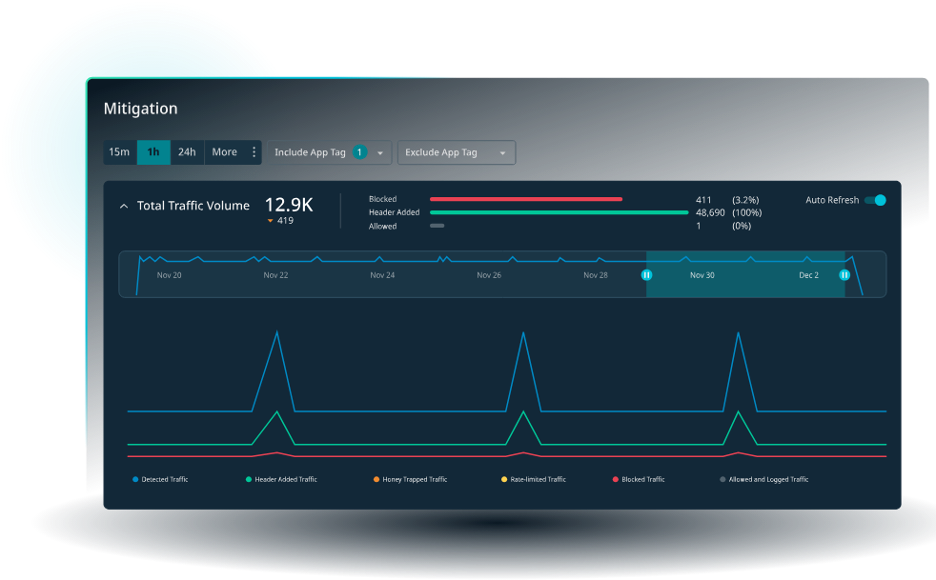
Source: Cequence
2. DataDome

Best for: Real-time bot protection across web, apps and APIs
Strengths: Edge detection under 2 ms with a very low false positive rate
Things to consider: Premium pricing and overage charges on high-traffic sites
DataDome Bot Protect detects and mitigates automated traffic across websites, mobile apps, APIs, and MCP servers. It analyzes every request rather than a sample, evaluating hundreds of client-side and server-side signals continuously throughout the user journey.
Its AI detection engine processes a high volume of signals daily and uses many out-of-the-box and custom models, plus shared threat intelligence, to separate human users, legitimate AI agents, and malicious bots. The platform runs at the edge across more than 30 points of presence with response times under two milliseconds. It also includes Agent Trust capabilities to identify, classify, and govern AI agent traffic.
Key features include:
- Every-request analysis: Evaluates each request rather than sampled traffic, assessing hundreds of client-side and server-side signals across the user journey.
- AI detection engine: Uses 1,000+ out-of-the-box and customer-specific models plus collective threat intelligence to classify humans, legitimate agents, and malicious bots.
- Edge mitigation: Operates across 30+ global points of presence with response times under two milliseconds so mitigation does not add latency.
- Automated response: Triggers automated mitigation aligned to business logic while maintaining a stated false positive rate below 0.01%.
- Agent Trust management: Identifies, classifies, scores, and governs AI agent traffic, validating agent identity and intent in real time.
- Threat dashboard: Provides visibility by threat type over time, endpoint discovery through Watchtower, custom dashboards, saved views, and reports.
- Integrations and SOC: Offers 80+ prebuilt integrations and a 24/7 SOC team that supervises model performance.
Limitations (as reported by users on G2):
- Pricing: Reviewers frequently describe it as expensive, particularly for smaller businesses and high-traffic sites where overage charges add up.
- Dashboard interpretation: Some non-specialist users find certain dashboard metrics hard to interpret and want plainer-language explanations.
- SIEM and alerting gaps: Some users want out-of-the-box data export to SIEM tools such as Splunk and more flexible alerting as request thresholds approach.
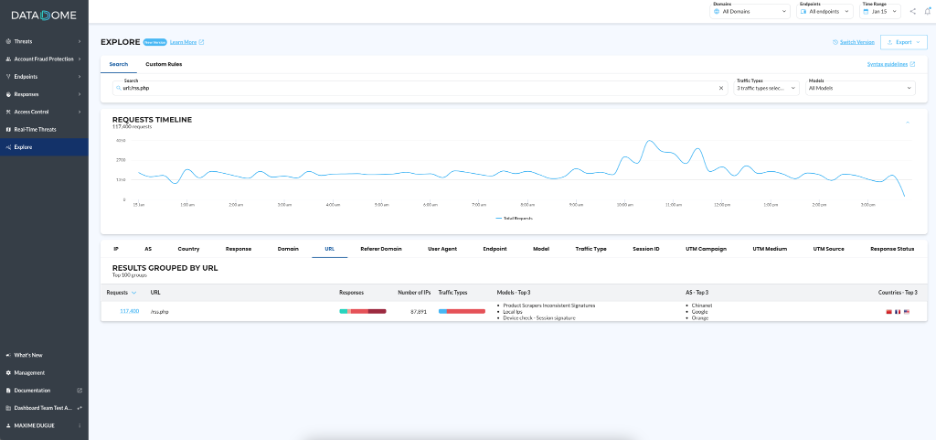
Source: DataDome
3. HUMAN Bot Defender

Best for: Defending against ad fraud; backed by threat intelligence
Strengths: Multi-method detection with full-lifecycle fraud investigation
Things to consider: Initial setup can be complex and the UI has rough edges
HUMAN Bot Defender, part of HUMAN Sightline, protects websites, mobile applications, and APIs from automated attacks. It uses machine learning, behavioral analysis, and fingerprinting to separate genuine users from bots and human-driven fraud.
Rather than scoring individual requests in isolation, it correlates session activity across each authentication stage and the wider user journey. Layered models learn from each detection and mitigation event to react to new attacker tactics. It applies a range of mitigation responses and includes investigative tooling along with visibility into AI agent and LLM scraper traffic.
Key features include:
- Session correlation: Continuously analyzes and correlates session activity across authentication stages instead of evaluating single requests at isolated points.
- Multi-method detection: Combines machine learning, behavioral analysis, and intelligent fingerprinting to identify automated and human-driven fraud.
- Adaptive models: Layered AI models learn from each detection and mitigation event to react to specific threat adaptations.
- Range of mitigations: Applies hard blocks, soft challenges, silent controls, and investigation triggers based on the assessed risk.
- AI and agent visibility: Reports activity from known bots, LLM scrapers, and AI agents, with policies to block, allow, limit, or monetize automated traffic.
- Investigation tooling: Provides dashboards and AI-generated insights to uncover threat networks, identify threat profiles, and track attack patterns.
- Threat intelligence: Draws on the Satori Threat Intelligence and Research team for research that feeds detections.
Limitations (as reported by users on G2):
- Complex setup: Several users report that initial setup and integration can be complex and involve a learning curve.
- Interface friction: Some reviewers note confusing elements in the UI and occasional complex rule management.
- Mitigation tuning: A portion of reviews mention performance concerns, CAPTCHA friction, or instances of less effective blocking that require tuning.
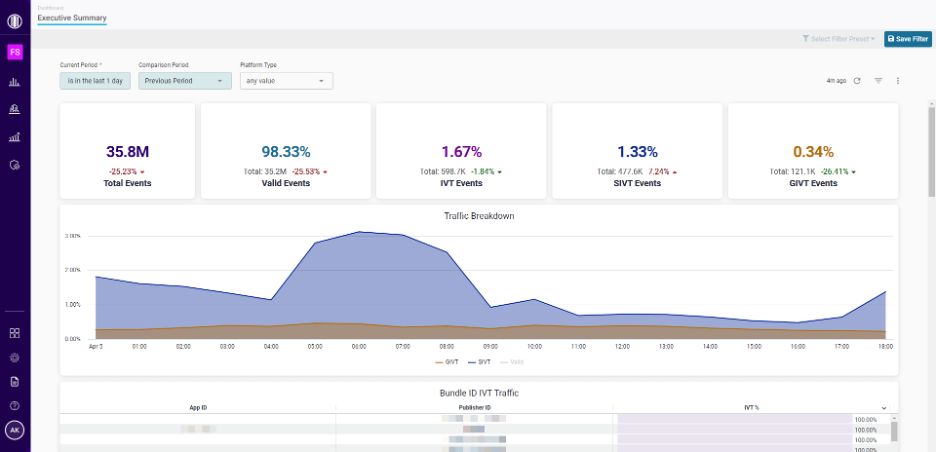
Source: HUMAN
4. Netacea

Best for: Server-side, agentless bot protection across sites, apps, APIs
Strengths: Intent-based behavioral detection with a low false positive rate
Things to consider: Limited self-service manual blocking and console features
Netacea provides server-side bot and agent management for websites, apps, and APIs. It uses a single, self-managing edge integration that is agentless, so there is no client-side code for attackers to inspect.
Natacea’s Intent Analytics engine analyzes the behavior and goal of traffic in real time to identify humans, good bots, bad bots, and AI agents before requests reach the application. It analyzes all traffic across the attack surface and denies bots before execution. The platform also provides threat intelligence feeds and integrates with SOC tooling for visibility into live attacks.
Key features include:
- Agentless deployment: Uses a single server-side edge integration across websites, apps, and APIs with no client-side agent required.
- Intent Analytics engine: Applies machine learning to the behavior and intent of traffic to distinguish humans, good bots, bad bots, and AI agents.
- Pre-execution blocking: Identifies and denies malicious automation before requests are executed against the application.
- Threat intelligence feeds: Supplies data from real attacks to strengthen existing defenses and provide forewarning of planned attacks.
- SOC and tooling integration: Visualizes live attacks and integrates with SOC tools, with CDN integrations such as Cloudflare, Fastly, and Amazon CloudFront.
- Coverage of attack types: Addresses account takeover, carding, credential stuffing, fake account creation, loyalty fraud, scalping, CAPTCHA bypass, and scraping.
Limitations (as reported by users on G2):
- Manual control: Some users want the ability to manually block issues themselves rather than relying on the managed approach.
- Console features: A few reviewers feel the management console could offer more features.
- Reporting and log export: Historically users noted limited ability to stream data into external log services, though reporting has improved over time.
Source: Netacea
5. Kasada
Best for: Invisible, CAPTCHA-free defense for web, mobile, and APIs
Strengths: Client-side obfuscation that resists attacker retooling
Things to consider: Careful pre-launch testing needed; limited public reviews
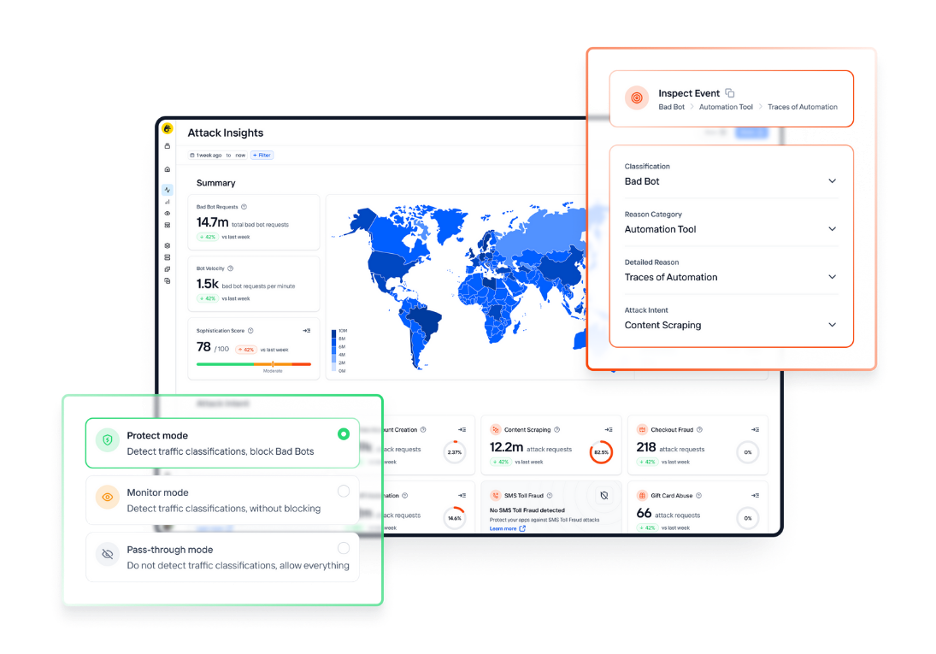
Kasada Bot Defense protects websites, APIs, and mobile apps from automated attacks. It uses invisible client-side challenges and server-side detection rather than visible CAPTCHAs. Hundreds of sensors collect signals from the client to detect automation from the first request, and data is checked for tampering before decisions are made.
A highly obfuscated virtual machine forces attackers to run code in real browsers and devices, which makes the collected signals hard to fake and slows reverse engineering. Analytical models built on large volumes of bot interactions flag automated sessions in milliseconds, and new client-side defenses can be deployed quickly across all customers.
Key features include:
- Invisible signal collection: Hundreds of sensors gather hidden traces of automation in the client and detect bots from the first request.
- Client validation: Checks data received from the client for signs of automation and tampering before making decisions.
- Proof of execution: Runs dynamic code paths inside an obfuscated virtual machine to force execution in real browsers and devices and protect signal data.
- Fast anomaly detection: Analytical models trained on large volumes of bot interactions identify automated sessions in under two milliseconds.
- Threat intelligence: Studies attacker tools and communities and adds new client-side sensors across the customer base in minutes.
- Low-management operation: Removes the need for rule updates and manual tuning, using hidden challenges rather than CAPTCHAs for users.
Limitations (as reported by users on G2 and other public sources):
- Limited critical reviews: Independent reviews are scarce and overwhelmingly positive, so there is less critical comparison data than for incumbents.
- Careful pre-launch testing: Reviewers note that, given how the product works, you need to test thoroughly before deploying in blocking mode.
- Pricing transparency: Pricing is not listed publicly and is quoted per deployment, which can make up-front budgeting harder to estimate.
Source: Kasada
Bot Protection in WAF, CDN, and Edge Platforms
6. Cloudflare Bot Management

Best for: Bot mitigation built into Cloudflare’s edge and CDN stack
Strengths: ML trained on a large share of internet traffic, plus edge speed
Things to consider: Advanced tuning and some features sit on higher tiers
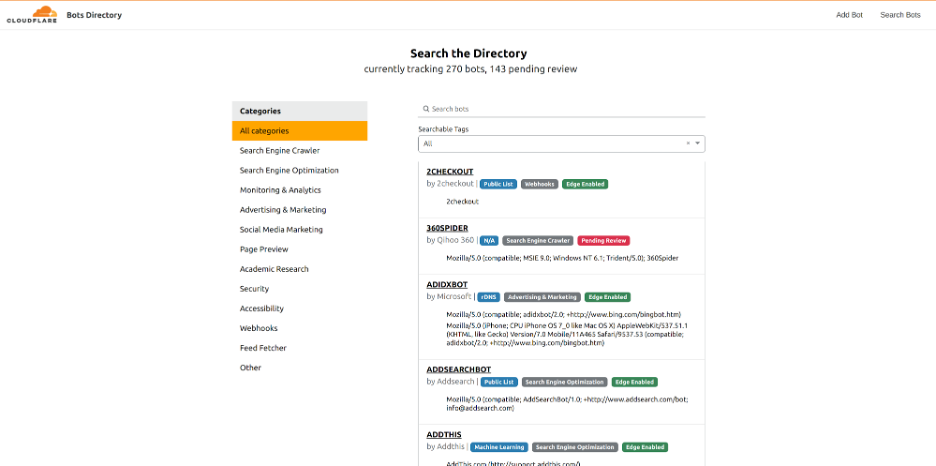
Cloudflare Bot Management uses machine learning and behavioral analysis across Cloudflare’s network to detect and stop malicious bot traffic before it reaches an application. Its models are trained on traffic from a large portion of the internet, and mitigation happens at the edge.
This solution is built into the Cloudflare stack rather than deployed as a separate product, so it shares infrastructure with the WAF, CDN, and other services. It generates a bot score for each request that teams can act on with rules, and it offers Turnstile as an alternative to CAPTCHA. It also tracks and controls AI crawler activity.
Key features include:
- Network-scale ML: Models trained on traffic across a large share of the internet generate a per-request bot score from 1 to 99.
- Edge mitigation: Runs at the edge across Cloudflare’s network so detection and response happen close to the user.
- Rules-based actions: Lets teams act on the bot score with WAF custom rules to block, challenge, or allow traffic, including per-endpoint handling.
- CAPTCHA alternative: Provides Turnstile and cryptographic verification methods such as Private Access Tokens in place of visible CAPTCHAs.
- Credential and API protection: Targets credential stuffing on login endpoints and automated scraping or abuse of APIs.
- AI crawler control: Identifies and controls AI crawlers and verifies legitimate bots against a maintained allowlist.
- Analytics and detections: Offers bot analytics and JavaScript-based detections, with mobile SDK support for app traffic.
Limitations (as reported by users on G2):
- Learning curve: Configuring advanced WAF rules, bot management, and rate limiting can become complex and feel unintuitive.
- Detection transparency: It is not always clear why a request was blocked or challenged, which can slow troubleshooting and tuning.
- Tiering and cost: Some advanced features, deeper analytics, and longer log retention sit behind higher tiers, and pricing can be hard to map.
Source: Cloudflare
7. Akamai Bot Manager

Best for: Edge bot detection for large enterprise estates
Strengths: Edge scoring with good and bad bot management and visibility
Things to consider: Premium pricing and tuning that may need pro services
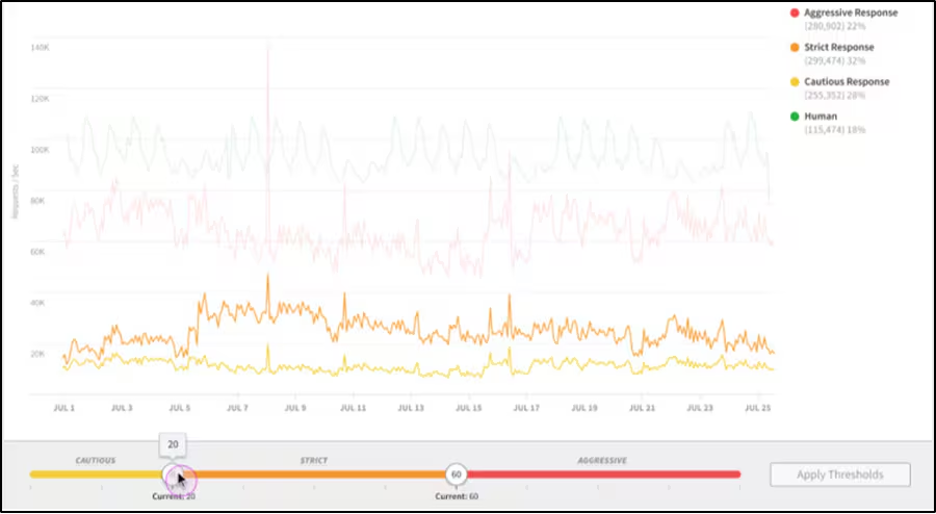
Akamai Bot Manager detects and mitigates bot traffic at the edge while managing good bots. It assigns a bot score from 0 to 100 to each request, starting with the first request, using patented techniques and an AI framework, and the score can adjust as more requests arrive.
Administrators define response strategies across cautious, strict, and aggressive segments and tune both the score thresholds and the actions applied. It includes a library of known good bots so useful automation can pass, and it provides visualization and reporting on the impact of bots. Functionality is available through APIs and integrates with SIEM tools.
Key features include:
- Edge bot scoring: Assigns a score from 0 to 100 per request at the edge, starting with the first request and learning over time.
- Tiered response strategies: Lets teams configure cautious, strict, and aggressive responses and tune the score thresholds and actions.
- Good bot management: Maintains a library of known bots and lets teams create custom categories so useful bots are not blocked.
- Behavioral anomaly detection: Configured by injecting a script into monitored pages to detect anomalies in behavior.
- Visibility and reporting: Provides visualization and reporting on bot types and their impact on business and infrastructure.
- API and SIEM integration: Exposes functionality through APIs for DevSecOps pipelines and feeds bot score insights into SIEM tools.
Limitations (as reported by users on Gartner Peer Insights):
- Cost: Multiple reviewers describe the product as expensive, with emergency response costs and a licensing model that can be hard to understand.
- Interface and tuning: Some find the UI complicated to navigate, and initial configuration can be complex with occasional false positives and negatives.
- Professional services reliance: Realizing full value sometimes requires engaging professional services.
Source: Akamai
8. Imperva Advanced Bot Protection

Best for: Protecting sites, apps, and APIs from all OWASP automated threats
Strengths: Multi-layered detection across 700+ dimensions with granular control
Things to consider: Initial configuration and policy tuning take effort
Imperva Advanced Bot Protection, formerly Distil Networks, protects websites, mobile apps, and APIs from automated threats and covers the OWASP Automated Threats. It uses a multi-layered approach that combines client interrogation, behavioral analysis, machine learning, connection characteristics, and threat intelligence, evaluating over 700 dimensions to separate human, good bot, and bad bot traffic into a fingerprint.
It provides granular control and transparency rather than opaque risk scores, with real-time monitoring and detailed reporting. It can deploy within Imperva’s Cloud Application Security stack or through connectors into other platforms, and it offers analyst managed services for setup, tuning, and ongoing reviews.
Key features include:
- Multi-layered detection: Combines client interrogation, behavioral analysis, machine learning, connection characteristics, and threat intelligence across 700+ dimensions.
- OWASP automated threat coverage: Protects against the full OWASP Automated Threats list across web, mobile, and API surfaces.
- Granular controls and transparency: Provides full visibility and granular tuning rather than black-box risk scores, with explainable reporting.
- Real-time monitoring and reporting: Analyzes trends by application, path, or rule and supports customized dashboards and reports.
- Flexible deployment: Runs in Imperva’s Cloud Application Security stack or through connectors into platforms such as AWS, Cloudflare, F5, NGINX, and Fastly.
- Response options and testing: Offers multiple response options including CAPTCHA and real-time testing tools for policy creation and false positive analysis.
- Managed service: Provides access to bot analysts for setup, fine-tuning, alerting, and ongoing program reviews.
Limitations (as reported by users on G2):
- Initial configuration: Some advanced settings need careful adjustment at the start to avoid affecting legitimate traffic.
- Learning curve: Parts of the dashboard take time for new users to navigate, and policy work can require manual fine-tuning.
- Documentation depth: A few reviewers want more real-world examples and clearer guidance for handling complex bot patterns.
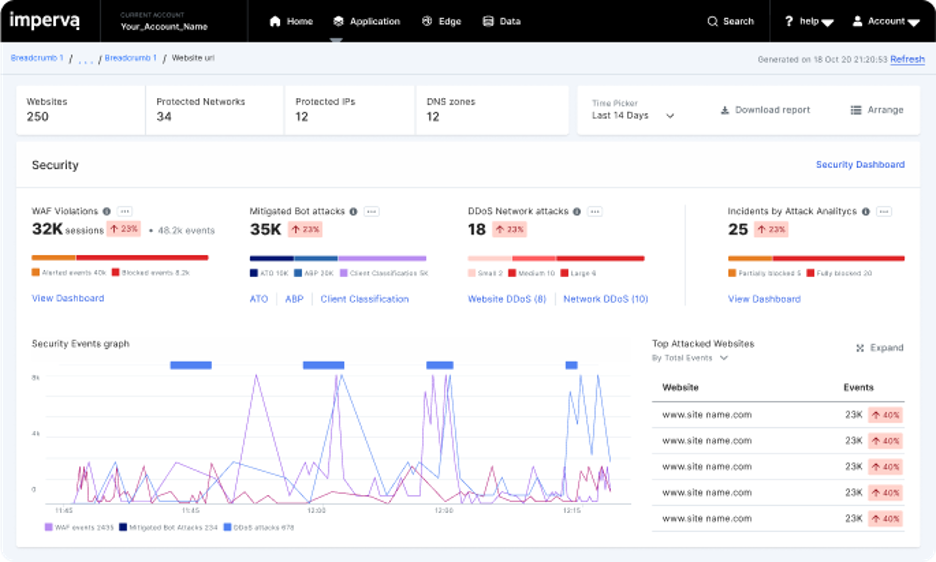
Source: Imperva
9. F5 Distributed Cloud Bot Defense

Best for: Adaptive bot defense for web, mobile, and APIs at scale
Strengths: Behavioral analysis and client telemetry resistant to retooling
Things to consider: Enterprise pricing and cloud and on-prem integration effort
F5 Distributed Cloud Bot Defense, formerly Shape Security, protects web applications, mobile apps, and APIs from automated attacks. It uses real-time behavioral analysis, client-side intelligence, and platform-wide telemetry to detect bots and AI agents at the application interaction layer.
It adapts as attackers retool, without manual tuning, and aims to avoid CAPTCHA-based friction. It separates humans, trusted agents, and malicious automation, and uses code obfuscation and telemetry encryption to resist reverse engineering. It can be enabled through the F5 Distributed Cloud Platform, integrated with BIG-IP, or deployed in custom on-premises, hybrid, and multi-cloud architectures.
Key features include:
- Behavioral and telemetry detection: Uses real-time behavioral analysis and client-side telemetry to unmask automation beyond static signatures.
- Agent-aware classification: Separates humans, trusted AI agents, and malicious automation based on behavior and intent.
- Continuous adaptation: Adjusts defenses automatically as attacker techniques and AI behaviors change, without manual tuning.
- Resilient signal collection: Applies code obfuscation and telemetry encryption to defeat evasion and reverse engineering.
- Deployment options: Enables through the F5 Distributed Cloud Platform, a BIG-IP module or iApp, or custom on-premises, hybrid, and multi-cloud setups.
- SIEM integration: Integrates with Syslog and leading SIEM systems for real-time threat analysis.
Limitations (as reported by users on Gartner Peer Insights):
- Pricing and bundling: Some reviewers find it expensive, especially for smaller organizations, and note bundles can include more than a simple use case needs.
- Hybrid integration: Integrating the cloud service with on-premises F5 products such as BIG-IP can be difficult to align.
- Interface and reporting: Some users describe the interface as dated and text-heavy and report early issues with reporting.
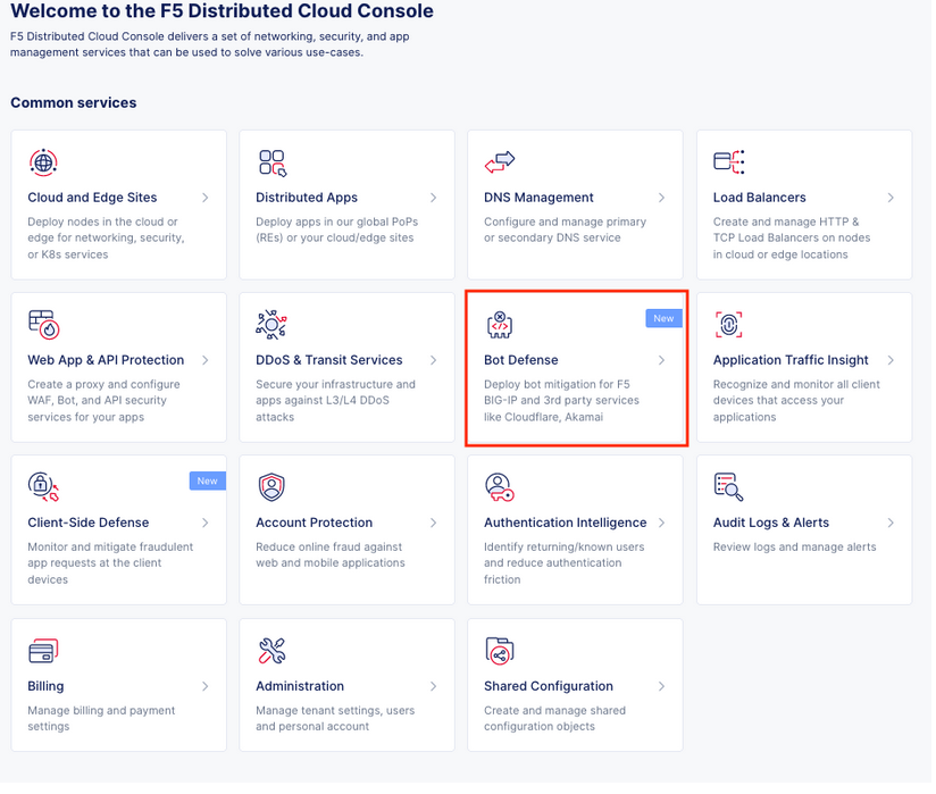
Source: F5
10. Fastly Bot Management

Best for: Edge bot control with nuanced responses and AI crawler control
Strengths: Server- and client-side detection with deception and challenges
Things to consider: WAF interface can feel complex and reporting adds cost
Fastly Bot Management runs at the edge to give visibility into bot traffic and control automated traffic with graduated responses. It combines server-side and client-side detection to surface bots reaching apps and APIs, including AI crawlers, headless browsers, and malicious bots.
Rather than relying only on block and allow actions, it offers dynamic challenges, deception, and AI traffic monetization controls. It uses signals to label traffic and a rule builder to create policies, and it can enforce in the delivery path before cache or in the Next-Gen WAF after cache. It does not rely on easily spoofed attributes such as IP address or user agent, instead correlating behavioral and client signals over time.
Key features include:
- Server and client-side detection: Combines both methods to expose bot traffic across apps and APIs, including AI crawlers and headless browsers.
- Graduated responses: Provides dynamic challenges, deception, and standard block and allow actions rather than only binary responses.
- Signals and rule builder: Labels traffic with customizable signals and a rule builder to create policies quickly.
- Flexible enforcement points: Enforces in the delivery path before cache or in the Next-Gen WAF after cache.
- Behavioral correlation: Correlates behavioral and client signals over time instead of relying on IP or user agent alone, with JA3 and JA4 client fingerprinting.
- AI crawler control and monetization: Controls and can monetize AI bot traffic down to the specific crawler, with ContentGuard protecting content at the edge.
- Verification options: Supports Private Access Token verification and Apple’s automatic verification to separate users from bots.
Limitations (as reported by users on G2):
- Interface complexity: Several reviewers describe the Next-Gen WAF interface as overwhelming and time-consuming to set up and manage rules.
- Support responsiveness: Some users report slow support response when refining configurations.
- Cost and documentation: Real-time analytical reporting is noted as costly, and some find documentation limited for optimization.
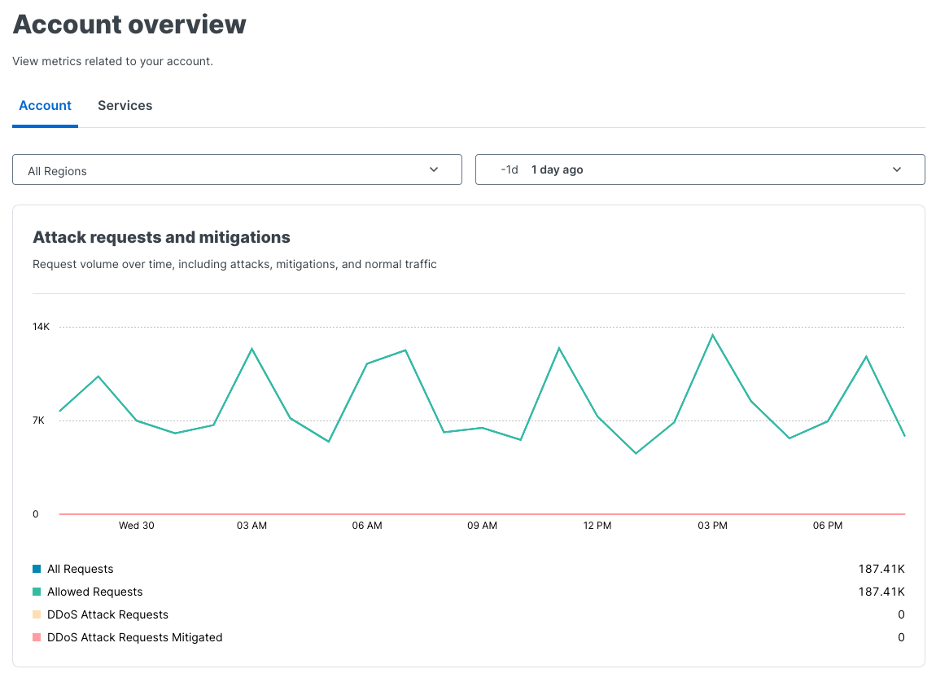
Source: Fastly
11. Barracuda Advanced Bot Protection

Best for: Bot defense within Barracuda’s WAF and application protection
Strengths: ML detection with crowd-sourced threat intelligence and fingerprinting
Things to consider: Dated configuration UI and slower update cadence
Barracuda Advanced Bot Protection is part of Barracuda’s Web Application Firewall and Application Protection platform and defends websites, mobile apps, and APIs from automated threats, including the OWASP Automated Threats.
The solution uses cloud-based machine learning with crowd-sourced data from Barracuda’s Active Threat Intelligence to identify human-like bots and other advanced attackers. It uses client fingerprinting to identify each client and offers responses such as tarpits, timed blocks, IP reputation, and fingerprint-based actions, and includes specific protections against account takeover, such as credential stuffing checks against a breached-credential database. An Active Threat Intelligence dashboard gives visibility into traffic patterns and individual bots.
Key features include:
- Machine learning with threat intelligence: Uses cloud-based machine learning and crowd-sourced Active Threat Intelligence to identify almost-human bots and advanced attackers.
- Client fingerprinting: Identifies each client through advanced fingerprinting to apply targeted actions.
- Graduated mitigation: Responds with tarpits, timed blocks, IP reputation, CAPTCHA challenges, and fingerprint-based actions to slow and block bots.
- Account takeover defense: Checks logins against a cloud database of breached credentials and uses behavior-based detection and MFA enforcement.
- Signature and reputation database: Includes an on-board database of known bots with reverse DNS lookups and honeytraps to identify simpler bots.
- Application DDoS protection: Defends against application-layer DDoS using heuristic fingerprinting, IP reputation, and client challenges.
- Threat intelligence dashboard: Provides traffic visibility and drill-down into individual bots, their visits, and data transferred.
Limitations (as reported by users on G2):
- Dated configuration UI: Some reviewers find the configuration interface unintuitive and little changed over many years.
- Update cadence: A reviewer notes bot detection updates are released less frequently than bot tactics evolve.
- Reporting and support: Reports can be confusing, and some rules are hard to implement without buying the support package.
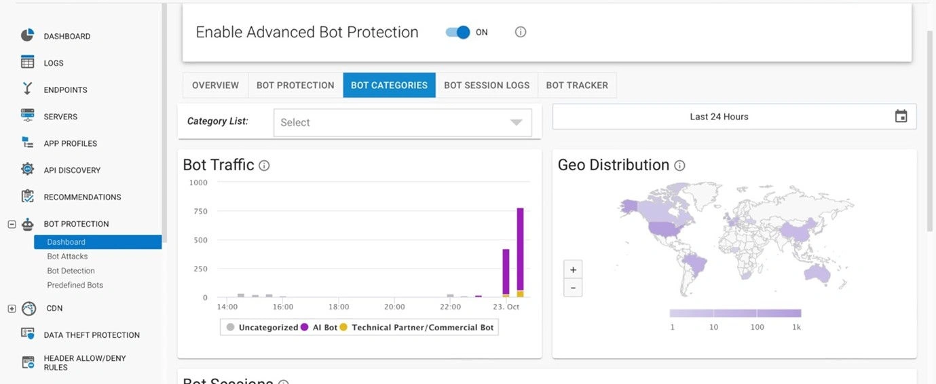
Source: Barracuda
Fraud and Identity-Focused Bot Defense
12. Arkose Bot Manager

Best for: Disrupting bot and human-driven attacks with adaptive challenges
Strengths: 225+ risk signals plus interactive challenges that drain attacker ROI
Things to consider: Challenge friction for users and opaque pricing
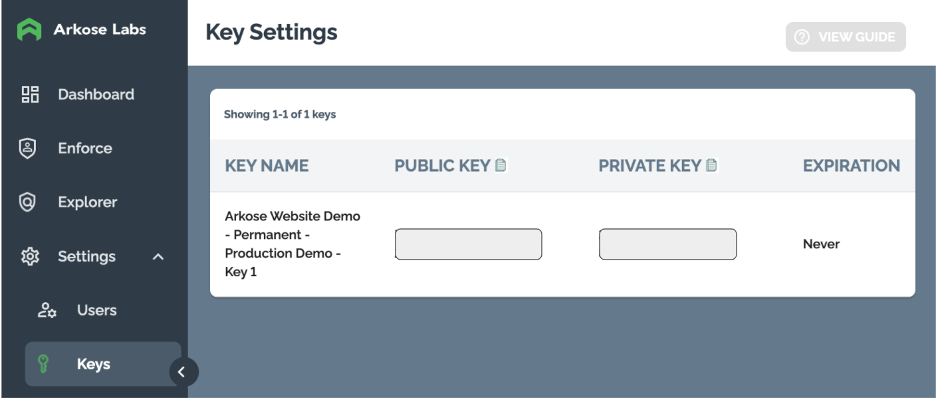
Arkose Bot Manager detects and disrupts automated and human-driven attacks while aiming to keep legitimate users moving through the experience. It combines risk assessment using more than 225 signals and the Arkose Global Intelligence Network with adaptive, interactive challenges that escalate for suspicious traffic.
The approach is designed to make attacks economically unviable by raising the cost of getting through, rather than only filtering risk. It targets account takeover, fake account creation, SMS toll fraud, scraping, and API abuse. It runs on the Arkose Titan platform and can add agent-aware controls through Arkose Agent Trust Manager, and it provides dashboards that turn threat data into reporting.
Key features include:
- Signal-based detection: Uses 225+ risk signals and the Arkose Global Intelligence Network to identify evasive threats.
- Adaptive challenges: Deploys dynamic interactive challenges that evolve in real time and escalate for suspicious traffic.
- Attacker ROI disruption: Designed to make attacks economically unviable by increasing the effort required to pass.
- Good-user flow: Aims to let legitimate users through with minimal friction while challenging suspicious sessions.
- Attack coverage: Targets account takeover, fake account creation, SMS toll fraud, scraping, and API abuse.
- Reporting and dashboards: Turns threat data into dashboards and insights for security teams.
- Titan platform and agent controls: Runs on Arkose Titan and adds AI agent classification and enforcement through Agent Trust Manager.
Limitations (as reported by users on G2):
- User friction: Some users report that visual challenges can frustrate legitimate users, especially when several appear at login.
- False positives on mobile: A few reviewers note occasional false positives with legitimate users, particularly on mobile traffic.
- Setup and pricing: Initial setup and custom rule and API integration can be time-consuming, and pricing is described as opaque.
Source: Arkose
13. Fingerprint

Best for: Developer-focused device intelligence and bot detection via API
Strengths: Accurate device identification with a single API response
Things to consider: A detection signal, not a full mitigation layer
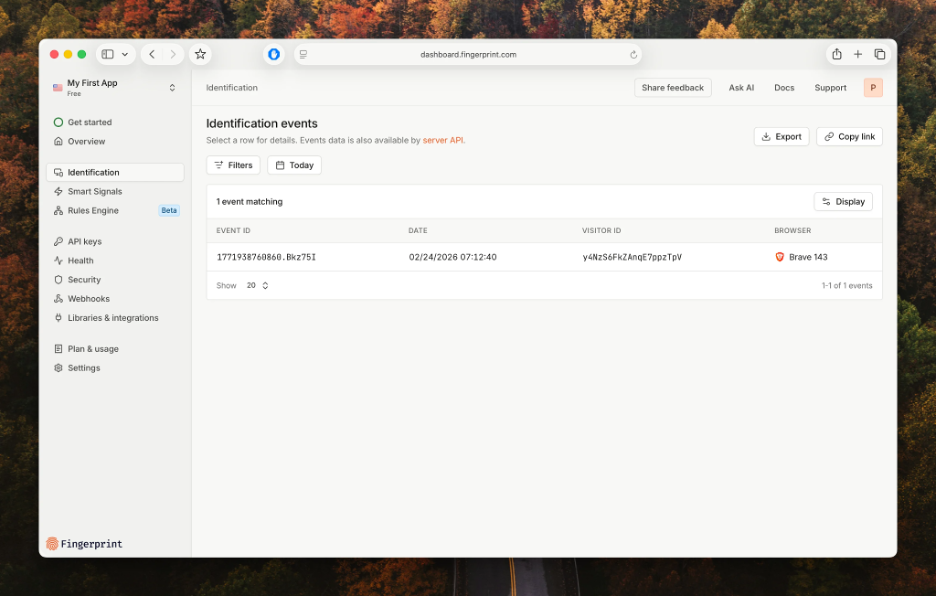
Fingerprint provides device intelligence and a Bot Detection product that identifies automated traffic through a developer-focused API. Its Bot Detection signal returns one of three values for a visitor: good bot, bad bot, or not detected. It analyzes hundreds of browser attributes and network signals to spot automation tools such as Selenium, Puppeteer, and Playwright, including bots that try to emulate human patterns.
The JavaScript agent is lightweight and integrates into existing risk and fraud engines, with server-side verification recommended for security. Cloud integrations let teams run detection at the edge, and Bot Detection works alongside Fingerprint’s visitor identification and Smart Signals.
Key features include:
- Three-state bot signal: Returns good bot, bad bot, or not detected for each visitor through a single API response.
- Browser and network analysis: Analyzes hundreds of browser attributes and network signals to detect automation and human emulation.
- Automation tool detection: Identifies tools such as Selenium, Puppeteer, and Playwright, and recognizes search bots so they can crawl.
- Developer integration: Provides a lightweight JavaScript agent and SDKs that integrate into existing risk and fraud engines.
- Server-side verification: Recommends verifying results server-side, with a Zero Trust mode that limits exposure of identifiers.
- Edge and cloud integrations: Runs detection at the edge through open-source cloud integrations across major providers.
- Smart Signals and identification: Combines with visitor identification and signals such as VPN, incognito, and proxy detection.
Limitations (as reported by users on G2):
- Scope: Fingerprint provides a detection signal and device intelligence rather than a full mitigation and enforcement layer, so teams build the response logic.
- Score transparency: Some users want more visibility into how confidence and suspect scores are derived for tuning.
- Pricing and signals: Reviewers flag the entry pricing as steep for early-stage or low-traffic projects, and note occasional proxy-detection inaccuracy.
Source: Fingerprint
14. Radware Bot Manager

Best for: Protecting web, mobile, and APIs from bots and AI-driven threats
Strengths: Intent-based behavioral detection with CAPTCHA-less mitigation
Things to consider: Reporting is basic and pricing sits at the higher end
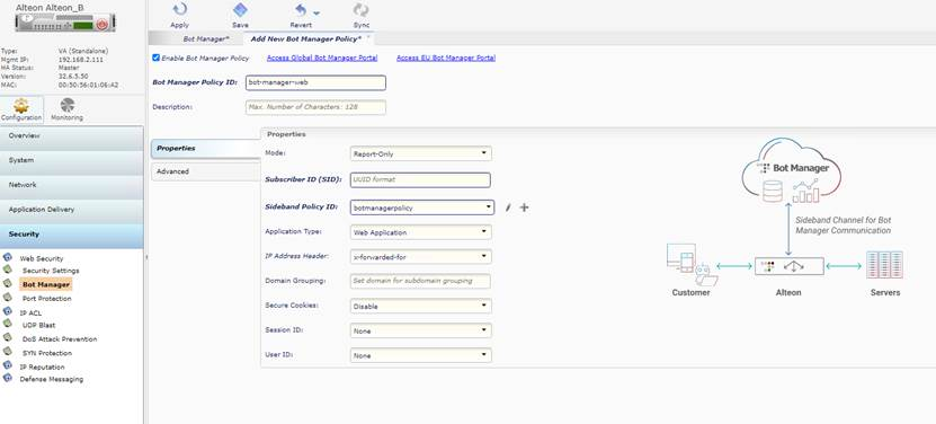
Radware Bot Manager protects web applications, mobile apps, and APIs from automated threats. It uses a multi-layered approach across preemptive protection, behavioral detection, and advanced mitigation. Its proprietary intent-based deep behavioral analysis and AI algorithms identify malicious bots in real time and generate attack signatures to block them, with the aim of keeping false positives low.
It combines behavioral modeling, collective bot intelligence, and fingerprinting of browsers, devices, and machines. Mitigation options include a blockchain-based crypto challenge that avoids CAPTCHAs, plus custom responses and feeding fake data. It also provides AI crawler and AI agent visibility and native mobile app protection.
Key features include:
- AI behavioral detection: Uses proprietary intent-based deep behavioral analysis and AI algorithms to identify malicious bots in real time.
- Multi-layered defense: Combines preemptive protection, behavioral detection, and advanced mitigation across web, mobile, and APIs.
- Fingerprinting and intelligence: Blends behavioral modeling, collective bot intelligence, and fingerprinting of browsers, devices, and machines.
- CAPTCHA-less mitigation: Offers a blockchain-based crypto challenge plus options such as custom responses and feeding fake data.
- AI crawler and agent management: Provides intent-based classification and control of AI crawlers and visibility into AI agent traffic.
- Native mobile protection: Uses integrated device authentication for Android and iOS and secure identity to validate requests.
- Cross-module correlation: Correlates threats with other Radware security modules to preemptively block malicious sources.
Limitations (as reported by users on G2):
- Reporting flexibility: Some reviewers find the reporting basic and hard to customize and want more dashboard functionality.
- Pricing: The product is described as sitting at the higher end and less suited to small organizations.
- Tuning and updates: A few reviewers note occasional blocking of good bots and crawlers and some issues with updates.
Source: Radware
How to Choose Bot Management Solutions
Choosing the right bot management solution requires evaluating more than basic bot detection. Modern bot attacks target web applications, mobile apps, and APIs, often using sophisticated techniques that mimic legitimate user behavior. Organizations should look for a solution that can identify malicious automation accurately, minimize friction for real users, and adapt as attackers change tactics.
Key considerations include:
- Coverage across applications and APIs – The solution should protect web applications, mobile applications, and APIs, including cloud-native and microservices-based environments. This is especially important because many traditional bot defenses rely on browser-based JavaScript, which does not directly protect APIs.
- Multi-dimensional detection – Look for capabilities that combine behavioral analysis, device and client signals, IP reputation, user agent analysis, threat intelligence, and request patterns instead of relying on a single detection method.
- API security alignment – Since bots frequently abuse APIs to conduct credential stuffing, scraping, account takeover, fraud, and business logic attacks, bot management should work closely with API discovery, API inventory, and runtime API protection.
- Protection against business logic abuse – Effective solutions should detect activity that may appear legitimate at the request level but becomes suspicious when analyzed across sessions, users, endpoints, and workflows.
- Adaptive defense against evasive bots – Attackers frequently rotate IPs, change user agents, use residential proxies, and retool their bots. A strong bot management platform should continue tracking malicious automation even as tactics evolve.
- Low friction for legitimate users – The solution should avoid overusing CAPTCHAs or challenges that disrupt customer experience. It should offer risk-based mitigation options that only introduce friction when necessary.
- Flexible mitigation options – Organizations should be able to apply different responses based on risk, such as monitoring, logging, rate limiting, blocking, deception, step-up authentication, or other policy-based controls.
- Fast deployment and time to value – The solution should be easy to deploy without requiring major application changes, lengthy tuning periods, or heavy development work.
- Visibility and actionable intelligence – Security teams should be able to see which bots are active, what they are targeting, how attacks are evolving, and which mitigation actions are being applied.
- Integration with the broader security stack – Bot management should complement existing WAF, API security, fraud prevention, identity, SIEM, and incident response workflows rather than operate as an isolated control.
The Modern Bot Management Solution: How to Get Started with Cequence
Traditional bot management solutions have proven daunting to implement, especially if they require application modification through JavaScript or mobile SDK integration. This approach also means that only modified applications are afforded any coverage. Cequence is the modern solution. Compared to traditional approaches, Cequence can be deployed via SaaS without needing to modify your applications, dramatically simplifying onboarding and streamlining the number of departments and subject matter experts that are required. Cequence deployments enable customers to first see the detected malicious traffic that would be blocked before later transitioning to an active mode where blocking or other customer-chosen mitigation occurs.
Cequence offers a unique approach to bot management that is easy to deploy, provides rapid time to value, and is highly effective. If you’d like to learn more, contact us and let Cequence show you how we can address bots in your unique situation.
Frequently Asked Questions
What Problems and Attacks Does Bot Management Solve?
Bots are simply a vehicle for automated attacks, and organizations may not always be aware that they have a bot problem. Some of the common attacks that bots enable at scale include:
- Account takeover (ATO) – Gaining unauthorized access to legitimate user accounts, usually with stolen credentials
- Sensitive data exposure – Accessing inadvertently exposed sensitive data from applications and APIs
- Credential stuffing – Accessing protected services with stolen, legitimate credentials
- Flash sales, hype sales, and ticket scalping – “Jumping the line” to acquire products that would otherwise be available to legitimate customers or purchasing in-demand products quickly for resale
- Content scraping/IP theft – Scraping data from web applications or APIs for resale, ransom, or other nefarious purposes • Gift card/loyalty program abuse – Brute-forcing card object combinations such as card numbers or PINs to access valid gift cards or loyalty programs
- Fake account creation – Creating user accounts from fake or stolen user identity information
- SIM swapping – Cellular account takeover that compromises user accounts through unauthorized SIM swaps
What Does a Bot Manager Do?
A bot manager is software designed to protect websites, web applications, and APIs from attacks, business logic abuse, and fraud. Bot managers must not only determine human from synthetic (bot) traffic, but also good bots from bad bots. Bot managers then serve as a sort of gatekeeper, allowing good bots, such as web crawlers or AI agents, while blocking malicious bots. However, it’s imperative to be accurate and not block good bots or actual human traffic which may cost you revenue or cause brand damage. Ideal bot managers offer some or all of the following features:
- Distinguish human from synthetic traffic, and good bots from bad
- Detect bots without modifying applications
- Mitigate attacks in real time, before they reach the targeted applications or APIs
- Integrate with an API security solution to provide business context to the attacks
- Adapt to changing threats and provide protection as attacks evolve
What is the Difference Between Good and Bad Bots?
According to some estimates, bot traffic makes up over half or internet traffic. Of course, that includes both good and bad bots, but most of that bot traffic is not malicious. This makes accurate detection and accurate differentiation critical. Good bots that follow site rules such as robots.txt are desirable and can even be critical to commerce, while bad bots cause abuse services, automate fraud, or deface websites. A solution that can discern intent through behavior can ensure accurate detection and enable mitigation of bad bots while allowing good bots.
How Does Bot Management Work?
Sophisticated bots are difficult to distinguish from humans, and the inability to accurately detect malicious bots can be costly. Like the rest of cybersecurity, it’s asymmetric, meaning the defender must be successful every time, while the attacker only needs to be successful once.
Challenge-Based Bot Detection
Different types of bot management solutions use different types of bot detection methods. The most common, but unfortunately one of the least effective and most annoying for the end user, is JavaScript-based challenges such as CAPTCHA. As mentioned in the blog above, they cause user friction and can now be easily bypassed by AI.
Static Bot Detection
Another type of bot detection method is static detection which relies on threat intelligence signatures or IP data. This method is easily bypassed by attacks that use residential proxies to mix in with good IPs. Static detection greatly increases the possibility of blocking good traffic with bad.
Behavior-Based Bot Detection
Modern bot management solutions utilize behavior-based bot detection. This method analyzes network traffic to determine intent, providing much greater accuracy to human/synthetic and good/bad bot identification. Some vendors will claim that layered detection is most effective, but that’s simply because their individual methods alone are insufficient. Behavioral intent-based identification, performed correctly, requires no other detection method to be effective.
Bot Mitigation
Once identified, malicious bots can be mitigated in several ways depending on the type of business or other factors. Top bot management solutions offer mitigation options including blocking, rate limiting, header injection, and deceptive responses.
Bots are Evolving
As previously mentioned, security is asymmetrical, and bot management solutions must evolve to keep up with ever-changing malicious bots. This is best enacted with the help of AI/ML. This can range from improved detection methods that can learn normal behavior and thereby detect abnormal behavior to the ability of the solution to automatically detect a bot attack, create a mitigation policy, and enact it – without user intervention, and in real-time.