
TL;DR: Bot detection vendors need to accurately separate humans from malicious automation across web, mobile, and API traffic. Best for comprehensive bot defense: Cequence; best for targeting sophisticated fraud: HUMAN; best for edge mitigation: DataDome; best for CDN-integrated users: Akamai.
How to Evaluate Bot Detection Vendors for Accuracy
Top-tier bot detection vendors provide multi-layered defense to stop malicious automated traffic, web scraping, and API abuse. They achieve high accuracy by using a combination of behavioral analysis, device fingerprinting, machine learning, and intent-based telemetry to separate humans from bad bots in real-time.
Here are the main things to consider when evaluating bot detection solutions for accuracy:
- Detection methods: Choose vendors that combine behavioral analysis, fingerprinting, machine learning, and threat intelligence instead of relying on static rules.
- Coverage: Ensure protection extends across websites, mobile apps, APIs, and other digital channels with consistent detection.
- Accuracy: Look for low false positive rates that minimize disruption to legitimate users while blocking malicious automation.
- Real-time mitigation: Verify the platform can immediately block, rate-limit, or challenge suspicious traffic based on risk scores.
- Application awareness: Prefer solutions that understand business logic, API context, and user journeys to detect sophisticated abuse.
- Deployment and visibility: Evaluate deployment flexibility, reporting, investigation tools, and policy customization for ongoing tuning and incident response.
This is part of a series of articles about bot management
In this article:
- Bot Detection Solutions at a Glance
- Why Accurate Bot Detection Is Difficult
- Key Technologies Used to Improve Bot Detection Accuracy
- Notable Accurate Bot Detection Solutions
Bot Detection Solutions at a Glance
The table below summarizes the key differences between the solutions covered in this article. We explore each one in more detail in the sections that follow.
Category Solution Best For Key Strengths Detection Accuracy API and Application Bot Defense Cequence Security Network-based bot and API defense with no client-side code Behavioral intent-based detection across web, mobile, APIs, and AI Highly accurate; requires tuning on niche threats and high-volume attacks API and Application Bot Defense HUMAN Security Full-lifecycle bot, AI agent, and human fraud defense Multi-method detection across web, mobile, and APIs False positives flagged during testing API and Application Bot Defense DataDome Edge bot mitigation with low latency and false positives Real-time detection across sites, apps, APIs, MCP servers Corporate VPNs and partner traffic can occasionally be flagged API and Application Bot Defense Arkose Labs Bot defense with adaptive challenge-response at login 225+ risk signals plus dynamic challenges and analytics Occasional false positives on mobile traffic WAAP and Edge-Delivered Bot Management Cloudflare Bot mitigation built into Cloudflare’s CDN and network ML, behavioral analysis, and fingerprinting at scale Corporate proxies and mobile traffic can trigger false positives WAAP and Edge-Delivered Bot Management Akamai Edge bot mitigation for Akamai CDN and WAF customers Edge bot scoring using AI on billions of daily requests VPN- and proxy-masked scrapers can evade detection WAAP and Edge-Delivered Bot Management Imperva Multi-layered bot defense across web, mobile, and APIs 700+ detection dimensions with granular tuning Accuracy requires ongoing manual tuning WAAP and Edge-Delivered Bot Management F5 Agent-aware bot defense across hybrid and multi-cloud Behavioral analysis and client-side telemetry vs. evasion False positives reported on legacy browsers
Why Accurate Bot Detection Is Difficult
Bots Increasingly Resemble Human Users
Modern bots go far beyond simple scripts, using techniques that closely mimic human browsing behavior. Advanced bots can simulate mouse movements, randomize click timings, and interact with web page elements in ways that appear natural to traditional detection systems. As a result, distinguishing between automated and human activity has become more challenging, especially when bots adapt their tactics in real time.
Static rule-based approaches are no longer sufficient. Vendors use adaptive systems that analyze subtle behavioral cues and spot inconsistencies that reveal automation. The ongoing competition between bot developers and security vendors makes accurate identification a moving target that requires continuous research and updates.
Related content: Read our article about bot detection in the AI age
Residential Proxies and Rotating Infrastructure
Bots often use residential proxies to disguise their origins, routing traffic through real consumer IP addresses to appear as legitimate users. This makes traditional IP-based blocking less effective, as requests come from a wide range of authentic-looking locations. By using large pools of residential IPs, bots can evade blacklists, making it difficult to flag or block malicious activity based only on network signals.
Rotating infrastructure adds complexity. Bots can switch IP addresses, devices, and even user agent strings at high frequency, rendering static fingerprints less useful. Detection systems must correlate multiple signals across sessions and devices to identify patterns that indicate automation.
Limited Visibility Across Channels
Organizations often operate multiple digital channels, including websites, mobile applications, and APIs, each with its own access patterns and security challenges. Bots can target any of these channels, exploiting gaps in visibility or inconsistent security policies. For example, a bot blocked on a website may shift to attacking the same business through its mobile app or API.
Accurate detection requires unified visibility and analysis across all access points. Integrating data from disparate systems and normalizing it for real-time analysis is technically challenging. Vendors provide solutions that aggregate and correlate signals from web, mobile, and API traffic so bots cannot simply switch channels to avoid detection.
Key Technologies Used to Improve Bot Detection Accuracy
Behavioral and Intent Analysis
Behavioral and intent analysis involves monitoring user interactions in real time to identify anomalies that suggest automation. This technology tracks metrics such as mouse movements, scroll patterns, typing cadence, and navigation flows to build a behavioral profile for each user session. Bots often reveal themselves through inconsistencies in these patterns, such as unnaturally precise movements or repetitive sequences.
Intent analysis examines the sequence and context of actions to determine whether the user’s goals align with expected human behavior. For example, rapidly attempting multiple logins or navigating directly to high-value actions without normal browsing patterns can indicate bot activity. By correlating behavioral signals with contextual intent, detection systems distinguish between genuine users and automated threats while reducing false positives.
Machine Learning and Global Threat Intelligence
Machine learning models analyze large volumes of data and identify patterns that static rules cannot capture. These models are trained on labeled datasets of known bot and human interactions, allowing them to recognize indicators of automation and adapt to evolving attack techniques.
Global threat intelligence provides data on emerging botnets, attack vectors, and infrastructure. Vendors maintain threat databases and share insights across clients to identify and block new threats. Combining machine learning with threat intelligence helps bot detection systems respond to new tactics.
Device and Browser Fingerprinting
Device and browser fingerprinting collects information about the hardware and software environment of each visitor. This includes operating system, browser version, screen resolution, installed fonts, and other attributes. Vendors generate a fingerprint for each device, making it harder for bots to masquerade as legitimate users by rotating IP addresses or user agents.
Advanced bots may attempt to spoof or randomize fingerprint data, but inconsistencies or rare combinations can still signal automation. Fingerprinting also enables detection of device sharing or rapid switching between identities, common in bot operations.
Network and Protocol Fingerprinting
Network and protocol fingerprinting analyzes the characteristics of network connections and the underlying protocols used by visitors. This includes TCP/IP stack behavior, packet timing, SSL/TLS handshake attributes, and other low-level signals that are difficult for bots to replicate.
By cross-referencing network fingerprints with other detection methods, vendors can uncover coordinated botnets, proxy usage, or infrastructure designed to obscure bot origins. Protocol fingerprinting is valuable against bots using residential proxies or rotating IPs because it captures signals beyond the application layer.
Application and API Context
Understanding the context in which requests are made is critical for accurate bot detection. This includes analyzing the endpoints being accessed, expected behavior for those endpoints, and the business logic behind them. For example, a spike in API calls to a login endpoint or unusual usage of account creation forms may indicate automated attacks.
Application and API context allows detection systems to apply custom rules and risk scoring based on the sensitivity and typical usage of each resource. Incorporating business logic and expected user journeys helps flag anomalous activity aligned with bot-driven abuse.
Related content: Read our article about API security
Identity and Account Signals
Identity and account signals involve monitoring account-related behaviors and attributes to detect suspicious patterns. This includes analyzing login frequency, geolocation changes, device switching, and the use of stolen or synthetic credentials. Bots often show high-velocity or coordinated account activity that deviates from normal user patterns.
Vendors also use signals from authentication providers, threat intelligence feeds, and third-party risk data to enrich account profiles. Correlating identity signals with behavioral and network data helps detection systems identify compromised accounts and credential stuffing attempts.
Notable Accurate Bot Detection Solutions
How we selected these solutions: We shortlisted bot detection vendors based on their accuracy in separating humans from malicious automation, their coverage across web, mobile, and API channels, and their use of behavioral analysis, fingerprinting, machine learning, and intent-based detection.
API and Application Bot Defense Platforms
1. Cequence Security

Best for: Network-based bot and API defense with no client-side code
Strengths: Highly accurate behavioral intent-based detection across web, mobile, APIs, and AI
Things to consider: Requires tuning on niche threats and high-volume attacks
Cequence Bot Management protects web, mobile, and API applications from bot attacks, including account takeover, content scraping, flash and hype sale abuse, sensitive data exposure, gift card and loyalty program abuse, and business logic abuse. It works at the network level and requires no client-side JavaScript or SDK integration, protecting web and mobile apps, APIs, and microservices-based architectures without application changes or regression testing.
Its machine learning analyzes behavioral intent across web, mobile, and API traffic to build a behavioral fingerprint that distinguishes good bots from bad ones and continues tracking malicious activity as attackers retool. Bot Management is part of the wider Cequence platform, which also covers API security and agentic AI governance and processes more than 10 billion daily API interactions.
Key features include:
- Network-based detection: Operates at the network level with no client-side JavaScript or SDK, protecting web, mobile, APIs, and microservices without code changes.
- Behavioral intent analysis: Machine learning analyzes behavioral intent across web, mobile, and API traffic to build a fingerprint that separates good bots from bad and follows attackers as they change tactics.
- Real-time mitigation: Detects attacks and generates threat mitigation rules and policies that run automatically or after human review, with options including blocking, rate limiting, header injection, and deception.
- Friction-free verification: Biometric Check routes suspicious traffic to native device authentication such as Face ID, Touch ID, or Windows Hello instead of CAPTCHAs or SMS codes.
- Fraud prevention: Identifies and mitigates fraud in real time with customizable, granular policies, plus incident forensics and transaction analysis.
- Flexible deployment: Deploys on-premises, in the cloud, or hybrid; software sensors inspect traffic passively or inline, with predefined rules and machine learning baselining within hours.
Bot detection accuracy:
- Network-based accuracy: Analyzes behavioral intent across web, mobile, and API traffic instead of relying on end-user device signals, producing what Cequence describes as a more accurate behavioral fingerprint than client-side approaches.
- Continuous re-tooling tracking: Machine learning models consistently distinguish good bots from bad bots and keep tracking malicious activity even as attackers change tactics to evade detection.
- Frictionless verification: Biometric Check confirms a real person is present in under a second using native device authentication, avoiding CAPTCHAs and SMS codes that Cequence notes bots and fraud farms can defeat at scale.
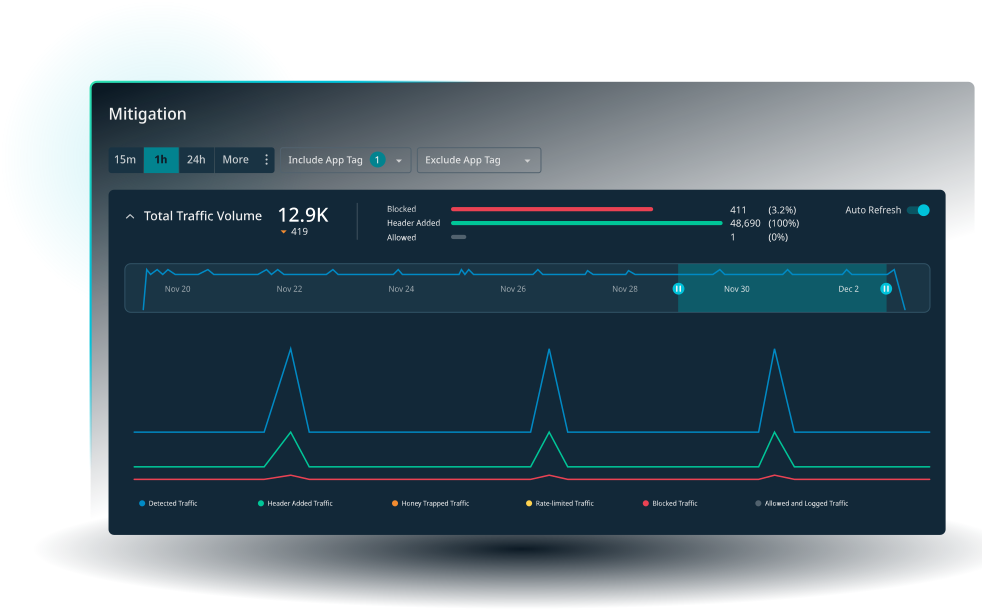
Source: Cequence
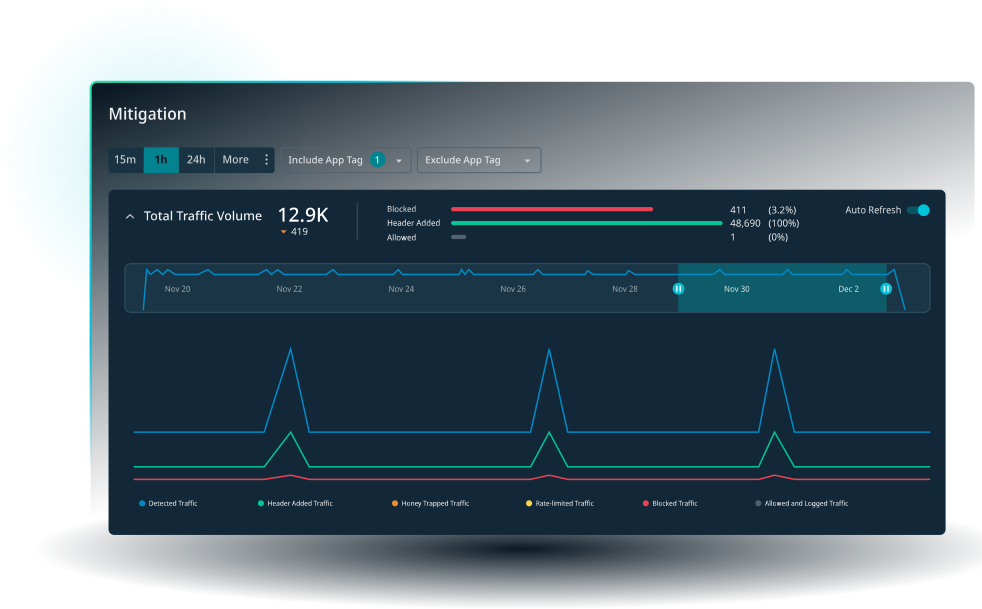
2. HUMAN Security

Best for: Full-lifecycle bot, AI agent, and human fraud defense
Strengths: Multi-method detection across web, mobile, and APIs
Things to consider: Dashboard and rule management have a learning curve
HUMAN Sightline Cyberfraud Defense governs traffic across web, mobile, and APIs, allowing legitimate visitors while stopping automated, AI-driven, and human-led fraud and abuse. It uses machine learning, behavioral analysis, and fingerprinting to manage good and bad bots as well as fraudulent human traffic.
The platform analyzes and correlates session activity across each authentication stage rather than judging individual requests at single points such as login or checkout. Mitigation ranges from hard blocks to soft challenges and silent controls, and it integrates with WAF, CDN, IAM, and fraud operations tooling. It also provides visibility into crawlers, LLM scrapers, and AI agents so teams can block, allow, limit, or monetize automated traffic.
Key features include:
- Multi-method detection: Combines machine learning, behavioral analysis, and fingerprinting, correlating session activity across each authentication stage rather than single requests.
- Customizable mitigation: Applies hard blocks, soft challenges, silent controls, and investigation triggers, integrating into existing WAF, CDN, IAM, and fraud operations stacks.
- Crawler and AI agent control: Provides visibility into known bots, LLM scrapers, and AI agents and applies policies to block, allow, limit, or monetize automated traffic.
- Human challenge: A verification method intended to counter CAPTCHA-solving bots while collecting behavioral data about the user.
- Threat investigation: Provides AI-generated insights, pattern analysis, automated reports, and secondary detection to uncover fraud networks and track attack patterns.
- Adaptive learning: Layered AI models learn from detection and mitigation events and can be informed by first-party data to tune toward specific business goals.
Bot detection accuracy:
- Industry-leading decision engine: Detects sophisticated bots with what HUMAN describes as unparalleled accuracy, responding with scenario-optimized actions rather than uniform blocking.
- AI and known-bot visibility: Distinguishes trusted AI agents and known bots from malicious traffic, letting teams allow, deny, monetize, or serve alternate content based on intent.
- Precision without friction: Designed to precisely block malicious bot attacks and automated fraud without adding friction for trusted users.
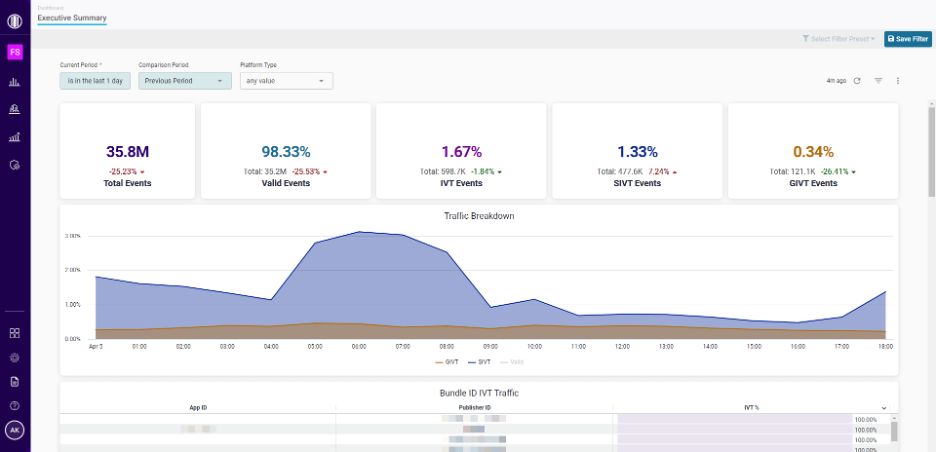
Source: HUMAN
3. DataDome

Best for: Edge bot mitigation with low latency and false positives
Strengths: Real-time detection across sites, apps, APIs, and MCP servers
Things to consider: Dashboard data exports are capped by volume
DataDome Bot Protect delivers real-time bot detection for websites, mobile apps, APIs, and MCP servers. It analyzes over 5 trillion signals per day with AI models to distinguish human users, legitimate AI agents, and malicious bots, operating at the edge across more than 35 points of presence with response times under 2 milliseconds.
It analyzes every request rather than a sample, evaluating client-side and server-side signals throughout the user journey. High-risk traffic triggers automated mitigation aligned with business logic, with CAPTCHAs optionally enabled by policy for a small fraction of requests. It also includes Agent Trust to identify, classify, and govern AI agent traffic.
Key features include:
- Continuous request analysis: Evaluates every request across the user journey using client-side and server-side signals rather than sampled data.
- AI detection engine: Uses out-of-the-box and customer-specific models plus collective threat intelligence, processing over 5 trillion signals per day.
- Edge mitigation: Runs at the edge across global points of presence with response times under 2 milliseconds.
- Automated mitigation: Triggers responses aligned with business logic automatically, with optional CAPTCHAs applied to a small fraction of requests.
- Agent trust management: Identifies, classifies, scores, and governs AI agent traffic and validates agent identity and intent in real time.
- Threat dashboard and SOC: Provides endpoint discovery, threat views, and custom dashboards, backed by a 24/7 SOC team that monitors traffic and model performance.
Bot detection accuracy:
- Sub-0.01% false positive rate: DataDome states its AI-powered detection maintains a false positive rate below 0.01%, measured continuously against live traffic.
- High-volume signal analysis: Processes more than 5 trillion signals per day using 1,000+ out-of-the-box and customer-specific models plus collective threat intelligence to separate humans, trusted AI agents, and malicious bots.
- Low-latency edge decisions: Delivers detection decisions in under 2 milliseconds across 35+ points of presence, so accuracy checks add no noticeable delay.
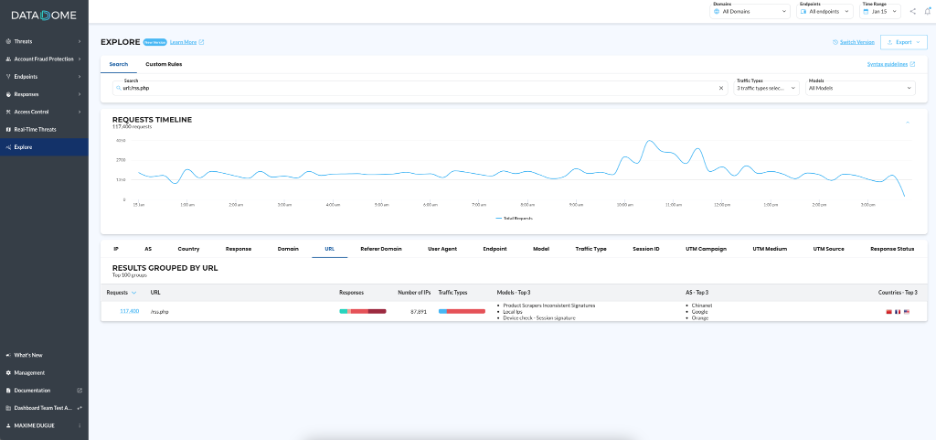
Source: DataDome
4. Arkose Labs

Best for: Bot defense with adaptive challenge-response at login
Strengths: 225+ risk signals plus dynamic challenges and analytics
Things to consider: Opaque pricing and time-consuming initial tuning
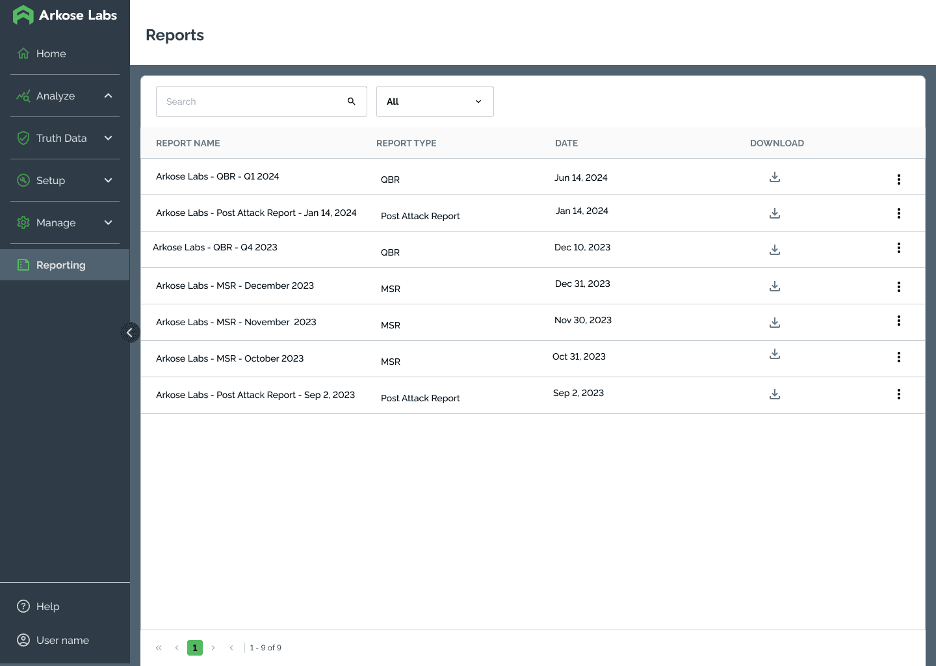
Arkose Bot Manager detects and disrupts automated and human-driven attacks across the user journey, targeting account takeover, SMS toll fraud, and fake account creation. It runs on the Arkose Titan platform and combines device intelligence, network and IP signals, and behavioral analysis to score risk.
Suspicious traffic is routed to adaptive challenge-response that is harder for automation than for people, including traffic from human fraud farms. The system draws on more than 225 risk signals and the Arkose Global Intelligence Network, and its challenges change in real time to counter new attack vectors. Dashboards convert threat data into reporting for security and fraud teams, and 24/7 SOC support accompanies the platform.
Key features include:
- Multi-signal detection: Uses 225+ risk signals across device, network, IP, and behavior, plus the Arkose Global Intelligence Network to identify evasive threats.
- Adaptive challenge-response: Deploys dynamic challenges that change in real time to separate automated activity from legitimate users, including against human fraud farms.
- Account and API protection: Targets account takeover, credential stuffing, fake account creation, SMS toll fraud, and API abuse across the user journey.
- Agent-aware option: Arkose Agent Trust Manager classifies AI agents by intent and enforces allow, monitor, or block on the same Titan session infrastructure.
- Analytics dashboards: Convert threat data into reporting and insights on attack patterns and risk levels for stakeholders.
- Managed SOC support: 24/7 monitoring and investigation support accompanies the platform.
Bot detection accuracy:
- Multi-signal risk scoring: Combines device intelligence, network and IP signals, and behavioral analysis with 225+ risk signals to score each session before deciding how to respond.
- Adaptive challenge accuracy: Uses sixth-generation adaptive challenges that evolve in real time, designed to defeat bots and AI-powered solvers while letting legitimate users pass with minimal friction.
- Global intelligence network: Draws on the Arkose Global Intelligence Network for cross-industry attack signals to keep detection current against new attack patterns.
Source: Arkose
WAAP and Edge-Delivered Bot Management
5. Cloudflare Bot Management

Best for: Bot mitigation built into Cloudflare’s CDN and network
Strengths: ML, behavioral analysis, and fingerprinting at network scale
Things to consider: Full behavioral detection sits in the Enterprise tier
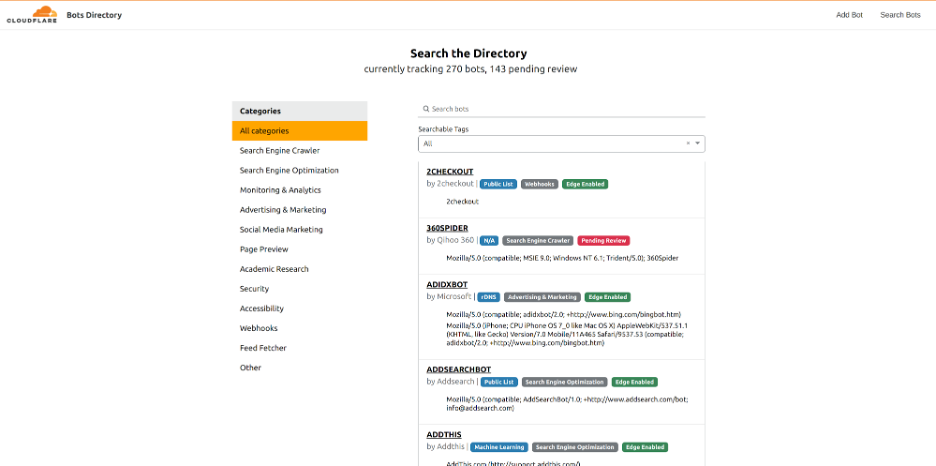
Cloudflare Bot Management identifies and mitigates automated traffic across the Cloudflare network, using machine learning, behavioral analysis, and fingerprinting to score every request from 1 to 99. The machine learning engine trains on traffic flowing through Cloudflare’s network, while heuristics match requests against a database of known malicious fingerprints.
Behavioral analysis records a baseline of a domain’s traffic to flag outliers, and an optional JavaScript detection engine identifies headless browsers. The product challenges bots without CAPTCHAs and recommends rules out of the box. It targets credential stuffing, content scraping, inventory hoarding, and automated probing across login endpoints, APIs, and e-commerce flows.
Key features include:
- Machine learning scoring: Generates a bot score from 1 to 99 for every request, trained on traffic across Cloudflare’s network.
- Multiple detection engines: Combines heuristics against known fingerprints, behavioral analysis against a traffic baseline, and machine learning.
- JavaScript detection: Optional lightweight JavaScript injection identifies headless browsers and other automated fingerprints.
- CAPTCHA alternatives: Challenges suspected bots without traditional CAPTCHAs, with Turnstile available as a separate challenge option.
- Automatic rules: Recommends configuration and rules out of the box to reduce manual tuning.
- Network coverage: Protects login endpoints, APIs, and e-commerce flows against credential stuffing, scraping, inventory hoarding, and automated probing.
Bot detection accuracy:
- Network-scale machine learning: Bot scores are generated using models trained on traffic across a large share of the Internet, letting Cloudflare identify novel attacks early and push protection network-wide.
- Multi-engine scoring: Combines heuristics against known malicious fingerprints, behavioral analysis against a domain’s traffic baseline, and machine learning into a single score from 1 to 99 for every request.
- Session-level smoothing: Uses a dedicated cookie to smooth bot scores across a user’s session, which Cloudflare states reduces false positives for legitimate user sessions.
Source: Cloudflare
6. Akamai Bot Manager

Best for: Edge bot mitigation for Akamai CDN and WAF customers
Strengths: Edge bot scoring using AI on billions of daily requests
Things to consider: Higher cost and much tuning handled by Akamai
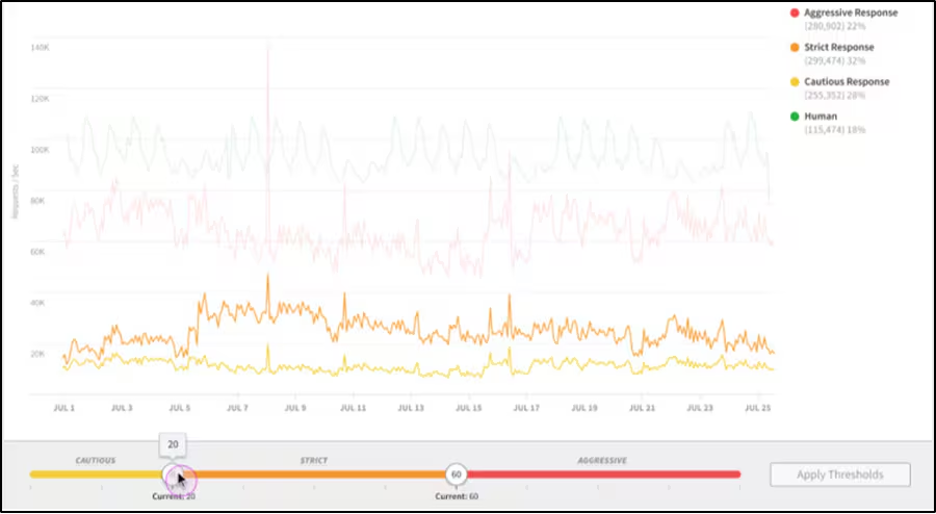
Akamai Bot Manager detects and mitigates malicious bots at the edge while managing good bots, protecting apps and assets across customer channels. It injects a script into monitored pages for behavior anomaly detection, then assigns a Bot Score from 0 (human) to 100 (bot) starting on the first request and refining the score as more requests arrive from the same source.
Responses are grouped into cautious, strict, and aggressive segments that customers can tune, and the product applies actions beyond block-and-allow to avoid tipping off bot operators. It uses AI models for user behavior analysis and browser fingerprinting, maintains a continuously updated known-bot directory, and provides reporting on bot traffic.
Key features include:
- Bot scoring: Assigns a score from 0 to 100 starting on the first request and adjusts it as request volume grows, with tunable response segments.
- AI behavior analysis: Uses AI models for user behavior analysis and browser fingerprinting, drawing on billions of daily bot requests and logins.
- Stealthy responses: Applies actions beyond block-and-allow, such as serving alternate content or challenges, to avoid alerting bot operators.
- Known-bot directory: Maintains and updates a library of known bots and lets customers define their own categories.
- Mobile and API coverage: Extends the same detections to mobile apps, and Bot Manager functions are available via APIs for DevSecOps integration.
- Reporting and SIEM: Provides trend and detailed bot traffic reporting and integrates Bot Score insights into SIEM tools.
Bot detection accuracy:
- Continuously refined scoring: Assigns a Bot Score from 0 to 100 starting on the first request and refines it as more requests arrive, using a patented AI framework that learns over time.
- Layered behavioral and fingerprint analysis: AI models analyze user behavior and browser fingerprinting, using a script injected into monitored pages to capture behavioral anomalies.
- Continuously updated bot directory: Maintains a known-bot directory that is updated on an ongoing basis, with the option for customers to define their own bot categories.
Source: Akamai
7. Imperva Advanced Bot Protection

Best for: Multi-layered bot defense across web, mobile, and APIs
Strengths: 700+ detection dimensions with granular tuning and reporting
Things to consider: Dashboard and pricing draw some user criticism
Imperva Advanced Bot Protection safeguards websites, mobile apps, and APIs against automated threats, including OWASP Automated Threats, while aiming to keep business-critical traffic flowing. It uses a multi-layered approach that combines direct client interrogation, behavior analysis, machine learning, connection characteristics, and threat intelligence feeds.
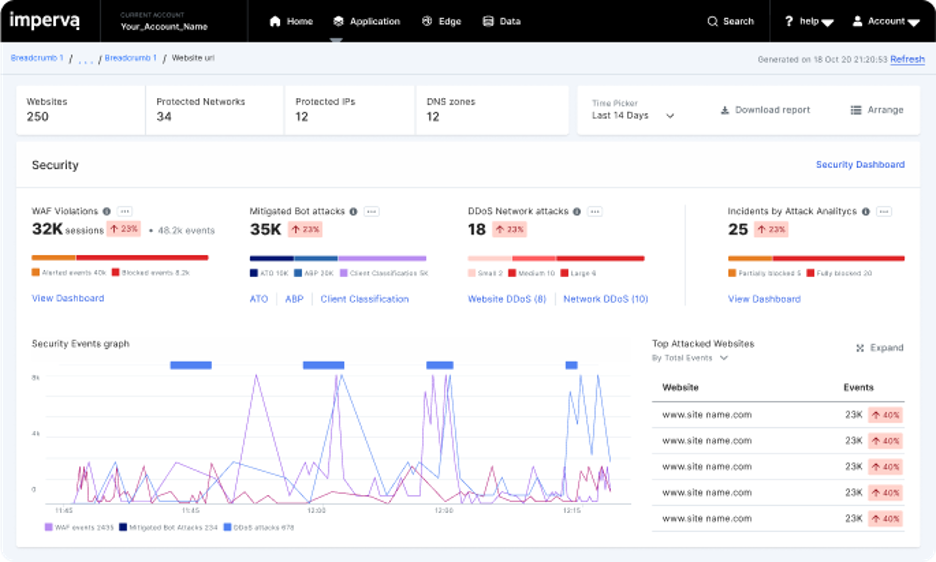
The solution evaluates more than 700 dimensions to separate human, good bot, and bad bot traffic into a fingerprint built to withstand evasion techniques. It provides granular controls, real-time monitoring, and detailed reporting by application, path, or rule, with post-deployment feedback loops to reduce false positives. Deployment options include Cloud WAF, connectors to other stacks, and on-premises integration.
Key features include:
- Multi-layered detection: Combines client interrogation, behavior analysis, machine learning, connection characteristics, and threat intelligence across 700+ dimensions.
- OWASP automated threat coverage: Protects against OWASP Automated Threats, including scraping, account takeover, and credential stuffing.
- Granular controls and reporting: Provides real-time monitoring, customizable dashboards, and reporting by application, path, or rule.
- Flexible deployment: Offers deployment with Cloud WAF, connectors to platforms such as AWS, Cloudflare, and Fastly, or on-premises integration.
- Real-time testing tools: Lets teams test configurations in a production environment to refine policies and analyze false positives.
- Expert support: Provides access to bot analysts for setup, ongoing reviews, policy tuning, and alerting.
Bot detection accuracy:
- Multi-layered precision: Combines client interrogation, behavioral analysis, machine learning, connection characteristics, and threat intelligence to stop sophisticated threats with what Imperva describes as the fewest false positives.
- Validated against real-world data: Detection capabilities are tested and validated against historical data and hundreds of browsers to help ensure accuracy.
- Feedback loops reduce errors: Post-deployment feedback loops and metadata replay are used to continuously minimize false positives and false negatives over time.
Source: Imperva
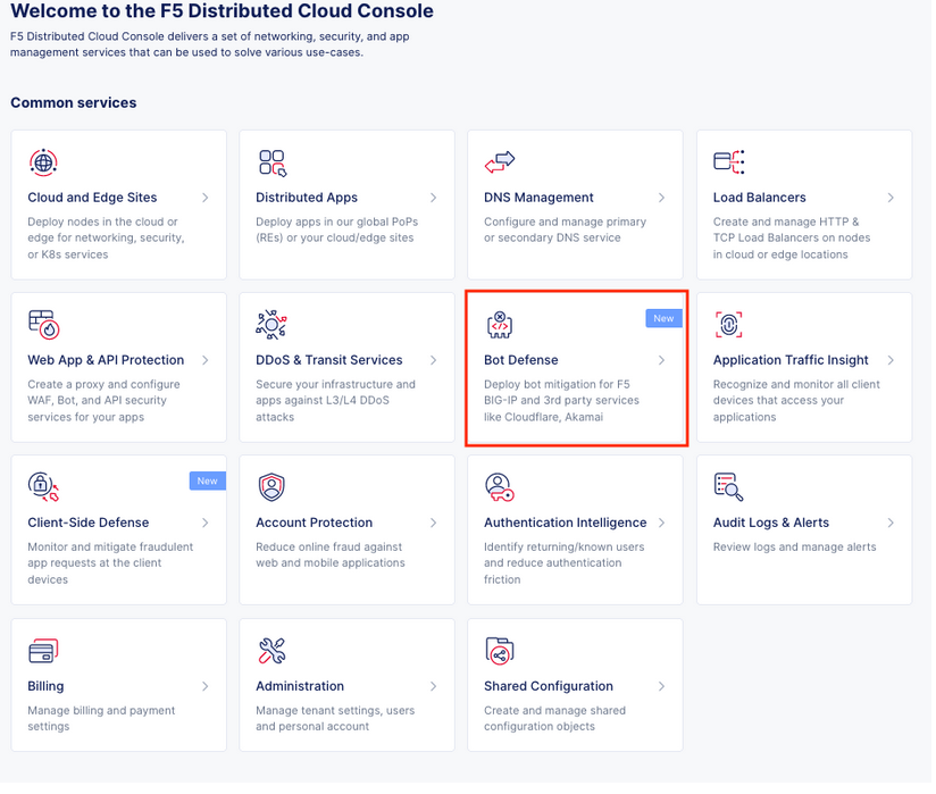
8. F5 Distributed Cloud Bot Defense

Best for: Agent-aware bot defense across hybrid and multi-cloud apps
Strengths: Behavioral analysis and client-side telemetry against evasion
Things to consider: Cluttered admin console and steeper learning curve
F5 Distributed Cloud Bot Defense detects and mitigates automated attacks on web apps, mobile apps, and APIs, distinguishing humans, trusted AI agents, and harmful automation. It uses real-time behavioral analysis, client-side intelligence, and platform-wide telemetry to identify bots at the application interaction layer and adapts as attackers retool rather than relying on manual tuning.
It applies allow, block, rate-limit, or step-up controls where risk is present, targeting login, checkout, account recovery, and API flows. The service is delivered on the F5 Application Delivery and Security Platform and integrates across hybrid, multi-cloud, and on-premises environments, with connectors to BIG-IP and to Syslog and SIEM systems.
Key features include:
- Agent-aware classification: Separates humans, trusted AI agents, and malicious automation based on behavior and intent rather than static signatures.
- Behavioral analysis: Detects human-like bots beyond signature detection, using client-side telemetry to counter evasion.
- Real-time enforcement: Applies allow, block, rate-limit, or step-up controls where abuse occurs, targeting login, checkout, account recovery, and APIs.
- Continuous adaptation: Adjusts defenses as attacker techniques and AI behaviors change, without constant rule tuning.
- API and mobile protection: Secures non-browser and mobile traffic in addition to web applications.
- Platform integration: Integrates with the F5 platform and BIG-IP and connects to Syslog and SIEM systems, deployable across hybrid, multi-cloud, and public cloud environments.
Bot detection accuracy:
- Behavior- and intent-based classification: Separates humans, trusted AI agents, and malicious automation using real-time behavioral analysis and intent rather than static signatures.
- Client-side telemetry against evasion: Collects high-fidelity signals directly from the client side, with obfuscation designed to prevent attackers from reverse-engineering detection methods.
- Continuous adaptation without manual tuning: Automatically adjusts defenses as attacker techniques evolve, aiming to maintain accuracy without requiring constant rule tuning from customers.
Source: F5
Conclusion
Selecting the right bot detection partner requires balancing technical sophistication with operational ease, ensuring protection across web, mobile, and API channels. Organizations must prioritize solutions that provide real-time, behavioral-based defense to counter increasingly human-like automated threats. Consistent monitoring and tuning are essential to maintaining robust security while minimizing friction for legitimate users. By aligning vendor capabilities with specific business goals, security teams can effectively mitigate risk and safeguard digital assets.