
TL;DR: Enterprise bot management solutions block malicious automation across web, mobile, and APIs without blocking real users. Best for comprehensive bot defense: Cequence, best for edge: Cloudflare; best for global reach: Akamai; best for fraud protection: DataDome.
What Are Enterprise Bot Management Solutions?
Enterprise bot management solutions protect websites and APIs from malicious automated traffic, like account takeover scripts and fake account creators, without blocking real users. These tools use artificial intelligence and behavioral tracking to assign risk scores to every visitor.
These solutions go beyond simple filtering by leveraging advanced techniques such as behavioral analysis, machine learning, and real-time monitoring. Their primary goal is to distinguish between legitimate human users, authorized bots (like search engine crawlers), and malicious or unwanted automated traffic that can threaten business operations or data integrity.
Unlike traditional security tools that focus on broader threats, enterprise bot management platforms target the unique challenges posed by bots. These challenges range from credential stuffing and data scraping to inventory hoarding and denial-of-service attacks. The platforms provide enterprises with the ability to enforce custom policies, gain actionable insights, and adapt to new threats as they evolve.
In this article:
- Why Are the Unique Requirements of Enterprises when Selecting Bot Management Solutions?
- Enterprise Bot Management Solutions at a Glance
- Key Features of Enterprise-Grade Bot Management Platforms
- Notable Enterprise Bot Management Solutions
Why Are the Unique Requirements of Enterprises when Selecting Bot Management Solutions?
Large enterprises operate complex digital environments that span public websites, customer portals, mobile applications, partner integrations, and APIs across multiple cloud providers and regions. They face a broader range of automated attacks, higher traffic volumes, and stricter compliance requirements than smaller organizations.
As a result, enterprise bot management platforms must deliver accurate detection at scale while integrating with existing security, networking, and identity infrastructure:
- Scalability across environments: Protect web applications, mobile apps, APIs, and hybrid or multi-cloud deployments without creating operational bottlenecks.
- Low false-positive rates: Stop malicious automation while minimizing friction for legitimate customers, partners, and employees.
- API and non-browser protection: Detect automated abuse targeting APIs, mobile applications, and machine-to-machine traffic, not just browser sessions.
- Flexible deployment options: Support inline, reverse proxy, CDN, network-based, and on-premises deployments to match enterprise architectures.
- Granular policy controls: Apply different actions by application, endpoint, geography, user type, or risk score instead of using one global policy.
- Integration with existing security tools: Connect with SIEM, SOAR, WAF, IAM, fraud prevention, and SOC workflows for centralized operations.
- Advanced threat intelligence: Continuously adapt to new bot frameworks, AI agents, credential stuffing campaigns, and large-scale scraping attacks.
- High-performance mitigation: Analyze and respond to requests in real time without introducing noticeable latency for end users.
- Comprehensive analytics and reporting: Provide detailed visibility into attack trends, bot categories, business impact, and policy effectiveness for both technical and executive teams.
- Governance and compliance support: Help satisfy regulatory, audit, and data privacy requirements through logging, reporting, and controlled handling of traffic.
Related content: Read our article about how bot management solutions work
Enterprise Bot Management Solutions at a Glance
The table below summarizes the key differences between the solutions covered in this article. We explore each of them in more detail in the sections that follow.
CategorySolutionBest ForKey StrengthsThings to ConsiderUnified Application, API & Edge SecurityCequence Bot ManagementComprehensive web, mobile, and API bot defense with no client-side codeNetwork-based detection, no JavaScript or SDK, real-time mitigationInitial tuning and policy setup can benefit from dedicated expertiseUnified Application, API & Edge SecurityCloudflare Bot ManagementTeams wanting bot defense built into an edge/CDN platformNetwork-scale ML, edge mitigation, Turnstile CAPTCHA alternativeFalse positives are a recurring issue for users behind corporate proxiesUnified Application, API & Edge SecurityAkamai Bot ManagerEnterprises on Akamai’s edge protecting apps, APIs, and mobileEdge Bot Score, large known-bot directory, stealthy responsesExpensive, with tuning and onboarding that often require Akamai’s own teamUnified Application, API & Edge SecurityImperva Advanced Bot ProtectionWeb, mobile, and API defense against OWASP automated threats700+ detection dimensions, flexible deployment, granular controlsAdvanced features drive up cost, and the dashboard lags behind competing toolsDedicated Bot & Fraud PreventionDataDome Bot ProtectReal-time bot and AI-agent defense across web, apps, and APIsSub-2ms edge detection, low false positives, 24/7 SOCExpensive, and integration regularly requires developer effortDedicated Bot & Fraud PreventionHUMAN SightlineBest-in-class bot and fraud defense across web, mobile, and APIsDecision engine, AI-traffic control, deep investigation toolsExternal deployment adds an extra ingress hop, and pricing climbs with traffic volumeDedicated Bot & Fraud PreventionF5 Distributed Cloud Bot DefenseEnterprises needing adaptive bot and AI-agent defense at scaleClient-side telemetry, agent-aware, no manual rule tuningA steep setup and learning curve, paired with premium pricingDedicated Bot & Fraud PreventionArkose Bot ManagerLogin, signup, and account flows facing bots and fraud farms225+ risk signals, adaptive challenges, global intelligenceOpaque pricing, and dashboards and reporting fall short of deeper analysis needs
Key Features of Enterprise-Grade Bot Management Platforms
Multi-Layered Client and Environment Fingerprinting
Enterprise platforms collect signals from browsers, devices, networks, operating systems, TLS handshakes, and runtime behavior to build a detailed fingerprint for every client. This makes it harder for attackers to evade detection by rotating IP addresses, changing user-agent strings, or moving traffic through residential proxy networks.
Modern fingerprinting also detects signs of automation frameworks, headless browsers, browser tampering, virtual machines, and emulated mobile devices. It can compare claimed device attributes with observed behavior to identify mismatches that indicate spoofing.
Because attackers can manipulate individual signals, enterprise platforms do not rely on one identifier. They combine many weak indicators into a stronger risk profile and update it as the session develops. This improves accuracy while reducing the chance that legitimate users are blocked because of one unusual attribute.
Related content: Read our article about bot detection in the AI age
Cross-Channel Protection for Web, Mobile, and APIs
Bot attacks increasingly target APIs and mobile applications because they often expose the same business functions as websites. Enterprise platforms monitor requests across all channels to identify coordinated attacks that move between browsers, mobile apps, and API endpoints.
This unified approach allows organizations to apply consistent security policies regardless of how users access an application. It also provides a single view of automated activity instead of forcing security teams to manage separate detection systems for each channel.
For mobile traffic, platforms may verify application integrity, device signals, request patterns, and the use of modified clients. For APIs, they analyze tokens, request sequences, payload structure, endpoint usage, and traffic velocity to detect abuse that does not depend on browser-based signals.
Cross-channel correlation is important because attackers often test credentials on an API and complete the attack through a website or mobile app. Linking activity across these paths helps reveal patterns that would look harmless when each channel is reviewed separately.
Granular, Risk-Based Response Orchestration
Instead of blocking every suspicious request, enterprise platforms assign a risk score and choose the most appropriate response. Low-risk traffic may be allowed, medium-risk sessions can be challenged, and high-risk requests can be blocked, rate limited, redirected, or sent for additional verification.
Risk-based responses reduce friction for legitimate users while making automated attacks more expensive and less effective. Policies can change dynamically based on user behavior, application sensitivity, transaction value, geography, authentication state, or current attack conditions.
Response orchestration can also use progressive controls. A client may first receive a lightweight JavaScript challenge, then a CAPTCHA, and finally a block if suspicious behavior continues. This approach avoids applying the strongest control too early.
Enterprise platforms may also trigger actions outside the request path. For example, they can alert a security operations center, force step-up authentication, revoke a session, create a fraud case, or feed indicators into a SIEM or SOAR platform.
Application-Specific Policy Management
Different applications face different bot threats. A public product catalog may primarily need protection against scraping, while a customer portal requires stronger defenses against account takeover, credential stuffing, and automated transaction abuse.
Enterprise platforms let security teams define separate policies for individual applications, endpoints, APIs, user groups, or business functions. This enables more precise protection without applying unnecessary restrictions across the entire environment.
Policies can account for the normal behavior of each application. High request rates may be expected on a public API but suspicious on a login endpoint. Similarly, anonymous browsing may be acceptable for a product page but not for a payment or account recovery workflow.
Application-specific controls also support staged rollout and testing. Security teams can monitor a policy in detection-only mode, review its effect, and then enable mitigation. This reduces the risk of disrupting critical services when new rules are introduced.
Global and Organization-Specific Learning Models
Enterprise bot management combines threat intelligence gathered across many customers with models trained on an organization’s own traffic. Global intelligence helps identify emerging attack tools, proxy networks, automation frameworks, and campaign patterns seen across industries.
Organization-specific models learn what normal behavior looks like for particular applications, users, endpoints, and transaction flows. They can detect small deviations that would not appear suspicious when compared only with global traffic patterns.
Using both approaches improves detection accuracy and helps the platform adapt as attackers change tactics. It also reduces dependence on manually maintained signatures and static rules, which can become outdated quickly.
The models should be continuously updated and monitored for drift. Enterprise teams also need controls to review detections, provide feedback, exclude trusted automation, and understand which signals contributed to a decision. These capabilities make automated detection easier to govern and tune.
Enterprise Integration and Deployment Flexibility
Bot management platforms are designed to integrate with existing security, networking, identity, and fraud prevention infrastructure. Common integrations include web application firewalls, SIEM platforms, SOAR workflows, identity providers, API gateways, content delivery networks, and case management systems.
These integrations allow bot events to become part of wider incident response processes. A high-risk login attempt, for example, can trigger step-up authentication, create an alert, enrich a fraud investigation, and update access controls without requiring manual action.
Deployment options typically include reverse proxy, CDN, inline gateway, cloud-native, network-based, and on-premises models. Some platforms also support agentless deployment, application connectors, SDKs, or API-based integrations for mobile and non-browser traffic.
This flexibility is important for enterprises with legacy systems, regulated workloads, regional data requirements, or multiple cloud providers. The platform should provide consistent policies and reporting across deployment models so teams do not have to operate separate security programs for each environment.
High-Scale Protection With Minimal User Friction
Enterprise environments may process millions of requests while maintaining strict performance and availability requirements. Bot management platforms must analyze traffic and make mitigation decisions in real time without introducing noticeable latency.
The goal is to stop malicious automation without interrupting legitimate business activity. Accurate detection reduces unnecessary CAPTCHA challenges, login failures, blocked transactions, and customer support issues while maintaining protection during large-scale attacks.
High-scale platforms use distributed processing, edge enforcement, caching, and automated policy updates to handle traffic spikes. They should continue to operate during product launches, ticket sales, seasonal demand, and coordinated bot campaigns without becoming a bottleneck.
Resilience is also important. Enterprise solutions should support failover, regional redundancy, capacity planning, and clear service-level commitments. They must maintain stable enforcement even when traffic patterns change suddenly or parts of the underlying infrastructure become unavailable.
Notable Enterprise Bot Management Solutions
How we selected these solutions: We shortlisted enterprise bot management platforms based on detection accuracy across web, mobile, and API traffic, mitigation flexibility, good-bot and AI-agent classification, account takeover and scraping defense, and real-time analytics and reporting.
Unified Application, API & Edge Security Platforms
These platforms deliver bot management as part of a broader application, API, or edge security stack, letting enterprises consolidate detection, mitigation, and policy under one console.
1. Cequence Bot Management

Best for: Comprehensive web, mobile, and API bot defense with no client-side code.
Strengths: Network-based detection, no JavaScript or SDK, and real-time mitigation.
Things to consider: Initial tuning and policy setup benefit from dedicated expertise.
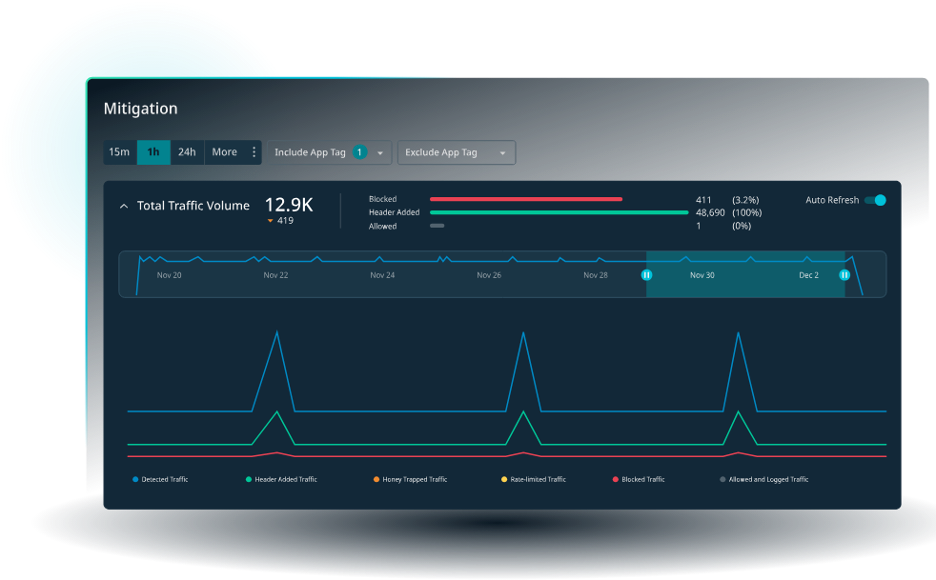
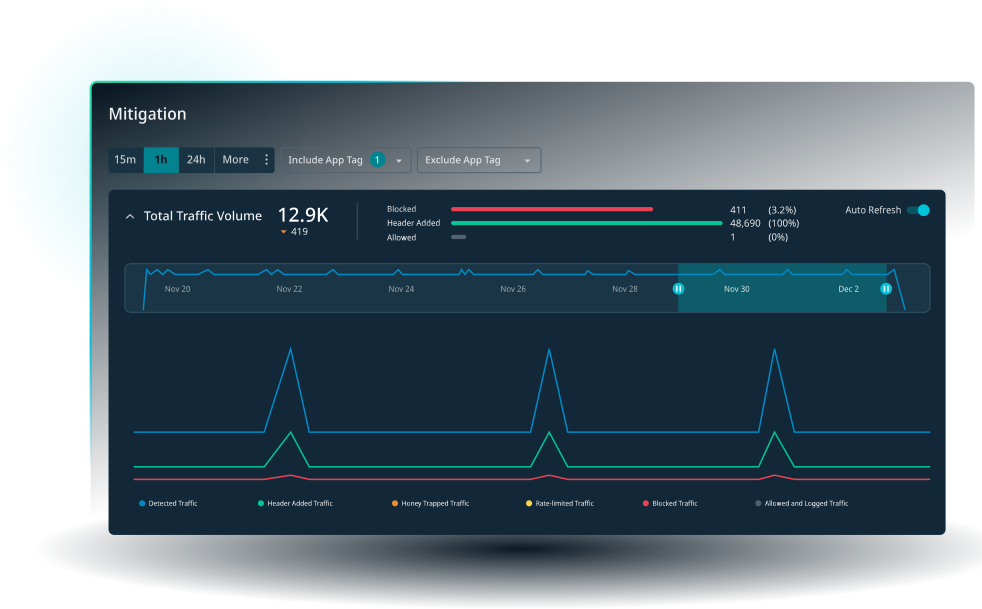
Cequence Bot Management protects web, mobile, and API applications from automated attacks at the network level, without requiring client-side JavaScript or SDK integration. This approach removes the regression testing and third-party code changes that other tools introduce, and extends consistent protection across cloud and microservices architectures.
Rather than relying on signals from end-user devices, its machine learning analyzes behavioral intent across web, mobile, and API traffic to build a behavioral fingerprint that separates good bots from bad ones and continues to track malicious activity as attackers re-tool. The solution addresses account takeover, content scraping, flash and sneaker-drop abuse, sensitive data exposure, gift card and loyalty program abuse, and business logic abuse, and it is part of the wider Cequence platform.
General features:
- Network-based bot detection: Inspects web, mobile, and API traffic at the network layer with no client-side JavaScript or SDK, so all applications are covered consistently.
- Behavioral intent analysis: Machine learning models user, entity, and traffic behavior to build a fingerprint that distinguishes good bots, bad bots, and humans even as attackers change tactics.
- Real-time mitigation: AI creates threat mitigation rules and policies that run automatically or after human review, with options including blocking, rate limiting, header injection, and deception.
- Friction-free user verification: Biometric Check routes suspicious traffic to native device authentication such as Face ID, Touch ID, or Windows Hello instead of puzzles or SMS codes.
- AI and agent protection: Discovers unauthorized internal AI use, prevents sensitive data leakage through AI APIs, and blocks unwanted AI bot content scraping.
- Flexible, fast deployment: Deploys on-premises, in the cloud, or hybrid, with passive or inline sensors, hundreds of predefined rules, and machine learning baselining within hours.
Enterprise features:
- Industry-tailored compliance: Provides dedicated PCI DSS compliance support and readiness guidance for the EU AI Act.
- Vertical-specific protection: Offers configurations tuned for financial services, healthcare, public sector, retail, and telecom.
- Agentic AI governance: Extends into the wider Cequence platform to secure and control agentic AI workflows across the enterprise.
- Massive operational scale: Protects more than 10 billion daily API interactions and 4 billion user accounts for its largest customers.
- Flexible regulated deployment: Supports on-premises, cloud, or hybrid deployment to fit data residency and regulatory requirements.
- Fraud forensics at scale: Provides detailed incident forensics and industry-specific fraud policies for large security teams.
Limitations (as reported by users on G2):
- Onboarding time: Tuning detection and policies for large or complex API environments benefits from dedicated expertise, particularly during initial onboarding.
- Dashboard performance: Large data queries can take a moment to return in the dashboard, an area the team continues to optimize.
- Report customization: Tailoring dashboards and reports for different stakeholders is straightforward with a bit of upfront planning.
Source: Cequence
2. Cloudflare Bot Management

Best for: Teams wanting bot defense built into an edge/CDN platform.
Strengths: Network-scale ML, edge mitigation, and a Turnstile CAPTCHA alternative.
Things to consider: False positives are a recurring issue for users behind corporate proxies.
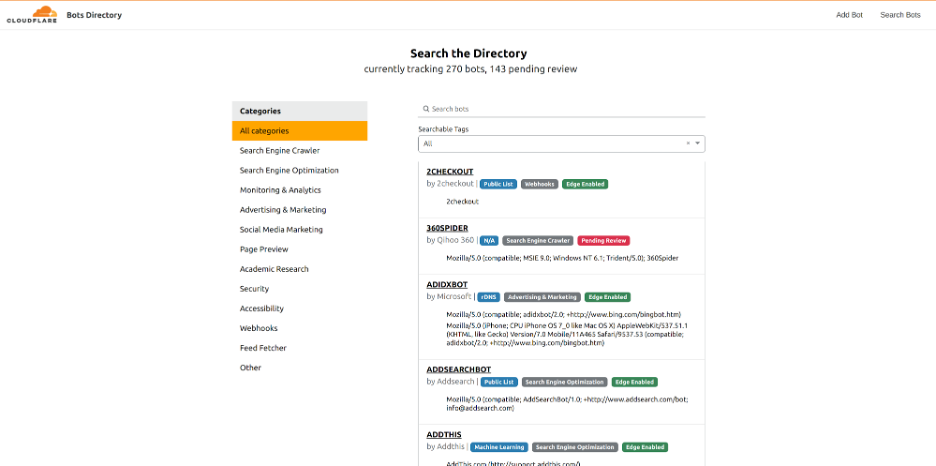
Cloudflare Bot Management uses machine learning and behavioral analysis across Cloudflare’s global network to detect and stop malicious bot traffic before it reaches an application. Because its models are trained on traffic from a large share of the Internet, Cloudflare identifies novel attacks early and pushes protection across its network. Detection and mitigation run at the edge, inside the Cloudflare stack, so responses happen close to the user.
The solution covers credential and API protection, e-commerce use cases such as inventory hoarding, and turns bot detection into real-time signals for user experience and marketing spend. Cloudflare Turnstile provides a privacy-preserving alternative to traditional CAPTCHA.
General features:
- Network-scale machine learning: Models trained on a large portion of Internet traffic score every request, so novel attacks are seen first and protection is deployed across the network.
- Edge-based mitigation: Detection and mitigation run within the Cloudflare stack at the edge, close to users.
- Turnstile CAPTCHA alternative: A privacy-preserving challenge replaces traditional CAPTCHA.
- Credential and API protection: Protects login endpoints from credential stuffing and APIs from scraping, resource abuse, and automated probing.
- E-commerce bot defense: Identifies and blocks inventory hoarding bots.
- Real-time traffic optimization: Uses bot detection as a real-time signal for user experience and marketing spend.
Enterprise features:
- Custom SLAs: Enterprise contracts include a 100% uptime guarantee backed by service credits.
- Dedicated support model: Provides 24/7 phone support and a technical account manager as a direct point of contact.
- Dedicated IP ranges: Offers IP addresses not shared with other Cloudflare customers for compliance and traffic allowlisting.
- SSO and priority routing: Adds single sign-on and prioritized network routing on enterprise contracts.
- Full product suite access: Bundles the broader Cloudflare stack, including Zero Trust, API Shield, and Advanced Rate Limiting, into enterprise agreements.
Limitations (as reported by users on Gartner Peer Insights):
- False positives behind proxies: Legitimate visitors routed through corporate proxies such as McAfee or Zscaler are regularly flagged as bad bots, and one reviewer reported months of unresolved escalation.
- Analytics depth: Reviewers consistently want deeper analysis and visibility than the platform currently provides.
- Deployment effort: Rolling the solution out in stages demands significant time and resources, especially for teams without prior experience.
Source: Cloudflare
3. Akamai Bot Manager

Best for: Enterprises on Akamai’s edge protecting apps, APIs, and mobile.
Strengths: Edge Bot Score, a large known-bot directory, and stealthy responses.
Things to consider: Expensive, with tuning and onboarding that often require Akamai’s own team.
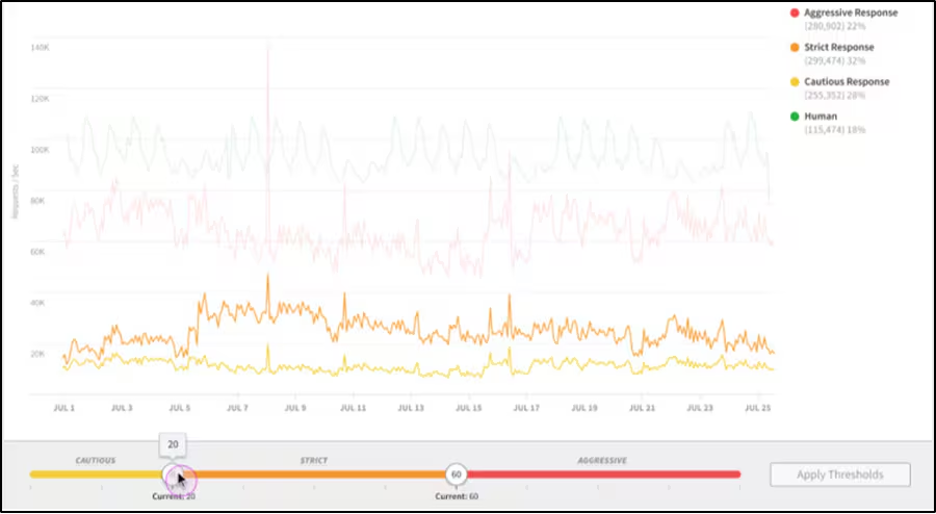
Akamai Bot Manager detects bot traffic and mitigates malicious bots at the edge while managing good bots, protecting apps and assets regardless of how customers interact. A script injected into monitored pages feeds behavioral anomaly detection, and patented technology with an AI framework assigns a Bot Score to each request and learns over time.
The Bot Score runs from 0 (human) to 100 (bot) and maps to configurable response segments, so teams can watch, challenge, or mitigate traffic based on risk. Visualization and reporting tools show the impact of different bot types on the business, and the same detections extend across the attack surface, including mobile apps.
General features:
- Edge Bot Scoring: Assigns each request a score from 0 (human) to 100 (bot) starting at the first request, refining it as more requests arrive.
- AI behavioral detection: AI models analyze user behavior and browser fingerprinting, using a script injected into monitored pages to capture behavioral anomalies.
- Known-bot directory: A continuously updated library of categorized bots, with the option to add custom bot categories.
- Stealthy responses: Actions go beyond block-and-allow, including challenge, slow, and serve alternate content, to avoid tipping off bots.
- Cross-surface protection: The same detections extend to mobile apps and the full attack surface.
- Reporting and SIEM integration: Real-time reporting of trends, with functionality available via APIs and Bot Score data that feeds into SIEM tools.
Enterprise features:
- SIEM integration: Feeds Bot Score data into SIEM tools such as Splunk, QRadar, and ArcSight through a dedicated connector.
- Custom bot categorization: Lets teams create their own bot categories on top of Akamai’s continuously updated known-bot directory.
- DevSecOps integration: Exposes Bot Manager functionality via APIs for integration into existing development pipelines.
- Privacy and legal review: Collected data points are reviewed regularly by Akamai’s legal team for GDPR and CCPA compliance.
- Configurable response tiers: Supports cautious, strict, and aggressive response segments mapped to the Bot Score for tailored enterprise policy.
Limitations (as reported by users on G2):
- Learning curve: New users consistently report that console navigation takes weeks to learn.
- Premium pricing and fees: The price point is high, and customers are charged separate onboarding fees just to activate new products.
- Manual mitigation at scale: High bot-traffic surges often require Akamai’s own team to step in, rather than the platform handling it automatically.
- Tuning and hidden thresholds: Without careful tuning, false positives rise quickly, and some thresholds such as session validation stay hidden from customers entirely.
Source: Akamai
4. Imperva Advanced Bot Protection

Best for: Web, mobile, and API defense against OWASP automated threats.
Strengths: 700+ detection dimensions, flexible deployment, and granular controls.
Things to consider: Advanced features drive up cost, and the dashboard lags behind competing tools.
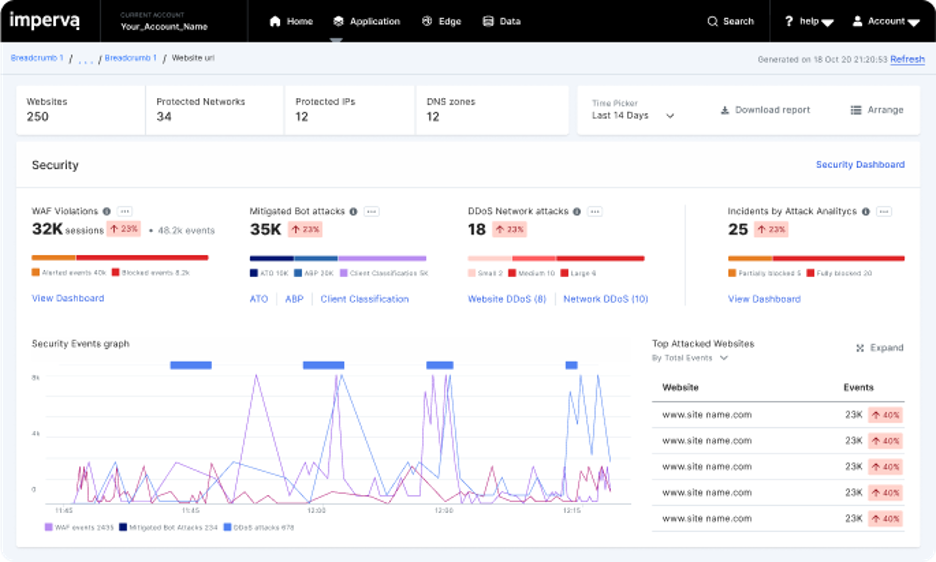
Imperva Advanced Bot Protection safeguards websites, mobile apps, and APIs from bot attacks, including all OWASP 21 Automated Threats. Its multi-layered detection combines direct client interrogation, behavior analysis, machine learning, connection characteristics, and threat intelligence feeds, evaluating more than 700 dimensions to separate human, good bot, and bad bot traffic and create a fingerprint that resists evasion.
Teams get granular controls and reporting, with real-time monitoring and analysis by path or rule. Deployment options include single-stack Cloud WAF integration or connectors for AWS, Cloudflare, F5, NGINX, and Fastly, as well as on-premises. Response options range from monitor and challenge to block and rate-limit.
General features:
- Multi-layered detection: Combines client interrogation, behavioral analysis, machine learning, connection characteristics, and threat intelligence across more than 700 dimensions.
- OWASP automated threat coverage: Protects against all OWASP 21 Automated Threats across web, mobile apps, and APIs.
- Flexible deployment: Single-stack Cloud WAF integration, connectors for AWS, Cloudflare, F5, NGINX, and Fastly, or on-premises.
- Granular response options: Monitor, challenge, block, or rate-limit by path, domain, or application.
- Good and bad bot classification: Separates humans, good bots such as search crawlers, and malicious bots.
- Reporting and real-time testing: Analyzes trends by path or rule and tests configurations in a production environment.
Enterprise features:
- Regulatory compliance tooling: Provides logging, auditing, and access controls to support GDPR, PCI DSS, and PII protection requirements.
- Multi-tenant platform protection: Secures SaaS and multi-cloud platforms from automated misuse across tenants.
- SIEM and security stack integration: Connects with SIEMs and other security management platforms for centralized monitoring.
- Flexible enterprise deployment: Runs across public/private cloud, hybrid, and on-premises environments.
- Unified security suite: Integrates with the broader Imperva WAF, API Security, DDoS Protection, and CDN products.
Limitations (as reported by users on G2):
- Dashboard experience: Users consistently describe the dashboard as less refined than those of competing tools.
- Add-on cost: Advanced capabilities are delivered as paid add-ons, raising the overall cost beyond the base platform.
- Testing constraints: Users are limited to validating the tool with Imperva’s own testing bot and cannot test against their own.
- Reverse proxy setup: Deployment requires routing through a reverse proxy, adding real setup work before the platform is live.
Source: Imperva
Dedicated Bot & Fraud Prevention Platforms
These platforms focus specifically on bot detection, mitigation, and fraud prevention, often layering onto an existing WAF, CDN, or authentication stack for best-of-breed protection.
5. DataDome Bot Protect

Best for: Real-time bot and AI-agent defense across web, apps, and APIs.
Strengths: Sub-2ms edge detection, a low false-positive rate, and a 24/7 SOC.
Things to consider: Expensive, and integration regularly requires developer effort.
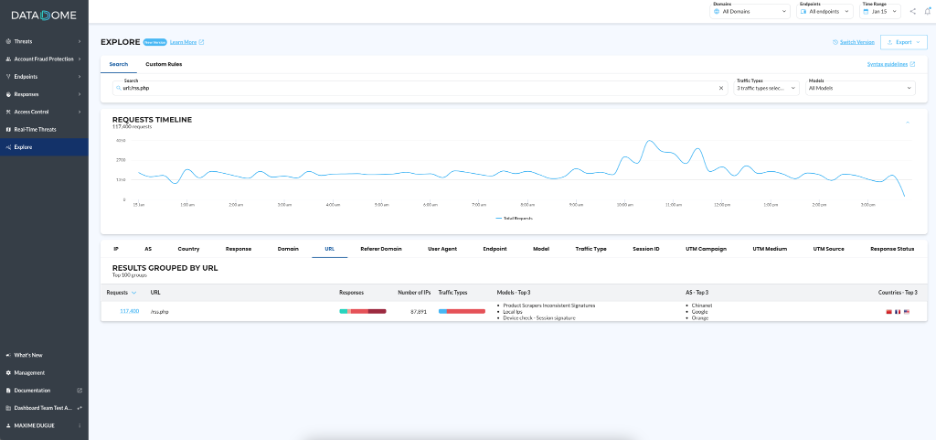
DataDome Bot Protect delivers real-time bot protection for websites, mobile apps, APIs, and MCP servers. It analyzes every request using hundreds of client-side and server-side signals and processes over 5 trillion signals per day, with AI models that separate human users, legitimate AI agents, and malicious bots. Detection runs at the edge across more than 35 points of presence, with response times under 2 milliseconds and a false-positive rate under 0.01%.
Beyond standard detection, DataDome includes Agent Trust to identify, classify, score, and govern agentic AI traffic. Mitigation runs automatically in line with business logic, and the platform integrates across CDNs and servers while applying two-layer PII encryption for GDPR and CCPA.
General features:
- Real-time signal analysis: Evaluates every request using hundreds of client-side and server-side signals, processing over 5 trillion signals daily.
- Edge detection at low latency: Runs across 35+ points of presence with response times under 2 milliseconds.
- AI model detection: Uses 1000+ out-of-the-box and customer-specific models plus collective threat intelligence to classify humans, trusted AI agents, and malicious bots.
- Agent Trust management: Identifies, classifies, scores, and governs agentic AI traffic in real time.
- Automated mitigation: High-risk traffic triggers automated responses aligned with business logic while keeping a false-positive rate under 0.01%.
- Broad integrations and privacy: Offers 80+ integrations across CDNs and servers, with two-layer PII encryption for GDPR and CCPA.
Enterprise features:
- 24/7 SOC and threat research: Backed by the Galileo Threat Research team and round-the-clock SOC monitoring.
- Availability SLA: Most plans include a 99.9% availability guarantee across its 35+ points of presence.
- Enterprise data protection: Applies two-layer PII encryption to support GDPR and CCPA compliance.
- Broad integration footprint: Offers 80+ integrations across CDNs, servers, and infrastructure providers.
- Structured onboarding: Runs onboarding across parallel deployment, management, and training workstreams for large teams.
Limitations (as reported by users on G2):
- Cost: Pricing sits on the higher end and puts the platform out of reach for many smaller teams.
- Integration effort: Setup regularly requires developer involvement, especially for PWAs, service workers, and mobile SDKs.
- False positives during spikes: Strict detection challenges legitimate users during traffic surges unless it is carefully tuned in advance.
- Data retention and limits: Short log retention and per-workspace endpoint limits meaningfully constrain long-term analysis.
Source: DataDome
6. HUMAN Sightline

Best for: Best-in-class bot and fraud defense across web, mobile, and APIs.
Strengths: A strong decision engine, AI-traffic control, and deep investigation tools.
Things to consider: External deployment adds an extra ingress hop, and pricing climbs with traffic volume.
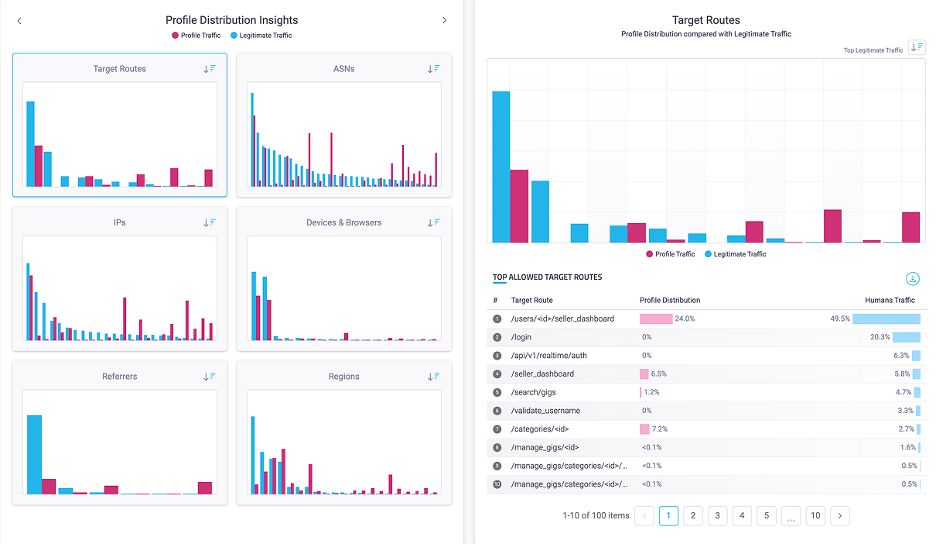
HUMAN Sightline detects and mitigates malicious bot attacks, including account takeover, scraping, fake accounts, carding, and scalping, while giving teams visibility and control over known bots, crawlers, and AI. Its decision engine identifies sophisticated bots and responds with scenario-optimized actions that range from hard blocks to softer mitigations.
Teams can monitor and control known bots and AI traffic, choosing to allow, deny, monetize, suppress ads, or serve alternate content. Granular investigation tools surface attack paths, changing behaviors, and attacker intent, and the Satori Threat Intelligence and Research team analyzes and disrupts emerging fraud schemes. Protection spans websites, mobile applications, and APIs.
General features:
- Decision engine detection: Detects sophisticated bots and responds with scenario-optimized actions, including hard blocks and soft mitigations.
- Known bot and AI-traffic control: Monitors known bots, crawlers, and AI, with options to allow, deny, monetize, suppress ads, or serve alternate content.
- Investigation tooling: Pinpoints attack paths and changing behaviors, with detail on attacker actions and intent for prioritizing threats.
- Multi-surface coverage: Protects websites, mobile applications, and APIs.
- Threat intelligence: The Satori Threat Intelligence and Research team analyzes and disrupts cyberthreats and fraud schemes.
Enterprise features:
- Dedicated threat research: The Satori Threat Intelligence and Research team investigates and disrupts large-scale fraud schemes.
- Regulatory compliance support: Includes a dedicated PCI DSS compliance solution.
- Industry-specific protection: Offers tailored configurations for financial services, healthcare, public sector, retail, and other regulated sectors.
- SOC-level investigation tooling: Provides Threat Tracker for pinpointing attack paths and attacker intent during incident response.
- AI agent governance: Adds AgenticTrust to monitor and enforce policy on AI agent traffic across the customer journey.
Limitations (as reported by users on G2):
- Dashboard and reporting: The console is difficult to navigate, and reporting and analytics fall short of user-friendly.
- Limited historical data: A short data-retention window and slow searches make long-range investigations meaningfully harder.
- Cost: Traffic-based pricing climbs quickly for large or scaling teams, making costs hard to predict.
- Configuration and friction: Initial tuning is complex, config-as-code support is limited, and users report recurring repeat challenges.
Source: HUMAN
7. F5 Distributed Cloud Bot Defense

Best for: Enterprises needing adaptive bot and AI-agent defense at scale.
Strengths: Client-side telemetry, agent-aware classification, and no manual rule tuning.
Things to consider: A steep setup and learning curve, paired with premium pricing.
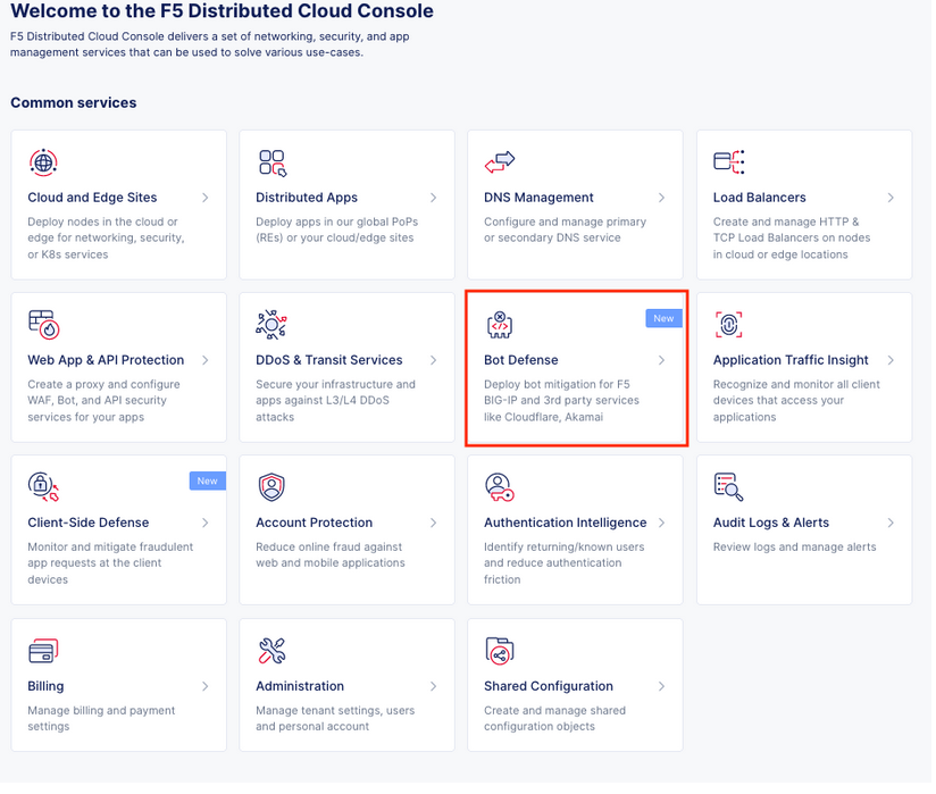
F5 Distributed Cloud Bot Defense uses real-time behavioral analysis, client-side intelligence, and platform-wide telemetry to detect and control bots and AI agents at the application interaction layer. It distinguishes humans, trusted AI agents, and harmful automation based on behavior and intent rather than static signatures, and it continuously adapts as attacker techniques change without manual tuning.
The solution protects web apps, mobile apps, and APIs, and applies real-time enforcement such as allow, block, rate-limit, or step-up controls where abuse occurs. It runs natively on the F5 Application Delivery and Security Platform across hybrid, multi-cloud, and on-premises environments, with centralized visibility and SIEM integration.
General features:
- Agent-aware classification: Separates humans, trusted AI agents, and malicious automation based on behavior and intent rather than static signatures.
- Behavioral analysis: Detects human-like bots that move beyond signature-based detection.
- Client-side telemetry: High-fidelity signal collection resists evasion, with obfuscation guarding the collected data.
- Continuous adaptation: Defenses adjust automatically as attacker techniques change, without manual rule tuning.
- API and mobile protection: Secures non-browser and mobile traffic alongside web apps.
- Real-time enforcement and SIEM integration: Applies allow, block, rate-limit, or step-up actions and feeds signal data into Syslog and SIEM systems.
Enterprise features:
- Platform-native integration: Connects natively with the F5 Application Delivery and Security Platform for centralized policy across hybrid, multi-cloud, and on-premises environments.
- Flexible support models: Offers a fully managed option with a dedicated SOC, an augmented self-managed model with shared SOC, or a fully self-architected deployment.
- Data residency controls: Lets customers choose where data is stored (US, Canada, or EU), with 24/7 global SOC support.
- SIEM and Syslog integration: Feeds signal data into Syslog and leading SIEM systems for unified security operations.
- Dedicated deployment support: Technical Account Managers and Solution Architects assist with rollout for Bot Defense customers.
Limitations (as reported by users on G2):
- Setup complexity: First-time setup takes real time and frequently requires F5’s own assistance, with a steep learning curve.
- Premium pricing: Costs run consistently higher than competing tools.
- Interface: Users describe the management interface as dated and overly text-heavy.
- Latency and transparency: Cloud routing adds latency, and the detection models operate as a black box, making efficacy hard to gauge.
Source: F5
8. Arkose Bot Manager

Best for: Login, signup, and account flows facing bots and fraud farms.
Strengths: 225+ risk signals, adaptive challenges, and global intelligence.
Things to consider: Opaque pricing, and dashboards and reporting fall short of deeper analysis needs.
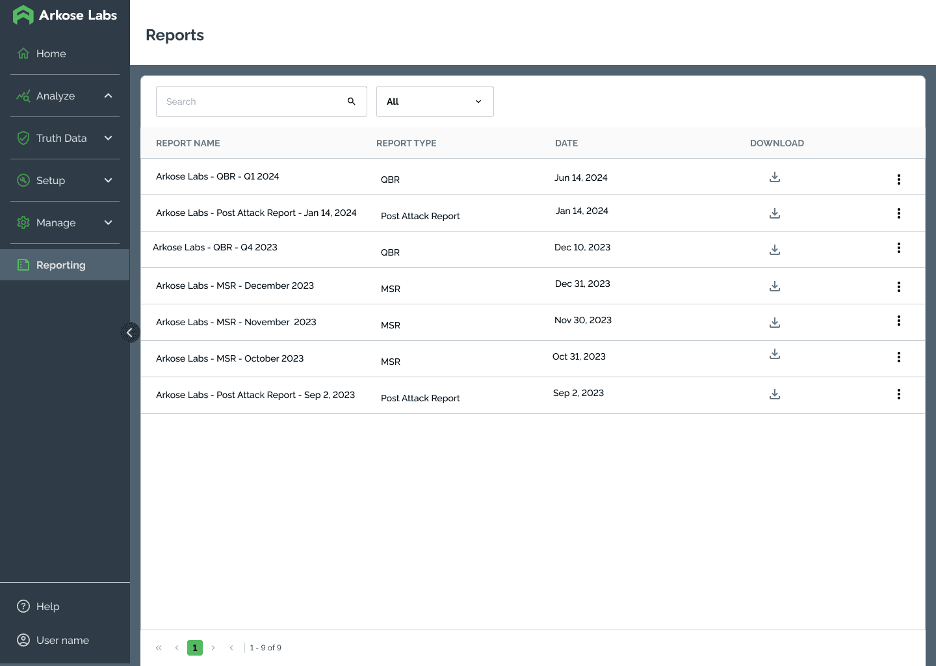
Arkose Bot Manager detects and disrupts advanced bot and human-driven attacks, preventing account takeover, SMS toll fraud, and fake account creation. It combines device intelligence, network and IP signals, and behavioral analysis with more than 225 risk signals and the Arkose Global Intelligence Network to score each session, then routes high-risk traffic through a challenge stack that resists AI-powered solvers.
Its dynamic challenges evolve in real time to counter new attack vectors while letting legitimate users pass without added friction. Arkose Bot Manager runs on the Arkose Titan platform, and the Agent Trust Manager option classifies AI agents by intent and enforces Allow, Monitor, or Block on the same session infrastructure.
General features:
- Multi-signal risk scoring: Combines device intelligence, network and IP signals, and behavioral analysis with 225+ risk signals to score each session.
- Adaptive challenge stack: Routes high-risk traffic through dynamic challenges that evolve in real time and resist AI-powered solvers.
- Global intelligence network: Draws on the Arkose Global Intelligence Network for cross-industry attack signals.
- Low-friction user flow: Separates legitimate users from bots so genuine users pass without added friction.
- Agent Trust Manager option: Classifies AI agents by intent and enforces Allow, Monitor, or Block on the same Titan session infrastructure.
- Reporting and dashboards: Surfaces attack patterns and risk data for stakeholders.
Enterprise features:
- Embedded SOC: A 24/7/365 security operations center proactively tunes protection to each business’s specific KPIs.
- Dedicated threat research unit: The Arkose Cyber Threat Intelligence Research (ACTIR) team conducts proactive threat hunting.
- Financial warranties: Backs the platform with warranties of up to $1 million against credential stuffing, SMS toll fraud, and card testing attacks.
- Full data transparency: Shares 175+ telltale rules and decision logic in real time so customers can extend protection downstream.
- AI agent enforcement: Agent Trust Manager classifies and enforces policy on AI agent sessions across the same infrastructure.
Limitations (as reported by users on G2):
- Dashboards and reporting: Analytics lack the self-service drill-down into individual sessions that teams need.
- Opaque pricing: Pricing and customization are difficult to scale, and smaller companies struggle to establish clear ROI.
- Setup and tuning: Initial tuning for complex traffic patterns takes real time, and challenge sensitivity requires ongoing adjustment.
- User friction: Users report repeated challenges at login, and front-end integration adds another implementation step.
Source: Arkose
Conclusion
Enterprise bot management has evolved from basic bot blocking into a critical security capability that protects web applications, mobile apps, and APIs from increasingly sophisticated automated threats. The right platform should accurately distinguish legitimate users, trusted bots, AI agents, and malicious automation while minimizing user friction and integrating with existing security infrastructure. Organizations should prioritize solutions that provide behavioral detection, flexible deployment, risk-based mitigation, and comprehensive visibility across digital channels, ensuring they can adapt as attacker techniques and AI-driven automation continue to evolve.