What Are Bot Management Vendors?
Choosing the right bot management vendor requires balancing detection efficacy against user friction and infrastructure costs. Focus on how well vendors handle advanced threats (credential stuffing, scraping), their impact on latency, and their ability to differentiate malicious bots from AI and search engine crawlers.
Bot management tools aim to distinguish between legitimate human users, beneficial bots (such as search engine crawlers), and malicious bots that can harm websites or applications. Vendors use a combination of behavioral analysis, machine learning, and fingerprinting techniques to identify and filter out unwanted bot activity in real-time.
Key evaluation criteria
Use these six dimensions to compare vendors like for like:
- Detection accuracy and bot coverage: How reliably the solution separates humans, good bots, and malicious automation, and which attack types it stops.
- Impact on user experience and friction: How much the solution disrupts real users through CAPTCHAs, challenges, or added latency.
- Protection across web, mobile, and APIs: Whether coverage spans browsers, mobile apps, and API and business-logic endpoints.
- Deployment, integration, and scalability: The deployment models, existing-stack integrations, and scale the platform supports.
- Good bot and AI agent management: How well it recognizes search crawlers, partners, and AI agents, and lets you allow, limit, or monetize them.
- Visibility, analytics, and managed operations: The quality of dashboards, reporting, and managed or SOC support.
Solutions compared in this guide
- Dedicated bot and fraud defense platforms
- Cequence Bot Management
- DataDome Bot Protect
- HUMAN Bot Defender
- Arkose Bot Manager
- WAF and CDN-integrated bot management
- Cloudflare Bot Management
- Akamai Bot Manager
- Imperva Advanced Bot Protection
- F5 Distributed Cloud Bot Defense
In this article:
- Why Choosing the Right Bot Management Vendor Matters
- How to Choose a Bot Management Vendor
- Common Bot Management Solutions and How They Meet the Criteria
- Notable Bot Management Solutions
Why Choosing the Right Bot Management Vendor Matters
Reducing Account Takeover and Credential Stuffing
Credential stuffing and account takeover attacks are persistent threats for businesses with user login systems. Malicious bots systematically test stolen or leaked usernames and passwords across multiple sites, exploiting users who reuse credentials. Bot management vendors identify and block these automated login attempts in real time, reducing the risk of unauthorized access using:
- Advanced anomaly detection
- Behavioral analysis
- Device fingerprinting
A reliable bot management solution also integrates with multi-factor authentication and risk-based authentication systems, adding further layers of defense. By preventing credential stuffing at scale, these vendors help organizations protect user accounts, reduce fraud losses, and avoid regulatory penalties that result from compromised data.
Stopping Fake Account Creation and Transaction Abuse
Malicious bots are frequently used to create fake accounts, which are then exploited for spam, fraud, or to manipulate online services. Bot management vendors deploy sophisticated detection methods, including CAPTCHA alternatives, behavioral biometrics, and real-time threat intelligence to identify and block automated account creation attempts. This reduces fake registrations and prevents downstream abuse such as:
- Promo code fraud
- Spam messaging
- Inventory hoarding
Transaction abuse, such as card testing, gift card fraud, or scalping, often involves high-speed, automated attacks that can evade traditional security controls. Bot management solutions analyze transaction patterns and user behaviors to spot and stop these activities before they impact business operations. By mitigating fake account creation and transaction abuse, vendors help organizations protect revenue, maintain platform integrity, and deliver a fair user experience.
Managing Approved Search, Partner, Monitoring, and AI Bots
Not all bots are harmful. Many serve critical business functions, such as search engine indexing, partner integrations, and uptime monitoring. Bot management vendors provide granular controls to distinguish between approved and unwanted bots, ensuring that essential automated traffic is not inadvertently blocked. This involves:
- Maintaining updated allowlists
- Verifying bot identities
- Monitoring bot behavior for compliance with agreed usage policies
Vendors also help organizations accommodate the growing presence of AI-driven bots that interact with platforms for legitimate purposes, such as data aggregation or API usage. By managing these relationships, bot management vendors enable businesses to maximize the value of beneficial bots while maintaining security and performance. This careful balance is key to supporting digital growth without exposing assets to unnecessary risk.
Stopping Business Logic Abuse
Business logic abuse occurs when attackers use bots to exploit intended application workflows in ways that cause financial or operational harm. These attacks often appear as valid user activity, making them difficult for traditional web application firewalls or rate limiting controls to detect. Examples include:
- Repeatedly redeeming promotional offers
- Bypassing purchase limits
- Abusing loyalty programs
- Reserving inventory without completing purchases
- Manipulating pricing rules
Bot management vendors address this challenge by combining behavioral analysis, session monitoring, device intelligence, and machine learning to identify patterns that indicate automated abuse. Rather than relying only on signatures or request rates, they evaluate how users interact with application workflows and enforce policies that block suspicious activity while allowing legitimate customers to complete transactions. This helps organizations protect revenue, preserve the integrity of business processes, and reduce operational costs caused by automated abuse.
Minimizing Friction for Legitimate Users
Bot defenses must stop automated abuse without creating unnecessary obstacles for genuine customers. Traditional challenges such as CAPTCHAs, SMS one-time passwords, and email verification codes can interrupt the user journey, increase abandonment, and create accessibility issues. When detection systems produce false positives, organizations may also weaken their security policies to avoid blocking legitimate users, allowing more malicious traffic to pass through.
The right bot management vendor uses behavioral risk scoring and adaptive challenges to intervene only when a session appears suspicious. Instead of automatically blocking the user, the solution can request fast, device-native verification, such as:
- Touch ID
- Face ID
- Windows Hello
Hardware-bound verification can confirm that a person is present in less than a second without redirects, puzzles, or codes, while keeping biometric data on the user’s device. Pass-and-fail results can also help teams measure false-positive rates and refine detection thresholds over time, improving both security and conversion.
How to Choose a Bot Management Vendor
The criteria below map to the questions buyers actually weigh when comparing bot management vendors. Work through each one against the solutions on your shortlist.
1. Detection Accuracy and Bot Coverage
The core job of any bot management vendor is telling humans, good bots, and malicious automation apart, and doing it accurately as attackers retool. Detection quality depends on the mix of techniques used, including behavioral analysis, machine learning, device or network fingerprinting, and threat intelligence, and on how well the system holds up against sophisticated bots that rotate fingerprints and mimic human behavior. Just as important is the false positive rate, since over-blocking real users is as damaging as missing bots. Coverage matters too: the solution should handle credential stuffing, scraping, account takeover, carding, and scalping rather than only simple, known bots.
Evaluation criteria:
- Does it combine behavioral analysis, machine learning, and fingerprinting rather than static signatures alone?
- Can it catch sophisticated bots that rotate fingerprints and imitate human behavior?
- What false positive rate does it document or guarantee?
- Does it cover credential stuffing, scraping, account takeover, carding, and inventory abuse?
- How current and broad is its threat intelligence?
Related content: Read our guide to bot detection in the AI age, including detection methods and best practices.
2. Impact on User Experience and Friction
Security that frustrates real customers costs revenue, so friction is a first-class evaluation criterion. Traditional defenses lean on CAPTCHAs and hard challenges that interrupt legitimate users, while modern approaches favor passive detection, risk scoring, and challenges applied only to suspicious traffic. Latency matters as well, since inline inspection can slow page loads if it is not done efficiently. The goal is strong blocking with minimal visible impact on genuine users.
Evaluation criteria:
- Does it rely on passive or behavioral detection rather than blanket CAPTCHAs?
- Are challenges applied only to suspicious or high-risk traffic?
- What latency does inspection add, and where does it run?
- Are CAPTCHA-free or low-friction verification options available?
3. Protection Across Web, Mobile, and APIs
Bots no longer target only websites; they hit mobile apps and, increasingly, APIs and business-logic endpoints. A vendor that only covers browser traffic leaves gaps at exactly the points where automated fraud concentrates. Look for consistent protection across web, mobile SDKs, and API traffic, plus coverage for non-browser and machine-to-machine requests.
Evaluation criteria:
- Does it protect web, mobile apps, and APIs under one policy?
- Is there mobile SDK or app-level coverage?
- Does it inspect API and non-browser traffic, not just page loads?
- Can it defend business-logic flows like login, checkout, and account recovery?
Related content: Read our article about API security to understand how automated abuse targets API endpoints.
4. Deployment, Integration, and Scalability
How a solution deploys shapes time-to-value and operational fit. Options range from edge and CDN delivery to server-side sensors, reverse proxy, JavaScript snippets, and on-premises appliances, and the right choice depends on your architecture. Integration with your existing WAF, CDN, SIEM, and fraud stack determines how well the tool fits your workflows, and the platform must scale to peak traffic and attack spikes without degrading performance.
Evaluation criteria:
- Does it support the deployment models you need across cloud, on-premises, hybrid, and edge?
- Does it integrate with your existing WAF, CDN, SIEM, and fraud tools?
- How much application change or client-side code does it require?
- Can it scale to peak events and large attack volumes?
5. Good Bot and AI Agent Management
Not all automation is hostile. Search crawlers, partner integrations, monitoring bots, and a growing wave of AI agents and LLM scrapers all need to be recognized and handled deliberately rather than blanket-blocked. Strong vendors maintain verified-bot directories, let you allow, limit, or monetize legitimate automation, and increasingly classify AI agents by identity and intent so you can enable agentic use cases while blocking abuse.
Evaluation criteria:
- Can it distinguish verified good bots such as search, partner, and monitoring bots from bad ones?
- Does it classify and govern AI agents and LLM scrapers by intent?
- Can you allow, limit, or monetize legitimate automated traffic?
- Are bot allowlists and directories kept current?
6. Visibility, Analytics, and Managed Operations
Bot management is ongoing, so dashboards, reporting, and support matter as much as detection. Teams need clear visibility into bot versus human traffic, attack trends, and false positive rates, plus the ability to investigate incidents. Many vendors also offer managed or SOC services to tune models and respond to attacks, which is valuable for teams without in-house bot expertise.
Evaluation criteria:
- Does it provide dashboards showing bot versus human traffic and attack trends?
- Can you investigate incidents and export data to a SIEM?
- Are managed or 24/7 SOC services available?
- How much tuning and expertise does day-to-day operation require?
Common Bot Management Solutions and How They Meet the Criteria
The table below summarizes how each solution measures up against the criteria above. Each is explored in detail in the sections that follow.
| Category | Solution | How It Meets the Criteria |
|---|---|---|
| Dedicated bot and fraud defense platforms | Cequence Bot Management | Network-based ML detection across web, mobile, and API traffic with agentless deployment and autonomous, real-time mitigation; strong API and AI-agent coverage. |
| Dedicated bot and fraud defense platforms | DataDome Bot Protect | Edge-delivered AI detection across 35+ points of presence with sub-2ms latency; covers web, mobile, APIs, and MCP servers, with Agent Trust and a 24/7 SOC. |
| Dedicated bot and fraud defense platforms | HUMAN Bot Defender | Behavior-based, session-wide decisioning across web, mobile, and APIs with layered ML, deep investigation tooling, and policies to control crawlers, LLM scrapers, and AI agents. |
| Dedicated bot and fraud defense platforms | Arkose Bot Manager | Adaptive detection using 225+ risk signals and dynamic challenges focused on account security and fraud, with 24/7 SOC and AI agent governance via Arkose Titan, a separate product. |
| WAF and CDN-integrated bot management | Cloudflare Bot Management | Internet-scale ML detection built into the edge stack with Turnstile for low-friction challenges; broad coverage, though full behavioral features are gated to Enterprise. |
| WAF and CDN-integrated bot management | Akamai Bot Manager | Edge Bot Score detection with stealthy, tunable responses and a maintained good-bot directory; strong at global scale, offered as an add-on that rewards operational expertise. |
| WAF and CDN-integrated bot management | Imperva Advanced Bot Protection | Multi-layered detection covering web, mobile, and APIs against OWASP automated threats, with granular tuning and flexible cloud, connector, and on-premises deployment. |
| WAF and CDN-integrated bot management | F5 Distributed Cloud Bot Defense | Agent-aware behavioral and client-side detection across web, mobile, and APIs, delivered natively on the F5 platform across hybrid and multi-cloud, with SIEM integration. |
Notable Bot Management Solutions
How we selected these solutions: We shortlisted bot management vendors based on their ability to detect and mitigate automated attacks such as credential stuffing, scraping, account takeover, and inventory abuse across web, mobile, and API traffic while managing good bots and AI agents.
Dedicated Bot and Fraud Defense Platforms
1. Cequence Bot Management

Best for: Large enterprises protecting web, mobile, and API traffic at the network level
Strengths: Agentless, network-based detection with AI-driven, real-time mitigation
Things to consider: Solution works best inline with live traffic
Cequence Bot Management protects web, mobile, and API applications from the full range of bot attacks, including account takeover, content scraping, flash and sneaker-drop abuse, sensitive data exposure, gift card and loyalty fraud, and business logic abuse. Rather than relying on client-side signals, it operates at the network level and analyzes behavioral intent across web, mobile, and API traffic.
This network-based approach removes the need for client-side JavaScript or SDK integration, which simplifies rollout and keeps coverage consistent across cloud and microservices architectures. Cequence Bot Management is part of the wider Cequence Platform, which protects more than 10 billion daily API interactions and 4 billion user accounts.
Key features include:
- Network-based detection: Analyzes behavioral intent across web, mobile, and API traffic to build a behavioral fingerprint, without client-side JavaScript or SDK integration, and continues tracking malicious activity as attackers re-tool.
- Real-time mitigation: AI detects attacks and autonomously creates mitigation rules and policies that run automatically or after human review, with options including blocking, rate limiting, header injection, and deception.
- Friction-free verification: Biometric Check routes suspicious traffic to native authentication such as Face ID, Touch ID, or Windows Hello to confirm a real person in under a second, avoiding puzzles and codes.
- Built with and for AI: Protects GenAI and agentic AI use in the enterprise, discovers unauthorized internal AI use, prevents data leakage through AI APIs, and defends against AI content scraping.
- Rapid time to value: Deploys on-premises, in the cloud, or hybrid with passive or inline software sensors, over 150 predefined rules, and machine learning that baselines applications within hours.
- Fraud prevention: Applies customizable, granular policies with detailed incident forensics and transaction analysis for insight into fraudulent activity.
| Criterion | Solution Fit | Key Considerations |
|---|---|---|
| Detection accuracy and bot coverage | Network-based ML analyzes behavioral intent across web, mobile, and API traffic to track attackers as they re-tool; covers ATO, scraping, scalping, and business logic abuse. | Detection baselines over a short learning period before mitigating, and alert tuning helps reduce noise. |
| Impact on user experience and friction | Requires no CAPTCHAs by default; Biometric Check confirms real users in under a second. | A CAPTCHA-style fallback is newer than some competitors’ long-standing challenge libraries. |
| Protection across web, mobile, and APIs | Protects web, mobile, API, and microservices traffic at the network level under one approach. | Value is highest in environments where API traffic is significant. |
| Deployment, integration, and scalability | Deploys on-premises, cloud, or hybrid with passive or inline sensors, no JS or SDK, 150+ predefined rules, and ML baselining in hours; exports to SIEM and fraud tools. | Live traffic provides the greatest value. |
| Good bot and AI agent management | Distinguishes good from bad bots and protects GenAI and agentic AI use, including unauthorized internal AI and AI content scraping. | Agentic controls are part of the broader platform rather than a standalone module. |
| Visibility, analytics, and managed operations | Dashboards, incident forensics, and transaction analysis, plus managed threat services from the CQ Prime team. | Reporting dashboards could offer more executive-summary customization. |

Source: Cequence
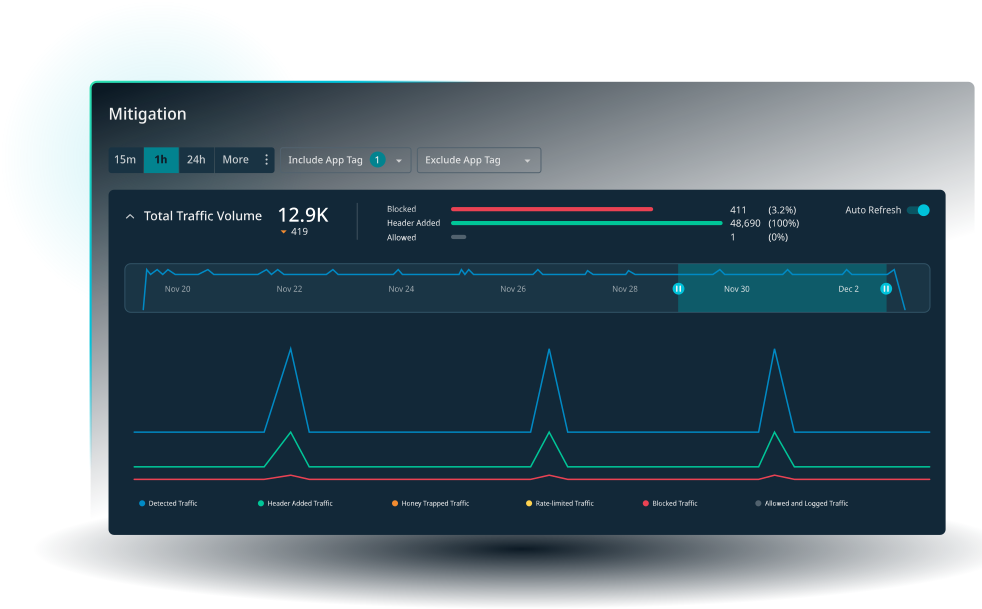
2. DataDome Bot Protect
Best for: Real-time, low-latency bot and AI agent defense at the edge
Strengths: Documented under 0.01% false positive rate and fast setup
Things to consider: Pairs with a WAF or WAAP for non-bot threat coverage
DataDome Bot Protect delivers real-time bot detection across websites, mobile apps, APIs, and MCP servers. It analyzes every request rather than a sample, evaluating hundreds of client-side and server-side signals to assess risk continuously throughout the user journey.
The detection engine processes over 5 trillion signals per day using more than 1,000 out-of-the-box and customer-specific models plus collective threat intelligence, and it operates at the edge across 35+ points of presence in under 2 milliseconds. DataDome cites an industry-leading false positive rate of under 0.01%.
Key features include:
- Continuous request analysis: Inspects every request, from page visits to logins and cart actions, evaluating hundreds of signals to assess intent throughout the session.
- AI detection engine: Uses over 1,000 models and 5 trillion daily signals to distinguish human users, trusted AI agents, and malicious bots.
- Edge mitigation: Runs across 35+ global points of presence with sub-2ms response times, keeping a false positive rate under 0.01% and showing CAPTCHAs to less than 0.01% of requests.
- Agent Trust management: Identifies, classifies, scores, and governs agentic AI traffic, validating AI agent identity and intent so verified agents can transact.
- Integrations and deployment: Offers more than 50 out-of-the-box integrations across edge CDNs such as Fastly, Cloudflare, Akamai, and CloudFront, and server-side platforms including NGINX, F5, HAProxy, and Envoy, with setup measured in hours.
- Visibility and SOC: Provides a threat dashboard with Watchtower endpoint discovery, custom dashboards and reports, and a dedicated 24/7 SOC team, plus two-layer PII encryption.
| Criterion | Solution Fit | Key Considerations |
|---|---|---|
| Detection accuracy and bot coverage | Analyzes every request with 1,000+ models and 5 trillion daily signals, distinguishing humans, AI agents, and bots at a documented under 0.01% false positive rate. | Manual, human-driven scraping can be harder to stop than automated bots. |
| Impact on user experience and friction | Edge inspection in under 2ms with CAPTCHAs shown to under 0.01% of requests. | The dashboard can occasionally lag under heavy load. |
| Protection across web, mobile, and APIs | Covers websites, mobile apps, APIs, and MCP servers. | Focused on bots and fraud; pair with a WAF or WAAP for broader web threats. |
| Deployment, integration, and scalability | 50+ integrations across edge CDNs and server-side platforms, with setup in hours and 35+ points of presence. | Some initial configuration steps and edge-case setups can take extra time. |
| Good bot and AI agent management | Agent Trust classifies, scores, and governs AI agents, allows verified crawlers, and monetizes AI traffic. | Agent Trust is a distinct capability layered onto Bot Protect. |
| Visibility, analytics, and managed operations | Watchtower discovery, custom dashboards and reports, and a 24/7 SOC. | Pricing flexibility can be a consideration for some buyers. |
Source: DataDome
3. HUMAN Bot Defender
Best for: Behavior-based defense across web, mobile, and APIs
Strengths: Session-wide decisioning and deep fraud investigation tools
Things to consider: Initial configuration and dashboard tuning take time
HUMAN Bot Defender, delivered through HUMAN Sightline Cyberfraud Defense, governs traffic across web, mobile, and APIs to stop automated, AI-driven, and human-led fraud. It uses machine learning, behavioral analysis, and intelligent fingerprinting, and it continuously correlates session activity across each authentication stage rather than judging individual requests in isolation.
The platform deploys with existing infrastructure through a JavaScript snippet or SDK and operates out of band, so it preserves page load performance while keeping false positives low. It is backed by the Satori Threat Intelligence and Research team.
Key features include:
- High-fidelity decisioning: Correlates session activity across each authentication stage, with layered AI models that adapt automatically to new threat behavior.
- Multi-method detection: Combines fingerprinting, behavior-based analysis, and predictive methods to detect hyper-distributed attacks.
- Customizable mitigation: Applies hard blocks, soft challenges, silent controls, and investigation triggers, and integrates with WAF, CDN, IAM, and fraud operations tooling; HUMAN Challenge replaces CAPTCHA for suspected bots.
- Crawler, scraper, and agent control: Provides visibility into known bots, LLM scrapers, and AI agents, with policies to block, allow, limit, or monetize automated activity.
- Reporting and investigation: Delivers AI-generated insights, pattern analysis, automated reports, and secondary detection to uncover fraud networks, with dashboards tailored to fraud, security, and business stakeholders.
- Flexible deployment: Integrates with existing infrastructure using more than 40 pre-built integrations across CDNs, load balancers, and web and application servers, with no in-line appliance required.
| Criterion | Solution Fit | Key Considerations |
|---|---|---|
| Detection accuracy and bot coverage | Multi-method ML, behavioral analysis, and fingerprinting with session-wide correlation and adaptive learning. | The Analyzer investigation tool is not real-time and can be slow. |
| Impact on user experience and friction | HUMAN Challenge replaces CAPTCHA and the asynchronous sensor preserves page load performance, with low false positives. | Some challenge and tuning decisions still require configuration. |
| Protection across web, mobile, and APIs | Governs traffic across web, mobile, and APIs. | Full value depends on correct sensor and enforcer placement. |
| Deployment, integration, and scalability | Deploys with existing infrastructure via JS snippet or SDK, out of band, with 40+ CDN, load balancer, and server integrations. | Customer autonomy for rule creation is limited, for example VPN blocking and multi-parameter logic. |
| Good bot and AI agent management | Controls known bots, LLM scrapers, and AI agents with policies to block, allow, limit, or monetize. | Handled through policy configuration rather than a directory-first model. |
| Visibility, analytics, and managed operations | AI-generated insights, secondary detection, and stakeholder dashboards, backed by the Satori research team. | Historical log retention can be limited for older investigations. |
Source: HUMAN
4. Arkose Bot Manager
Best for: Account security and fraud prevention at login and signup
Strengths: Adaptive challenges and 225+ risk signals with 24/7 SOC
Things to consider: Interactive challenges and pricing suit larger budgets
Arkose Bot Manager detects and disrupts advanced bot and human-driven attacks across the user journey, with a focus on account takeover, fake account creation, SMS toll fraud, credential stuffing, and scraping. It draws on more than 225 risk signals and the Arkose Global Intelligence Network to identify evasive threats and applies dynamic challenges that evolve in real time.
The product runs on Arkose Titan, the shared session infrastructure behind Arkose’s portfolio, which lets teams add AI agent governance through Arkose Agent Trust Manager in one click without a new integration. It is supported by a 24/7 global SOC and real-time threat intelligence.
Key features include:
- Risk-signal detection: Uses 225+ risk signals and the Arkose Global Intelligence Network to spot evasive bot and human-driven attacks.
- Adaptive challenges: Deploys dynamic challenges that evolve in real time to counter emerging attack vectors while letting good users pass without friction.
- Account and API protection: Defends account flows against takeover, brute force, and credential stuffing, with Arkose Edge adding server-side API protection.
- AI agent governance: Arkose Agent Trust Manager classifies AI agents by intent and enforces Allow, Monitor, or Block at every endpoint, sharing the Arkose Titan session infrastructure.
- Actionable intelligence: Turns threat data into dashboards and analytics, with real-time classification and triage of traffic.
- Managed support: Provides 24/7 global SOC support, real-time threat intelligence, and financial warranties against automated attacks.
| Criterion | Solution Fit | Key Considerations |
|---|---|---|
| Detection accuracy and bot coverage | 225+ risk signals plus the Global Intelligence Network detect evasive bot and human-driven attacks. | Latency in synchronous events has been cited as an area to improve. |
| Impact on user experience and friction | Differentiates good users without friction and applies dynamic challenges only when risk is present. | Interactive challenges add friction versus fully invisible approaches. |
| Protection across web, mobile, and APIs | Protects account flows and APIs across the user journey, with Arkose Edge for server-side API protection. | Emphasis is on account security and fraud rather than general web traffic. |
| Deployment, integration, and scalability | Runs on Arkose Titan session infrastructure with flexible integration; AI agent governance added in one click. | Setup can be complex and benefits from guided onboarding. |
| Good bot and AI agent management | Agent Trust Manager classifies AI agents by intent and enforces Allow, Monitor, or Block. | Agent governance is a separate module on the platform. |
| Visibility, analytics, and managed operations | Real-time analytics and dashboards with 24/7 SOC support and financial warranties. | Detailed monitor results can be hard to interpret without vendor support, and pricing suits larger budgets. |
Source: Arkose
WAF and CDN-integrated bot management
5. Cloudflare Bot Management
Best for: Web-heavy traffic already on Cloudflare’s edge network
Strengths: Internet-scale ML detection built into the edge stack
Things to consider: Full behavioral features require the Enterprise tier
Cloudflare Bot Management uses machine learning and behavioral analysis across Cloudflare’s global network to detect and stop malicious bot traffic before it reaches an application. Its models are trained on the traffic of a large portion of the Internet, which it uses to generate a bot score for each request and to deploy protection against novel attacks quickly.
Because it is built into the Cloudflare stack alongside WAF, CDN, and rate limiting, mitigation happens at the edge with minimal added latency. It also includes Turnstile, a free CAPTCHA alternative.
Key features include:
- Network-scale ML detection: Trains models on a large share of Internet traffic to produce a bot score per request and deploy protection against novel attacks instantly.
- Turnstile challenge: Offers a free, privacy-preserving CAPTCHA alternative in place of traditional challenges.
- Edge mitigation: Runs on the same infrastructure powering a fifth of the Internet, so bot detection happens at the edge without adding latency for humans.
- Credential and API protection: Protects login endpoints from credential stuffing and secures APIs from scraping, resource abuse, and automated probing.
- eCommerce and UX use cases: Blocks inventory-hoarding bots and turns bot detection into a real-time UX and marketing-spend optimizer.
- Integrated stack: Combines with WAF, rate limiting, CDN, and DDoS protection under one platform, with automatic allowlists for verified bots.
| Criterion | Solution Fit | Key Considerations |
|---|---|---|
| Detection accuracy and bot coverage | ML models trained on a large share of Internet traffic produce a bot score per request and catch novel attacks. | Advanced behavioral analysis is limited to the Enterprise tier. |
| Impact on user experience and friction | Turnstile offers a free CAPTCHA alternative, and edge mitigation adds minimal latency. | Occasional false positives require manual whitelisting. |
| Protection across web, mobile, and APIs | Protects login endpoints, APIs, and eCommerce flows, with mobile and API coverage. | Some mitigation relies on customer-written rules. |
| Deployment, integration, and scalability | Built into Cloudflare’s stack with WAF, CDN, and rate limiting, running across a global network. | The reverse-proxy model requires pointing DNS to Cloudflare. |
| Good bot and AI agent management | Verified-bot handling and automatic allowlists with good-versus-bad bot control. | AI-agent-specific governance is less detailed than some dedicated vendors. |
| Visibility, analytics, and managed operations | Analytics, bot scores, and logs. | SIEM log export and stronger support are gated to higher tiers, and response times vary by plan. |
Source: Cloudflare
6. Akamai Bot Manager

Best for: Global enterprises with high-traffic, edge-delivered apps
Strengths: Edge Bot Score detection with stealthy response actions
Things to consider: Add-on licensing, and tuning needs operational expertise
Akamai Bot Manager detects bot traffic and mitigates malicious bots at the edge while managing good bots, with visibility into more than 40 billion bots a day. It assigns a Bot Score from 0 (human) to 100 (bot) starting with the first request, and lets teams define response strategies across cautious, strict, and aggressive segments.
Detection combines AI models for user behavior analysis, browser fingerprinting, and a continuously updated known-bot directory, and the same detections extend to mobile apps. Bot Manager also integrates its insights into SIEM tools.
Key features include:
- Edge Bot Score detection: Assigns a 0–100 score from the first request using patented technologies and an AI framework, with tunable cautious, strict, and aggressive response segments.
- Advanced behavioral detection: Uses AI models for user behavior analysis and browser fingerprinting, drawing on intelligence from billions of bot requests and logins daily.
- Stealthy responses: Goes beyond block-and-allow with crypto and interstitial challenges that slow attacks without tipping off bots.
- Good bot management: Maintains a continuously updated known-bot directory and lets customers create custom categories for their own or partner bots.
- Mobile and API coverage: Extends the same detections to mobile apps and exposes functionality via APIs for DevSecOps workflows.
- Reporting and SIEM integration: Provides real-time reporting of trends and detailed bot traffic analysis, and integrates Bot Score insights into SIEM tools.
| Criterion | Solution Fit | Key Considerations |
|---|---|---|
| Detection accuracy and bot coverage | Edge Bot Score from the first request using AI behavior models and fingerprinting, with visibility across 40B+ bots per day. | Anomaly detection can be less effective against human-mimicking bots, and some scrapers from unknown origins or VPNs slip through. |
| Impact on user experience and friction | Stealthy responses avoid tipping off bots, and crypto and interstitial challenges limit user disruption. | No built-in CAPTCHA, and tuning affects friction. |
| Protection across web, mobile, and APIs | The same detections extend to mobile apps, and functionality is available via APIs. | SDK and mobile integration has been flagged for improvement. |
| Deployment, integration, and scalability | Delivered at the Akamai edge with quick activation for existing customers and SIEM integration. | Bot management is an add-on, and licensing can be hard to interpret. |
| Good bot and AI agent management | Maintains a known-bot directory with good-bot policies and custom bot categories. | AI-agent governance is less prominent than in newer platforms. |
| Visibility, analytics, and managed operations | Real-time reporting and trend analysis with a response tuning simulator. | Costly for smaller firms, tuning needs operational expertise, and support has drawn mixed feedback. |
Source: Akamai
7. Imperva Advanced Bot Protection
Best for: Unified web, mobile, and API protection under one platform
Strengths: Multi-layered detection across 700+ dimensions with low false positives
Things to consider: Setup and full features can add cost and complexity
Imperva Advanced Bot Protection secures websites, mobile apps, and APIs from sophisticated bot attacks, including all OWASP automated threats. It uses a multi-layered approach that combines direct client interrogation, behavior analysis, machine learning, connection characteristics, and threat intelligence feeds, evaluating more than 700 dimensions to create a fingerprint that resists evasion.
Imperva emphasizes granular controls, explainable reporting, and full visibility rather than opaque risk scores, and it supports flexible deployment across cloud, connector, and on-premises models. Post-deployment feedback loops help minimize false positives and negatives.
Key features include:
- Multi-layered detection: Combines client interrogation, behavior analysis, ML, connection characteristics, and threat intelligence across 700+ dimensions to separate human, good, and bad bot traffic.
- Focus on efficacy: Uses rigorous testing against historical data and hundreds of browsers, plus feedback loops and metadata replay, to reduce false positives and negatives.
- Granular controls and reporting: Offers real-time monitoring, in-depth reporting, and customizable responses such as monitor, challenge, block, and rate-limit, tunable by path or application.
- Explainable, adaptive protection: Provides full visibility and granular tuning beyond risk scores, with real-time testing in production for confident policy creation.
- Broad surface coverage: Protects websites, mobile apps, and APIs against all OWASP automated threats.
- Flexible deployment: Supports single-stack Cloud WAF, connectors for AWS, Cloudflare, F5, NGINX, and Fastly, and on-premises WAF integration.
| Criterion | Solution Fit | Key Considerations |
|---|---|---|
| Detection accuracy and bot coverage | Multi-layered detection across 700+ dimensions against OWASP automated threats, backed by feedback loops for accuracy. | Can produce false positives or negatives that need tuning. |
| Impact on user experience and friction | Aims to block bad bots without CAPTCHAs, with low false positives on challenge responses. | Effective tuning requires familiarity with the platform. |
| Protection across web, mobile, and APIs | Protects websites, mobile apps, and APIs under one platform. | Full coverage is strongest within the broader Imperva stack. |
| Deployment, integration, and scalability | Flexible deployment via Cloud WAF single-stack, connectors for AWS, Cloudflare, F5, NGINX, and Fastly, or on-premises WAF. | Initial setup and configuration can be complex and time-consuming. |
| Good bot and AI agent management | Distinguishes human, good, and bad bot traffic with granular per-path policies. | AI-agent-specific controls are less detailed than dedicated agent-trust tools. |
| Visibility, analytics, and managed operations | Explainable reporting, customizable dashboards, real-time testing, and expert bot analysts. | Advanced features can be add-ons that raise cost. |
Source: Imperva
8. F5 Distributed Cloud Bot Defense
Best for: Agent-aware defense across hybrid and multi-cloud apps
Strengths: Behavioral and client-side telemetry with F5 platform fit
Things to consider: Interface and custom policies can lean on support
F5 Distributed Cloud Bot Defense protects web apps, mobile apps, and APIs by distinguishing humans, trusted AI agents, and harmful automation. It uses real-time behavioral analysis, client-side intelligence, and platform-wide telemetry to detect human-like bots at the application interaction layer, and it continuously adapts to attacker evolution without manual tuning.
Delivered on the F5 Application Delivery and Security Platform, it integrates natively across hybrid, multi-cloud, and on-premises environments with centralized visibility and control, and it feeds data into SIEM systems for threat analysis.
Key features include:
- Agent-aware classification: Separates humans, trusted agents, and malicious automation by behavior and intent rather than static signatures or identity claims.
- Behavioral and client-side detection: Uses real-time behavioral analysis and high-fidelity client-side telemetry to detect human-like bots and defeat evasion.
- Real-time enforcement: Applies allow, block, rate-limit, or step-up controls exactly where abuse occurs, with stricter controls only for low-trust interactions.
- Business logic protection: Defends login, checkout, account recovery, and APIs, detecting workflow abuse even when traffic looks human.
- Platform-native delivery: Runs on the F5 Application Delivery and Security Platform and BIG-IP, with unified policies and telemetry across hybrid, multi-cloud, and on-premises environments.
- Integrations: Deploys close to public cloud workloads via VMs or containers and integrates with Syslog and leading SIEM systems.
| Criterion | Solution Fit | Key Considerations |
|---|---|---|
| Detection accuracy and bot coverage | Real-time behavioral analysis and client-side telemetry detect human-like bots beyond signatures, with agent-aware classification. | Less precise tuning has been linked to false positives in some deployments. |
| Impact on user experience and friction | Applies controls only to low-trust interactions, avoiding blanket CAPTCHAs. | Configuration changes can require support or scheduled windows. |
| Protection across web, mobile, and APIs | Protects web apps, mobile apps, and APIs, including business-logic flows. | Depth of coverage is strongest within the F5 platform. |
| Deployment, integration, and scalability | Native to the F5 Application Delivery and Security Platform and BIG-IP, deployable across hybrid, multi-cloud, and on-premises with SIEM integration. | Custom policy creation can depend on F5 support. |
| Good bot and AI agent management | Identifies and controls AI agents by behavior and intent, enabling trusted agentic commerce. | Good-bot allowlisting is less directory-driven than some CDN vendors. |
| Visibility, analytics, and managed operations | Centralized visibility and telemetry across the F5 platform, with SIEM data sharing. | The interface has been described as dated and text-heavy. |
Source: F5
Conclusion
Choosing a bot management vendor is ultimately about finding the right balance between security, user experience, operational effort, and long-term flexibility. The strongest solutions consistently detect sophisticated automated attacks across web, mobile, and API environments while minimizing false positives and unnecessary friction for legitimate users. By evaluating vendors against consistent criteria such as detection accuracy, deployment model, good bot governance, analytics, and scalability, organizations can select a platform that protects critical business workflows today and adapts as attacker techniques and AI-driven automation continue to evolve.