What Is Web Application and API Protection?
Web Application and API Protection (WAAP) is a security framework to safeguard web applications and APIs from a broad range of cyber threats. WAAP solutions combine multiple security technologies, such as Web Application Firewalls (WAF), API security, bot management, and Distributed Denial of Service (DDoS) protection, into a unified platform.
The goal of WAAP solutions is to protect digital assets against attacks that exploit vulnerabilities in code, application logic, and network infrastructure, while ensuring application availability and performance remain uncompromised.
In this article:
- WAAP Providers with Bot and DDoS Mitigation at a Glance
- Why Bot and DDoS Mitigation Should Be Part of WAAP
- Key Features of WAAP Providers with Bot and DDoS Mitigation
- Notable WAAP Providers with Bot and DDoS Mitigation
WAAP Providers with Bot and DDoS Mitigation at a Glance
The table below summarizes the key differences between the platforms covered in this guide. We explore each one in more detail in the sections that follow.
| Category | Solution | Best For | Key Strengths | Things to Consider |
|---|---|---|---|---|
| API and Bot Defense-Led | Cequence Security | Best-in-class bot defense, API security, WAF and DDoS in one platform | Network-based bot mitigation needing no app changes or SDKs | Initial setup and policy tuning need networking know-how |
| API and Bot Defense-Led | Imperva | Enterprises needing WAAP across SaaS, on-prem and cloud | Bot, API, DDoS and client-side modules on one platform | Configuration and rule customization can feel restrictive |
| API and Bot Defense-Led | F5 | Hybrid estates mixing SaaS, appliance and NGINX WAF | Multi-signal bot defense plus on-prem and SaaS DDoS options | Configuration depth demands trained specialists |
| API and Bot Defense-Led | Radware | Organizations with heavy Web DDoS and bot exposure | Behavioral policy generation with 24×7 managed ERT support | Reporting and dashboards offer limited customization |
| Edge and Cloud Network | Cloudflare | Teams wanting fast edge rollout via a single DNS change | Managed rulesets, anycast DDoS and ML bot scoring at the edge | Advanced logging and bot controls sit on higher tiers |
| Edge and Cloud Network | Akamai App & API Protector | Large estates needing edge WAAP plus hybrid coverage | Self-tuning security engine and behavioral L7 DDoS defense | Configuration pushes and rule tuning take time |
| Edge and Cloud Network | Fastly | DevOps teams wanting low-tuning WAF across deployments | SmartParse detection and shared NLX malicious IP feed | Advanced rule work often needs vendor support |
| Edge and Cloud Network | AWS WAF | Workloads already fronted by CloudFront, ALB or API Gateway | Managed rule groups with bot control and L7 DDoS automation | Rule structure and cost model get complex at scale |
Why Bot and DDoS Mitigation Should Be Part of WAAP
Bot and DDoS attacks target application availability, performance, and business logic. Including both controls in WAAP helps organizations detect automated abuse and large-scale traffic attacks before they affect users or backend systems.
- Protects application availability: DDoS mitigation filters high-volume attacks that attempt to exhaust network, server, or application resources.
- Blocks malicious automation: Bot management identifies and stops credential stuffing, account takeover attempts, content scraping, spam, and automated fraud.
- Distinguishes users from attack traffic: Behavioral analysis, device signals, and traffic patterns help separate legitimate users, helpful bots, and malicious bots.
- Protects APIs: APIs are common targets for automated abuse because attackers can send requests at scale. Rate limiting and bot detection reduce unauthorized access and resource consumption.
- Reduces backend load: Blocking harmful traffic at the edge prevents unnecessary requests from reaching application servers, databases, and API services.
- Improves detection across attack types: A unified WAAP platform can correlate WAF, API, bot, and DDoS signals to identify attacks that use several techniques at once.
- Supports faster response: Automated policies can challenge, block, or limit suspicious traffic without waiting for manual investigation.
- Maintains user experience: Effective mitigation controls attacks without adding unnecessary friction or latency for legitimate users.
Related content: Read our guide to the best bot management solutions for large enterprises.
Key Features of WAAP Providers with Bot and DDoS Mitigation
1. Advanced Web Application Firewall
An advanced Web Application Firewall (WAF) is foundational to WAAP, providing deep inspection of HTTP and HTTPS traffic to block threats such as:
- SQL injection
- Cross-site scripting (XSS)
- Remote code execution
Unlike legacy WAFs that rely heavily on static rule sets, modern solutions use machine learning and behavioral analytics to adapt to new attack patterns and evolving vulnerabilities. This enables more accurate detection and fewer false positives, ensuring legitimate traffic is not disrupted.
Effective WAFs also offer granular policy controls and automated rule updates to address zero-day threats as they emerge. They integrate with API gateways and DevOps pipelines, allowing security teams to enforce consistent protection across microservices and cloud-native environments. By providing both signature-based and anomaly-based detection, advanced WAFs form a first line of defense for web applications and APIs.
2. Behavioral Bot Detection
Behavioral bot detection uses advanced analytics to differentiate between human users and automated scripts based on interaction patterns. Instead of relying solely on IP reputation or user-agent strings, behavioral solutions analyze mouse movements, keystrokes, click rates, and navigation flows to identify non-human activity. This approach is more effective against sophisticated bots that mimic human behavior or rotate identities to avoid traditional detection methods.
Machine learning models continuously learn from new data, improving their ability to detect emerging bot tactics. These models can flag suspicious activity in real time, enabling automated mitigation actions such as:
- CAPTCHA challenges
- Rate limiting
- Blocking
By focusing on behavioral indicators, WAAP solutions can minimize false positives and ensure that legitimate users are not inconvenienced by bot defenses.
3. Custom Bot Management Policies
Custom bot management policies allow organizations to tailor responses to different types of automated traffic. Not all bots are malicious; some perform valuable functions like indexing or monitoring. WAAP solutions provide the flexibility to allow, challenge, or block bots based on:
- Business requirements
- User roles
- Compliance obligations
This helps prevent unnecessary disruptions while maintaining control over who accesses your applications and APIs. Policy customization can be applied at multiple levels, such as endpoint, geographic region, or user segment. Security teams can define granular rules that respond dynamically to changing threat landscapes or business needs.
For example, stricter controls might be implemented during a product launch or in response to an ongoing attack. Custom policies ensure that bot mitigation aligns with operational objectives without compromising usability.
4. Network-Layer DDoS Protection
Network-layer DDoS protection safeguards against attacks that flood network resources with massive volumes of traffic, such as:
- UDP floods
- SYN floods
- Amplification attacks
WAAP providers use globally distributed scrubbing centers to detect and mitigate these attacks before they reach application infrastructure. By filtering malicious traffic at the edge, they preserve bandwidth and maintain service availability even during large-scale assaults.
Protection at the network layer is critical for preventing outages and performance degradation. Modern WAAP solutions employ automated, always-on monitoring that instantly reacts to abnormal spikes in traffic. Integration with backbone providers and content delivery networks (CDNs) further enhances resilience, enabling rapid response and minimal latency impact for end users.
5. Application-Layer DDoS Mitigation
Application-layer DDoS attacks target the logic and functionality of web applications and APIs, often using low-and-slow tactics that are harder to detect than volumetric attacks. WAAP solutions employ deep packet inspection and behavioral analysis to identify requests that seek to:
- Exhaust server resources
- Exploit application logic
- Bypass traditional DDoS defenses
These capabilities are essential for protecting login pages, search endpoints, and other critical components vulnerable to application-layer abuse. Mitigation strategies include dynamic rate limiting, session validation, and challenge-response mechanisms that increase the cost and complexity for attackers.
By focusing on the intent and context of each request, WAAP providers can block or throttle malicious traffic without affecting legitimate users. This ensures applications remain responsive and available, even under sustained, targeted attack campaigns.
6. Rate Limiting and Abuse Prevention
Rate limiting restricts the number of requests a user or client can make within a given timeframe, preventing abuse of APIs and application endpoints. WAAP solutions offer configurable rate-limiting rules that can be applied based on:
- IP address
- User account
- Session
- Geographic location
This helps block brute-force attacks, credential stuffing, and resource exhaustion attempts without impacting normal usage patterns.
Abuse prevention extends beyond simple request counting, incorporating anomaly detection and contextual analysis to identify suspicious activity. For example, sudden spikes in login attempts or API calls from a single source can trigger automated defenses. By combining rate limiting with adaptive controls, WAAP platforms can effectively mitigate both automated and manual abuse, preserving application integrity and performance.
7. Global Network and Traffic Capacity
A global network is essential for effective WAAP, particularly when mitigating large-scale DDoS attacks or handling surges in legitimate traffic. Leading providers operate expansive, geographically distributed networks with high traffic capacity and multiple points of presence (PoPs). This allows them to absorb and filter attacks close to their source, reducing latency and preventing localized outages.
Scalability and redundancy are critical for maintaining service availability during peak loads or attack events. WAAP solutions ensure uninterrupted protection and optimal performance worldwide, leveraging:
- Load balancing
- Failover mechanisms
- Traffic engineering
By distributing security functions across a global infrastructure, organizations can support users wherever they are while minimizing the risk of downtime.
8. Real-Time Threat Intelligence
Real-time threat intelligence enables WAAP platforms to detect and respond to emerging threats faster and more accurately. Providers aggregate data from global sensors, honeypots, and customer environments to identify:
- New attack vectors
- Malicious IPs
- Evolving tactics
This intelligence feeds automated detection engines, allowing them to update rules and signatures dynamically as threats evolve. Timely insights from threat intelligence improve the effectiveness of all WAAP components, from WAF policies to bot and DDoS mitigation.
Security teams receive actionable alerts and context about ongoing attacks, supporting faster incident response and informed decision-making. By integrating real-time intelligence, WAAP solutions help organizations stay ahead of adversaries and reduce the risk of successful breaches.
Notable WAAP Providers with Bot and DDoS Mitigation
How we selected these providers: We shortlisted web application and API protection platforms based on integrated WAF, API security, bot management and DDoS mitigation capabilities, deployment flexibility across cloud and hybrid environments, and coverage of both automated abuse and volumetric attack types.
API and Bot Defense-Led WAAP Platforms
1. Cequence Security
Best for: Best-in-class bot defense, API security, WAF and DDoS in one platform
Strengths: Network-based bot mitigation needing no app changes or SDKs
Things to consider: Initial setup and policy tuning need networking know-how
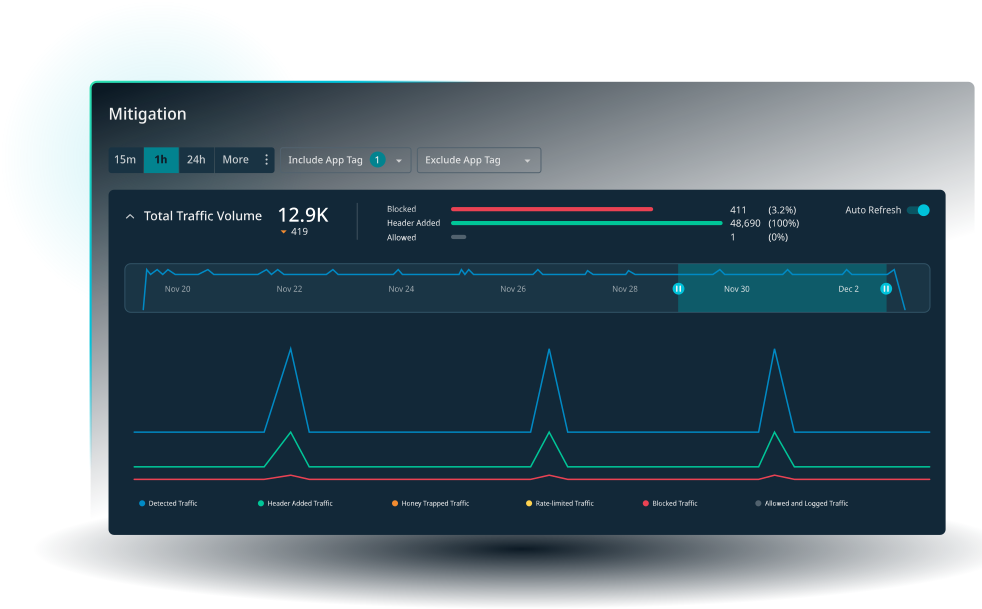
Cequence Web Application and API Protection combines the Cequence API Security and Bot Management products with WAF and DDoS protection, delivered in a single unified platform. Administration for all four functions runs through one application protection portal, and a single cloud deployment removes the extra network hops that occur when traffic is routed through separate services.
Because the components sit inside one tenant, traffic follows a consistent path rather than being split across services with different routing. Documented use cases include the OWASP Web Application and API Security Top 10, business logic abuse, DDoS, content scraping, SQL injection, sensitive data exposure, API discovery and inventory, and account takeover.
Key features include:
- Bot management without application changes: Protects web, mobile and API applications from the full range of bot attacks. No application modification is required, so there is nothing to add to the client side before detection starts.
- Real-time bot mitigation: Detection and mitigation run inline, with fraud prevention covering data loss, theft and fraud driven by automated traffic.
- API discovery and inventory: Discovers, monitors and tests APIs, generates API specifications automatically, and maintains continuous real-time risk visibility across the API estate.
- Sensitive data and testing coverage: Prevents sensitive data exposure and includes integrated API security testing that assesses risks tied to compliance and governance issues.
- WAF ruleset coverage: Provides OWASP Web App Top 10 protection, blocks malicious input patterns and prevents SQL injection. Cequence native mitigation handles traffic before it adds load to the WAF.
- Layer 3, 4 and 7 DDoS protection: Covers SYN floods, UDP floods and reflection attacks, with a 99.99% availability commitment against common infrastructure attacks.
Limitations (as reported by users on G2):
- Setup effort on complex estates: Onboarding large environments with many APIs takes time, and getting detection and mitigation policies balanced requires ongoing adjustment.
- Learning curve for configuration: Understanding the analytics and policy options takes familiarity with the platform, and directing traffic through a CDN calls for solid DNS and routing knowledge.
- Dashboard responsiveness on large queries: The interface can slow down when running large data queries, and tailoring reports for different stakeholders takes extra configuration work.
Source: Cequence

2. Imperva

Best for: Enterprises needing WAAP across SaaS, on-prem and cloud
Strengths: Bot, API, DDoS and client-side modules on one platform
Things to consider: Configuration and rule customization can feel restrictive
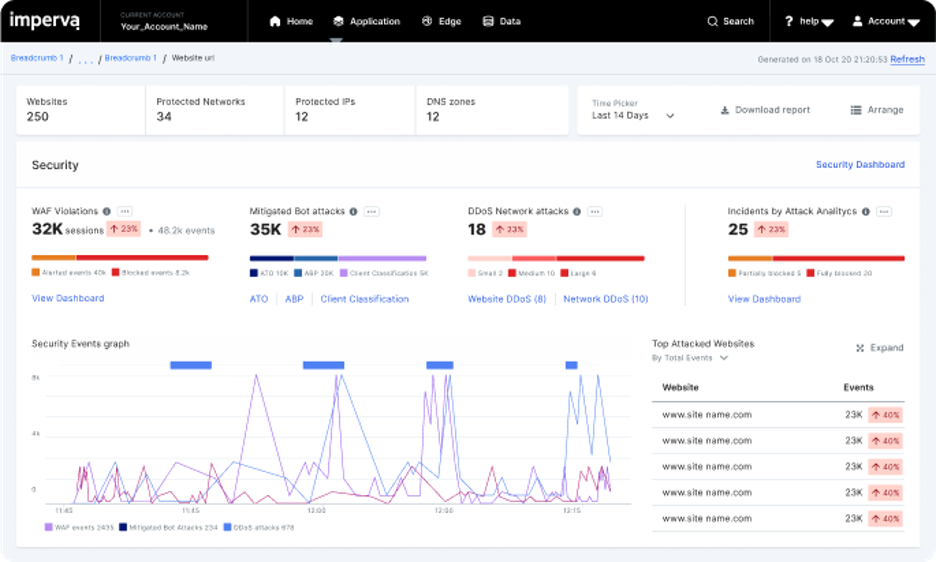
Imperva Application Security Platform brings together Web Application Firewall, Advanced Bot Protection, API Security, DDoS Protection, Client-Side Protection, DNS Protection, Account Takeover Protection and a content delivery network under a single platform. Each module is licensed separately but managed through the same console.
Deployment options cover SaaS, on-premises and native integrations for AWS, Azure and Google Cloud, which lets the same policy set apply to applications that sit in different environments. The platform also includes AI Application Security for homegrown generative AI applications.
Key features include:
- Web Application Firewall across environments: Protects applications wherever they run, with the same policy model applied to cloud, on-premises and hybrid deployments.
- Advanced Bot Protection: Covers websites, mobile apps and APIs against sophisticated automated attacks, and is built to act without disrupting legitimate user traffic.
- API Security with data classification: Provides continuous protection for all APIs using deep discovery and classification of sensitive data, so exposed endpoints and the data they return are both in scope.
- Automatic DDoS mitigation: Mitigates DDoS attacks against applications and networks at the edge, with an uptime guarantee attached to the service.
- Client-Side Protection: Detects formjacking, digital skimming and Magecart activity in the browser, and maps to PCI DSS 4.0 client-side requirements.
- Account Takeover Protection: Applies dedicated controls to login endpoints to prevent account-based fraud, separate from generic bot filtering.
- Secure CDN: Caches and accelerates content delivery from the same platform that applies the security policy.
Limitations (as reported by users on G2):
- Configuration complexity: Setting up and configuring the WAF requires security expertise, and teams new to the platform face a steeper start.
- False positives on legitimate traffic: Blocking accuracy is reported as inconsistent in places, with legitimate requests occasionally flagged and needing manual correction.
- Limited policy customization: Several reviewers wanted more configuration options than the available rules and policies provide, and noted a lower default rule limit than competing products.
- Interface and reporting: The management interface is described as having hidden options that are hard to navigate, and downloading reports is not always straightforward.
- Cost of ownership: Implementation and ongoing maintenance costs are considered high, and licensing counts staging and production URLs separately.
Source: Imperva
3. F5

Best for: Hybrid estates mixing SaaS, appliance and NGINX WAF
Strengths: Multi-signal bot defense plus on-prem and SaaS DDoS options
Things to consider: Configuration depth demands trained specialists
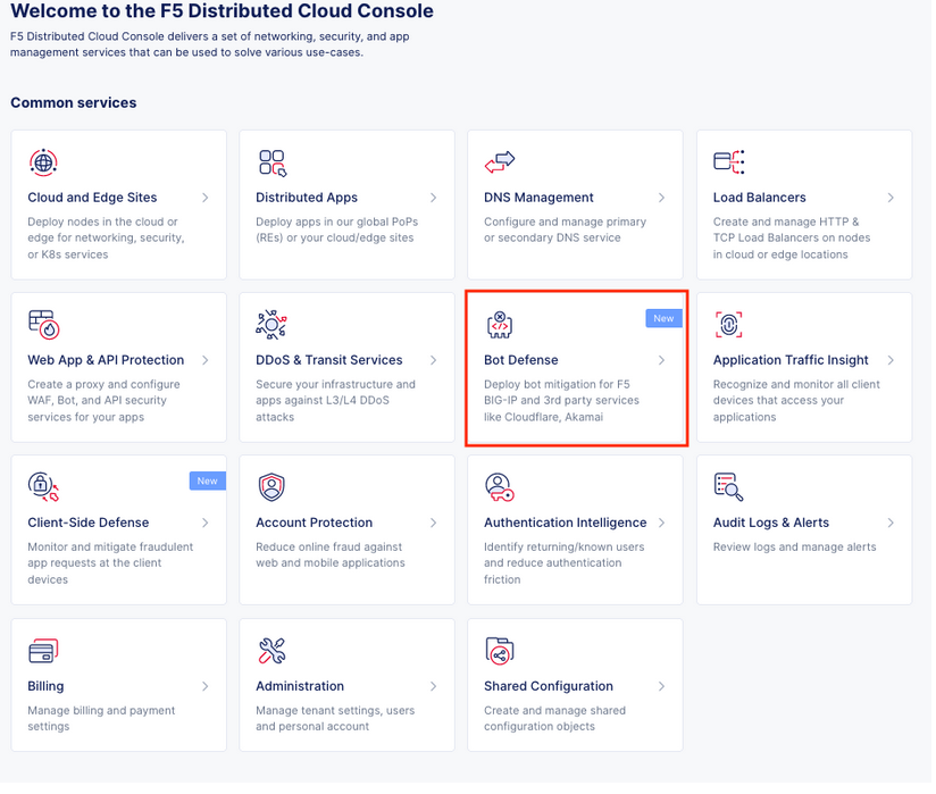
The F5 Application Delivery and Security Platform converges WAF, API security, bot management and DDoS mitigation into an integrated WAAP offering. Rather than one product, it is a set of enforcement points that share policy management: Distributed Cloud WAF for SaaS delivery, BIG-IP Advanced WAF for data center deployments, and F5 WAF for NGINX for containerized and Kubernetes environments.
That structure lets organizations apply protection close to each application while keeping one policy view across on-premises, cloud and edge. F5 also offers Distributed Cloud Managed Services, a SaaS-delivered managed WAF service that runs the platform on the customer’s behalf.
Key features include:
- Virtual patching for OWASP Top 10 and zero-days: WAF policies apply mitigations for known and emerging vulnerabilities before application code is patched, with consistent policy management across hybrid multicloud deployments.
- Multi-signal bot defense: Distributed Cloud Bot Defense separates human from automated traffic using client, device, browser, identity and behavior signals, and applies step-up challenges only when a request warrants one.
- Aggregator traffic control: Distributed Cloud Aggregator Management governs third-party aggregator traffic separately from general bot policy, so approved automation is handled differently from abuse.
- Full lifecycle API security: Distributed Cloud API Security discovers and catalogs API endpoints, baselines normal behavior, and protects APIs from development through runtime with anomaly detection for access violations such as BOLA.
- Layered DDoS mitigation: Distributed Cloud DDoS Mitigation handles multi-vector attacks as a SaaS service, F5 DoS for NGINX covers Layer 7 DoS in lightweight deployments, and BIG-IP AFM handles mitigation on-premises.
- Continuous attack surface assessment: F5 Web Application Scanning identifies exposed applications and APIs using automated testing, and Client-Side Defense monitors third-party and injected browser scripts.
Limitations (as reported by users on G2):
- Interface complexity: The configuration interface is repeatedly described as complex and hard to navigate, with users reporting they can lose their place while building policies.
- Expertise requirement: Configuring and managing the platform requires deep product knowledge, and misconfiguration is a stated risk for teams without it.
- Cost and licensing: Pricing is positioned toward larger enterprises, and the move from perpetual to per-CPU licensing was raised as a concern.
- Appliance stability and updates: Some users reported operating system hangs on appliance deployments and update processes that reverted configuration.
- Reporting requires an add-on: Advanced reporting is not included with BIG-IP and requires the separate BIG-IQ system.
Source: F5
4. Radware

Best for: Organizations with heavy Web DDoS and bot exposure
Strengths: Behavioral policy generation with 24×7 managed ERT support
Things to consider: Reporting and dashboards offer limited customization
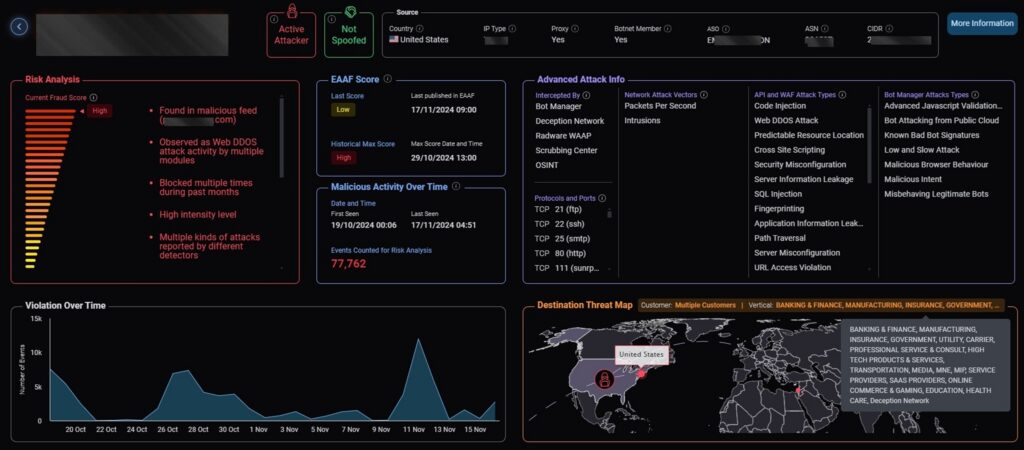
Radware Cloud Application Protection Services groups Cloud WAF, Bot Manager, API Protection, Web DDoS Protection, Client-Side Protection and an LLM Firewall into one integrated service. The modules share attack data with each other, so a signal picked up by one engine informs the others rather than being handled in isolation.
Radware applies AI reasoning across those engines and extends enforcement to third-party services as well as its own. Coverage spans on-premises, Kubernetes, hybrid and cloud environments, and the service is available with managed operation backed by a 24×7 Emergency Response Team.
Key features include:
- Automated positive security model: Learns normal application behavior and generates security policy automatically, updating it as applications change rather than relying on hand-written rules alone.
- Bot Manager across channels: Distinguishes good bot activity from bad across websites, mobile apps and APIs, with policy applied per traffic type.
- API auto-discovery and business logic analysis: Discovers APIs automatically and applies continuous AI-driven mapping and analysis of business logic to mitigate API-targeted attacks in real time.
- Web DDoS Protection: Uses AI-driven behavioral algorithms to detect and mitigate HTTP and HTTPS-based DDoS floods, including encrypted tsunami-scale attacks.
- Account takeover detection: Identifies large-scale distributed account takeover attempts across websites, mobile apps and APIs using behavioral analysis rather than credential checks alone.
- Client-side protection: Covers supply chain attacks that target end user data through third-party services embedded in the application.
- OWASP list coverage: Spans the OWASP lists for web application security, API security, client-side security, automated threats and LLM security.
Limitations (as reported by users on G2):
- Reporting flexibility: Out-of-the-box reports rely on predefined templates, and users often export data to build the views they want.
- Learning curve on advanced controls: The behavioral engine and custom rule management take time to master, and less experienced analysts find the depth of options hard to work through.
- Initial policy tuning: Getting policies aligned to normal application behavior takes longer than expected in some deployments, with a higher alert volume during the early phase.
- Interface navigation: Some insights require several clicks to reach, and users have moved between separate dashboards to correlate WAF and bot alerts.
- Pricing and licensing model: Costs are considered high for smaller organizations, and several advanced capabilities require purchasing additional modules.
Source: Radware
Edge and Cloud Network WAAP Platforms
5. Cloudflare

Best for: Teams wanting fast edge rollout via a single DNS change
Strengths: Managed rulesets, anycast DDoS and ML bot scoring at the edge
Things to consider: Advanced logging and bot controls sit on higher tiers
Cloudflare delivers WAF, rate limiting, mTLS, Bot Management and DDoS mitigation from its global network, with deployment handled through a single DNS change and no agents or appliances to install. Because enforcement runs on the same network that serves the traffic, inspection happens close to the user.
The WAF inspects HTTP and HTTPS requests at the edge using managed and custom rules, and API Shield extends that coverage to API-specific controls. One API and dashboard covers edge rules, logs and analytics, and the configuration can be driven through CI/CD as policy-as-code.
Key features include:
- Continuously updated managed rulesets: Managed WAF rules are updated as new vulnerabilities appear, and virtual patching blocks exploits targeting a specified CVE before application code is patched.
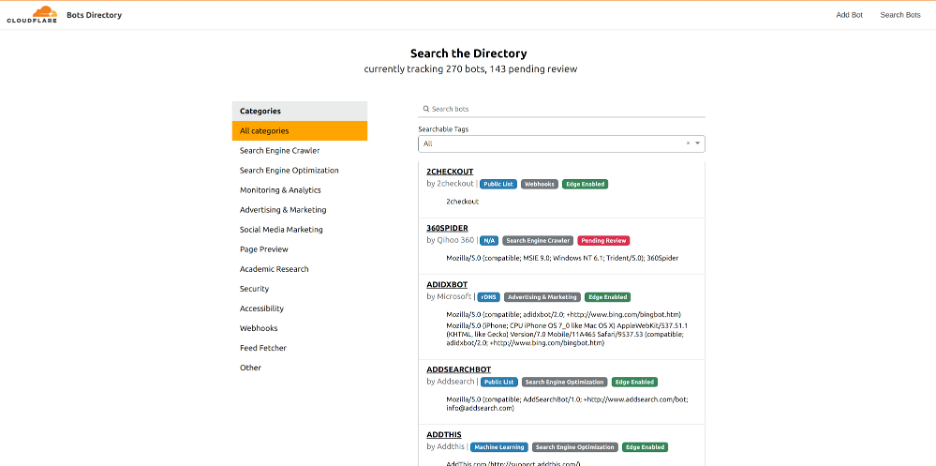
- ML-based bot scoring: Bot Management applies machine learning and behavioral analysis to score each request in milliseconds, covering credential stuffing, scraping, resource abuse, automated probing and inventory hoarding.
- Turnstile as a CAPTCHA alternative: Provides a privacy-preserving challenge for cases where verification is needed, instead of routing legitimate users into a CAPTCHA.
- Anycast DDoS mitigation: Traffic is absorbed and auto-routed across the network, with mitigations triggering in seconds and no manual tuning required.
- API Shield: Applies schema validation and mTLS to REST and GraphQL traffic and enforces client identity without requiring an SDK in the application.
- Per-path rate limiting: Granular policies block floods against endpoints while leaving other paths unrestricted.
- Content scanning and client-side security: WAF Content Scanning inspects file-upload endpoints and returns fields that rules can act on to quarantine or rewrite files, while Page Shield detects Magecart-style client-side tampering.
- Security analytics and Logpush: Real-time dashboards sit alongside raw log delivery to R2, S3 or a SIEM for forensics and compliance evidence.
Limitations (as reported by users on G2):
- Interface complexity: The volume of products and settings makes navigation difficult, and overlapping rule layers can leave users unsure which one governs a given policy.
- Cost at higher tiers: Many capabilities that teams need as they grow require upgrading, and pricing scales sharply beyond the entry plans.
- Learning curve on advanced features: Custom WAF rules, bot configuration and caching policies take time to configure correctly, particularly for teams without dedicated security staff.
- False positive troubleshooting: Managed rules occasionally block legitimate API traffic, and identifying which rule fired means working through logs.
- Support access on lower plans: Response times on lower tiers are reported as slower, with direct channels reserved for enterprise accounts.
Source: Cloudflare
6. Akamai App & API Protector

Best for: Large estates needing edge WAAP plus hybrid coverage
Strengths: Self-tuning security engine and behavioral L7 DDoS defense
Things to consider: Configuration pushes and rule tuning take time
Akamai App & API Protector combines WAF, Layer 7 DDoS defense, API discovery, sensitive data protection, and bot controls in a single solution delivered from the Akamai edge. Every request is inspected in real time before it reaches the origin, and protections are updated by Akamai rather than maintained by the customer.
For environments that are not entirely behind the Akamai platform, App & API Protector Hybrid extends WAF protections to on-premises, hybrid cloud, and multi-CDN deployments. Support is available as fully managed, co-managed, or self-service.
Key features include:
- Adaptive Security Engine: Learns attack patterns and updates protections automatically, using machine learning-powered self-tuning and single-click policy recommendations to reduce manual rule maintenance.
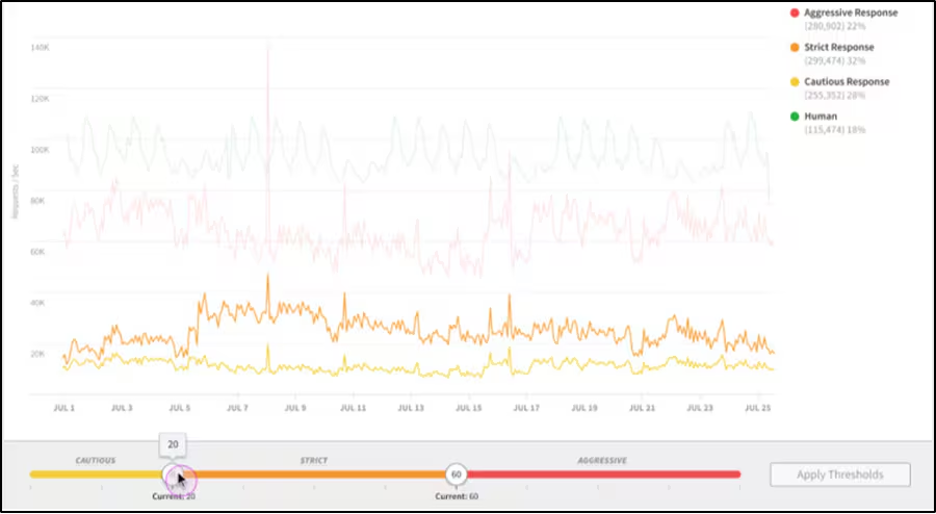
- Behavioral DDoS Engine: Applies behavioral and anomaly-based detection to Layer 7 traffic, providing automated defense against sophisticated volumetric attacks without operator intervention.
- API discovery and protection: Identifies APIs across the estate and applies protections that cover the OWASP API Top 10 alongside the standard OWASP Top 10 web risks.
- Hybrid deployment: App & API Protector Hybrid takes WAF protections off the Akamai edge and into on-premises, hybrid cloud, and multi-CDN environments for consistent policy across distributed architectures.
- DevOps integration: Configuration changes can be automated in a CI/CD pipeline through an open API, a Terraform provider, or the Akamai CLI, with a public Postman collection available for testing.
- Edge malware scanning: An optional malware protection module scans files at the edge so they do not reach the origin.
- SIEM connectivity: Connectors for Splunk and other providers, plus a SIEM integration module, feed attack data into existing detection and forensics workflows.
Limitations (as reported by users on PeerSpot):
- Configuration propagation time: Pushing a configuration across the network takes around twenty minutes, and retracting it takes a similar amount of time.
- Application layer protection depth: Some users compare the application layer attack protection unfavorably with competing platforms and run a second layer for advanced cases.
- Bot tuning effort: Bot management is effective but requires substantial fine-tuning, often with support involvement, before it fits a specific application.
- Documentation and support knowledge base: Documentation is described as outdated in places, including gaps on how conflicting rules resolve, and response times on support requests can be slow.
- Custom rules and analytics: Custom rule capabilities and analytics visibility in the console were both raised as areas needing improvement, along with the absence of a built-in CAPTCHA challenge in bot policy.
- Pricing: Costs are considered high relative to the market.
Source: Akamai
7. Fastly

Best for: DevOps teams wanting low-tuning WAF across deployments
Strengths: SmartParse detection and shared NLX malicious IP feed
Things to consider: Advanced rule work often needs vendor support
The Fastly Next-Gen WAF protects applications, APIs, and microservices from a single solution regardless of where they run. Instead of regex pattern matching that requires constant tuning, it uses SmartParse, a detection method that evaluates the context of each request and how it would execute to determine whether the payload is malicious or anomalous.
Deployment is deliberately flexible: the WAF installs through an agent-module software pair, or through edge and cloud-based options that need no software installation at all. Fastly also offers deployment through A10 Networks Thunder ADC for hardware and virtual platforms.
Key features include:
- SmartParse contextual detection: Evaluates request context rather than matching patterns, which allows detection to start without an extended tuning period.
- Network Learning Exchange: NLX is a shared IP reputation feed built from anonymized, confirmed malicious activity across Fastly’s customer base, used to act on attack sources before they reach a given application.
- Broad API protocol coverage: Detects and blocks attacks in SOAP, REST, gRPC, WebSockets, and GraphQL APIs, with dedicated GraphQL Inspection, and monitors for unexpected values and parameters submitted to endpoints.
- Bot protection and AI bot management: Identifies and mitigates bad bots against websites and APIs, with a separate AI Bot Management product aimed at stopping AI bots from scraping site content.
- Account takeover detection: Inspects web requests and correlates anomalous activity with malicious intent to block credential stuffing and account takeover attempts.
- Threshold-based DDoS blocking: When defined traffic thresholds for key application functions are met, abusive traffic is blocked automatically.
- Advanced rate limiting: Stops high-volume anomalous requests and reduces web server and API utilization while letting legitimate traffic through.
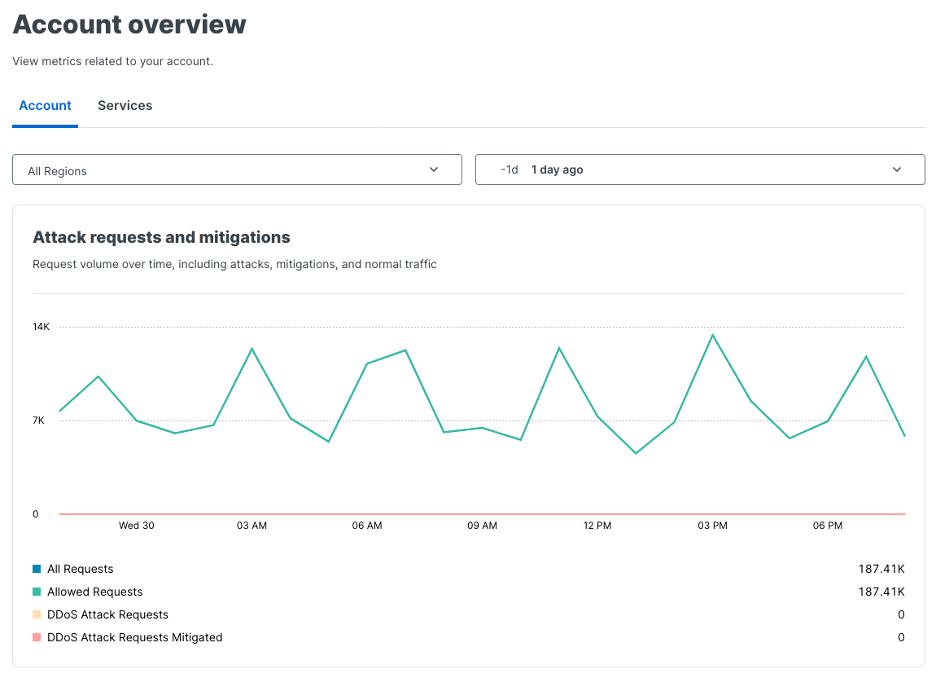
- Layer 7 visibility: Reporting and alerting feedback loops cover the full application and API footprint, with integrations into DevOps and security toolchains.
Limitations (as reported by users on G2):
- Pricing at smaller scale: Costs are considered high for small projects, and licensing rises quickly once multiple hostnames or subdomains are added.
- Support responsiveness: Response times for configuration refinements are reported as slow, which delays issue resolution.
- Advanced rule configuration: Defining rules is described as challenging, and advanced rules often require support involvement rather than being handled in-house.
- Documentation gaps: Limited documentation and tutorials make it harder to use the full feature set without assistance.
- Interface and monitoring: Some users found the interface cumbersome to navigate for rule setup and management, and raised gaps in monitoring traffic data.
Source: Fastly
8. AWS WAF
Best for: Workloads already fronted by CloudFront, ALB, or API Gateway
Strengths: Managed rule groups with bot control and L7 DDoS automation
Things to consider: Rule structure and cost model get complex at scale
AWS WAF applies security rules that control bot traffic and block common attack patterns such as SQL injection and cross-site scripting. Rules filter web requests based on conditions including IP addresses, HTTP headers and body content, and custom URIs, and managed rule groups cover common cases without hand-writing each rule.
A consolidated interface brings core security functions together with specialized partner protections, which AWS states reduces security deployment configuration steps by up to 80%. Guided onboarding activates preconfigured security defaults through a single-page setup.
Key features include:
- Managed rules and protection packs: Preconfigured protection packs target specific industries and workload types, including APIs, PHP applications, and web services, and are continuously optimized without requiring deep deployment expertise.
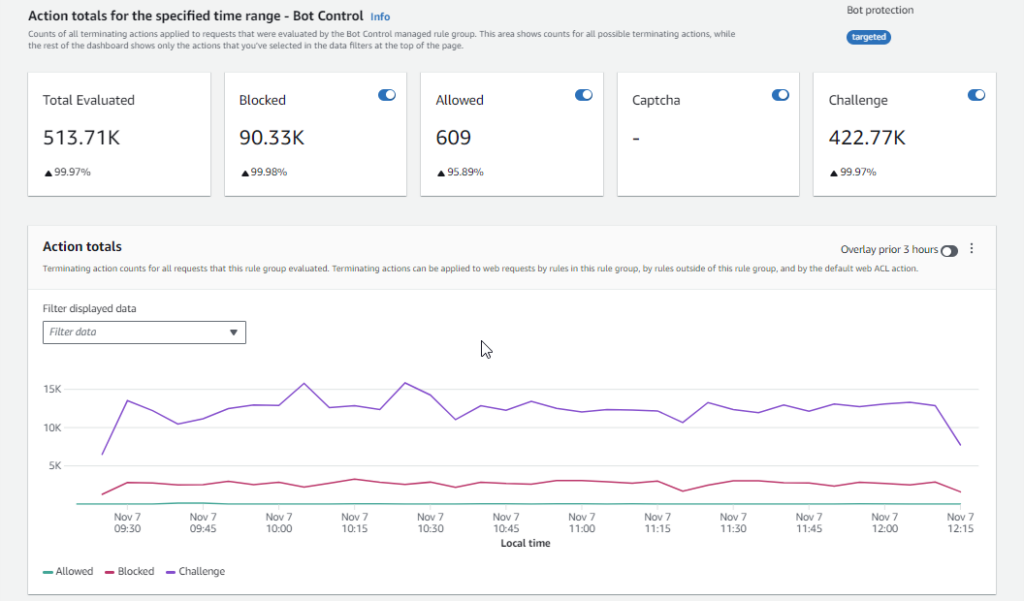
- Bot traffic controls: Monitors, blocks, or rate-limits common and pervasive bot traffic, with the option to collect payments from AI bots and agents accessing content and APIs through Coinbase’s x402 Facilitator.
- Automatic Layer 7 DDoS protection: Continuously monitors for application-layer DDoS events and mitigates them automatically within seconds.
- Account takeover and fake account prevention: Monitors login pages for unauthorized access using compromised credentials and signup pages for fake account creation by automated bots or disposable email addresses.
- Custom request filtering: Rules can be built on IP address, HTTP header and body content, or custom URI conditions to shape which requests reach the application.
- Centralized visibility: A single interface combines core security functions with partner protections and turns security data into ongoing recommendations for tightening posture.
Limitations (as reported by users on PeerSpot):
- Rule structure complexity: The rule structure is described as complicated and hard to maintain, particularly as the number of rules grows.
- Bot and DDoS depth: Users have asked for stronger bot and DDoS protection to match what dedicated WAAP vendors provide.
- Pricing transparency: Cost management is not intuitive, especially for smaller organizations and teams without in-house expertise to model usage.
- Support responsiveness: Technical support is reported as less responsive and less knowledgeable than that of competing vendors.
- Documentation: Documentation is described as complex during initial implementation and incomplete on newer features, pushing users toward community forums.
- False positives and monitoring: Signature sets generate false positives that need manual correction, and dashboards, default metrics, and reporting formats were all raised as areas needing improvement.
Source: AWS
Conclusion
Web Application and API Protection platforms help organizations defend modern applications against a combination of web exploits, API attacks, malicious bots, and denial-of-service campaigns through a unified security architecture. When evaluating a WAAP solution, organizations should consider the breadth of protection across application and API traffic, the effectiveness of behavioral detection, deployment flexibility, automation capabilities, and the ability to correlate threats across multiple attack vectors. A platform that combines strong prevention, real-time visibility, and centralized policy management can reduce operational complexity while improving application availability, security, and resilience as digital services continue to expand.