Back to API Bites

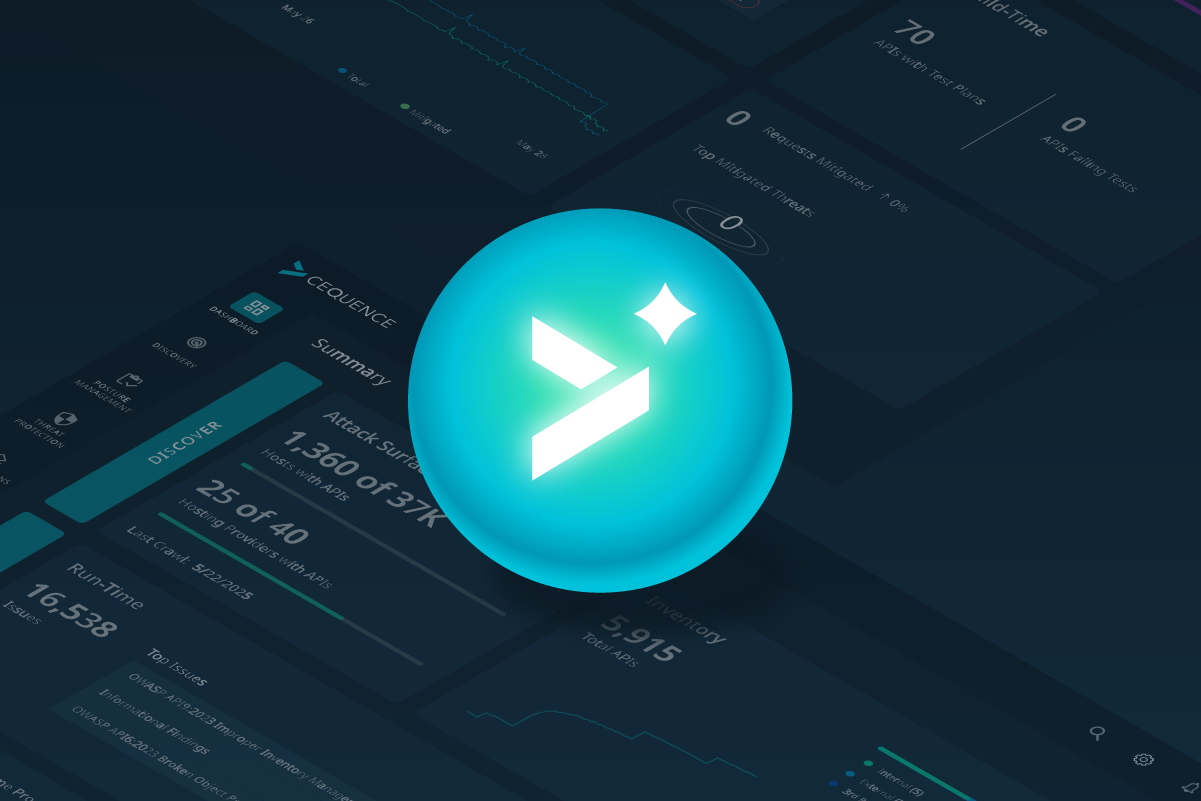
Cequence Platform 9.0 embeds an AI assistant and exposes the full platform via MCP, so every team gets the expertise it needs and every agent gets the access it earns.
AI agents are changing how customers interact with applications. Shopping, banking, claims processing, network configuration — workflows that once required a human to navigate a UI are now handled by AI agents that call APIs directly, autonomously, and at machine scale. For most of the enterprise, that’s a productivity story. For security teams, it’s more pressure on a problem they were already behind on.
Postman’s 2025 State of the API Report found that 51% of organizations have already deployed AI agents, and another 35% plan to within two years. Most APIs in production were never built with this in mind. They were designed for humans, at human scale, and the security programs watching them were staffed accordingly. Meanwhile the API estate keeps growing.
In telecom, financial services, and retail, where Cequence protects some of the world’s largest API footprints, that growth isn’t abstract. It’s thousands of microservices stacked on legacy SOAP infrastructure, internal, public, and partner APIs, and mobile backends running in parallel with web-facing endpoints that were supposed to be decommissioned years ago. That last part is the quiet risk. A forgotten API isn’t just a hygiene problem; it’s a live attack surface, and increasingly, a problem made worse by AI agents that will likely find and consume it anyway, burning tokens and budget, and sometimes surfacing data they were never meant to reach.
Security teams are expected to manage the risk across all of it. Headcount rarely keeps pace.
The architecture most vendors got wrong
The common answer for most vendors is to bolt a chat interface onto their security product. This is the wrong answer. A chatbot layered onto a closed platform delivers value only to people who already know what questions to ask. For an experienced analyst, it saves time. For a generalist, a compliance officer, or a team that just inherited an API security program, it adds very little. A bolted-on chatbot also locks users into the chatbot’s particular model and prevents them from leveraging existing agentic workflows with the application.
The Cequence Platform 9.0 takes a different approach. Rather than simply adding an AI chatbot to the product, we made the entire platform AI-accessible by exposing it as a set of MCP (Model Context Protocol) tools. Every capability available in the UI is now accessible by any MCP-compatible agent: the built-in assistant, a SOAR platform, a custom automation script, a third-party AI workflow. The platform can be driven by agents, not just operated through a browser.
The built-in AI Assistant is the first expression of that architecture. The result is a product where the UI is optional, where the interface that makes the most sense for your team’s workflow, whether that’s a chat window, an automated pipeline, or an agent your engineers built in-house, works equally well.
While other products confine users to the built-in agent in a closed system, Platform 9.0 plugs into the agentic infrastructure an organization already has, extending it rather than replacing it. And the same MCP architecture that today covers the full API Security capability set provides the foundation for adding bot management and threat protection use cases in upcoming releases, no redesign required.
Compliance-ready risk rules and compliance packages
Compliance drives most API security purchases, and it’s also where most programs stall. Platform 9.0 ships with more than 250 pre-built risk rules mapped to 25 global compliance frameworks: the OWASP API Security Top 10, PCI DSS, GDPR, HIPAA, SOC 2, ISO 27001, NIST CSF, LGPD, SAMA, and additional regional frameworks across the Americas, EMEA, and APAC. Teams get audit-grade coverage out of the box, with no professional services engagement and no custom rule development.
Adding a framework doesn’t mean drowning in alerts. An “observe” mode lets teams validate them against live traffic without raising formal issues, and a test panel checks any rule against sample data before it goes live. New coverage comes online deliberately, mapped to the controls a CISO or auditor will ask about.
API security that scales to millions of endpoints
Platform 9.0 runs at the scale Cequence’s enterprise customers need: millions of endpoints, thousands of API specifications, deployed across global organizations in the industries where API complexity runs deepest. Pages load in seconds across every view at enterprise scale. Parameterization keeps that scale legible. In a large estate, a single logical endpoint can surface as thousands of paths that differ only by a variable, so /users/12345/orders and /users/67890/orders read as two APIs and an IoT fleet of a million devices reads as a million endpoints. Parameterization collapses the near-duplicates into one endpoint pattern, so the inventory reflects the real API surface and risk scoring stays meaningful across the most complex environments – IoT device fleets, SOAP services, GraphQL alongside REST, and API estates that no one designed a clean architecture diagram for.
A different capability at every stage of the program
The value compounds differently depending on where you are in an API security program.
Day 0: “What do I have, and what’s actually at risk?”
A team implementing an API security program for the first time faces a disorienting amount of data. Hundreds or thousands of endpoints, risk findings across dozens of categories, and without domain expertise, no obvious place to start.
The Platform 9.0 AI Assistant is the guide. Ask it which APIs need attention first, and it doesn’t return a raw list sorted by score. It surfaces prioritized findings grounded in your environment:
- An unauthenticated account creation flow with PII and payment card data in the response
- A shadow /oauth/token endpoint leaking API keys, not in any spec, not in any runbook
- Documented endpoints actively violating PCI DSS requirements, with evidence attached
These findings used to require someone who knew both the platform and the business well enough to distinguish “this endpoint is intentionally public” from “this endpoint is exposed and shouldn’t be.” That judgment is now built into the assistant. Teams without a dedicated API security specialist get a starting point that reflects actual risk, not just what’s technically detectable.
Day 180: “Show me how we’re progressing, in a format that means something to my stakeholders”
Six months in, a team’s questions shift from discovery to accountability. How has posture changed? What does our risk profile look like against the frameworks our regulators care about? How do we communicate this to leadership?
Platform 9.0 generates compliance reports on demand through the assistant: PCI DSS posture for the CISO, GDPR coverage for legal, SAMA compliance for the Saudi Arabia operations team, CDR status for the Australian entity. With over 25 compliance framework categories available out of the box, the coverage is broad.
Customers can also bring their own report templates. Define the sections, the metrics, and the framing that matter to your stakeholders, not just what a system report offers. A regional bank reporting to its board has different needs than a global retailer presenting to a compliance committee. Both are supported, and neither is forced into a format designed for someone else.
Year 2: “Keep the posture sharp while I focus on everything else”
Security teams at scale carry long lists of competing priorities and API security is only one of them. At year two of a program, the question becomes how to maintain rigor without requiring constant expert attention. This is where the multi-step AI workflow changes things.
A security engineer suspects that customer-facing API responses may be leaking a proprietary internal identifier, a field pattern that doesn’t match any existing detection rule. They describe it to the assistant in plain language. The assistant creates a custom sensitive data expression, then without requiring further prompting, creates a risk rule that looks for that expression specifically in response payloads. Two issues surface across production endpoints. The assistant presents the evidence. The engineer confirms they’re valid. A Jira ticket is filed automatically, pre-populated with the affected endpoints, rule details, and masked evidence. The assistant monitors the ticket status and alerts when the developer marks it resolved, triggering a 24-hour verification window before the issue auto-closes.
That sequence, from “I think there might be a problem” to verified, documented remediation, previously required an experienced analyst, familiarity with CEL expression syntax, manual ITSM access, and someone remembering to follow up weeks later. Now, it’s a conversation.
For resource-constrained security teams, that’s not just convenient. It’s time returned to the work that requires human judgment. The AI handles the instrumentation; the analyst handles the decisions.
Making the platform agent-accessible is one thing. Governing the agents is another.
Platform 9.0’s MCP server opens the platform to your organization’s agentic workflows. But making a platform accessible to agents raises an immediate governance question: which agents should be able to do what?
An agent that queries API inventory to generate a weekly posture report doesn’t need the same permissions as one that creates and modifies risk rules. An agent used by a compliance analyst shouldn’t have access to the same tools as one used by a platform administrator. As agents proliferate across teams, vendors, and use cases, least privilege isn’t just a principle. It’s an operational requirement.
This is where the Cequence AI Gateway complements the new features in Platform 9.0. Agent Personas enforce tool-level access controls for every agent that connects to your MCP infrastructure, scoping each agent to only the tools and data its specific role requires, with full audit trails for every action. Think of it as least privilege access for agents: not just who the agent is, but what it’s allowed to do.
Making your API security platform AI-native is the right call. Governing the agents that use it is what keeps that decision from creating new problems.
Want to see Platform 9.0 in action? Contact us to get a personalized demo.