What Is Web Application and API Protection (WAAP) and How Do You Evaluate It for a Hybrid Environment?
Web Application and API Protection (WAAP) is a security framework to protect web applications and APIs from a range of cyber threats. It combines multiple security technologies (including web application firewalls, API security, bot management, and DDoS protection) into a unified platform.
To choose WAAP for hybrid cloud environments, you must select a platform that provides universal visibility, consistent policy enforcement, and localized traffic inspection across both on-premises data centers and public clouds.
Key Evaluation Criteria for Hybrid Environments
Use these five criteria to compare solutions across a distributed estate:
- Hybrid deployment and enforcement model: Where the solution can run and whether traffic can be inspected locally.
- Unified control plane and visibility: Whether one console governs policy, logs, and analytics across every environment.
- API discovery and inventory: How the solution finds documented, undocumented, and shadow APIs across clusters and clouds.
- Bot and automated abuse defense: How automated traffic is detected and mitigated without blocking real users.
- Automation and DevOps integration: How policy is deployed and maintained through pipelines, IaC, and security tooling.
Solutions Covered in This Guide
WAAP Platforms With Hybrid Deployment Options
- Cequence Web Application and API Protection: Combines API discovery, bot defense, WAF, and DDoS protection with passive or inline deployment across on-premises, cloud, and hybrid environments.
- F5 Web Application and API Protection: Provides WAF, API, bot, and DDoS protection across SaaS, BIG-IP, NGINX, Kubernetes, and hybrid multicloud deployments.
- Imperva Application Security Platform: Offers cloud, locally deployed, and Kubernetes-based WAF options alongside API security, bot protection, and DDoS mitigation.
- Fortinet FortiWeb: Supports hardware, VM, container, public cloud, and SaaS deployment with ML-based API discovery and application protection.
- Barracuda Application Protection: Provides WAF, bot, DDoS, and application security through appliance, container, cloud, and SaaS deployment models.
Edge-Delivered WAAP Services
- Akamai App & API Protector: Delivers edge-based WAF, API, bot, and DDoS protection with a hybrid option extending WAF enforcement to on-premises and multi-cloud environments.
- Cloudflare Application Services: Consolidates WAF, DDoS, bot management, and API security on Cloudflare’s global network for applications hosted across cloud and on-premises environments.
- Fastly Next-Gen WAF: Protects distributed applications and APIs through agent-based local enforcement or edge and cloud deployment options with contextual attack detection.
In this article:
- Why Hybrid Cloud Environments Complicate Application Security
- Key WAAP Capabilities for Hybrid Cloud
- How to Choose a WAAP Solution for Hybrid Cloud
- Common WAAP Solutions and How They Meet the Criteria
- Notable WAAP Solutions for Hybrid Cloud Environments
Why Hybrid Cloud Environments Complicate Application Security
Hybrid cloud environments distribute applications, APIs, and data across on-premises infrastructure, private clouds, and public cloud platforms. This distribution can create inconsistent security controls, fragmented visibility, and additional entry points for attackers. Security teams must protect workloads across these environments while accounting for different architectures, tools, and operational models.
- Inconsistent security policies:
Different environments may use separate security products and policy formats, creating protection gaps or conflicting rules between cloud and on-premises systems. - Limited visibility:
Application traffic and security events are distributed across multiple platforms. Without centralized monitoring, security teams may struggle to identify attacks that move between environments. - Larger attack surface:
Hybrid deployments expose more applications, APIs, endpoints, and network paths. Each additional component can introduce vulnerabilities or configuration errors. - API complexity:
Applications in hybrid environments often rely on APIs to connect services across infrastructure boundaries. Unmanaged or poorly secured APIs can expose sensitive data and critical business functions. - Configuration differences:
Cloud providers and on-premises systems use different security settings, identity models, and networking controls. Misconfigurations can occur when teams apply the same security assumptions across different platforms. - Dynamic workloads:
Cloud resources can be created, scaled, and removed automatically. Security controls must adapt quickly so that new workloads receive protection as soon as they become available. - Distributed identity and access management:
Users, services, and machines may authenticate through multiple identity systems. Maintaining consistent access controls becomes more difficult as identities and permissions span multiple environments.
Key WAAP Capabilities for Hybrid Cloud
Web Application Firewall
A Web Application Firewall (WAF) serves as the frontline defense for web applications, inspecting and filtering HTTP traffic to block malicious requests. It protects against common threats such as SQL injection, cross-site scripting, and remote code execution by enforcing security policies tailored to the application’s needs. Modern WAFs in a WAAP platform are designed to support both traditional and cloud-native architectures, ensuring consistent protection regardless of where the application is hosted.
In hybrid cloud environments, WAFs must be highly adaptable, providing centralized management and automated policy updates across distributed deployments. This capability allows organizations to maintain uniform protection as applications scale or migrate between environments. Advanced WAF solutions use machine learning and threat intelligence to identify and block zero-day attacks and evolving threats, reducing the risk of breaches while minimizing false positives that could disrupt legitimate user activity.
API Security
APIs have become essential for modern applications, but they also introduce new security risks, including exposure of sensitive data, unauthorized access, and abuse by attackers. API security in a WAAP platform focuses on discovering, monitoring, and protecting all APIs in use, regardless of their location. This includes enforcing authentication, authorization, input validation, and rate limiting to prevent common API-specific threats such as broken object-level authorization and mass assignment vulnerabilities.
Effective API security goes beyond basic protection by offering automated discovery of undocumented or “shadow” APIs and providing real-time visibility into API traffic. In hybrid cloud environments, this is critical for preventing data leaks and ensuring that all endpoints are secured consistently. WAAP solutions often integrate with API gateways and developer workflows, enabling rapid deployment of security policies and immediate response to new threats as applications evolve.
Bot Management
Malicious bots are responsible for a significant portion of online attacks, including credential stuffing, scraping, and denial-of-service attempts. Bot management in a WAAP platform uses behavioral analysis, machine learning, and fingerprinting techniques to distinguish between legitimate users and automated bots. This enables the system to block or challenge harmful bots while allowing good bots, such as search engine crawlers, to operate without disruption.
In hybrid cloud environments, bot management solutions must scale dynamically and provide centralized visibility across all application instances. This ensures consistent protection regardless of where the application is running. Advanced bot management features may include real-time threat intelligence, customizable response actions, and integration with fraud prevention systems to stop sophisticated attacks that target APIs and web applications.
DDoS Protection
Distributed Denial of Service (DDoS) attacks can overwhelm web applications and APIs, rendering them inaccessible to legitimate users. DDoS protection within a WAAP platform provides always-on monitoring and automated mitigation to absorb and deflect volumetric, protocol-based, and application-layer attacks. This is achieved through a combination of traffic scrubbing, rate limiting, and dynamic filtering, often leveraging a globally distributed network to absorb large-scale attacks.
For hybrid cloud deployments, DDoS protection must extend across all environments and entry points to prevent attackers from exploiting gaps in coverage. Centralized management and real-time visibility enable security teams to respond quickly to active threats and adjust protection strategies as needed. Integration with other WAAP components ensures that DDoS mitigation works in concert with application and API security, providing comprehensive defense without impacting performance.
Threat Intelligence
Threat intelligence is a foundational capability of WAAP platforms, providing real-time data on emerging threats, attack patterns, and known malicious actors. By integrating threat intelligence feeds, WAAP solutions can automatically update security policies and detection rules to defend against the latest exploits and attack campaigns. This helps organizations stay ahead of attackers, reducing the window of exposure for new vulnerabilities.
In hybrid cloud environments, threat intelligence must be actionable and accessible across all deployed components. Centralized dashboards and automated policy enforcement ensure that threat data is quickly translated into protective measures, regardless of where applications and APIs reside. Advanced WAAP platforms may also use threat intelligence to prioritize alerts, support incident response, and integrate with external security operations tools for a coordinated defense.
Unified Control Plane
A unified control plane allows organizations to manage security policies, configurations, and monitoring from a single interface, regardless of where applications and APIs are deployed. This centralization simplifies operations, reduces the risk of misconfiguration, and ensures consistency across hybrid and multi-cloud environments. Security teams can deploy, update, and enforce policies globally without having to manually synchronize changes across disparate systems.
A unified control plane also improves visibility, allowing administrators to monitor threats, traffic patterns, and compliance status in real time. Advanced solutions offer automation capabilities, role-based access controls, and integration with other IT management tools. This simplifies security operations and makes it easier to adapt to changing business requirements or respond to incidents quickly and efficiently.
Local Enforcement Engine
A local enforcement engine delivers security controls directly at the point of application deployment, providing inline protection without routing traffic through external gateways. This approach reduces latency and ensures that security policies are enforced even if connectivity to the central control plane is lost. Local enforcement is particularly important in hybrid cloud environments, where applications may be distributed across multiple clouds, data centers, or edge locations.
By deploying enforcement engines close to the application, organizations can maintain granular control over security posture, adapt to local compliance requirements, and minimize the risk of single points of failure. These engines can operate autonomously, updating policies and responding to threats in real time based on guidance from the centralized WAAP platform. The result is a more resilient and responsive security architecture that aligns with the demands of modern, distributed applications.
CI/CD Integration
Continuous Integration and Continuous Deployment (CI/CD) pipelines are critical for delivering software quickly, but they can also introduce security risks if not properly managed. WAAP platforms that integrate with CI/CD workflows enable organizations to embed security checks and policy enforcement directly into the development lifecycle. This ensures that vulnerabilities are detected and remediated before code is deployed to production environments.
CI/CD integration also supports automated policy updates, compliance checks, and threat modeling as part of the software delivery process. By aligning security with DevOps practices, organizations can reduce manual effort, accelerate response to emerging threats, and maintain consistent protection across rapidly evolving hybrid cloud applications. This approach fosters a culture of “security as code,” making security an integral part of application development and deployment.
How to Choose a WAAP Solution for Hybrid Cloud
The criteria below map to the problems hybrid environments create. Work through them in order, since the deployment model constrains what the other four can realistically deliver.
1. Hybrid Deployment and Enforcement Model
This criterion covers the form factors a solution supports and where inspection physically happens. Some platforms enforce policy only on the vendor’s network, which requires routing production traffic outward through a reverse proxy. Others run software or appliances inside your environment, so traffic stays local. That distinction drives latency, data residency, and whether internal service-to-service traffic can be inspected at all.
Evaluation criteria:
- Does it support on-premises, private cloud, public cloud, Kubernetes, and edge deployment?
- Can traffic be inspected locally, or must it be routed to the vendor’s network first?
- Does enforcement continue if connectivity to the central control plane is lost?
- Are passive and inline modes both available, so you can start in monitoring mode?
- Can it inspect east-west traffic between services, not just north-south traffic?
2. Unified Control Plane and Visibility
A hybrid estate typically accumulates one security product per environment, each with its own policy format and log destination. A unified control plane means one console defines policy, one place shows what happened, and changes propagate without manual synchronization. Without it, gaps appear at the seams between environments, and attacks that move between them are hard to reconstruct.
Evaluation criteria:
- Is there a single console for WAF, API security, bot management, and DDoS?
- Do policies apply consistently to legacy and cloud-native applications alike?
- Are logs and security events exportable to your existing SIEM?
- Does the dashboard show traffic and threats across all environments in one view?
- Are role-based access controls available for distributed teams?
3. API Discovery and Inventory
Applications in hybrid environments connect through APIs that cross infrastructure boundaries, and many of those endpoints are never documented. Discovery is what turns an unknown attack surface into a manageable inventory, covering internal, external, and third-party APIs plus the gateways and hosting providers behind them. Without continuous discovery, protection only covers the endpoints someone remembered to register.
Evaluation criteria:
- Does it discover undocumented and shadow APIs continuously, not just at onboarding?
- Does discovery cover internal and third-party APIs as well as public-facing ones?
- Can it generate or validate API specifications when none exist?
- Does it detect and classify sensitive data flowing through endpoints?
- Does it integrate with existing API gateways, proxies, and ingress controllers?
Related content: Read our article about building and maintaining an API inventory.
4. Bot and Automated Abuse Defense
Automated traffic drives credential stuffing, scraping, and business logic abuse, and it targets APIs directly rather than going through a browser. Detection methods vary: some solutions rely on client-side JavaScript or SDKs, while others analyze traffic behavior at the network level. The method matters in hybrid environments, because client-side instrumentation has to be added to every application.
Evaluation criteria:
- Does detection require client-side JavaScript, SDK integration, or code changes?
- Does it distinguish good bots such as search crawlers from malicious automation?
- Does detection hold up when attackers re-tool to evade fingerprints?
- What mitigation options exist beyond blocking, such as rate limiting or deception?
- How much tuning is needed before false positives reach an acceptable level?
5. Automation and DevOps Integration
Hybrid workloads are created, scaled, and removed automatically, so security policy has to move at the same speed. This criterion covers whether policy can be defined as code, tested before release, and updated through the same pipelines that ship the application. It also covers how findings reach the teams that fix them.
Evaluation criteria:
- Is there a Terraform provider, CLI, or public API for policy management?
- Can security testing run in pre-production CI/CD pipelines?
- Do new workloads inherit protection automatically as they come online?
- Are there connectors for SIEM, ticketing, and alerting tools?
- How quickly do policy changes propagate across all environments?
Common WAAP Solutions and How They Meet the Criteria
The table summarizes how each solution measures up against the five criteria. Each is explored in detail below.
| Category | Solution | How It Meets the Criteria |
|---|---|---|
| WAAP platforms with hybrid deployment options | Cequence Web Application and API Protection | Deploys on-premises, in cloud, or hybrid with passive or inline sensors, and combines API discovery, network-based bot detection, WAF, and DDoS in a single tenant. Bot detection needs no client-side code. |
| WAAP platforms with hybrid deployment options | F5 Web Application and API Protection | Covers the widest range of form factors, from SaaS to BIG-IP appliances to NGINX for Kubernetes, with centralized policy across hybrid multicloud. Capability is spread across several products. |
| WAAP platforms with hybrid deployment options | Imperva Application Security Platform | Offers three WAF models: SaaS Cloud WAF, locally deployed WAF Gateway for data sovereignty, and Kubernetes-based Elastic WAF managed through SaaS. Terraform automates Cloud WAF deployment. |
| WAAP platforms with hybrid deployment options | Fortinet FortiWeb | Available as hardware, VM, container, public cloud image, and SaaS, with ML-based API discovery and schema-derived positive security policies. Strongest inside existing Fortinet estates. |
| WAAP platforms with hybrid deployment options | Barracuda Application Protection | Runs as appliance, container, or SaaS, with the containerized WAF manageable from the SaaS console. Adds full-spectrum DDoS, bot protection, and application delivery in one platform. |
| Edge-delivered WAAP services | Akamai App & API Protector | Delivers WAF, API discovery, bot, and DDoS from the edge, with a Hybrid option extending WAF protections to on-premises, hybrid cloud, and multi-CDN environments. Strong DevOps tooling. |
| Edge-delivered WAAP services | Cloudflare Application Services | Consolidates WAF, DDoS, bot management, API security, and CDN in one console for apps hosted anywhere, but enforcement happens on Cloudflare’s network via reverse proxy. |
| Edge-delivered WAAP services | Fastly Next-Gen WAF | Installs via an agent-module pair inside customer environments or runs from the edge, with SmartParse contextual detection and coverage for REST, SOAP, gRPC, GraphQL, and WebSockets. |
Notable WAAP Solutions for Hybrid Cloud Environments
How we selected these solutions: We shortlisted WAAP platforms based on integrated web application firewall, API discovery and protection, bot management, DDoS mitigation, and the ability to enforce consistent policy across on-premises, cloud, and hybrid environments.
WAAP Platforms with Hybrid Deployment Options
1. Cequence Web Application and API Protection

Best for: Protecting APIs and web apps across on-prem, cloud, and hybrid
Strengths: Network-based bot detection, API discovery, native mitigation
Things to consider: Initial setup and tuning benefit from networking expertise
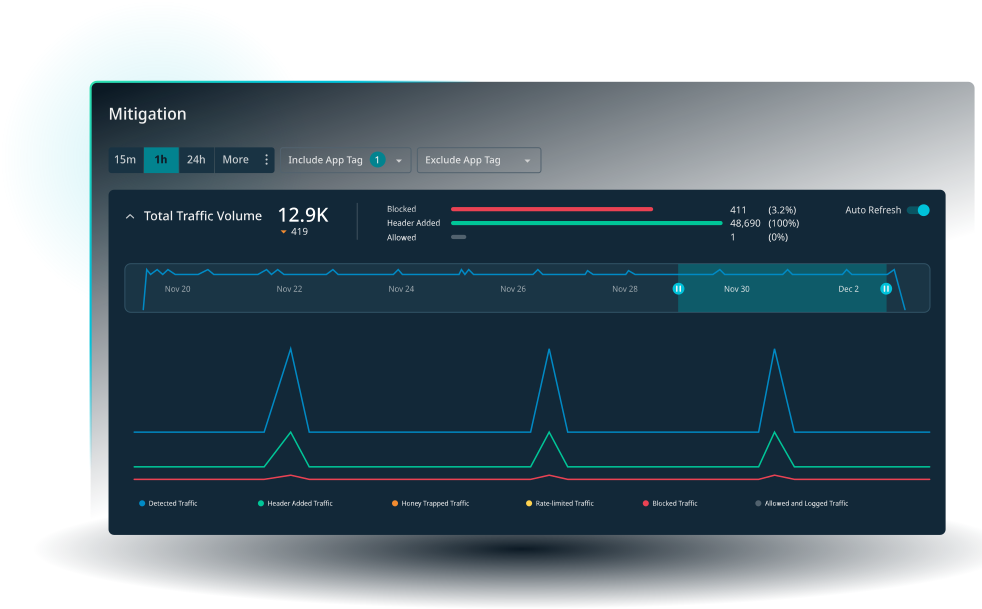
Cequence WAAP combines API security, bot management, WAF, and DDoS protection in a single SaaS cloud tenant. One application protection portal covers all four functions, and running the components in one tenant removes the extra cloud hops and the coverage gaps that come from inconsistent traffic routing between separate products.
Deployment covers on-premises, cloud, and hybrid environments. Software sensors inspect traffic passively to identify anomalies, or run inline for real-time mitigation. Cequence integrates directly with existing infrastructure such as API gateways, and requires no client-side JavaScript or SDK integration in applications, so protection extends across web, mobile, API, and microservices architectures without code changes.
Key features include:
- API discovery and inventory:
Discovers internal, external, and third-party APIs as well as edge, infrastructure, gateway, and hosting providers. A combination of inside-out and outside-in discovery builds a runtime API catalog covering documented, undocumented, third-party, and shadow endpoints. - Compliance-ready risk rules:
Ships more than 250 pre-built risk rules mapped to 25 global frameworks, including every version of the OWASP API Security Top 10, PCI DSS, GDPR, HIPAA, SOC 2, ISO 27001, and NIST CSF, with audit-ready reports generated from live data in a single click. - Sensitive data detection and masking:
Identifies and masks sensitive data using ML-based rules with predefined and customizable patterns, supported worldwide so it can distinguish a US driver’s license number from a Saudi National ID card number. - Network-based bot detection:
Machine learning analyzes behavioral intent across web, mobile, and API traffic rather than relying on end-user device signals, and tracks malicious activity as attackers re-tool. Mitigation includes blocking, rate limiting, header injection, and deception. - Integrated API security testing:
Test plans can be generated automatically from Postman collections or API specifications and run in pre-production and at runtime, with support for CI/CD pipelines, IDEs, and stand-alone testing. - WAF and DDoS protection:
Applies OWASP Web Application Top 10 rules, protection from malicious input patterns, and SQL injection prevention, alongside Layer 3, 4, and 7 DDoS defense against SYN floods, UDP floods, and reflection attacks. - Friction-free user verification:
Biometric Check routes suspicious traffic to a device’s native biometric authentication, such as Face ID, Touch ID, or Windows Hello, instead of CAPTCHA or SMS codes.
| Criterion | Solution Fit | Key Considerations |
|---|---|---|
| Hybrid deployment and enforcement model | Deploys on-premises, in the cloud, or hybrid; sensors run passively for detection or inline for mitigation. | Inline placement involves traffic routing decisions, so DNS and CDN routing knowledge helps during setup. |
| Unified control plane and visibility | Single application protection portal for WAF, bot management, and API security within one cloud tenant. | Tailoring real-time reporting dashboards to a specific team’s preferences can take some iteration. |
| API discovery and inventory | Inside-out and outside-in discovery of internal, external, and third-party APIs, gateways, and hosting providers. | Large estates with many endpoints take time to baseline fully before the inventory settles. |
| Bot and automated abuse defense | Network-level ML detection with no JavaScript or SDK required; blocking, rate limiting, header injection, and deception. | Some policy tuning is needed to reach the right alert volume in noisy environments. |
| Automation and DevOps integration | Testing plugs into CI/CD pipelines and IDEs; integrates with third-party WAFs and API gateways; capabilities exposed as MCP tools. | The full range of configuration and analytics options has a learning curve for new administrators. |
Source: Cequence
2. F5 Web Application and API Protection

Best for: Standardizing security across data center, cloud, and edge
Strengths: Converged WAF, API, bot, and DDoS across many form factors
Things to consider: Capability spans several products, so scoping takes work
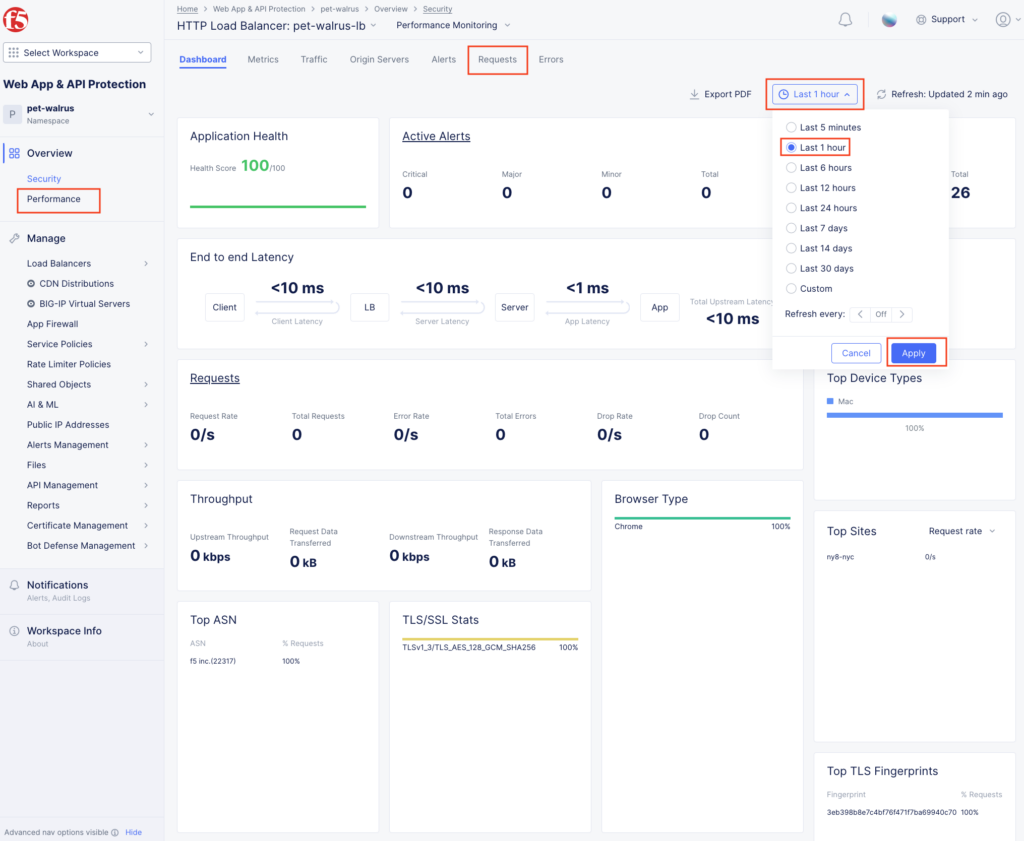
F5 converges WAF, API security, bot management, and DDoS mitigation into an integrated WAAP solution built on the F5 Application Delivery and Security Platform. Protection is delivered close to the application across on-premises, cloud, and edge environments, with consistent policy management so teams can apply virtual patching for OWASP Top 10 and zero-day risks across hybrid multicloud deployments.
The portfolio spans SaaS and self-managed products. F5 Distributed Cloud WAF handles distributed applications, BIG-IP Advanced WAF provides on-premises controls and virtual patching, and F5 WAF for NGINX covers Kubernetes-ready enforcement. Distributed Cloud API Security, Bot Defense, and DDoS Mitigation supply the remaining WAAP layers, with managed service options available.
Key features include:
- Full lifecycle API security:
Discovers and catalogs API endpoints, baselines normal behavior, and protects APIs from development through runtime, with centralized visibility and enforcement across hybrid multicloud environments to reduce blind spots where API-to-API traffic never crosses a perimeter WAF. - Multi-signal bot defense:
Detects automated threats using client, device, browser, identity, and behavior signals, applying step-up challenges only when needed and adapting mitigation as attackers change tactics across BIG-IP and NGINX environments. - Continuous external attack surface assessment:
F5 Web Application Scanning identifies exposed web applications and APIs and runs automated testing to uncover vulnerabilities, feeding prioritized remediation that works alongside inline controls. - Layered DDoS mitigation:
Combines SaaS-delivered mitigation for distributed environments, lightweight Layer 7 DoS protection for NGINX, and BIG-IP AFM controls running on-premises or as a virtual edition. - Client-side and aggregator controls:
Client-Side Defense monitors third-party and injected browser scripts and data skimming, while Aggregator Management controls third-party aggregator traffic. - Virtual patching:
WAF protections act as the core enforcement point, letting teams mitigate newly disclosed vulnerabilities before vendor patches are applied. - CI/CD-embedded protection:
Security controls embed directly into the CI/CD pipeline so policy travels with application delivery rather than being applied only after deployment.
| Criterion | Solution Fit | Key Considerations |
|---|---|---|
| Hybrid deployment and enforcement model | SaaS, on-premises BIG-IP, and NGINX or Kubernetes form factors deliver protection close to the application in any environment. | Capability is spread across several distinct products, so licensing and scope need mapping before purchase. |
| Unified control plane and visibility | Centralized management and integrated monitoring apply consistent policy across hybrid multicloud deployments. | Reviewers point to log dashboards and report export limits as areas needing improvement. |
| API discovery and inventory | Discovery and cataloging of endpoints with behavioral baselining and runtime protection across environments. | Reviewers describe documentation as hard to follow and implementation as time-consuming. |
| Bot and automated abuse defense | Multi-signal detection across client, device, browser, identity, and behavior, with adaptive mitigation. | Cloud-routed bot inspection can add latency, and default configurations may generate false positives until tuned. |
| Automation and DevOps integration | Security controls embed into CI/CD pipelines, with telemetry shared across BIG-IP and NGINX deployments. | Configuration is complex enough that reviewers recommend experienced administrators, and cost is frequently cited. |
Source: F5
3. Imperva Application Security Platform
Best for: Estates mixing legacy on-prem applications with cloud apps
Strengths: Three WAF models including a locally deployed gateway
Things to consider: Pricing and regional partner support draw criticism
Imperva’s Application Security Platform brings WAF, Advanced Bot Protection, API Security, DDoS Protection, Client-Side Protection, and a secure CDN together. The WAF protects applications in cloud and on-premises environments using managed rules that the Imperva Threat Research team writes and tests in production before pushing them, with daily updates and real-time updates for critical threats.
Three WAF deployment models cover different environments. Cloud WAF is a SaaS service managed through the Imperva Management Console. WAF Gateway is deployed and managed locally, which suits legacy applications that cannot move to the cloud and customers with data sovereignty requirements. Elastic WAF uses Kubernetes to deploy inside the customer environment while being managed through SaaS.
Key features include:
- Attack Analytics: Correlates thousands of security alerts into incident narratives using machine learning, providing unified visibility and context on attack origin, methods, and severity to reduce alert fatigue.
- Managed rules and blocking mode: Out-of-the-box rules tested in production environments allow deployment in blocking mode from the start, which Imperva reports more than 90% of customers use.
- API security with data classification: Provides continuous protection of APIs using deep discovery and classification of sensitive data, delivered through the Unified API Security Platform console.
- Advanced Bot Protection: Protects websites, mobile applications, and APIs from automated attacks including account takeover, scraping, and credential abuse, with a separate Account Takeover Protection product covering login endpoints.
- Terraform-based deployment automation: An Imperva Terraform provider and modular Terraform module automate Cloud WAF deployments and manage resources across environments using infrastructure-as-code practices.
- Upload scan and control: Validates, scans, and controls uploaded files before they reach application backends, reducing exposure to malware and data exfiltration through user-generated content.
- Client-Side Protection: Provides visibility and control over third-party JavaScript to address formjacking, digital skimming, and Magecart attacks, and supports PCI DSS 4.0 client-side requirements.
| Criterion | Solution Fit | Key Considerations |
|---|---|---|
| Hybrid deployment and enforcement model | Cloud WAF as SaaS, WAF Gateway deployed and managed locally for data sovereignty, and Elastic WAF running in Kubernetes inside the environment. | Three separate WAF products means feature coverage and operations differ depending on which model each application uses. |
| Unified control plane and visibility | Imperva Management Console manages Cloud WAF sites, and Attack Analytics correlates events across the application security stack. | Reviewers report that audit logging and SIEM export configuration is challenging to set up. |
| API discovery and inventory | Continuous API protection with deep discovery and classification of sensitive data across endpoints. | API Security is a distinct product within the platform rather than a feature of the WAF. |
| Bot and automated abuse defense | Advanced Bot Protection covers websites, mobile apps, and APIs, with dedicated account takeover protection. | Reviewers note limited options for testing rules and bot detection with their own test tooling. |
| Automation and DevOps integration | Terraform provider and modules automate Cloud WAF deployment, with automated policy creation and rapid rule propagation. | Cost is a recurring complaint, and partner support quality is reported to vary by region. |
Source: Imperva
4. Fortinet FortiWeb

Best for: Fortinet estates needing appliance, VM, container, or SaaS WAAP
Strengths: Broad form factors plus hardware-accelerated throughput
Things to consider: Scaling can require hardware upgrades; support can lag
FortiWeb protects web applications and APIs against OWASP Top 10 threats, bots, and DDoS attacks using anomaly detection, API discovery and protection, bot mitigation, and client-side security. It applies AI to detect zero-day exploits, adds advanced threat analytics and a built-in SOC agent, and covers local, hybrid, and cloud deployments.
A dual-layer machine learning approach models each application instead of relying on the manual tuning that traditional application learning requires, identifying malicious patterns, minimizing false positives, and prioritizing remediation contextually. FortiWeb ships as hardware appliances, virtual machines, container appliances, public cloud images, and SaaS, and is available through the FortiFlex consumption program.
Key features include:
- Automated API discovery and positive security policies: Machine learning algorithms discover APIs by continuously evaluating application traffic, and out-of-the-box policies generate a positive security model for each schema specification, covering OpenAPI, XML, and JSON.
- Bot deception and biometric detection: Uses bot deception, biometric detection, and machine learning to identify bot traffic while allowing search engines and monitoring tools through, reducing reliance on CAPTCHAs and other challenges that degrade user experience.
- Client-side protection: A policy-based feature that detects and mitigates third-party script injections, DOM manipulation, and form hijacking inside the user’s browser, addressing PCI DSS requirements for monitoring scripts on payment pages.
- Security Fabric integration: Integrates with FortiGate next-generation firewalls and FortiSandbox to defend against advanced persistent threats, with centralized management alongside other Fortinet products.
- Hardware-based acceleration: Appliances combine multi-core processor technology with hardware-based SSL tools to deliver protected WAF throughput and rapid traffic encryption and decryption.
- FortiAI-Assist and advanced analytics: Consolidates raw event data into a view of significant threats, with recommended playbooks, threat-hunting capabilities, and accelerated forensics.
- CI/CD API security integration: API security controls integrate into the CI/CD pipeline so protection is applied as new endpoints are released.
| Criterion | Solution Fit | Key Considerations |
|---|---|---|
| Hybrid deployment and enforcement model | Hardware, virtual machine, container, public cloud, and SaaS form factors support local, hybrid, and cloud deployments. | Reviewers report that high availability and scalability features are limited and can require costly hardware upgrades. |
| Unified control plane and visibility | Centralized management and visibility alongside FortiGate and FortiAnalyzer, with advanced analytics and threat hunting. | The consolidation benefit is largest inside an existing Fortinet estate; mixed-vendor environments gain less. |
| API discovery and inventory | ML-based discovery from live traffic, with automatically generated positive security policies per OpenAPI, XML, or JSON schema. | Schema-based enforcement depends on API definitions being kept current as endpoints change. |
| Bot and automated abuse defense | Bot deception, biometric detection, and machine learning classification, with allowances for legitimate bots. | Initial configuration is described as complex, and properly tuning policies takes time. |
| Automation and DevOps integration | API security integrates into CI/CD pipelines, and FortiFlex supports right-sizing cloud services and spend. | Reviewers describe third-party integrations as confusing and support response times as slow. |
Source: Fortinet
5. Barracuda Application Protection
Best for: One platform spanning appliance, container, and SaaS models
Strengths: WAF, DDoS, bot, and app delivery with auto-configuration
Things to consider: False-positive tuning takes time; reporting is basic
Barracuda Application Protection is an integrated platform that brings WAAP functionality together with advanced security services for applications deployed on-premises, in the cloud, or in hybrid environments. It covers the OWASP Top 10 web and API threats, zero-day attacks, and account takeover, with automatic detection and remediation through a Smart Signature engine and a positive security model.
Deployment options include hardware and virtual appliances that run on premises or hosted in the cloud, a container form factor, and a SaaS service. The containerized Barracuda Web Application Firewall can be deployed and managed using the SaaS version, so an organization can run either model or both depending on where each application lives.
Key features include:
- Active Threat Intelligence: Collects threat data from a worldwide network of sensors and customer traffic, processes it with machine learning in near real time, and pushes it to connected units. It also hosts the cloud machine-learning layer for bot protection and auto-configuration.
- Auto Configuration Engine: Reviews application traffic from all connected units and provides application-specific configuration recommendations, reducing the manual work of policy creation across multiple deployments.
- Full-spectrum DDoS protection: Covers Layer 3 through Layer 7 traffic and blocks both volumetric and application-based DDoS attacks as part of the WAAP package rather than as a separate service.
- Advanced Bot Protection: Uses artificial intelligence and machine learning in the cloud to identify bad bots and human-mimicking low and slow bots while allowing legitimate human and bot traffic through with minimal impact.
- Secure application delivery: Includes a hardened SSL/TLS stack with pre-built cipher templates, a built-in CDN with over 100 points of presence, HTTP load balancing, content routing, caching, and compression.
- Access integrations: Integrates with AD, LDAP, SAML, JWT, OpenID, and RADIUS for granular access control, with SAML-based single sign-on across on-premises and cloud-hosted applications and multi-factor authentication options.
- Reporting and SIEM export: Generates detailed logs automatically and customized reports on demand, with support for SIEM and log management tools including Sentinel, Splunk, QRadar, ArcSight, and Sumo Logic.
| Criterion | Solution Fit | Key Considerations |
|---|---|---|
| Hybrid deployment and enforcement model | Hardware and virtual appliances on premises or in the cloud, a container form factor, and SaaS, with the container manageable from the SaaS console. | Running multiple form factors means checking that feature coverage lines up across them. |
| Unified control plane and visibility | Connected units share Active Threat Intelligence and receive Auto Configuration recommendations centrally. | Reviewers consistently name reporting and dashboards as the area most in need of improvement. |
| API discovery and inventory | API protection is covered as a first-class use case alongside web application protection and OWASP API threats. | The product pages describe less automated discovery of undocumented endpoints than API-specialist platforms. |
| Bot and automated abuse defense | Cloud-based AI and ML models target bad bots and human-mimicking low and slow bots while allowing legitimate traffic. | Reviewers report it takes time before false positives are fully tuned out. |
| Automation and DevOps integration | Broad SIEM and log management integrations, with the Auto Configuration Engine reducing manual policy work. | Configuration is described as requiring substantial expertise, and support SLAs draw criticism. |
Source: Barracuda
Edge-Delivered WAAP Services
6. Akamai App & API Protector

Best for: Edge-first protection extended to on-prem and multi-CDN
Strengths: Adaptive security engine, self-tuning, hybrid WAF extension
Things to consider: Onboarding is involved and costs scale with traffic
App & API Protector combines a WAF with Layer 7 DDoS defense, API discovery, sensitive data protection, and bot controls in a single solution delivered from the Akamai edge. Its Adaptive Security Engine learns attack patterns, inspects every request in real time, and receives automatically updated protections covering the OWASP lists, CVEs, and API exploits.
App & API Protector Hybrid extends WAF protections beyond the CDN into on-premises, hybrid cloud, and multi-CDN environments, securing north-south and east-west traffic under consistent policies. Machine learning-powered self-tuning analyzes all security triggers, including actual attacks and false positives, and produces policy-specific tuning recommendations that administrators can accept in a few clicks.
Key features include:
- Adaptive Security Engine: A multidimensional detection engine correlates intelligence across the Akamai platform with data and metadata from each web and API request, applying decision logic tailored to an organization’s traffic.
- Hybrid WAF extension: App & API Protector Hybrid takes WAF protections off the Akamai platform and into on-premises, multicloud, and multi-CDN environments so policies stay consistent across distributed architectures.
- API discovery and registration: Automatically discovers known, unknown, and evolving web APIs across all web traffic, including endpoints, definitions, and traffic profiles, with newly discovered APIs registered in a few clicks.
- Behavioral DDoS Engine: Provides a full suite of Layer 7 capabilities that automatically defend against sophisticated application-layer DDoS attacks, alongside network-layer attacks dropped at the edge.
- DevOps tooling: An open API automates configuration changes in a CI/CD pipeline, with a CLI, a Terraform provider, publicly available documentation, and a public Postman collection for testing.
- SIEM connectors: Connectors for Splunk and other providers, plus a SIEM integration module for attack identification, detection, and forensic analysis.
- Malware protection module: Scans files at the edge to prevent malicious uploads from reaching the origin, available as an add-on module.
- Managed service options: Fully managed, co-managed, and self-service support tiers, with an enhanced Security Operations Command Center service available.
| Criterion | Solution Fit | Key Considerations |
|---|---|---|
| Hybrid deployment and enforcement model | Edge-delivered by default, with App & API Protector Hybrid extending protections to on-premises, hybrid cloud, and multi-CDN environments. | The hybrid option centers on WAF protections; bot, DDoS, and API controls are strongest at the edge. |
| Unified control plane and visibility | One solution covers WAF, API security, bot visibility, DDoS, SIEM connectors, and web optimization with AI-powered dashboards. | Reviewers describe initial configuration as complex and sometimes requiring production environment and code changes. |
| API discovery and inventory | Automatic discovery of known, unknown, and evolving APIs, including endpoints, definitions, and traffic profiles. | Registering newly discovered endpoints adds an ongoing operational review step. |
| Bot and automated abuse defense | Built-in bot mitigation with adaptive detections and a directory of known bots, tuned automatically over time. | Reviewers cite cumbersome initial implementation and integration with other tools as weak points. |
| Automation and DevOps integration | Open API, CLI, Terraform provider, Postman collection, and SIEM connectors support pipeline-driven configuration. | Costs scale with traffic and add-ons, and some reviewers report latency during high-traffic periods. |
Source: Akamai
7. Cloudflare Application Services
Best for: Public-facing apps and APIs proxied through a global network
Strengths: Consolidated WAF, DDoS, bot, and CDN in one console
Things to consider: Requires routing traffic through Cloudflare as a proxy
Cloudflare Application Services combines a web application firewall, Layer 7 DDoS protection, API security, bot management, and CDN on the Cloudflare network. Cloudflare states that it connects applications and APIs hosted in public, private, and hybrid clouds as well as on premises, and that it blocks an average of around 310 billion threats per day.
Because Cloudflare proxies traffic for a large share of websites, it uses that view to power machine learning models targeting zero-day attempts, aggressive bots, client-side threats, and API abuse. Network capacity of 388 Tbps absorbs large DDoS attacks, and the platform operates within 50 milliseconds of 95% of the internet-connected population.
Key features include:
- Web Application Firewall: Protects business-critical web applications and APIs, with managed rulesets, custom rules, rate limiting, exposed credential checks, and uploaded content scanning applied at every data center.
- API security: Provides a complete view of API usage and checks that APIs are not compromised or leaking data, with schema-based controls and inventory covering public-facing endpoints.
- Bot Management: Uses machine learning trained on network-wide traffic to identify and block unwanted bots across websites and APIs.
- DDoS protection: Mitigates attacks of any size and kind at both Layer 3/4 and Layer 7, backed by the network’s full capacity so mitigation happens before traffic reaches origin infrastructure.
- AI Security for Apps: Model-agnostic protection for public-facing AI applications and APIs against prompt injection and data leaks, integrated natively with the edge network.
- Composable architecture: Every application service runs from every data center, and the platform is programmable, so services can be combined and policy managed through APIs and infrastructure-as-code.
- Request-level analytics: A consolidated console provides deep, request-level analytics and machine learning-assisted policy across security, performance, compliance, and privacy functions.
| Criterion | Solution Fit | Key Considerations |
|---|---|---|
| Unified control plane and visibility | One integrated console covers WAF, DDoS, bot management, API security, and CDN, with request-level analytics. | Reviewers find product naming across the portfolio confusing and advanced settings hard for teams without security experience. |
| Hybrid deployment and enforcement model | Connects and protects apps and APIs hosted in public, private, and hybrid clouds and on premises, with enforcement on Cloudflare’s network. | Operating as a reverse proxy requires DNS to point at Cloudflare, which is a constraint for internal or data-resident workloads. |
| API discovery and inventory | Documents public APIs across the estate, scans response payloads for sensitive data, and enforces schema conformance. | Managed WAF rules can trigger false positives on complex API traffic such as GraphQL queries and custom JSON payloads. |
| Bot and automated abuse defense | Machine learning models trained on network-wide traffic identify and block unwanted bots across web and API endpoints. | Occasional false positives affect legitimate users or scripts and require manual allowlisting. |
| Automation and DevOps integration | Programmable, composable architecture with API-driven and infrastructure-as-code policy management across all locations. | Reviewers report limited direct technical support channels and note troubleshooting managed rules can feel opaque. |

Source: Cloudflare
8. Fastly Next-Gen WAF
Best for: Apps and APIs spread across clouds, data centers, and edge
Strengths: Agent-based hybrid deployment with near-zero tuning
Things to consider: Rule management interface and support draw complaints
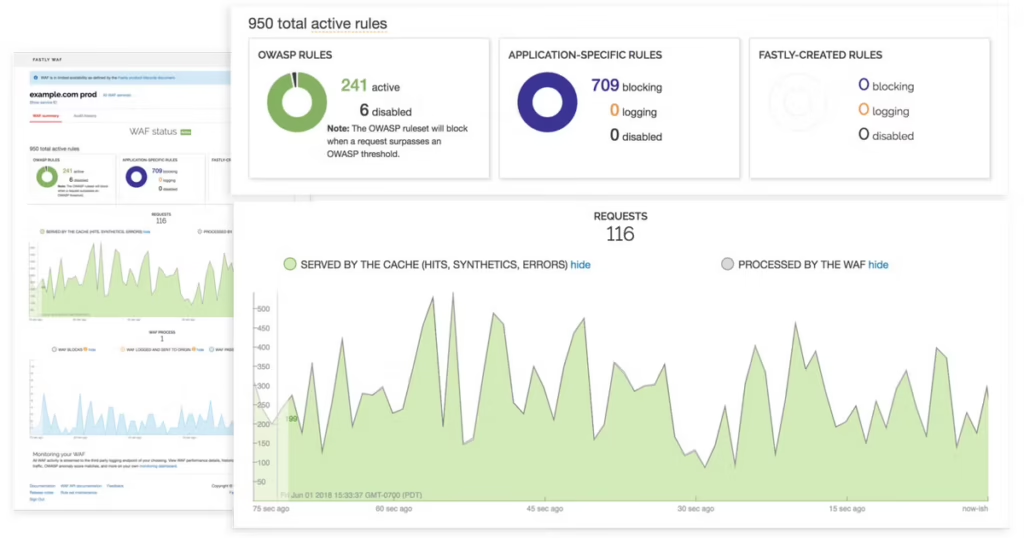
The Fastly Next-Gen WAF protects applications, APIs, and microservices from a single unified solution, covering OWASP Top 10 attacks plus account takeover through credential stuffing, malicious bots, API abuse, and application-layer denial of service. Detection works without the regex pattern-matching rules and constant tuning that traditional WAFs require.
Deployment is the main hybrid story. The hybrid SaaS WAF installs via an agent-module software pair, or runs through edge or cloud-based options that need no software installation. Through a partnership with A10 Networks, it can also be deployed through Thunder ADC on hardware and virtual platforms. Fastly reports support for more than 100 cloud-native and datacenter platforms.
Key features include:
- SmartParse contextual detection: Evaluates the context of each request and how it would execute to determine whether malicious or anomalous payloads are present, enabling near-zero tuning and immediate threat detection on deployment.
- Network Learning Exchange: A trusted IP reputation feed built from anonymized, confirmed malicious activity collected across tens of thousands of customers’ distributed software agents, used to alert on and preemptively block recognized attack patterns.
- Broad API protocol coverage: Detects and blocks attacks in SOAP, REST, gRPC, WebSockets, and GraphQL APIs, including dedicated GraphQL inspection, and monitors for unexpected values and parameters submitted by endpoints.
- Account takeover detection: Inspects web requests and correlates anomalous activity with malicious intent to block account takeover attacks against login endpoints.
- Advanced rate limiting: Blocks malicious and anomalous high-volume requests and automatically blocks abusive traffic when defined thresholds for key application functions are met, reducing web server and API utilization.
- Layer 7 visibility and toolchain integrations: Reporting and alerting feedback loops provide visibility across the entire application and API footprint, with integrations into DevOps and security toolchains that support automation and speed up CI/CD.
- Managed security options: Fastly Managed Security services are available for teams that want expert-run protection rather than self-managed operations.
| Criterion | Solution Fit | Key Considerations |
|---|---|---|
| Hybrid deployment and enforcement model | Agent-module pair installs inside customer environments, with edge and cloud options requiring no installation, plus A10 Thunder ADC support across 100+ platforms. | Agent-based deployment means software to install and maintain in each environment, and reviewers note agent updates can be cumbersome. |
| Unified control plane and visibility | One integrated solution provides the same visibility, insights, and alerts wherever applications run. | Reviewers describe the interface for setting up and managing rules as overwhelming and time-consuming to navigate. |
| API discovery and inventory | Protocol-aware inspection across REST, SOAP, gRPC, GraphQL, and WebSockets, monitoring for unexpected values and parameters. | Emphasis is on protecting known endpoints rather than continuously inventorying undocumented or shadow APIs. |
| Bot and automated abuse defense | Bot identification and mitigation plus account takeover detection, supported by the NLX shared threat feed. | Bot Management is a separate product alongside the Next-Gen WAF rather than an included module. |
| Automation and DevOps integration | DevOps and security toolchain integrations encourage data sharing and correlation and help simplify automation in CI/CD. | Pricing and support responsiveness are recurring complaints, and some reviewers cite documentation gaps. |
Source: Fastly
Conclusion
Choosing WAAP for a hybrid cloud environment requires matching the enforcement model to where applications and APIs actually run. Prioritize consistent policy across environments, continuous API visibility, effective bot and DDoS defenses, and automation that fits existing DevOps workflows. For workloads that cannot route traffic through an external network, local enforcement is particularly important, while centralized management helps prevent policy drift as the estate changes.