What Are API Security Tools?
API security tools protect application programming interfaces by automating discovery, testing vulnerabilities, and monitoring runtime traffic. Their primary purpose is to identify vulnerabilities, detect threats, and ensure that APIs are accessed only by authorized users and systems, thereby preventing unauthorized access, data leaks, and abuse.
Core categories of API security tools:
- API posture management: Builds inventory, classifies data usage, and tracks compliance drift.
- API runtime security: Analyzes live traffic behavior to block malicious requests and business logic abuse in real time.
- API security testing: Simulates DAST-like attacks and validates OpenAPI contracts during development or CI/CD pipelines.
In this article:
- API Security Tools at a Glance
- Why Do Businesses Need API Security Tools?
- What Do API Security Tools Do?
- Key Types of API Security Tools
- Notable API Security Tools
API Security Tools at a Glance
The table below summarizes the key differences between the tools covered in this guide, grouped by the part of the API security problem each one addresses. Each tool is explored in more detail in the sections that follow.
| Category | Solution | Best For | Key Strengths | Things to Consider |
|---|---|---|---|---|
| API Posture Management | Cequence Security | Teams needing API posture, compliance and abuse defense | Inside-out and outside-in API discovery; 250+ risk rules across 25 frameworks; native inline mitigation | Initial tuning and configuration can take time in very large environments |
| API Posture Management | Salt Security | Enterprises mapping API and AI agent exposure | Behavioral detection, posture governance, policy hub | Complex in smaller environments; API scaling costs |
| API Posture Management | Traceable (Harness) | Teams wanting trace-level API context across the SDLC | Inventory via eBPF and integrations, threat hunting | Traffic mirroring costs; reporting at large scale |
| API Posture Management | Data Theorem API Secure | Teams securing APIs across multi-cloud perimeters | Agentless discovery, 200+ attack signals, SAST/DAST/SCA | Expensive; limited pre-publish scanning |
| API Posture Management | Orca Security | Cloud teams wanting API posture inside a CNAPP | Agentless inventory, drift detection, risk prioritization | Costly; alert and dashboard clutter |
| API Runtime Security | Akamai API Security | Enterprises governing APIs from code through runtime | Multi-source discovery, 200+ tests, compliance mapping | Setup complexity and false-positive tuning |
| API Runtime Security | Cloudflare API Shield | Teams already routing traffic through Cloudflare | ML endpoint discovery, schema validation, payload scanning | Enterprise-tier gating; managed-rule false positives |
| API Runtime Security | Imperva API Security | Hybrid estates needing API security beside a WAF | BOLA detection, shadow API discovery, WAF mitigation | Slow discovery on centralized domains; cloud-first |
| API Runtime Security | F5 Distributed Cloud | Multi-cloud estates needing discovery plus enforcement | Repo, traffic and crawl discovery, OAS generation | Pricing; integration with F5 on-premises products |
| API Runtime Security | Wallarm | Teams replacing a WAF and adding API security | REST, GraphQL, gRPC and WebSocket protection | Complex tuning; dashboards are not customizable |
| API Security Testing | 42Crunch | Teams practising contract-first API development | 300+ checks, contract-driven fuzzing and firewall | Depends on accurate OpenAPI specifications |
| API Security Testing | StackHawk | Engineering teams testing APIs inside CI/CD | Repo-based discovery, spec generation, BOLA testing | ZAP-based false positives; YAML-driven config |
| API Security Testing | Invicti | AppSec teams consolidating DAST and API testing | Sensorless discovery, stateful scanning, proof-based results | Dense configuration; thin remediation detail |
| API Security Testing | Burp Suite | Security specialists doing hands-on API testing | API definition upload, authenticated scanning, OAST | Requires expertise; false positives and slow scans |
| API Security Testing | APIsec | Teams validating exploitability before deploy | Application modelling, custom attack generation, replay | Learning curve; limited business-logic customization |
Why Do Businesses Need API Security Tools?
Growing API Attack Surface
As businesses increasingly rely on APIs to connect services, integrate systems, and expose functionality to partners and customers, the potential attack surface expands significantly. Each new API endpoint represents a possible entry point for attackers, increasing the risk of unauthorized access or exploitation. This proliferation of APIs, often across hybrid and multi-cloud environments, makes it challenging for organizations to maintain consistent security controls and visibility.
Attackers target APIs because they often handle sensitive data and business logic directly. Without proper security tools, businesses may not even be aware of all their active APIs, making it difficult to assess risk and protect against threats. API security tools help organizations discover, inventory, and manage their APIs, reducing blind spots and enabling a more proactive security posture.
Sensitive Data Exposure
APIs frequently transmit sensitive data, such as personal information, payment details, or proprietary business information. If APIs are not properly secured, this data can be exposed through misconfigurations, weak authentication, or other vulnerabilities. Data breaches resulting from exposed APIs can lead to regulatory penalties, loss of customer trust, and significant financial harm.
API security tools help prevent sensitive data exposure by enforcing encryption, validating input and output, and monitoring for unauthorized data access. These tools can detect patterns indicative of data exfiltration or misuse, enabling rapid response to potential breaches. By securing data in transit and at rest, organizations reduce the risk of costly and damaging incidents.
API Abuse and Automated Attacks
APIs are attractive targets for automated attacks, such as credential stuffing, brute force attempts, and bot-driven abuse. These attacks can overwhelm backend systems, lead to unauthorized access, or exploit business logic flaws for fraud or data theft. Manual monitoring and legacy security controls are often insufficient to detect and block these sophisticated threats.
API security tools offer advanced detection capabilities tailored to the unique behaviors of API traffic. They can identify abnormal usage patterns, block malicious requests, and apply rate limiting to prevent abuse. By distinguishing between legitimate users and automated threats, these tools help businesses protect their services from downtime, data loss, and reputational damage.
Related content: Read our guide to bot management.
What Do API Security Tools Do?
1. API Discovery and Inventory
API discovery and inventory are foundational capabilities of API security tools. These features automatically identify all APIs in an organization’s environment, including undocumented or “shadow” APIs that may be overlooked by development and security teams. By building a comprehensive inventory, businesses gain visibility into their entire API landscape, which is essential for effective risk management.
Maintaining an up-to-date inventory allows organizations to track:
- API ownership
- Usage
- Exposure
Security teams can use this information to prioritize protection efforts, ensure compliance with policies, and reduce the chances of unmonitored or abandoned APIs being exploited. Automated discovery also helps identify changes in the environment, such as new endpoints or deprecated services, enabling timely security assessments.
2. Vulnerability Scanning
Vulnerability scanning is a core function of API security tools, enabling organizations to detect weaknesses in their APIs before they can be exploited. These tools analyze API endpoints for common vulnerabilities, such as:
- Injection flaws
- Insecure authentication
- Misconfigurations
Scans can be scheduled regularly or triggered by changes in code or infrastructure, ensuring continuous assessment. By identifying vulnerabilities early, businesses can remediate issues before they lead to data breaches or service disruptions. Vulnerability scanning tools often provide detailed reports and actionable recommendations.
3. API Security Testing
API security testing tools go beyond basic scanning by simulating real-world attack scenarios against APIs. These tools perform penetration testing, fuzzing, and other dynamic assessments to uncover:
- Logic flaws
- Improper access controls
- Other complex vulnerabilities
Security testing can be integrated into continuous integration and delivery (CI/CD) pipelines, enabling organizations to catch issues early in the software development lifecycle. Comprehensive security testing ensures that APIs are resilient to advanced attack techniques and business logic abuses. These tools generate detailed findings that help developers understand and fix weaknesses.
4. Runtime Threat Detection
Runtime threat detection focuses on monitoring APIs during active use to identify suspicious or malicious behavior in real time. These tools analyze live API traffic for indicators of compromise, such as:
- Unusual request patterns
- Data exfiltration attempts
- Known attack signatures
By providing immediate alerts, runtime detection enables rapid response to active threats before they escalate. Effective runtime detection leverages machine learning and behavioral analytics to differentiate between normal and anomalous activity. This allows security teams to detect zero-day attacks and insider threats that may bypass traditional controls. Continuous monitoring ensures that APIs remain protected even as attack techniques evolve and new vulnerabilities are discovered.
5. Authentication and Access Control
Authentication and access control are essential functions provided by API security tools. They ensure that only authorized users and systems can interact with API endpoints, using mechanisms such as:
- OAuth
- API keys
- JWT tokens
Robust authentication prevents unauthorized access, while granular access controls limit what each user or system can do within the API. API security tools enforce policy-based access management, supporting least privilege and role-based access models. They can also detect and block attempts to bypass authentication or escalate privileges.
6. API Traffic Monitoring
API traffic monitoring tools provide continuous visibility into API usage and performance, enabling organizations to detect anomalies and performance issues. Monitoring also helps identify trends, such as spikes in traffic or unusual access patterns, which may indicate abuse or emerging threats. These tools collect data on:
- Request volumes
- Response times
- Error rates
- User behaviors
Detailed traffic analysis supports incident response, compliance reporting, and capacity planning. Security teams can use monitoring data to investigate incidents, correlate events, and refine detection rules. By maintaining comprehensive logs and metrics, API traffic monitoring tools contribute to both security and operational reliability.
7. Schema and Specification Validation
Schema and specification validation ensures that API requests and responses conform to defined standards, such as OpenAPI or Swagger specifications. API security tools validate payloads against schemas, preventing attacks that exploit improper input handling or undocumented functionality. This reduces the risk of:
- Injection attacks
- Data corruption
- Other vulnerabilities
Automated validation helps catch errors early in development and enforces consistency across API implementations. It also ensures that changes to APIs do not introduce breaking changes or security issues. By maintaining strict adherence to specifications, organizations improve both the security and interoperability of their APIs.
8. Bot and Abuse Protection
Bot and abuse protection features in API security tools are designed to identify and block automated threats, such as bots, scrapers, and denial-of-service attacks. These tools:
- Analyze traffic patterns
- Use machine learning to distinguish between humans and bots
- Apply rate limiting or CAPTCHA challenges to suspicious traffic
By mitigating automated abuse, these tools protect APIs from credential stuffing, data harvesting, and fraud. They also help maintain service availability during attack attempts and reduce the risk of resource exhaustion.
Related content: Read our article about bot detection in the AI age.
Key Types of API Security Tools
API Posture Management
API posture management tools focus on assessing and improving the overall security posture of an organization’s API environment. They provide visibility into API configurations, usage patterns, and compliance with security policies. By continuously evaluating the state of APIs, these tools help organizations identify gaps, enforce best practices, and prioritize remediation efforts based on risk.
These tools often integrate with asset management and vulnerability assessment systems to provide a holistic view of API security. They enable automated policy enforcement, such as requiring encryption or authentication for all endpoints, and generate reports for compliance and audit purposes. API posture management is critical for maintaining consistent security across complex and dynamic API ecosystems.
Related content: Read our article about API compliance.
API Runtime Security
API runtime security tools are designed to protect APIs during live operation. They monitor real-time traffic, detect threats, and block malicious activity as it occurs. Runtime security solutions use behavioral analytics, signature detection, and anomaly detection to identify attacks such as data exfiltration, abuse, or logic exploitation.
These tools provide immediate response capabilities, such as blocking suspicious requests or alerting security teams. By operating in the runtime environment, they adapt to changing threats and evolving attack techniques. API runtime security is essential for preventing breaches and minimizing the impact of incidents in production environments.
API Security Testing
API security testing tools assess APIs for vulnerabilities before attackers can exploit them. They test endpoints, authentication flows, authorization rules, inputs, and responses using techniques such as fuzzing, dynamic testing, and automated attack simulation. These tools can identify issues including injection flaws, broken access controls, weak authentication, and insecure handling of unexpected input.
Testing tools are commonly integrated into CI/CD pipelines so security checks run as APIs are developed and updated. They can also test deployed APIs to identify vulnerabilities that appear only in running environments. Findings typically include affected endpoints, evidence of the vulnerability, and remediation guidance, helping development teams address security issues before they reach production.
Notable API Security Tools
How we selected these tools: We shortlisted API security tools based on their ability to discover and inventory APIs, assess posture and compliance risk, test APIs for vulnerabilities before release, and detect or block attacks against APIs in production.
API Posture Management
1. Cequence Security

Best for: API posture management, compliance reporting and abuse defense
Strengths: Inside-out and outside-in API discovery; 250+ risk rules across 25 frameworks; native inline mitigation
Things to consider: Initial configuration and tuning take time to complete
Cequence API Security discovers, monitors and tests APIs, then assesses them for risks tied to compliance, governance, data loss and business disruption. It covers internal, external and third-party APIs as well as edge, infrastructure, gateway and hosting providers, combining inside-out and outside-in discovery.
The product integrates directly with existing infrastructure such as API gateways or deploys inline. It forms part of the wider Cequence Platform, which protects web, mobile, API and AI channels and handles more than 10 billion daily API interactions and 4 billion user accounts.
Key features include:
- AI assistant and MCP server: A built-in assistant answers questions such as which public APIs handle sensitive data and returns ranked, evidence-backed findings. Every capability is exposed as MCP tools for use inside internal agentic workflows, with read actions running freely and writes requiring human approval that shows the exact change first.
- Compliance-ready risk rules: More than 250 pre-built risk rules map to 25 global frameworks, including every version of the OWASP API Security Top 10, PCI DSS, GDPR, HIPAA, SOC 2, ISO 27001 and NIST CSF. Audit-ready reports build from live data, score risk by control area and give remediation guidance for each gap.
- Runtime API catalog: The platform identifies documented, undocumented, third-party and shadow API endpoints and inventories them in a runtime catalog. Discovered APIs are assessed for access control issues, sensitive data leakage and conformance with the published API specification, which is generated automatically when missing.
- Sensitive data masking: ML-based rules identify and mask sensitive data using predefined patterns such as credit card numbers plus custom patterns. Regional patterns are supported worldwide, distinguishing a US driver’s license number from a Saudi National ID, without defining which APIs transact sensitive data.
- Integrated API security testing: Test plans generate automatically from Postman collections or API specifications, covering pre-production and runtime. Testing supports CI/CD pipelines, IDEs and standalone use.
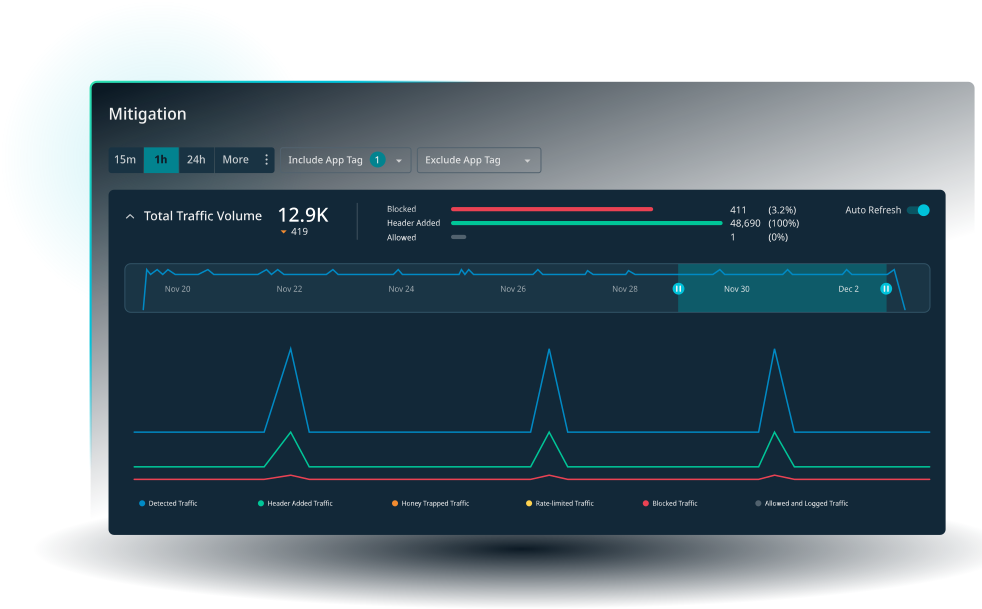
- Attack protection and mitigation: ML-powered threat detection and analytics work alongside third-party WAFs and API gateways. Native mitigation options include blocking, logging, rate limiting, header injection and deception.
Limitations (as reported by users on G2):
- Initial configuration effort: Users report that setting up new applications and fine-tuning policies to separate legitimate power users from automated abuse takes time, and that inline deployment requires solid DNS and CDN routing knowledge.
- Dashboard responsiveness: Some reviewers note that the interface can lag when large data queries are run, which slows down investigation work. This has been fixed in a recent version.
- Learning curve on configuration options: Reviewers mention that understanding the full range of analytics and policy configuration options takes time, and that simplified workflows and expanded documentation would speed up onboarding.
Source: Cequence
2. Salt Security

Strengths: Behavioral attack detection with posture governance and policy hub
Things to consider: Adding APIs raises cost; complex for smaller estates
Salt Security’s Agentic Security Platform is built around what the vendor calls the Agent Security Graph, the connected mesh of APIs behind an organization’s applications and digital services. The platform groups its work into three areas: discovery and visibility, posture and compliance, and threat detection and protection.
Discovery covers APIs running in production across environments, including shadow APIs, third-party connections and deprecated endpoints, without manual tagging or agents. The platform is packaged into components including Salt Surface for external exposure, Salt Connect for cloud APIs, Salt Collect for live traffic and Salt Protect for blocking.
Key features include:
- Production API discovery: The platform provides real-time visibility into APIs running in production across environments, targeting the portions of the live API surface that organizations are typically blind to.
- Posture analysis and framework mapping: API posture is continuously analyzed and mapped to frameworks including PCI DSS, GDPR, NIST and SOC 2, showing where controls are missing, misaligned or out of date.
- Policy Hub governance: Posture standards are enforced at scale through Salt’s Policy Hub, which is used to establish and apply API governance rules across the estate.
- Behavioral attack detection: Patented behavioral analysis detects API-specific threats, fraud patterns and low-and-slow attacks, with detection connected back to posture and discovery data.
- Code-stage policy enforcement: Salt Code enforces security policies inside AI coding assistants, extending the platform’s controls into the development stage.
- Stack integrations: The platform integrates with SIEMs for alert enrichment, Jira for closing gaps and firewalls for blocking, alongside connectors for CrowdStrike, AWS, GitHub, Microsoft Azure, Kong and Google.
Limitations (as reported by users on PeerSpot):
- Implementation complexity: Reviewers describe implementations as complex and time-consuming, particularly in unique environments, with a steep ramp-up period for teams new to the platform.
- Fit for smaller environments: Users note that scalability and usability are weaker for smaller organizations, and that the platform is not the most out-of-the-box option available.
- Cost of expanding coverage: Reviewers report that while initial setup cost was acceptable, adding further APIs became expensive.
- Alert tuning and integrations: Users mention that alert tuning takes time depending on API volume, that some findings need internal validation before action, and that specific system integrations are not always available out of the box.
3. Traceable (Harness)
Best for: Teams wanting trace-level API context across the full SDLC
Strengths: Continuous inventory, threat hunting and contextual testing
Things to consider: Traffic mirroring adds cost; reporting at large scale
Traceable, now part of Harness, is a context-aware application and API security platform that spans posture management, threat protection and threat management across the software development lifecycle. It builds and continuously updates an inventory of every API in an organization, including internal, private, public, externally exposed, rogue, shadow, partner and third-party APIs.
Changes are tracked through on-premises and cloud components, in-code instrumentation, integrations with API management systems, network traffic endpoints and workloads via eBPF. Deployment options include self-managed on-premises or cloud, customer cloud accounts on AWS, GCP and Azure, and SaaS.
Key features include:
- Continuous API inventory: The platform automatically discovers and inventories APIs across deployment types, tracking changes over time rather than producing a point-in-time list.
- eBPF and in-code discovery: Discovery draws on in-code components, API management integrations, network traffic endpoints and workload-level eBPF instrumentation.
- Security analytics and threat hunting: Application and API security and data flow analytics let SOC teams, incident responders, threat hunters and red and blue teams investigate issues and detect attacks as they occur.
- Runtime attack blocking: Contextual analysis of the connections between API activity, user activity, data flow and code execution is used to detect and block known and unknown attacks, business logic abuse, DDoS, bot activity and sensitive data exfiltration in production.
- Zero-configuration API testing: Testing runs without OpenAPI spec files or Postman collections, using context taken from active API traffic to test for vulnerable APIs.
- Data lake for API traffic: Historical nominal and malicious traffic is retained for analysis, supporting investigation and threat hunting workflows.
Limitations (as reported by users on G2):
- Traffic mirroring cost: Reviewers note that mirroring traffic is a significant cost factor, and that data is filtered after it reaches the platform rather than before transmission, so organizations pay to send data that is later redacted or discarded.
- Reporting at scale: Users report that reporting needs improvement when used across larger deployments.
- Infrastructure edge cases: Some reviewers describe substantial troubleshooting where their container platform did not support the scaling behavior the deployment required.
- Product maturity: Reviewers characterize the platform as still growing, with a number of areas the vendor is working through.
Source: Harness
4. Data Theorem API Secure
Best for: Continuous API discovery and protection across multi-cloud estates
Strengths: Agentless discovery with 200+ runtime API attack signals
Things to consider: Pricing is high and pre-publish scanning is limited
API Secure is an automated, continuous security service that discovers APIs, analyzes their health and applies runtime protection based on more than 200 API attack signals. Its analyzer engine continuously looks for vulnerabilities across multi-cloud and on-premises environments and returns alerts with remediation detail.
The product covers discovery and inventory, posture management, security testing and runtime protection in one service, delivered as fully automated SaaS-based monitoring of cloud environments with CI/CD tool integrations.
Key features include:
- Blackbox and cloud discovery: Discovery runs with no agents, configuration or maintenance, continuously monitoring the public perimeter, and extends across AWS, Azure, GCP and private cloud environments.
- Gateway and developer tool inventory: Inventories are consolidated from existing API gateway solutions such as Apigee, Kong and AWS, and developer tool integrations surface APIs as they are built.
- API posture management: Posture checks cover leaky APIs, authentication evaluation, authorization and encryption levels, security vulnerabilities, and orphaned and zombie APIs.
- Multiple testing techniques: Security testing combines static code analysis, dynamic analysis, software composition analysis, fully customized testing and hacker toolkits.
- Runtime protection areas: API Protect covers authentication, authorization, encryption, attack prevention, malicious domains, bot protection, abuse, anomaly detection and AI MCP.
- AI-augmented attack detection: Runtime detection covers prompt injection and LLM abuse, AI scraping defense, AI-driven error pattern recognition, password spraying and login automation.
Limitations (based on publicly available sources):
- Cost: Reviewers of Data Theorem products describe the pricing as expensive relative to comparable tooling.
- Pre-publication scanning: One reviewer reports being able to scan only after publishing rather than uploading and scanning beforehand.
- Performance overhead: A reviewer notes that overall product performance can be affected if the tooling is not configured and used correctly.
Source: Data Theorem
5. Orca Security
Best for: Cloud teams wanting API posture inside a wider CNAPP
Strengths: Agentless API inventory, drift detection and risk prioritization
Things to consider: Costly, with alert volume and reporting gaps
Orca’s API Security capability inventories APIs and related web domains across a cloud estate and surfaces API security and compliance risks without deploying agents. It sits inside the wider Orca Cloud Security Platform, so API findings are considered alongside vulnerabilities, misconfigurations, malware, sensitive data location and lateral movement risk.
Discovery uses Orca’s SideScanning technology, which reads cloud workload data out of band. This means an API inventory can be produced without agents, edge workers or log analysis by a vendor team.
Key features include:
- Continuous API discovery: Discovery runs automatically and continuously across the cloud estate, tracking managed and unmanaged API assets including applications, domains, subdomains, path groups, users and endpoints.
- Interactive API mapping: Interactive maps show API endpoints, requests and server responses, with screenshots of publicly exposed APIs viewable in-app.
- Exposure querying: The dashboard answers questions such as which assets are reachable from the internet and what they expose, and how many endpoints allow access to personally identifiable information.
- Risk prioritization with cloud context: API risks including OWASP API Security Top 10 alerts are scored by severity and enriched with context such as PII location and public exposure, then combined with other cloud risks to rank what matters most.
- Drift detection: The platform continuously monitors API behavior and usage, alerting on newly added and removed applications, domains, subdomains, API paths and operations.
- Swagger comparison view: A Swagger documentation view is available for comparing intended API policy against current usage, alongside compliance framework linkage for standards such as PCI DSS.
Limitations (as reported by users on G2):
- Cost: Reviewers describe the platform as expensive, with limited discounting available.
- Alert and dashboard density: Users report that the alerts window can become cluttered and that dashboards can feel overwhelming for newer users.
- Reporting depth: Some reviewers note limited reporting capabilities, with teams building custom reporting to track alert statistics over time, and mention that scheduled reporting lost functionality.
- API and deployment scope: Reviewers mention that the platform’s own API capabilities are not deep enough for external dashboarding, that results are near real time rather than real time, and that it does not cover on-premises environments.
Source: Orca Security
API Runtime Security
6. Akamai API Security

Best for: Governing and protecting APIs from code through to runtime
Strengths: Multi-source discovery, 200+ tests and compliance mapping
Things to consider: Setup complexity and false-positive tuning effort
Akamai API Security provides continuous visibility into APIs across traffic, code and documentation, including APIs connected to GenAI applications, LLM services and MCP servers. It identifies vulnerabilities, analyzes behavior, tests APIs before production and prioritizes remediation with ownership and code context.
The product is vendor-neutral and does not require other Akamai products, working across multicloud, hybrid and on-premises environments. It is separate from Akamai App & API Protector, which handles inline edge enforcement, and the two are often deployed together.
Key features include:
- Multi-source discovery: APIs are discovered across traffic, code, specifications, gateways, cloud environments and external exposure points, covering shadow, zombie, unmanaged, MCP and AI-linked APIs.
- Posture and compliance mapping: Posture is assessed against security best practices, OWASP API risks, internal policies and compliance frameworks including PCI DSS, HIPAA, ISO 27001, GDPR, HITRUST and NIST.
- Pre-release testing: More than 200 dynamic tests that simulate malicious traffic run inside CI/CD pipelines and pre-production workflows, including tests aligned to the OWASP API Security Top 10.
- Runtime behavior analysis: Runtime traffic is analyzed to detect abnormal activity, business logic abuse, sensitive data exposure, data scraping, tampering and resource exhaustion.
- Ownership mapping for remediation: Findings are mapped to owners, repositories, file paths and last committers where available, then routed into SIEM, ITSM, ticketing, CMDB, WAAP, gateway and developer workflows.
- AI-linked API governance: APIs connected to GenAI applications, LLM services, AI workflows and MCP servers are identified and tagged, including shadow and unmanaged AI-linked APIs.
Limitations (as reported by users on PeerSpot):
- Setup complexity: Reviewers point to setup complexity as an area needing attention, with configuration work required before the platform delivers results.
- False positive management: Users report that false-positive handling needs optimization, and that distinguishing reputable sources from malicious hosting providers is an ongoing challenge.
- Baseline tuning period: Reviewers describe several weeks of baseline tuning before signal-to-noise levels become workable.
- Policy tuning granularity and documentation: Users ask for more granular customization in policy tuning, clearer visibility into how behavioral decisions are made, and expanded documentation covering diverse use cases.
Source: Akamai
7. Cloudflare API Shield
Best for: Teams already routing application traffic through Cloudflare
Strengths: ML endpoint discovery, schema validation, payload scanning
Things to consider: Enterprise-tier gating and managed-rule false positives
API Shield catalogs and manages API endpoints, blocks attacks and vulnerability exploits, and works to prevent data leakage. It operates on Cloudflare’s global network, discovering and securing API endpoints as traffic passes through the edge rather than through separately deployed sensors.
The product consolidates application and API inventory, policy management, analytics and reporting on a single platform. Cloudflare positions API Shield as running on the same infrastructure used to build its own services.
Key features include:
- Automated endpoint discovery: Machine learning and heuristics analyze traffic to identify all API endpoints in use, including undocumented ones, building an inventory of the API estate.
- Positive security model: A positive security model blocks common API attacks including OWASP Top 10 API Security risks by requiring API traffic to conform to defined schemas.
- Schema and authentication validation: Incoming requests are validated against schemas, authentication and expected API business logic, which also reduces API hosting costs by rejecting invalid traffic earlier.
- Response payload scanning: Response payloads are continuously scanned to identify sensitive information, preventing data exfiltration and leakage through APIs.
- Volumetric abuse protection: Anomaly detection is used to stop volumetric API abuse, alongside authentication abuse, data loss and DDoS protection.
- Edge network delivery: Protection is delivered across Cloudflare’s global network, with DDoS mitigation running in every network location.
Limitations (as reported by users on G2):
- False positives on API traffic: Reviewers report that managed WAF rules frequently trigger on legitimate API traffic such as GraphQL queries and custom JSON payloads, and that troubleshooting blocked requests is difficult because the rule logic is not visible to customers.
- Feature gating by plan: Users note that many of the more powerful capabilities are limited to higher-tier plans, and Cloudflare’s own documentation states that the full API Shield suite is an Enterprise-only paid add-on.
- Configuration learning curve: Reviewers describe a learning curve on advanced security features and rule configuration for teams without dedicated networking or security expertise.
- Reverse proxy dependency: Because the service operates as a reverse proxy, users note that DNS must be pointed at Cloudflare, which adds risk during migration and troubleshooting.
Source: Cloudflare

8. Imperva API Security
Best for: Hybrid estates running API security alongside an existing WAF
Strengths: BOLA detection, shadow API discovery and WAF-based mitigation
Things to consider: Discovery is slower on centralized API domains
Imperva’s Unified API Security Platform combines API discovery, risk assessment, detection and mitigation in a single console across cloud, on-premises and hybrid environments. It includes detection and response for deprecated, unauthenticated and BOLA-prone APIs.
The platform integrates with Imperva’s WAF so that mitigation can be enforced inline, and works alongside Imperva Advanced Bot Protection to address automated abuse of sensitive APIs. Deployment options span cloud-managed and self-managed models with agent-based or agentless setups.
Key features include:
- Continuous discovery and classification: Public, private and shadow APIs are continuously discovered and monitored, with changes tracked and design flaws and vulnerabilities identified over time.
- Sensitivity classification: APIs are classified by the data they carry, including government ID, credit card details, address information and other personally identifiable information.
- BOLA detection and response: Traffic is profiled to establish behavioral baselines, then ML-driven analysis flags deviations and blocks Broken Object Level Authorization exploits alongside other OWASP API Top 10 threats using hybrid behavioral and rule-based engines.
- Specification-based testing: API Security Testing scans an uploaded API specification file to identify posture gaps, design flaws and configuration weaknesses, classifying issues by severity with developer-ready fixes.
- Automated inline mitigation: Response actions are enforced through Cloud WAF and WAF Gateway, and integrate with wider security automation.
- Gateway and proxy integrations: The platform integrates with Kong, MuleSoft, Azure APIM, Apigee and F5, inspecting API traffic through gateways, proxies and load balancers, including encrypted applications and microservices.
Limitations (as reported by users on PeerSpot):
- Discovery speed on centralized architectures: Reviewers note that architectures centralizing APIs on a single domain with hundreds or thousands of operations can take months to fully enumerate, with dynamic paths adding difficulty.
- On-premises coverage: Users report that API security capabilities are mainly cloud-based, which is a constraint for organizations that prefer on-premises deployments.
- Reporting and log management: Reviewers describe automated reporting and log management features as limited.
- Third-party integration and cost: Users cite integration with third-party services for on-premises deployments as needing improvement, and raise pricing as a recurring concern.
Source: Imperva
9. F5 Distributed Cloud API Security
Best for: Multi-cloud estates needing API discovery plus inline enforcement
Strengths: Repo, traffic and crawl discovery with automatic OAS generation
Things to consider: Pricing and integration with F5 on-premises products
F5 Distributed Cloud API Security discovers API endpoints mapped to applications, allows or denies connections, and monitors for anomalous behavior and sensitive data. It combines data analytics with AI and machine learning to discover, detect and protect APIs, delivered through a SaaS-based portal.
Coverage spans public cloud workloads on AWS, Azure and GCP, on-premises data center and edge sites, and F5’s own global points of presence. The portal is also used for threat analytics, forensics and troubleshooting of API communications.
Key features include:
- Multi-method API discovery: Discovery combines code repository analysis, runtime traffic inspection performed inline or out of band via a local SaaS connector for BIG-IP TMOS, and external web crawling, with automatic generation of OpenAPI Specification files.
- Pre-production API testing: Targeted automated testing runs against discovered API endpoints in pre-production environments to uncover vulnerabilities across OWASP API Top 10 threats.
- Sensitive data controls: Sensitive data exposure is identified and reported, covering common PII and data types tied to PCI-DSS, HIPAA and GDPR, with options to limit, mask or block.
- ML traffic monitoring with AI assistant: Continuous machine learning maintains behavioral baselines and flags or blocks suspicious activity, with an AI assistant answering natural language queries about API security events.
- Authentication risk scoring: The authentication state of all APIs in an environment is identified and baselined, producing views into authentication status, details and risk score.
- Positive security enforcement: Learned or existing OpenAPI specifications are imported to enforce valid endpoints, parameters, methods, authentication and payloads, backed by L7 policy controls including rate limiting, IP reputation and DoS protection.
Limitations (as reported by users on PeerSpot):
- Pricing and organization size: Reviewers state that the service is not worth it for smaller organizations and that pricing is considered too expensive in some regions.
- Integration with on-premises F5 products: Users identify integration with other parts of the F5 portfolio, such as on-premises WAF, as the main outstanding issue.
- Implementation effort: Reviewers describe challenges from an implementation perspective when standing the service up.
- Console availability: One reviewer reports a 30 minute period of downtime across the distributed cloud console during the prior year.
Source: F5
10. Wallarm
Best for: Teams consolidating WAF replacement with API security
Strengths: Protection for REST, SOAP, gRPC, GraphQL and WebSocket APIs
Things to consider: Complex tuning and dashboards that cannot be customized
Wallarm Advanced API Security discovers an organization’s API attack surface, blocks API attacks in real time and automates security testing in both development and production. The product is organized around four functions: discover, protect, respond and test.
Its architecture supports mixing deployment options while managing everything from one console. Options include a security edge reached by a DNS record change, pre-built cloud marketplace images, Kubernetes ingress controllers and Envoy sidecars, direct deployment into NGINX, Envoy or Kong, private data centers, and out-of-band deployment using eBPF.
Key features include:
- Inventory and topology reconstruction: APIs and AI assets are inventoried automatically, exposed APIs and services are mapped and tracked for changes, and API and application topology is reconstructed from traffic.
- OpenAPI spec generation: OpenAPI specs are created from actual traffic to establish visibility, and uploaded specs can be enforced to detect and block non-compliant API requests.
- Multi-protocol protection: Protection covers REST, SOAP, gRPC, GraphQL and WebSocket-based APIs, extending beyond the OWASP Top 10 to API-specific threats, account takeover, malicious bots and L7 DDoS.
- Sensitive data monitoring: Sensitive data usage across APIs is surfaced to support compliance work and reduce the risk of improper exposure.
- Incident response tooling: Malicious requests can be examined in detail and attacker action sequences tracked, with Active Threat Verification used to surface the most urgent issues.
- CI/CD security testing: Security testing of APIs and web assets is automated inside CI/CD pipelines using existing QA tests, with continuous assessments run from the cloud.
Limitations (as reported by users on G2):
- Configuration and tuning effort: Reviewers describe the configuration and tuning process as complex and time-consuming, particularly for new users, and mention gaps in documentation and manuals.
- Dashboard customization: Users report that dashboards are not customizable and that some statistics are only available at day-level granularity.
- Interface performance: Reviewers note that the interface slows down when handling high volumes of data.
- Evaluation and reporting: Users mention that pricing is not disclosed during the free trial and that a demo call is required to try the product, and that report creation needs work to align with security standards.
Source: Wallarm
API Security Testing
11. 42Crunch API Security Platform
Best for: Enforcing API security policy in contract-first development
Strengths: 300+ automated checks and contract-driven runtime firewall
Things to consider: Value depends on accurate OpenAPI specifications
42Crunch automates the enforcement of API security policies and standards across distributed development and security ecosystems. The platform is built on the OpenAPI Specification, so security is defined at design time and enforced through development, testing, deployment and runtime.
Work is organized into four areas: API governance, security governance and compliance, API security testing and vulnerability detection, and runtime API threat protection. The platform embeds into IDEs, code repositories and CI/CD environments, and deploys on container orchestrators including Kubernetes, Amazon ECS and Red Hat OpenShift.
Key features include:
- Automated API cataloging: APIs are discovered and cataloged automatically through integrations across an organization’s API gateway ecosystem, with API contracts built from traffic and other sources and repositories connected directly.
- Centrally managed security policy: Standardized, secured API contracts sit alongside centrally managed security compliance rules and runtime security policies.
- 300+ security checks: Each API’s security is scored against more than 300 automated checks, covering code hygiene, semantics and data definition.
- Contract-based fuzzing: Security fuzzing is generated directly from the API’s OpenAPI contract and runs inside any open-source or commercial CI/CD pipeline, flagging vulnerable code before merge.
- API firewall at runtime: Runtime threat protection configures firewall-style policies automatically from the API contract with no manual rule writing, detects and blocks shadow and zombie APIs and API-specific attacks, and works with any API gateway.
- GraphQL and MCP coverage: Dedicated capabilities cover GraphQL APIs in addition to REST, along with a Secure MCP Server capability and guardrails for AI-assisted coding workflows including GitHub Copilot integration.
Limitations (based on publicly available sources):
- Dependency on specification quality: Published analysis reports that effectiveness depends heavily on teams maintaining accurate and up-to-date OpenAPI specifications, so organizations with incomplete API documentation need to address that gap first.
- Discovery model: The platform works from API contracts rather than network traffic analysis, so teams that need traffic-based discovery as the primary mechanism require a separate tool.
- Learning curve: Reviews note a steeper learning curve than simpler point-and-scan alternatives.
- Scanner scope: Published comparisons note it is not positioned as a standalone DAST scanner for broader web application testing.
Source: 42Crunch
12. StackHawk
Best for: Engineering teams running API security testing inside CI/CD
Strengths: Repo-based discovery, spec generation and authorization testing
Things to consider: ZAP-based engine produces false positives to triage
StackHawk’s AppSec Intelligence Platform combines attack surface discovery from source code with runtime testing and program-level oversight. It integrates into CI/CD pipelines and pull requests, testing running applications rather than analyzing code patterns.
The platform is organized into three areas: discovery, which maps apps and APIs from source; testing, which runs dynamic scans against running services; and oversight, which reports on coverage and vulnerability trends across the application security program.
Key features include:
- Source-based API discovery: Source code repository integration maps all apps and APIs across the attack surface, including shadow APIs, internal microservices and AI or LLM interfaces.
- Automatic OpenAPI spec generation: API specifications are generated from source code, giving security teams testable assets without waiting for developers to write specs manually.
- Repo risk insights: The platform identifies where sensitive data lives, which languages and frameworks are in use, and commit activity, so testing can be prioritized by risk.
- Authorization and logic testing: Testing covers authorization and authentication flaws including BOLA, BFLA and broken access control, business logic vulnerabilities, API-specific risks such as mass assignment and excessive data exposure, and injection attacks.
- LLM risk detection: Scans cover LLM security risks including prompt injection, sensitive data disclosure and improper output handling.
- Workflow integrations: The platform connects to CI/CD, communications and ticketing systems, and correlates DAST findings with SAST results for prioritization.
Limitations (as reported by users on G2):
- False positives from the underlying engine: Reviewers note that because the scanner is built on ZAP, teams work with the vendor to reduce the volume of false positives.
- Configuration in the portal: Users report limited configuration options in the web portal, with most scan configuration handled in a YAML file, and mention overhead in managing the scanning container.
- Finding detail: Reviewers ask for better categorization of vulnerability descriptions and more worked examples for fixing reported issues.
- Depth versus manual testing: Users note it does not replace a full penetration test and that coverage of some technologies, including GraphQL in one reviewer’s case, was thinner than expected.
Source: StackHawk
13. Invicti
Best for: AppSec teams consolidating DAST with API discovery and testing
Strengths: Sensorless discovery, stateful scanning and proof-based results
Things to consider: Dense configuration and limited remediation detail
Invicti extends its DAST platform into API security with discovery, stateful scanning and proof-based validation. It covers shadow API discovery, spec reconstruction and runtime risk testing, then correlates API findings with other application security testing results in a single view.
The platform positions API security as part of a wider consolidated stack, so APIs, web apps and LLMs are tested together and results feed into its ASPM view for prioritization and deduplication.
Key features include:
- Sensorless API discovery: APIs are discovered without deploying agents or sensors, extracting downstream API specs during web application scans, and crawling target domains for Swagger and OpenAPI specs.
- Gateway and network integrations: Discovery connects to Amazon API Gateway, MuleSoft, Azure API Management and Apigee X, with a network traffic analyzer deployed into production infrastructure including F5, Nginx, Cloudflare, Kong and Kubernetes for broader coverage.
- Access control testing: Authentication testing supports tokens, cookies and OAuth2, and detects BOLA, BFLA and unauthenticated API access by comparing access attempts across higher and lower privilege accounts.
- Stateful API scanning: Parameter relationships are inferred across requests to uncover business logic flaws, with coverage mapped to much of the OWASP API Top 10.
- Proof-based validation: Proof-based scanning is applied to APIs where technically possible, confirming vulnerabilities by extracting data or demonstrating a working exploit.
- WAF virtual patching: Virtual patches are pushed to WAF and WAAP platforms for confirmed high-risk vulnerabilities, alongside noise suppression and deduplication across tools.
Limitations (as reported by users on G2):
- Configuration density: Reviewers describe settings and configuration options as overwhelming at first, with nested menus making it harder to fine-tune scan profiles and manage integrations.
- Remediation guidance: Users report that while vulnerabilities are identified effectively, the tool does not always provide detailed contextual fix instructions or code snippets.
- API scanning fit: One reviewer reports being unable to make API scanning work for their environment because their approach to APIs differed from the tool’s model, despite vendor support.
- Scan duration and licensing: Reviewers mention slow scans on large sites and raise concerns about annual price increases and changing target definitions.
Source: Invicti
14. Burp Suite
Best for: Security specialists running hands-on API security testing
Strengths: API definition upload, authenticated scanning and OAST checks
Things to consider: Requires expertise and produces false positives to verify
Burp Scanner includes built-in API security testing, allowing APIs to be scanned as part of a wider web application crawl and audit or as a standalone exercise. It sits at the heart of both Burp Suite DAST and Burp Suite Professional and is used by more than 70,000 users across over 16,000 organizations.
The scanner uses a crawling algorithm intended to mirror how an expert tester profiles a target, which surfaces attack surface without manual direction. PortSwigger states that API scanning capabilities are extended with each release.
Key features include:
- API definition upload: An API definition file can be uploaded directly to the scanner and tested without hosting your own API specification.
- Exposed API detection: Scanning identifies whether a hosted API has been left accessible to attackers, adding to attack surface visibility.
- Header and authentication coverage: A wider range of endpoints can be tested by including HTTP headers, and APIs requiring authentication can be scanned using user-defined login sequences.
- Configurable vulnerability classes: Custom scan configurations can be saved, with the option to focus on vulnerability classes relevant to APIs such as XML external entity injection or SQL injection.
- JavaScript-heavy application handling: The scanner handles JavaScript-heavy web applications and parses many API definition formats as part of the same crawl.
- Out-of-band testing: Automated OAST is used to detect vulnerabilities that do not surface in the immediate HTTP response.
Limitations (as reported by users on PeerSpot):
- False positives: Reviewers report significant false positives requiring manual verification, with some findings not reproducing under manual assessment.
- Expertise required: Users note the tool is best suited to teams with the bandwidth and skill to conduct manual penetration testing, and is not designed for one-click security testing.
- Scan duration and stability: Reviewers describe long scan times and scans stopping mid-run in the Enterprise edition, and note performance slowdowns after loading extensions.
- Reporting and pricing: Users identify reporting as a weak area, ask for clearer detail on what exactly is defective, and raise pricing concerns.
Source: Burp Suite
15. APIsec
Best for: Validating which API surfaces an attacker can actually exploit
Strengths: Application modelling with generated, replayable attack execution
Things to consider: Learning curve and limits on custom logic testing
APIsec is an application exploit validation platform that operates against a running application to determine which surfaces are exploitable and what the blast radius is. It produces replayable evidence for each finding rather than a list of potential issues.
The platform runs a four-stage process: discover the application, build a model of how it operates, generate custom exploits against that model, and execute them. APIsec draws a distinction between its approach and single-component assessment tools such as code scanners or general vulnerability scanners.
Key features include:
- Application-aware discovery: Discovery covers infrastructure, code, paths, authentication, web apps, gateways, Postman, SwaggerHub and Insomnia, plus agents, MCP servers and LLMs, surfacing shadow, zombie and undocumented endpoints.
- Dynamic application modelling: A knowledge graph of the application is built dynamically without documentation or developer input, providing context for the attacks that follow.
- Custom attack generation: Categories of breach defined by the vendor’s research team are applied to the application model to generate attacks specific to that application rather than a generic checklist.
- Deterministic execution: An execution harness rather than a model determines whether an attack succeeded, producing results the vendor describes as repeatable, auditable and replayable.
- Surface tooling: Free Surface tools produce the API spec and endpoints, auth and authorization model, agent, MCP and AI call sites, and the AI-BOM, API-BOM and S-BOM needed before validation.
- Deploy gate positioning: The platform is designed to sit at the deploy gate alongside existing deterministic testing rather than replacing it.
Limitations (as reported by users on G2):
- Learning curve: Reviewers describe a steep learning curve for advanced features, with initial setup and test case customization taking time for teams new to API security tooling.
- Documentation depth: Users report that some advanced features lack in-depth guidance and real-world usage examples, which slows onboarding.
- Business logic customization: Reviewers note limited flexibility for advanced or highly specific business logic tests.
- Agent requirements and dashboard detail: Some tests require installing an agent on the API server, which is not always feasible, and reviewers ask for failed scan reasons to be surfaced on the application dashboard rather than inside each scan.
Source: APIsec
Conclusion
Effective API security requires coverage across the API lifecycle, from discovering undocumented endpoints and assessing configuration risks to testing authorization and business logic before release and monitoring production traffic for attacks. Organizations should select capabilities based on their API architecture, development processes, deployment environments, and threat model, while ensuring security controls can keep pace as APIs change. Combining continuous inventory, pre-production testing, strong access controls, and runtime monitoring provides more complete protection than relying on any single layer.