What Are Enterprise AI Gateway Solutions?
Enterprise AI gateway solutions provide a centralized layer for managing, securing, and governing how AI applications, agents, and users interact with large language models (LLMs) and other AI services. Rather than allowing every user or application to connect directly to AI models, organizations route requests through the gateway, where they can enforce security policies, monitor usage, protect sensitive data, control costs, and collect audit logs.
Enterprise AI gateways fall into two broad categories:
- AI security and governance platforms that focus on protecting AI applications, agents, and data through capabilities such as prompt inspection, policy enforcement, identity management, and runtime guardrails.
- LLM gateways, which simplify access to multiple AI providers through a single API while adding features such as intelligent model routing, load balancing, caching, quota management, and observability.
Why enterprises need AI gateways:
- Control rapid AI adoption: Centralize AI access to reduce shadow IT, standardize model onboarding, and enforce approved usage across teams.
- Protect sensitive enterprise data: Inspect, redact, or block sensitive data before it reaches external AI models or third-party providers.
- Enforce consistent security policies: Apply uniform authentication, authorization, encryption, logging, and governance controls across all AI interactions.
- Manage multiple models and providers: Route requests through one control point to support provider flexibility, failover, cost optimization, and reduced lock-in.
- Support regulatory compliance and governance: Maintain audit trails, usage logs, and policy enforcement to support responsible AI use and regulatory reviews.
In this article:
- Enterprise AI Gateway Solutions at a Glance
- Why Enterprises Need AI Gateway Solutions
- Key Features of Enterprise AI Gateway Solutions
- Notable Enterprise AI Gateway Solutions
Enterprise AI Gateway Solutions at a Glance
The table below summarizes the key differences between the solutions covered in this article. We explore each one in more detail in the sections that follow.
| Category | Solution | Best For | Key Strengths | Things to Consider |
|---|---|---|---|---|
| AI Security & Governance | Cequence AI Gateway | Securing AI agent access to enterprise apps and APIs | Agent personas, MCP support, inline guardrails, audit logging | Full governance can take time to set up, given how much the platform covers |
| AI Security & Governance | F5 AI Guardrails | Runtime security for AI models, apps, and agents | Prompt injection defense, data leak prevention, agent guardrails | Newer product with an unproven track record; broad model routing requires purchasing additional F5 components |
| AI Security & Governance | NeuralTrust TrustGate | Security-first routing for LLM, MCP, and agent traffic | Open-source core, inline security, zero-trust identity, low latency | Unproven young vendor with a thin track record and small community |
| Multi-Model LLM Gateway | Kong AI Gateway | Governing LLM, MCP, and agent traffic on one platform | Multi-LLM routing, semantic caching, token quotas, MCP governance | Steep setup, with core features locked behind paid tiers |
| Multi-Model LLM Gateway | Cloudflare AI Gateway | Caching, observability, and routing for AI apps | Response caching, dynamic routing, unified billing, global network | Advanced controls and confusing pricing tiers create a real learning curve |
| Multi-Model LLM Gateway | Portkey (now PRISMA AIRS AI Gateway) | Unified access, routing, and governance across many LLMs | 1,600+ model access, smart routing, caching, key management | Real documentation gaps, and a feature set that overwhelms new users |
| Multi-Model LLM Gateway | TrueFoundry AI Gateway | Governed multi-model access with self-hosted deployment | 250+ models, routing, guardrails, observability, on-prem support | Full-stack breadth creates a steep learning curve that weighs heavily on smaller teams |
| Multi-Model LLM Gateway | LiteLLM | Open-source unified access to 100+ LLMs in OpenAI format | Unified API, spend tracking, budgets, rate limits, self-hosted | Proxy latency and real stability problems surface at high load |
Why Enterprises Need AI Gateway Solutions
Control Rapid AI Adoption
The proliferation of AI tools and models within organizations has led to decentralized and uncontrolled usage patterns. Without a centralized control mechanism, teams often integrate AI services independently, resulting in inconsistent practices and security risks. An AI gateway provides a unified interface for all AI integrations, allowing IT and security teams to monitor and manage how AI is adopted across the enterprise, reducing shadow IT and unapproved usage.
This centralized control is important as new AI models and providers emerge. Enterprises can standardize onboarding processes, enforce approval workflows, and restrict access to vetted models. This approach enables safe experimentation while minimizing exposure to unmanaged risks associated with rapid AI adoption.
Related content: Read our guide to the top agentic AI security risks and how to mitigate them
Protect Sensitive Enterprise Data
AI models require data to deliver value, but sharing sensitive enterprise information with external providers introduces security and privacy concerns. An AI gateway acts as a barrier, intercepting and inspecting data before it reaches external AI services. This allows organizations to enforce data handling policies, redact confidential information, and ensure that only appropriate data is shared with third parties.
Gateways can also provide auditing and monitoring capabilities to track what data is being accessed and processed by AI models. By maintaining visibility over data flows, organizations reduce the risk of data leaks, unauthorized access, or inadvertent exposure of sensitive information, especially in regulated industries or for organizations handling critical intellectual property.
Enforce Consistent Security Policies
With a range of AI models and providers, maintaining consistent security controls becomes challenging. Each AI service may have different security features, access controls, and compliance certifications. An enterprise AI gateway allows organizations to enforce standardized security policies across all AI interactions, regardless of the underlying provider or model.
By centralizing policy enforcement, enterprises can apply uniform authentication, authorization, encryption, and logging standards. This consistency simplifies compliance efforts and reduces the likelihood of security gaps caused by inconsistent or misconfigured AI integrations. It also enables adaptation to new regulatory requirements by updating policies in a single location rather than across multiple systems.
Manage Multiple Models and Providers
Organizations often use different AI models for various use cases, such as natural language processing, image recognition, or specialized industry tasks. Managing connections to multiple providers can become complex. An AI gateway simplifies this process by offering a single integration point, allowing enterprises to switch between models or providers based on performance, cost, or availability.
This flexibility enables multi-model strategies, such as using the best model for each task or distributing workloads across several providers to improve reliability and reduce vendor lock-in. The gateway’s abstraction layer simplifies the integration and management of new models, supporting evolving business needs without extensive reengineering.
Support Regulatory Compliance and Governance
Regulatory environments are increasingly focusing on the responsible use of AI, with requirements around data privacy, auditability, and transparency. Enterprise AI gateways support compliance by providing centralized logging, audit trails, and policy enforcement mechanisms. These features make it easier to demonstrate adherence to legal and industry standards during audits or regulatory reviews.
Gateways also enable organizations to implement governance frameworks that define acceptable AI usage, monitor for policy violations, and enforce remediation actions. This approach reduces compliance risk and promotes responsible AI practices throughout the organization.
Key Features of Enterprise AI Gateway Solutions
Enterprise AI gateway capabilities vary according to their primary purpose. AI security and governance gateways focus on controlling how agents, users, tools, and enterprise systems interact, while multi-LLM gateways emphasize model connectivity, routing, reliability, and cost optimization.
AI Security and Governance
- Centralized policy enforcement: Apply consistent security and governance rules to AI requests, agent actions, tool calls, and API interactions from a single control point.
- Agent identity and access controls: Assign each AI agent a defined identity, role, or persona with granular permissions that restrict which applications, APIs, data, and tools it can access.
- End-to-end authentication and authorization: Integrate with enterprise identity systems and protocols such as OAuth 2.1 to verify agents and users, manage tokens, and prevent unauthorized access to backend resources.
- Least-privilege tool access: Limit agents to the minimum set of tools and operations required for their tasks. Policies can also distinguish between read-only actions and higher-risk actions that modify data or trigger business processes.
- MCP and agent-tool governance: Discover, register, approve, and manage Model Context Protocol servers, APIs, skills, and tools that agents are permitted to use. Trusted registries reduce the risk of agents connecting to unverified integrations.
- Runtime guardrails: Inspect AI activity as it occurs and block, limit, or modify requests that violate organizational policies. Guardrails may include tool-risk scoring, rate limits, sensitive-data controls, and restrictions on dangerous actions.
- Prompt and response inspection: Analyze prompts, model responses, tool parameters, and retrieved content for prompt injection, malicious instructions, sensitive information, or prohibited content before allowing the interaction to continue.
- Sensitive data protection: Detect and redact personally identifiable information, credentials, intellectual property, and other confidential data before it is sent to models, agents, or external services.
- Behavioral monitoring: Monitor agent activity for unusual request patterns, excessive tool use, unauthorized resource access, or behavior that deviates from the agent’s expected purpose.
- Rate limiting and abuse prevention: Set limits by user, agent, persona, application, or tool to prevent runaway automation, resource exhaustion, excessive API calls, and unexpected operational costs.
- Approval and human oversight controls: Require human authorization before agents execute sensitive, destructive, financial, or otherwise high-impact actions.
- Comprehensive audit logging: Record which user or agent initiated an action, which tool or API was called, what data was accessed, and what result was returned. Logs can support compliance reviews, incident investigations, and SIEM integration.
- Deployment flexibility: Support cloud, private-cloud, on-premises, or hybrid deployment so organizations can place the gateway near sensitive applications and meet data-residency or infrastructure requirements.
Multi-LLM Gateway
- Unified model API: Provide one standardized interface for connecting applications to multiple commercial, open-source, and privately hosted models, reducing the need to maintain separate provider integrations.
- Dynamic model routing: Direct each request to a model based on factors such as task type, latency, context length, geographic location, quality requirements, or cost.
- Load balancing: Distribute requests across models, providers, deployments, or API keys to improve performance and avoid provider-specific rate limits.
- Automatic retries and fallbacks: Retry failed requests or switch to an alternative provider when the preferred model is unavailable, slow, or returns an error.
- Simple and semantic caching: Reuse responses for identical or semantically similar prompts to reduce inference costs and improve response times.
- Provider abstraction: Allow development teams to change models or providers without substantially rewriting application code, reducing vendor lock-in.
- Token and quota management: Enforce limits on request counts, token consumption, model usage, or spending by application, team, project, or API key.
- Cost tracking and budget controls: Calculate model usage costs, establish spending limits, and identify expensive applications, prompts, or providers.
- Usage observability: Track requests, latency, token consumption, cache performance, errors, provider availability, and costs through dashboards, logs, and telemetry integrations.
- Request transformation: Convert prompts, parameters, authentication formats, and model responses into a common structure when providers use different API conventions.
- Traffic optimization: Compress prompts, control context size, configure timeouts, and select lower-cost models when premium model performance is unnecessary.
- Reliability controls: Use circuit breakers, health checks, request timeouts, and canary routing to prevent failures in one provider from disrupting the entire application.
- Multimodal model support: Route text, image, audio, video, embedding, and other AI workloads to models capable of handling the required input and output formats.
- Self-hosted model connectivity: Connect to private or locally deployed models alongside external providers, allowing organizations to use the same gateway for public and internal AI infrastructure.
Notable Enterprise AI Gateway Solutions
How we selected these tools: We shortlisted enterprise AI gateway solutions based on their ability to route and connect AI traffic across models, secure and govern agent and API access, protect sensitive data, and provide observability and cost control.
AI Security and Governance Solutions
1. Cequence AI Gateway
Best for: Securing and governing AI agent access to enterprise apps and APIs.
Strengths: Agent personas, MCP support, inline guardrails, and audit logging.
Things to consider: Full governance can take time to set up, given how much the platform covers.
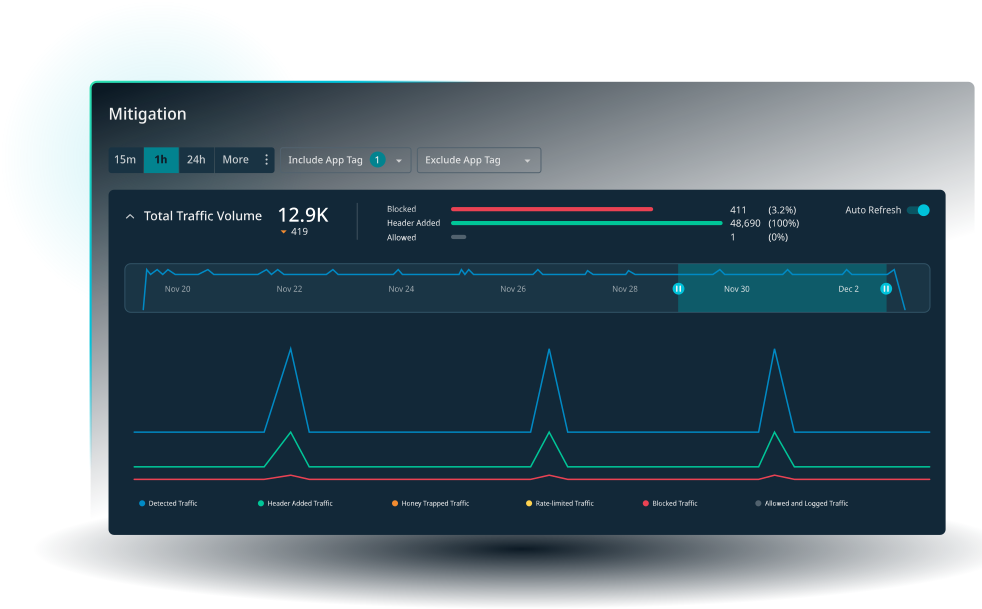
Cequence AI Gateway is a security and governance layer that connects AI agents to enterprise applications and data. It transforms internal, external, or SaaS APIs into MCP-compatible tools, so agents can access them without custom code. The gateway authenticates each agent and verifies every action it takes.
Policy is enforced inline on every tool call for the full session. Cequence Agent Personas bind an agent to a plain-English job description that defines the tools, APIs, skills, and permissions it is allowed to use. The gateway runs as a SaaS service with an on-premises option and integrates with existing OAuth 2.1 identity infrastructure.
Key features include:
- Agent personas: Generate an access profile from a plain-English job description, limiting an agent to only the tools, APIs, skills, and permissions it needs.
- Agentic zero trust enforcement: Authenticate agents and verify every action inline on each tool call, judging behavior against the agent’s defined role rather than authentication alone.
- MCP and API access control: Convert APIs into MCP-compatible tools and provide trusted registries of vetted MCP servers, APIs, and skills, with automated tool risk scoring and rate limiting.
- Sensitive data protection: Apply DLP scanning to agent requests and MCP responses, with more than 100 out-of-the-box detection types to monitor, redact, or block sensitive data, and integration with existing DLP tools.
- Identity and access governance: Integrate with OAuth 2.1-compliant identity providers, with token lifecycle management and session binding that locks sessions to originating IP addresses.
- Monitoring and AI discovery: Log every agent-to-tool interaction for audit, and surface sanctioned and shadow AI, MCP servers, and LLM providers from existing SIEM logs.
- Enterprise deployment: Support SaaS and on-premises models, RBAC, discrete pre-prod and production modes, and horizontal scaling.
Limitations (as reported by users on G2):
- Requires traffic to flow through it for governance: Organizations need to set up and maintain traffic flows through the AI Gateway for it to govern the agentic AI traffic.
- Prompt injection protection capabilities face arms race: As these types of attacks evolve, the Prompt Guard feature will have to evolve as well for protection.
- Learning curve for advanced configuration: Full use of all the features may take time as the platform covers a lot of ground in security and governance.
Source: Cequence
2. F5 AI Guardrails

Best for: Runtime security and governance for AI models, apps, and agents.
Strengths: Prompt injection defense, data leak prevention, and agent guardrails.
Things to consider: Newer product with an unproven track record; broad model routing requires purchasing additional F5 components.
F5 AI Guardrails provides runtime security for deployed AI models and agents. It inspects AI interactions to block adversarial attacks, prevent data leakage, and stop harmful outputs, applying policy consistently across public and proprietary models. It is model-agnostic and enforces controls independent of any single model provider.
The solution deploys in public cloud, private cloud, on-premises, and air-gapped environments. Teams can create custom controls through a natural-language interface and apply templates aligned to compliance frameworks. Enforcement actions are logged and traceable, and agent activity such as system prompts, reasoning, and tool calls can be observed and exported to a SIEM.
Key features include:
- Prompt injection and jailbreak defense: Detect and block prompt injection, data exfiltration, and jailbreak attempts, backed by a threat library that adds attack patterns monthly.
- Sensitive data protection: Enforce model-agnostic policies to detect and prevent leakage of standard and custom data categories at runtime, with controls for PII, PCI, and PHI.
- Custom policy creation: Build policy-driven controls through a natural-language interface, tailored by use case, region, and industry.
- Agent guardrails: Audit and block unauthorized tool calls and agent actions to limit excessive agency and privilege escalation.
- Content moderation: Align model outputs to enterprise definitions of biased, toxic, or harmful content.
- Compliance templates: Apply automated auditing templates for GDPR, HIPAA, EU AI Act, and similar frameworks.
- Audit-ready observability: Log and trace every enforcement action with guardrail attribution, capture agent system prompts, reasoning, and tool calls, and export to a SIEM.
- Flexible deployment: Run guardrails across public cloud, private cloud, on-premises, or air-gapped environments with consistent enforcement.
Limitations (based on publicly available sources):
- Newer offering: Introduced in 2026 following F5’s acquisition of CalypsoAI, so it carries an unproven standalone track record and very few third-party product reviews exist so far.
- Focus on security, not routing: It is a runtime security and guardrails layer only, not a multi-model routing gateway, so organizations needing broad LLM routing and cost management must purchase and integrate additional F5 platform components.
- GenAI guardrail overhead: A third-party reviewer found that generative-AI-based guardrails introduce noticeably more performance overhead than lighter classifier-based checks.
- Operational discipline: Getting full value depends entirely on teams maintaining strict workflow discipline around custom intents, oversight, and governance, a burden the platform does not automate away.
Source: F5
3. NeuralTrust TrustGate
Best for: Security-first routing and governance for LLM, MCP, and agent traffic.
Strengths: Open-source core, inline security, zero-trust identity, and low latency.
Things to consider: Young vendor with a thin track record and small community.
NeuralTrust TrustGate is an open-source AI gateway (Apache 2.0) for LLM, MCP, and agent-to-agent traffic. Built in Go as a single binary, it routes and load-balances across model providers behind one OpenAI-compatible interface, and centralizes security, observability, and governance on every call.
It forwards end-user identity through every hop and applies per-agent and per-tool role-based access control. Runtime inspection for jailbreaks, PII, and toxicity is added by attaching NeuralTrust’s TrustGuard engine. TrustGate runs as SaaS, hybrid, or on-premises and air-gapped, and ships as a single binary, a Docker image, or Kubernetes manifests.
Key features include:
- Multi-protocol gateway: Route and govern LLM, MCP, and agent-to-agent (A2A) traffic through one control point, with adapters for major providers behind an OpenAI-compatible surface.
- Identity forwarding and RBAC: Forward end-user identity through every hop and enforce per-agent and per-tool role-based access control.
- Inline runtime security: Attach TrustGuard to inspect prompts and responses for jailbreaks, injections, PII, and tool abuse, with PII redaction and prompt inspection in the data path.
- Traffic management: Apply rate limiting at request and token level, semantic caching, load balancing, and fallback across providers.
- Cryptographic audit trails: Produce records of every call and handoff for review by security teams and auditors.
- Flexible deployment: Run as SaaS, hybrid with a private data plane, or on-premises and air-gapped, via a single binary, Docker image, or Kubernetes with Helm.
- Open-source core: Start from the Apache 2.0 community edition and upgrade for deeper governance and multi-team control.
Limitations (based on publicly available sources):
- Young company: Founded in 2024 and still seed-funded, so it lacks the enterprise track record of long-established vendors.
- Enterprise depth behind commercial tier: The free open-source edition covers only the core gateway; meaningful governance, compliance, and multi-team controls are withheld behind a paid upgrade.
- Security depth relies on the wider suite: The gateway itself provides only routing and policy; full behavioral detection is unavailable unless customers attach TrustGuard and adopt more of the NeuralTrust platform.
- Concentrated customer base: Its published customers are concentrated almost entirely in Europe, leaving buyers elsewhere with few regional references to evaluate.
Source: NeuralTrust
Multi-Model LLM Gateway Platforms
4. Kong AI Gateway

Best for: Governing LLM, MCP, and agent traffic on one API platform.
Strengths: Multi-LLM routing, semantic caching, token quotas, and MCP governance.
Things to consider: Steep setup, with core features locked behind paid tiers.
Kong AI Gateway governs generative and agentic AI traffic across LLM, MCP, and agent-to-agent connectivity from a single platform. It sits on Kong’s API platform and gives developers a unified interface to multiple AI providers, with the ability to switch between them.
It enforces LLM policies such as PII sanitization, semantic prompt guards, and access control, and adds semantic caching, routing, and load balancing to manage cost and reliability. The gateway can generate MCP servers and tools on top of Kong-managed APIs, govern agent-to-agent traffic, and apply token and quota controls across the enterprise.
Key features include:
Multi-LLM routing: Use one unified API to work with multiple AI providers and switch between them for new use cases or availability during downtime.
LLM policy enforcement: Stop data leakage with PII sanitization, and apply semantic prompt guards, access control, and semantic caching.
MCP governance: Generate MCP servers and tools on top of Kong-managed APIs, enforce auth for MCP access, and optimize token spend through context optimization.
Agent-to-agent governance: Observe A2A traffic, capture telemetry on payloads, latency, token usage, and errors, and enforce centralized authentication and authorization.
Token and quota management: Set user, model, and time-bound quotas on consumption and token spend, and build showback and chargeback across LLM, agent, and MCP usage.
AI observability: Track consumption, tool usage, and token spend with L7 observability, plus logging and tracing for debugging.
Limitations (as reported by users on G2):
Configuration complexity: Users consistently report the platform is complex to configure and manage at first, with a steep learning curve for teams new to API gateways.
Enterprise features gated: Core capabilities such as analytics, RBAC, and the developer portal are withheld entirely unless customers pay for higher tiers.
Documentation and onboarding: Users repeatedly found initial setup instructions unclear and had to ask for more beginner-friendly guidance and clearer error messages.
Note: Reviews reference the broader Kong Gateway and Konnect platform that the AI Gateway is part of.
Source: Kong
5. Cloudflare AI Gateway
Best for: Caching, observability, and routing for AI applications.
Strengths: Response caching, dynamic routing, unified billing, and a global network.
Things to consider: Advanced controls and confusing pricing tiers create a real learning curve.
Cloudflare AI Gateway is a control plane for AI applications that connects to multiple model providers through a single API. It caches responses to cut redundant provider calls, dynamically routes requests based on latency, cost, or availability, and adds observability such as token counts and prompt performance.
It runs on Cloudflare’s global network and includes fallback routing, rate limiting, and safety guardrails to manage cost, behavior, and compliance across providers. A single bill and unified API cover every connected provider, and logs can feed custom dashboards and alerting.
Key features include:
- Response caching: Store and reuse frequent requests to reduce redundant API calls.
- Dynamic routing: Route requests by latency, cost, or availability, and adjust rules from the dashboard or API without redeploys.
- Observability: Log individual requests with prompt, response, provider, token usage, cost, and duration, and build custom dashboards and alerts.
- Fallback and rate limiting: Configure fallback routing and rate limits to keep AI operations reliable across providers.
- Security guardrails: Apply controls to protect applications from leaking sensitive information and from malicious traffic.
- Unified billing and API: Access every provider through a single API and manage costs with one bill.
Limitations (as reported by users on G2):
- Learning curve for advanced features: Configuring advanced rules and tuning is complex and consistently feels unintuitive for newer users.
- Tiered feature access: Advanced capabilities are locked to higher-tier plans, and customers often can’t tell what is actually included until they hit the limit.
- Detection transparency: Users report it is frequently unclear why certain requests are blocked or challenged, which meaningfully slows troubleshooting.
Note: Reviews reference the broader Cloudflare security and performance platform that AI Gateway is part of.
Source: Cloudflare
6. Portkey

Best for: Unified access, routing, and governance across many LLMs.
Strengths: Access to 1,600+ models, smart routing, caching, and key management.
Things to consider: Real documentation gaps, and a feature set that overwhelms new users.
Portkey (acquired by Palo Alto Networks in May 2026) is an enterprise AI gateway that connects to a large catalog of LLMs and providers through a unified API. It adds smart routing with configurable rules to switch models, distribute workloads, and fail over during errors, plus simple and semantic caching.
It stores provider keys in a vault and manages access with virtual keys that can be rotated, revoked, and monitored. The gateway supports conditional and multimodal routing, batching for large volumes, and provider-specific fine-tuning through the unified API. Portkey is part of Palo Alto Networks.
Key features include:
- Unified model access: Connect to a large catalog of LLMs and providers across modalities through one API without separate integrations.
- Smart routing and fallbacks: Switch between models with configurable rules, load-balance traffic, and fail over automatically during errors, with automatic retries.
- Caching: Use simple and semantic caching on repeat requests.
- Key management: Store LLM keys in a vault and manage access with virtual keys that can be rotated, revoked, and monitored.
- Conditional and multimodal routing: Route to providers by custom conditions and support vision, audio, and image-generation models.
- Batching and fine-tuning: Handle large volumes with provider batch APIs or custom batching, and apply provider-specific fine-tuning through the unified API.
Limitations (as reported by users on G2):
- Documentation gaps: Users consistently report the documentation falls short, regularly leaving them to figure things out entirely on their own.
- Evolving analytics and UI: Advanced analytics and customization options are still playing catch-up, and the interface lags behind in several areas.
- Feature complexity: The breadth of features regularly overwhelms newcomers.
Source: Portkey
7. TrueFoundry AI Gateway
Best for: Governed multi-model access with self-hosted deployment options.
Strengths: 250+ models, routing, guardrails, observability, and on-prem support.
Things to consider: Full-stack breadth creates a steep learning curve that weighs heavily on smaller teams.
TrueFoundry AI Gateway provides unified access to a large set of models through one OpenAI-compatible API, with routing, guardrails, observability, and policy control. It centralizes API key management and team authentication, and supports chat, completion, embedding, and reranking model types.
It can run in VPC, on-premises, hybrid, or air-gapped environments, keeping data within enterprise boundaries. The gateway also serves self-hosted open-source models with runtimes such as vLLM, and integrates MCP tools with OAuth2 and RBAC applied to every tool call.
Key features include:
- Unified model access: Connect to many providers and 250+ models through one gateway API and key, and orchestrate multi-model workloads without app changes.
- Routing and fallbacks: Use latency-based routing, weighted load balancing, automatic fallback to secondary models, and geo-aware routing for compliance.
- Guardrails: Apply input and output guardrails for PII filtering and toxicity detection, and plug in external safety services or custom rules.
- Observability: Track token usage, latency, error rates, and cost by model, team, user, or environment, with full request and response logs.
- Quota and access control: Set rate limits and token or cost quotas, and use RBAC to isolate usage across teams and service accounts.
- MCP integration: Register internal MCP servers and connect enterprise tools such as Slack, GitHub, and Confluence, with OAuth2 and RBAC on every tool call.
- Self-hosted models and deployment: Serve open-source models with vLLM and similar runtimes, and deploy across VPC, on-prem, hybrid, or air-gapped environments.
Limitations (as reported by users on G2):
- Access-control depth: Users have asked for significantly more RBAC depth and an approval-based deployment rollout workflow, gaps that limit production oversight today.
- Adjacent feature gaps: The platform still lacks adjacent capabilities such as LLM evaluations that users have asked for.
- Learning curve: The breadth of the full-stack platform takes real time to learn, and teams regularly depend on support just to navigate complex setups.
Source: TrueFoundry
8. LiteLLM
Best for: Open-source unified access to 100+ LLMs in the OpenAI format.
Strengths: Unified API, spend tracking, budgets, rate limits, and self-hosting.
Things to consider: Proxy latency and real stability problems surface at high load.
LiteLLM is an open-source AI gateway that provides a single, unified interface to call more than 100 LLM providers in the OpenAI format. It runs as a proxy server, or as a Python SDK, to manage authentication, load balancing, and spend tracking across models.
Teams can set budgets and rate limits, delegate access to organizations and teams, and generate temporary tokens with OIDC/JWT auth. It logs to destinations such as Datadog and OpenTelemetry, exposes Prometheus metrics, and deploys self-hosted, on-premises, or in a private cloud via Kubernetes and Helm.
Key features include:
- Unified API: Call 100+ LLM providers through one OpenAI-compatible interface, swapping providers without rewriting application code.
- Spend tracking and budgets: Track spend across providers and set budgets and quotas per key, team, or organization.
- Rate limiting and access control: Apply rate limits and use RBAC with virtual keys, delegating access to admins for teams and organizations.
- Authentication: Support OIDC/JWT and SSO, with group-based access and on-the-fly temporary tokens.
- MCP and guardrails: Add MCP servers to the gateway and apply built-in and third-party guardrails.
- Logging and metrics: Log to Datadog, OpenTelemetry, s3, and similar destinations, with Prometheus metrics for production monitoring.
- Flexible deployment: Self-host on-premises, across multiple clouds, or on Kubernetes with Helm.
Limitations (based on publicly available sources):
- Proxy latency: Public benchmarks and community reports consistently cite meaningful latency overhead when it proxies external providers.
- Stability tuning at scale: Community reports describe real memory growth under high concurrency along with readiness-probe and cascading-failure issues under sustained load, problems that demand careful resource-limit tuning to avoid.
- Retry defaults: The default retry setting retries non-retryable errors out of the box, triggering rate-limit cascades and higher token spend unless customers manually tune it.
- Enterprise depth: Advanced security controls, audit trails, and governance features fall well short of commercial platforms, and closing that gap requires upgrading to the enterprise edition for SSO and support.
Source: LiteLLM
Conclusion
Enterprise AI gateways provide the critical infrastructure needed to secure, govern, and optimize AI model usage across an organization. By centralizing traffic management, data protection, and policy enforcement, these solutions enable scalable AI adoption while mitigating risks and controlling costs. Implementing an AI gateway ensures consistent security and operational reliability as businesses integrate diverse AI models into their workflows.