
TL;DR: AI governance platforms for explainability and audit trails record how AI models, agents, and tools reach outputs and actions. Cequence AI Gateway is best for agent, API, and MCP audit trails; IBM watsonx.governance for enterprise lifecycle governance; Credo AI for regulatory policy mapping; and Fiddler AI for model and agent observability.
What Are AI Governance Platforms?
AI governance platforms are tools that help organizations manage, monitor, and control AI systems throughout their lifecycle. They provide a central way to track AI models, applications, agents, and their use of data and external services. These platforms support risk assessments, policy enforcement, regulatory compliance, and accountability.
For explainability and audit trails, AI governance platforms help teams understand what influenced an AI output, trace the actions taken by AI agents, and record who approved or changed a system. They also preserve evidence of AI activity and governance decisions, making it easier to investigate incidents, verify compliance, and demonstrate that AI systems operate within defined policies.
Core capabilities to look for:
- AI discovery and inventory: Identifies approved and unregistered models, applications, agents, datasets, and supporting services while tracking ownership, versions, dependencies, and lifecycle status.
- Centralized AI activity monitoring: Consolidates model requests, agent actions, tool calls, policy violations, configuration changes, and governance decisions for investigation and alerting.
- Comprehensive audit logging: Maintains chronological, tamper-resistant records of prompts, outputs, identities, model versions, tool calls, approvals, policy decisions, and administrative changes.
- Model and application risk classification: Classifies AI systems based on factors such as autonomy, data sensitivity, decision impact, affected users, and regulatory requirements.
- User and AI agent identity attribution: Links AI activity to human users, applications, service accounts, agents, and sub-agents to establish accountability.
- AI agent and workflow visibility: Traces agent objectives, delegated tasks, tool selections, approval checkpoints, failures, retries, and resulting actions across multi-step workflows.
- API and tool-level visibility: Records interactions with APIs, plugins, databases, functions, and MCP servers, including requested operations, authorization context, and results.
- Prompt and LLM interaction monitoring: Tracks prompts, responses, model metadata, and relevant context while supporting controls such as redaction, encryption, and configurable retention.
- Compliance reporting and evidence generation: Converts inventories, assessments, tests, approvals, exceptions, incidents, and monitoring records into traceable evidence for audits and compliance reviews.
This is part of a series of articles about AI security
In this article:
- AI Governance Platforms for Explainability and Audit Trails at a Glance
- Why Are Explainability and Audit Trails Important for AI Governance?
- What Should AI Governance Platforms Make Explainable?
- Key Capabilities to Look for in AI Governance Platforms for Explainability and Audit Trails
- Notable AI Governance Platforms for Explainability and Audit Trails
AI Governance Platforms for Explainability and Audit Trails at a Glance
The table below summarizes the key differences between the AI governance platforms covered in this guide. We explore each platform in more detail in the sections that follow.
Category Solution Best For Key Strengths Things to Consider AI Agent and Runtime Governance Cequence AI Gateway Governing agent access to APIs, MCP servers, and LLMs Agent Personas, tool-level and agent-level audit trails Breadth of features can be intimidating at first AI Agent and Runtime Governance Zenity Governing agents across SaaS, cloud, and endpoints Live agent inventory, step-level monitoring Agent security focus; no model evaluation AI Agent and Runtime Governance Noma Security Controlling agents, MCP servers, and models Session-level detection, Open Enforcement Few user reviews; some endpoint features planned AI Governance, Risk, and Compliance IBM watsonx.governance ML, generative AI, and agent governance with GRC Governance graph, end-to-end traceability Complex setup; cost at scale AI Governance, Risk, and Compliance Credo AI Mapping AI systems to regulations and policies Agent registry, policy packs, automated evidence Some enforcement integrations planned AI Governance, Risk, and Compliance OneTrust AI Governance Extending OneTrust programs to AI Intake workflows, runtime violation detection Runtime coverage varies by platform AI Governance, Risk, and Compliance ModelOp Enterprise AI Command Center One system of record for all AI assets Control mapping, regulator-grade audit trail Self-hosted only AI Governance, Risk, and Compliance Fiddler AI Monitoring and enforcing policy on agents and ML models Inline guardrails, recorded enforcement decisions Onboarding effort for non-technical users
Why Are Explainability and Audit Trails Important for AI Governance?
Understand How AI Systems Reach Decisions
Explainability techniques show which inputs, features, rules, or model behavior contributed to an output. The appropriate method depends on the system. For example, teams may use feature importance for predictive models, decision paths for rule-based systems, or input and output analysis for generative AI.
This information helps reviewers determine whether a system is using relevant signals rather than inappropriate proxies or unreliable patterns. It can also reveal cases where a model produces acceptable results for the wrong reasons, creating risks that standard performance metrics may not detect.
Investigate Unexpected or High-Risk AI Behavior
When an AI system produces an incorrect, unsafe, or unusual result, teams need enough evidence to reconstruct what happened. Audit trails can record the model and prompt versions, configuration, input data, retrieved context, tool calls, output, and subsequent human actions.
These records make incident investigation more systematic. Teams can identify whether a problem came from the model, data, application logic, configuration, or user interaction. They can then reproduce the issue, determine its scope, and verify that corrective controls work.
Demonstrate Compliance With AI Regulations and Internal Policies
AI regulations and organizational policies can require documentation of risk assessments, testing, approvals, oversight, and system behavior. Explainability provides evidence about how decisions are produced, while audit trails show which governance activities occurred and who performed them.
Maintaining this evidence reduces dependence on manual reconstruction during an audit or regulatory review. Organizations can trace requirements to specific controls and records, such as evaluation results, approval decisions, model changes, and monitoring events.
Establish Accountability Across the AI Lifecycle
AI systems can involve model developers, data teams, application owners, security teams, compliance functions, and business users. Without clear records, it can be difficult to determine who approved a system, changed its configuration, or responded to a detected risk.
Audit trails connect actions to users, systems, timestamps, and versions. Combined with defined ownership and approval workflows, these records establish responsibility from development through deployment and monitoring. This makes governance decisions traceable and helps prevent important controls from becoming informal or unassigned.
Related content: Read our article about AI governance risks, frameworks, and components
What Should AI Governance Platforms Make Explainable?
Model Outputs and Recommendations
Platforms should connect significant outputs and recommendations to the model version, configuration, inputs, and relevant evaluation results. For predictive models, this can include feature importance, confidence scores, thresholds, or decision paths. For generative AI, useful context can include system instructions, model parameters, and retrieved information.
Teams should also be able to compare outputs across model versions and configuration changes. This can reveal whether an update introduced different behavior, reduced accuracy, or changed how the system handles particular inputs.
For high-impact decisions, the platform should preserve enough evidence for a reviewer to understand the main factors behind the result. This is especially important when AI influences areas such as credit, employment, healthcare, fraud detection, or access to services.
Data Sources and Context Used by AI Systems
AI behavior depends on the information supplied to the model. Governance platforms should record relevant datasets, documents, databases, vector stores, retrieved passages, and other context used when producing an output.
Teams should be able to trace information to its source and, where possible, its version. Metadata can include ownership, collection date, sensitivity classification, retention requirements, and authorization status. This makes it easier to identify outdated, incorrect, unauthorized, or sensitive data.
For retrieval-augmented generation systems, governance should also cover the retrieval process. Recording which documents were retrieved and which passages were supplied to the model helps distinguish model errors from problems caused by retrieval quality or source content.
User Prompts and Model Responses
For generative AI applications, prompts and responses provide essential evidence of system behavior. Platforms should capture them when permitted by privacy, security, and retention policies, together with timestamps, model versions, session identifiers, and relevant configuration.
These records help teams reproduce failures and investigate issues such as hallucinations, prompt injection, unsafe content, or sensitive data disclosure. They also provide useful samples for evaluating whether guardrails continue to work after models or prompts change.
Prompt logging itself introduces governance requirements. Prompts can contain personal, confidential, or regulated information, so platforms may need redaction, encryption, access controls, retention limits, or selective logging instead of storing every interaction in full.
AI Agent Decisions and Actions
AI agents can plan tasks, make intermediate decisions, invoke tools, and modify external systems with limited human involvement. Governance platforms should therefore record the agent's objective, selected steps, relevant state, approvals, actions, and results.
A useful agent trace shows the sequence of events rather than only the final response. For example, it can show that an agent searched a database, selected a customer record, called an API, received an error, retried the operation, and then updated another system.
Platforms should also record where human approval was required and whether the agent remained within its assigned permissions. This helps investigators distinguish incorrect reasoning from excessive privileges, faulty tool behavior, or missing approval controls.
API, Tool, and MCP Server Interactions
AI applications and agents increasingly interact with external services through APIs, tools, plugins, and Model Context Protocol (MCP) servers. Governance platforms should record which service was called, which operation was requested, when it occurred, and whether it succeeded.
Where security policies permit, records can also include request parameters, returned data, authorization context, tool versions, and errors. These details help teams determine whether an incident resulted from the model's decision, the integration layer, incorrect permissions, or an external service.
This visibility is particularly important for tools that can change data or perform transactions. A governance platform should make it possible to determine what the AI attempted, what the external system actually executed, and which identity or credential authorized the action.
Policy and Governance Decisions
Explainability should cover decisions made by the governance process itself. Platforms should record risk classifications, policy checks, assessment results, exceptions, approvals, rejected requests, and changes to governance controls.
Each decision should be linked to the applicable policy, responsible owner, supporting evidence, and timestamp where appropriate. If an exception is granted, the record should explain its scope, justification, compensating controls, approver, and expiration date.
Governance rules also change over time. Versioning policies and approval criteria allows teams to determine which requirements applied when a system was reviewed or an action occurred. This creates an audit trail showing not only what an AI system did, but also why the organization allowed, restricted, or modified its use.
Key AI Governance Capabilities to Look When Explainability and Compliance are a Priority
AI Discovery and Inventory
The platform should discover and maintain an inventory of AI models, applications, agents, datasets, and supporting services. Discovery can include both approved systems and unregistered AI deployed outside established governance processes. Inventory records should include:
- Ownership
- Purpose
- Deployment environment
- Model provider
- Version
- Data source
- Integrations
- Lifecycle status
Connecting inventory information with runtime activity helps teams understand which AI assets are actually being used and where governance gaps exist. The inventory should also track dependencies between components. For example, an application might use an external LLM, a vector database, several APIs, and an MCP server. Mapping these relationships provides context when investigating incidents or assessing changes.
Centralized AI Activity Monitoring
Organizations need a consolidated view of AI activity across models, applications, users, agents, and environments. Centralized monitoring reduces the need to investigate separate logs from every model provider or application. The platform should capture relevant events such as:
- Model requests
- Agent actions
- Tool calls
- Policy violations
- Configuration changes
- Approval decisions
Teams should be able to filter and correlate these events by application, user, agent, model, risk level, and time period. Monitoring should also support alerts for important conditions. Examples include unusual usage volumes, prohibited models, sensitive data exposure, failed policy checks, or high-risk agent actions.
Comprehensive and Tamper-Resistant Audit Logging
Audit logs should provide a chronological record of significant AI and governance events. Useful records include:
- Timestamps
- Identities
- Model versions
- Prompts
- Outputs
- Tool calls
- Policy decisions
- Configuration changes
- Approvals
- Administrative actions
Logs should be protected against unauthorized modification or deletion. Depending on the risk level, this can involve append-only storage, cryptographic integrity controls, restricted administrative permissions, immutable storage, or export to an independent security logging system.
Retention and access controls are equally important. Organizations should define how long different records are retained and who can view them, particularly when logs contain personal information, confidential prompts, or sensitive model outputs.
Model and Application Risk Classification
Not every AI system requires the same level of oversight. Governance platforms should support risk classification based on factors such as:
- Intended use
- Autonomy
- Affected users
- Data sensitivity
- Decision impact
- Regulatory requirements
Risk classifications should determine which controls apply. A low-risk internal summarization tool, for example, may require fewer approvals than an AI system involved in employment or financial decisions.
The platform should also support reassessment when systems change. A new model, data source, integration, or agent capability can alter an application's risk profile and trigger additional testing or approval requirements.
User and AI Agent Identity Attribution
Audit records are more useful when actions can be attributed to an identity. Platforms should distinguish between human users, service accounts, applications, AI agents, and sub-agents rather than recording all activity under a shared system identity. Identity records should show who initiated an AI interaction and which identities subsequently performed actions.
For agentic systems, this can include:
- The user who started a task
- The agent that selected an action
- The credential used to execute it
Strong attribution supports incident investigation and accountability. It also helps teams detect shared credentials, excessive privileges, unauthorized users, and agents operating outside their assigned scope.
AI Agent and Agentic Workflow Visibility
Agentic systems introduce additional governance challenges because a single request can result in multiple decisions and actions. Platforms should expose the complete execution path instead of recording only the initial prompt and final response. A trace can include:
- The agent's objective
- Planning steps where available
- Delegated tasks
- Tool selections
- Approval checkpoints
- Retries
- Failures
- Resulting actions
The platform should also show interactions between multiple agents when workflows use specialized or hierarchical agents. This visibility helps teams identify where a workflow failed and determine whether existing controls operated correctly. It is particularly important when agents can send messages, modify records, execute code, or initiate transactions.
API and Tool-Level Visibility
AI systems often interact with external resources through APIs, plugins, functions, databases, and MCP servers. Governance platforms should provide visibility into these interactions because important risks can occur outside the model itself. Records should identify:
- The tool or endpoint
- The requested operation
- The calling identity
- A timestamp
- Authorization context
- The result
Where appropriate, request and response details can be retained or selectively captured according to security and privacy policies. Platforms should also help identify unusual or prohibited tool use. Examples include attempts to access restricted data, invoke unapproved APIs, perform operations outside an agent's permissions, or repeatedly call a failing external service.
Prompt and LLM Interaction Monitoring
Governance platforms should provide visibility into interactions with LLMs, including user prompts, system prompts, model responses, and relevant context. Metadata can make these records easier to investigate:
- Model name
- Version
- Provider
- Application
- Timestamp
- Configuration
Monitoring can help detect prompt injection, sensitive data exposure, unsafe outputs, prohibited topics, and unexpected model behavior. It can also reveal changes in behavior after prompt templates, guardrails, models, or retrieval components are updated.
Because prompts and responses can contain sensitive information, full logging is not always appropriate. Platforms should support controls such as masking, redaction, encryption, role-based access, sampling, and configurable retention.
Compliance Reporting and Evidence Generation
Governance platforms should convert operational and governance records into evidence that can support audits and compliance reviews. Reports can cover:
- AI inventories
- Risk assessments
- Testing results
- Approvals
- Policy exceptions
- Incidents
- Model changes
- Monitoring activities
Evidence should be traceable to the underlying records rather than relying only on manually prepared summaries. Reviewers should be able to determine when a control operated, which system it applied to, who performed or approved it, and what result it produced.
Reporting should also support different regulatory and internal control frameworks without duplicating evidence unnecessarily. Mapping one technical or governance control to multiple requirements can reduce manual compliance work while maintaining a consistent audit trail.
Notable AI Governance Platforms Supporting Explainability and Audit Trails
How we selected these platforms: We shortlisted AI governance platforms based on AI discovery and inventory, AI activity and agent monitoring, audit logging, risk and policy controls, and evidence generation for compliance reviews.
AI Agent and Runtime Governance Platforms
1. Cequence AI Gateway

Best for: Governing AI agent access to APIs, MCP servers, and LLMs
Strengths: Agent Personas with tool-level and agent-level audit trails
Things to consider: Breadth of features can be intimidating at first
Cequence AI Gateway sits between AI agents and the enterprise applications, APIs, and data they access. It authenticates each agent and then verifies every action inline in the request path, for the full session and on every tool call. The gateway records user, agent, and tool activity in a central audit log that shows which applications agents access and which API calls they make.
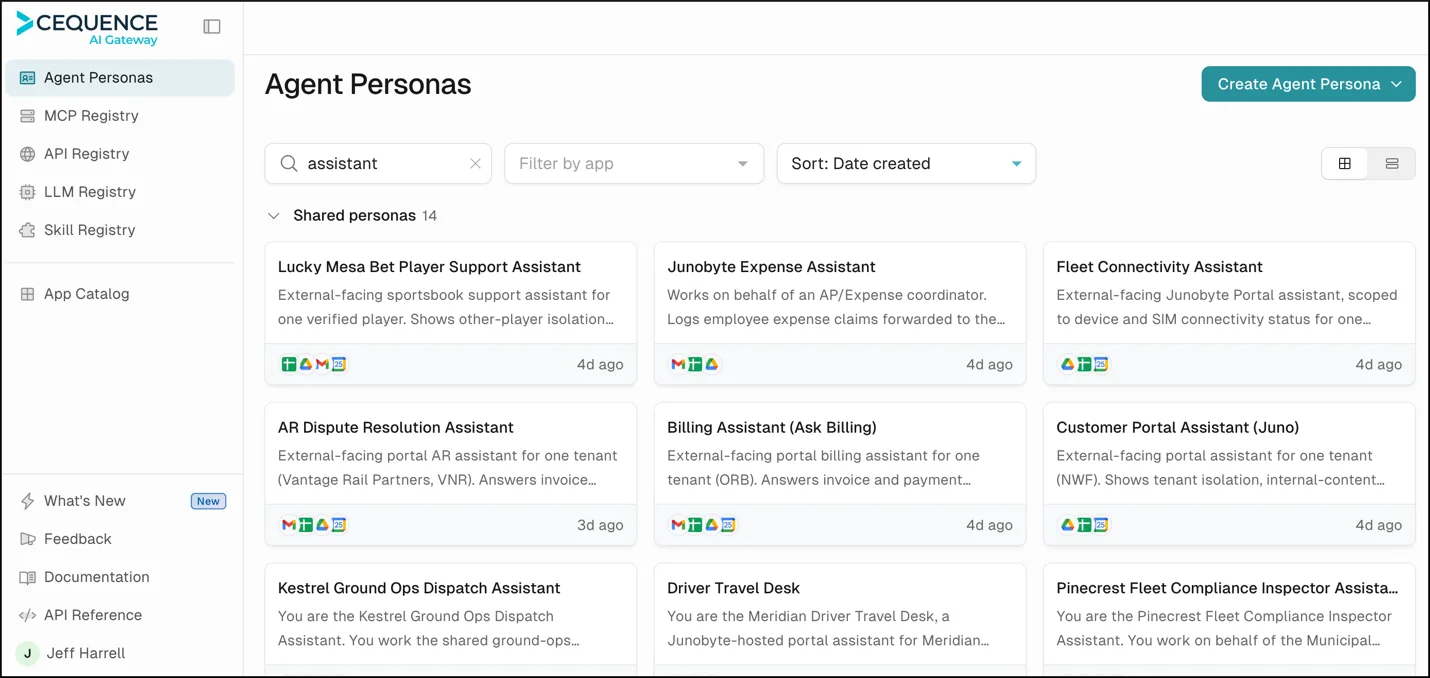
Each agent is bound to an Agent Persona, a plain-English job description that defines its permitted tools, APIs, skills, and guardrails. The gateway also maintains registries of approved MCP servers, APIs, LLMs, and skills, and converts existing APIs into MCP tools. It runs as SaaS or on premises and integrates with Cequence API Security and Bot Management.
Key features include:
- Agent Personas: Teams describe an agent's job in plain English, and the gateway generates a persona with only the tools, APIs, skills, and permissions that job requires. Least-privilege access policies are scoped dynamically from the job description.
- Tool-level and agent-level audit trails: Activity logs capture agent identity, user context, data accessed, applications reached, API calls, and full request and response flows. Behavior is attributed to the agent and the person behind it, and logs export to SIEM tools.
- Agentic Zero Trust enforcement: Agents authenticate through OAuth 2.1-compliant identity providers with built-in token lifecycle management. Each action is then evaluated on both identity and behavior, so an authorized agent that acts outside its persona can be contained.
- Trusted registries and LLM routing: Registries of vetted MCP servers, APIs, LLMs, and skills limit agents to approved endpoints. Multi-model LLM routing applies model and cost policies, with token and spend limits per minute, day, or month by team.
- AI discovery: The gateway identifies sanctioned and shadow AI use, surfacing unregistered MCP servers, agents, and LLM providers from existing SIEM logs.
- Runtime guardrails and data protection: Prompt Guard screens prompts for injection, jailbreak, and system-prompt extraction patterns, with support for custom rules. DLP scanning covers agent requests and MCP server responses across more than 100 detection types, with options to monitor, redact, or block.
- Human oversight controls: Anomaly detection, policy enforcement, and kill-switch controls let teams intervene in agent activity. Automatic agent discovery supports the AI inventory needed for regulatory registration decisions.
- No-code MCP enablement: Uploading an OpenAPI specification turns an existing API into agent-ready MCP tools. A catalog covers more than 140 enterprise applications, including Salesforce, Jira, Slack, and Confluence.
Limitations (as reported by users on G2):
- Breadth of features can be intimidating at first. Beginners may be intimidated by the breadth of features and capabilities. An AI assistant is built in to help guide new users.
2. Zenity

Best for: Security teams governing agents across SaaS, cloud, and endpoints
Strengths: Live agent inventory with step-level behavioral monitoring
Things to consider: Centered on agent security, not model evaluation or testing
Zenity is an AI agent security and governance platform covering agents embedded in SaaS tools, homegrown agents on cloud platforms, and coding and personal agents running on endpoints. The platform is organized into three layers: Surface builds an agent inventory and evaluates configuration and exposure, Enforce acts when an agent makes a decision, and Protect monitors what happens afterward.
Supported environments include Microsoft Copilot Studio, Microsoft 365 Copilot, ChatGPT Enterprise, Claude Enterprise, Salesforce Agentforce, ServiceNow, Amazon Bedrock and AgentCore, Microsoft Foundry, and Google Vertex AI. Each discovered agent is recorded with its configuration, permissions, and tool access.
Key features include:
- AI Observability: Continuous discovery catalogs agents across SaaS, custom, and endpoint deployments. It shows counts and trends for agents, threads, and MCPs over time and flags agents operating outside sanctioned deployment channels.
- Step-level behavioral monitoring: The platform analyzes agent execution paths, tool invocations, memory updates, decision flows, RAG queries, file access, and user attachments.
- Data Lens: Data and tools accessed by agents are tracked by frequency and by user. This surfaces sensitive files and pages that are both frequently accessed and broadly exposed across agents.
- AI Security Posture Management (AISPM): Agent configuration and permissions are evaluated against policy before an agent goes live.
- AI Exposure Management: The platform validates which of an agent's attack paths are exploitable, scores each one, and produces a fix that can be applied through Runtime Boundaries.
- Coverage for coding and personal agents: Visibility extends to coding assistants and local MCPs running outside centrally managed platforms.
Limitations (based on publicly available sources):
- Limited independent user reviews: G2 does not have enough reviews to provide buying insight, and Gartner Peer Insights lists a single review.
- Scope centered on agent security: The platform does not cover model evaluation or quality testing, which typically requires a separate tool.
- Enforcement depth varies by platform: Inline prevention capabilities are announced per platform, so runtime enforcement coverage depends on which agent platforms an organization uses.
3. Noma Security

Best for: Discovering and controlling agents, MCP servers, and models
Strengths: Session-level behavioral detection with policy enforcement
Things to consider: Few public user reviews; endpoint Agent Boundaries still planned
Noma Security is an AI and agent security platform covering three environments: endpoint agents such as Claude Code, Cursor, and Codex; homegrown AI built on AWS Bedrock, Azure AI Foundry, Databricks, LangChain, or CrewAI; and agents built on SaaS platforms such as Copilot Studio, Agentforce, and ServiceNow.
The platform consists of four products: AI-SPM, Access Control, AI-DR, and AI Red Teaming, which share findings with each other. Open Enforcement applies a single policy set through existing control points, including agent hooks, MCP gateways, AI gateways, agent SDKs, and direct APIs.
Key features include:
- AI-SPM and agent risk map: Noma discovers agents, MCP servers, skills, models, and tools across endpoint, SaaS, and homegrown environments. The risk map shows each agent's connections, permissions, and data access, and flags misconfigurations and risky combinations of capabilities.
- Access control: Policies define which MCP servers, skills, and tools each agent can use, keyed to IdP groups or applied by tool sensitivity. A live registry tracks approved items and blocks the rest at the moment the agent acts.
- AI-DR session tracking: The platform monitors the full chain of each agent session, including prompts, tool calls, data access, and actions. It detects prompt injection, data exfiltration, and scope violations, and can alert, block, mask data, or route to a human.
- AI red teaming: Multi-turn test campaigns probe AI apps and agents for prompt injection, jailbreaks, data leakage, and goal drift. Findings are converted into AI-DR runtime policies.
- Agentic identity: Noma records which identity an agent acts as, what it is permitted to do, and whether its actions match the user's intent.
- Compliance and reporting: Reports combine AI inventory, framework mappings, red team results, and audit trails.
Limitations (based on publicly available sources):
- Limited independent user reviews: G2 and Gartner Peer Insights do not list user reviews for the platform.
- Endpoint boundaries still in development: Agent Boundaries for enforcing business rules on endpoint agents are announced as planned rather than available.
- Pricing not published: Pricing is usage-based and varies by the number of protected endpoints, enabled features, and support level.
AI Governance, Risk, and Compliance Platforms
4. IBM watsonx.governance

Best for: Enterprises governing ML, generative AI, and agents with GRC
Strengths: Governance graph, policy enforcement, end-to-end traceability
Things to consider: Setup and non-IBM integrations can be complex and costly
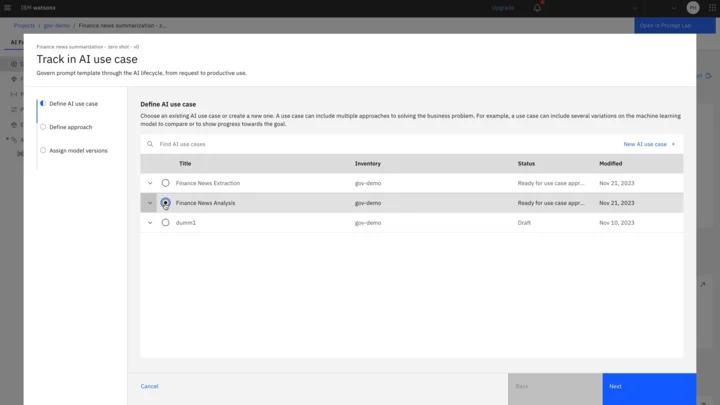
IBM watsonx.governance combines AI governance with enterprise governance, risk, and compliance (GRC) capabilities. It provides visibility into AI systems, automates policy enforcement and obligation mapping, and tracks governance activities, decisions, and model changes for reporting and accountability.
The platform includes a governance graph that maps relationships between AI systems, risks, controls, and policies, as well as shadow AI detection and continuous monitoring. It can be purchased for cloud or on-premises environments and offers a 14-day trial.
Key features include:
- Governance graph: A connected map of the AI estate shows relationships between AI assets, policies, enterprise AI risks, and regulatory requirements.
- Policy enforcement and evidence capture: Teams create and enforce governance policies across models and AI workflows. Obligation mapping and compliance evidence capture run continuously.
- End-to-end traceability: Governance activities, decisions, and model changes are tracked to support reporting and accountability.
- Shadow AI detection: The platform discovers unmanaged and unapproved AI usage across the organization.
- Continuous monitoring: AI systems are monitored for compliance, operational issues, and emerging risks on an ongoing basis.
- AI-native governance assistants: Embedded AI assistants help onboard AI use cases, capture governance information, and automate workflows within enterprise tools and conversational interfaces.
- Regulatory and risk content: A library of AI regulatory and risk content supports mapping AI initiatives to regulations and governance frameworks.
Limitations (as reported by users on G2):
- Setup and learning curve: Many users describe initial configuration of policies, workflows, and roles as complex and time-consuming.
- Integration outside the IBM ecosystem: Some users report that connecting models from other environments, such as AWS SageMaker, requires manual configuration with limited documentation.
- Cost at scale: Several users note that costs rise significantly in production, which can be a barrier for smaller organizations.
- Interface performance: Some users find the interface heavy, with slower loading when the inventory holds many use cases.
Source: IBM
5. Credo AI

Best for: Governance teams mapping AI systems to regulations and policies
Strengths: Agent registry, regulatory policy packs, automated evidence
Things to consider: Runtime enforcement integrations are still listed as planned
Credo AI is an AI governance platform covering agents, models, applications, and vendors. Its modules include AI Registry and Discovery, Risk Intelligence, a Compliance and Policy Engine, and a Governance module that evaluates agent traces in production.
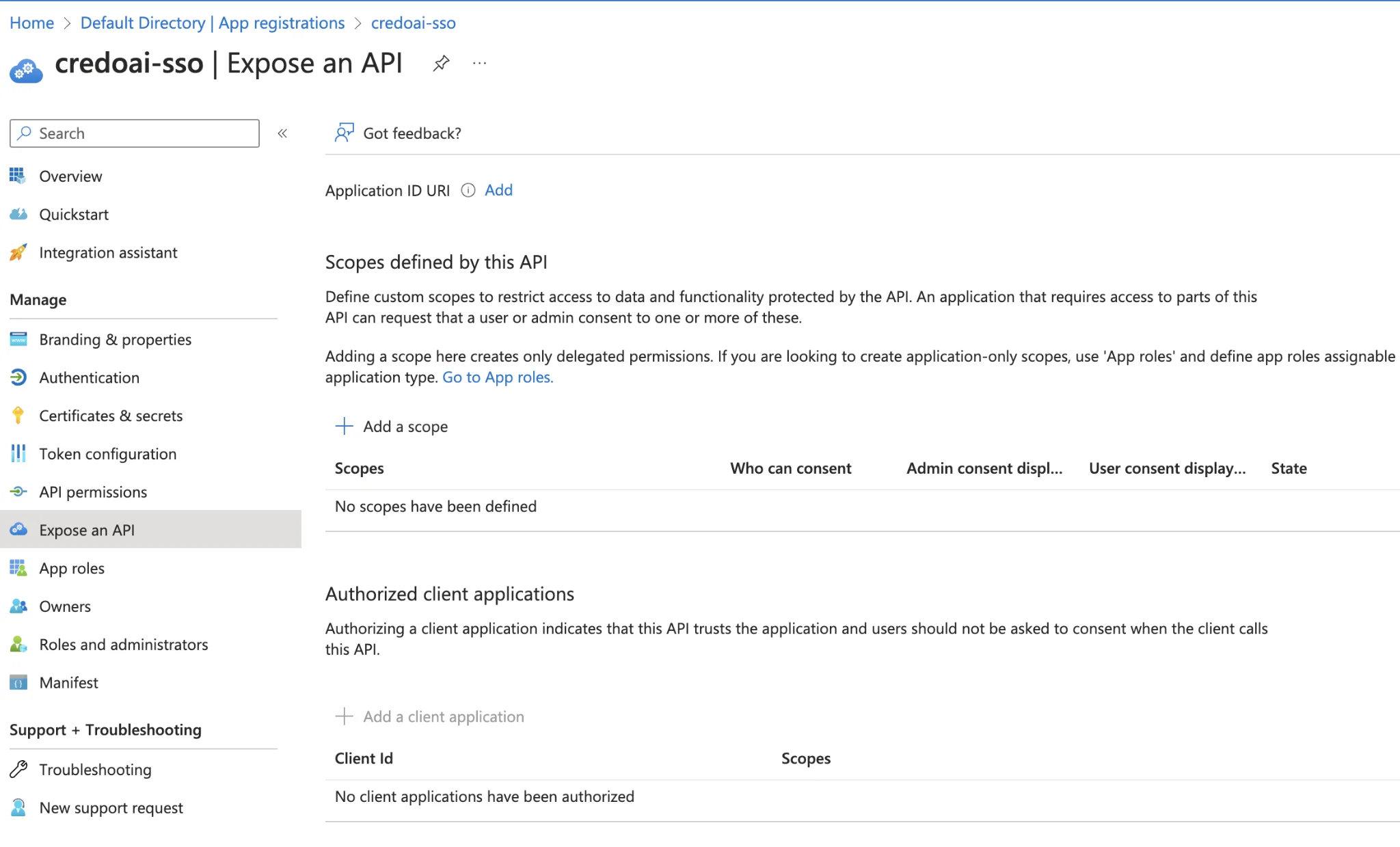
A Governance Knowledge Graph connects regulations, business context, and AI system configurations to determine which controls apply to each system. The platform integrates with AWS, Azure, GCP, Databricks, Snowflake, LangChain, CrewAI, ServiceNow, Archer, GitHub, MLflow, and Jira.
Key features include:
- AI and agent registry: A central inventory covers agents, models, apps, and shadow AI. Agent cards document each agent's purpose, tools, data sources, and guardrails.
- Dependency graph: The platform maps relationships between agents, sub-agents, models, tools, and data, along with MCP server governance.
- Risk Intelligence: An agentic risk assessment library includes mapped controls, policy inheritance, and aggregate risk scoring, along with automated red-teaming and drift detection.
- Compliance and Policy Engine: Pre-built policy packs cover the EU AI Act, NIST AI RMF, ISO 42001, and SOC 2. Governance workflows include approval gates, automated evidence generation, and audit trails.
- Trace evaluation in production: Agent traces are ingested and continuously evaluated for policy violations, drift, and unsafe behavior, with human-in-the-loop escalation for high-risk actions.
- GAIA governance agents: AI agents retrieve evidence, assess risk, generate governance plans, and support incident remediation.
Limitations (based on publicly available sources):
- Planned enforcement integrations: Integration with CI/CD pipelines, CASBs, and API gateways for policy enforcement is listed as planned.
- Agent Governor in preview: The Agent Governor capability is offered as a research preview.
- Documentation for advanced setups: Some public comparisons note limited documentation and training resources for advanced configurations.
Source: Credo AI
6. OneTrust AI Governance

Best for: Organizations extending OneTrust privacy and GRC programs to AI
Strengths: Intake workflows, runtime violation detection, audit evidence
Things to consider: Runtime coverage varies by platform; setup can be demanding
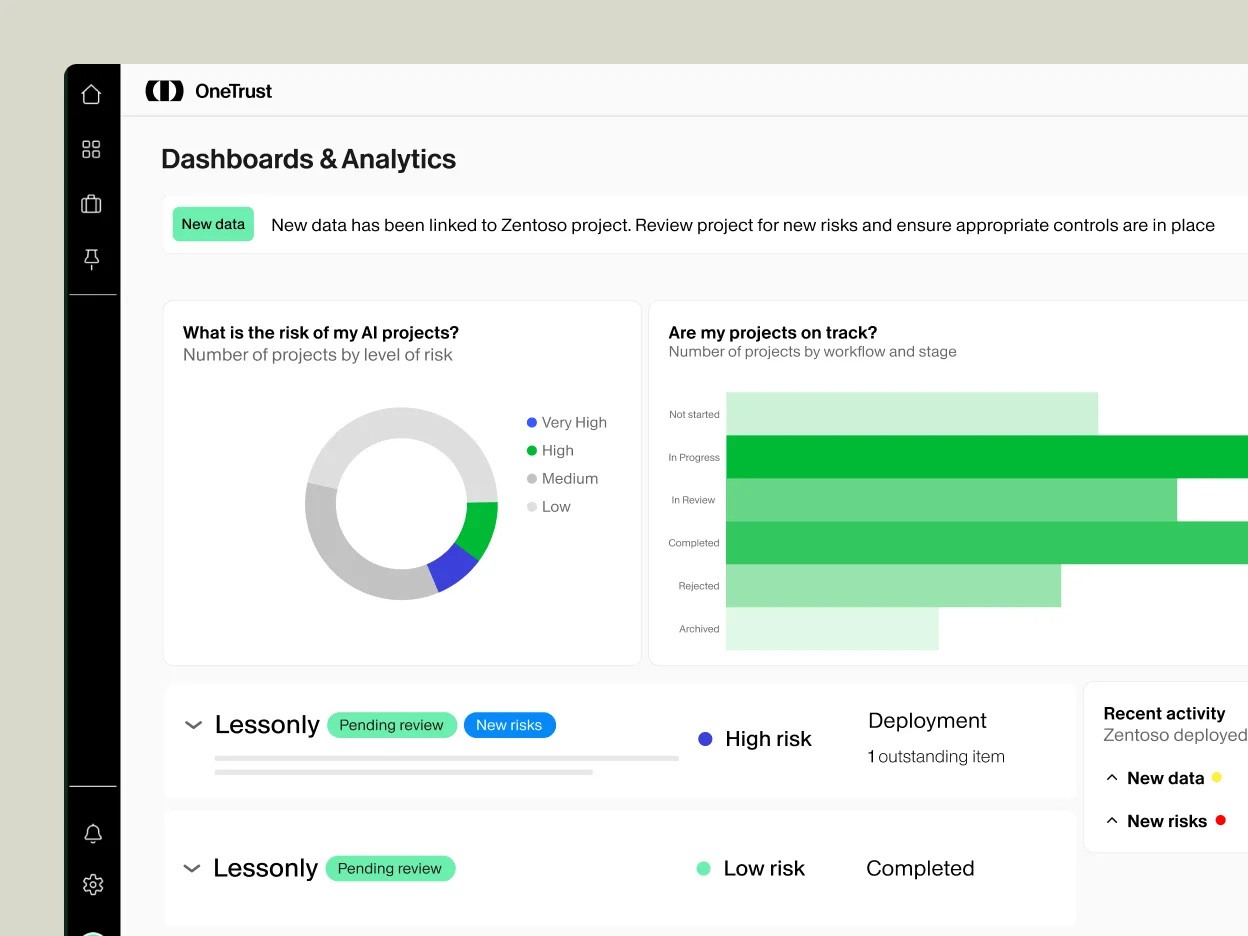
OneTrust AI Governance brings AI systems, agents, models, datasets, vendors, and projects into a central program center. It handles intake, risk scoring, approvals, and attestations, and connects to production AI platforms to monitor runtime signals and policy violations.
AI Policy Manager defines policy intent and required controls, while Guardrail Enforcement and the AI Guard SDK apply them where AI runs. Native integrations include Amazon Bedrock, Microsoft Foundry, Google Vertex, and Databricks Unity Catalog. Runtime coverage differs by integration.
Key features include:
- Discovery and inventory: Continuous discovery covers AI systems, models, agents, datasets, and vendors. Records include ownership, lifecycle status, decision logic, and dependencies across the AI estate.
- Risk assessment templates: Built-in templates cover the EU AI Act, NIST AI RMF, and ISO 42001. Risk tiering is automated, and risk is revalidated when a model, agent, dataset, or usage pattern changes.
- Governance workflows: Configurable intake, approval, attestation, and signoff workflows route reviews by risk. Lifecycle status, exceptions, and required controls are tracked.
- Runtime observation: Evaluation metrics are collected across Amazon Bedrock and AgentCore, Microsoft Foundry, Databricks, and Gemini Enterprise Agent Platform. Interaction logs from Bedrock and Foundry are analyzed for PII in prompts and responses.
- Policy violation detection: Violations are detected and logged in real time, with tracking of policy versions, applicability, exceptions, and remediation status.
- Guardrails and AI Guard SDK: Policies can block, allow, redact, escalate, or route actions. A Python SDK detects sensitive data in prompts and responses before it reaches the model.
- Agent and MCP governance: Agents are registered with a defined purpose, permissions, and allowed actions. MCP policies are enforced with audit logs, and multi-agent handoffs are governed.
- Evidence generation: Audit evidence is drawn from assessments, approvals, attestations, policies, telemetry, and enforcement actions.
Limitations (as reported by users on Gartner Peer Insights):
- Usability: Some users find the platform not very user friendly and the end-user experience uneven.
- Post-implementation effort: Users note that customers handle a significant amount of configuration work after implementation.
- Total cost of ownership: Some users describe the total cost of ownership as high, along with limited guidance.
- Workflow complexity: Reviewers note that setup and workflow configuration can be demanding for new teams.
Source: OneTrust
7. ModelOp Enterprise AI Command Center
Best for: Enterprises running one system of record for all AI assets
Strengths: Lifecycle workflows, control mapping, regulator-grade audit trail
Things to consider: Self-hosted only; not offered as a public SaaS service
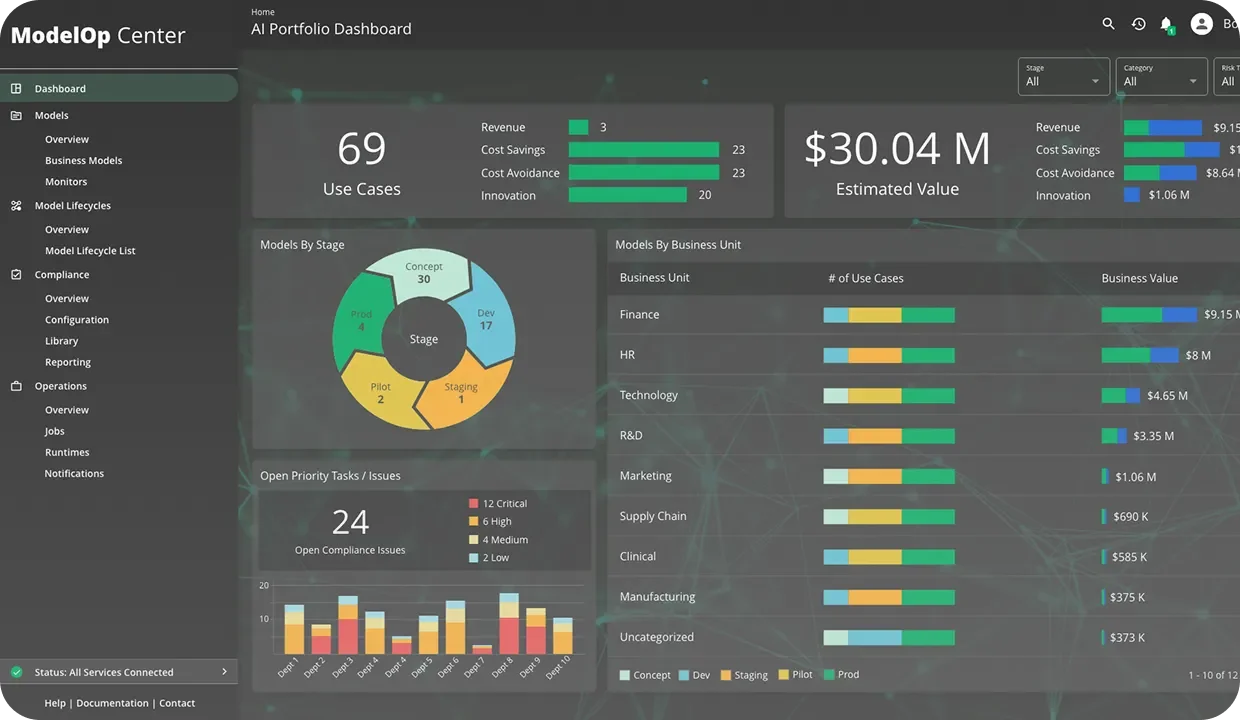
ModelOp Enterprise AI Command Center is a system of record for ML, generative AI, agentic, and vendor AI. It sits above existing MLOps, AI execution, security, GRC, ITSM, and data tools and orchestrates the AI lifecycle across them, including intake, risk review, approval, monitoring, and audit.
The platform installs on premises, in private cloud, or in hybrid environments and references data in place. Its AI Delivery Engine (MADE) provides integrations with more than 50 technologies.
Key features include:
- AI system of record: A searchable registry covers ML models, generative AI, agents, vendor tools, and AI embedded in SaaS. Continuous discovery finds unregistered custom GPTs, agents, and MCP-connected tools.
- Automated documentation capture: Code, prompts, agent cards, configurations, dependencies, and data usage are recorded across the lifecycle. MCP and A2A import brings external agents and tools into the registry.
- Intake and risk tiering workflows: Use-case intake captures purpose, data, risks, and controls. Risk classification is automated, and approvals are routed across security, privacy, legal, risk, and compliance teams.
- Control mapping and enforcement: Controls map to the EU AI Act, NIST AI RMF, OCC SR 11-7 (SR 26-2), and ISO 42001 based on risk tier, geography, and system type. Workflows validate controls and block non-compliant actions.
- Regulator-grade audit trail: Model cards, validation summaries, and evidence are captured automatically.
- Runtime policy via gateways: Integrations with AI and API gateways apply policies and guardrails to live AI traffic.
- Continuous monitoring: Systems are monitored for bias, drift, performance, data stability, and prompt vulnerabilities, along with token usage and tool invocations.
Limitations (based on publicly available sources):
- Self-hosted deployment: The platform is not offered as a public SaaS service, so it runs in the customer's own environment.
- Runtime enforcement depends on integrations: Policy enforcement on live AI traffic requires integration with separate AI or API gateways.
- Limited independent user reviews: Public review platforms list few or no user reviews for the product.
Source: ModelOp
8. Fiddler AI

Best for: Teams monitoring and enforcing policy on agents and ML models
Strengths: Inline guardrails with recorded enforcement decisions
Things to consider: Onboarding can take effort for non-technical stakeholders
Fiddler AI is a control plane for first-party and third-party agents and predictive models. It combines continuous evaluation, monitoring, policy enforcement, and governance, covering coding agents in development as well as agents in production.
Fiddler Centor Models run guardrails and evaluations inside the customer's environment without external LLM API calls. The platform deploys as SaaS, in a VPC, on premises, or in AWS GovCloud and works with Azure OpenAI, Amazon Bedrock, LangGraph, and other providers. Plans include Free, Developer at $0.002 per trace, and Enterprise.
Key features include:
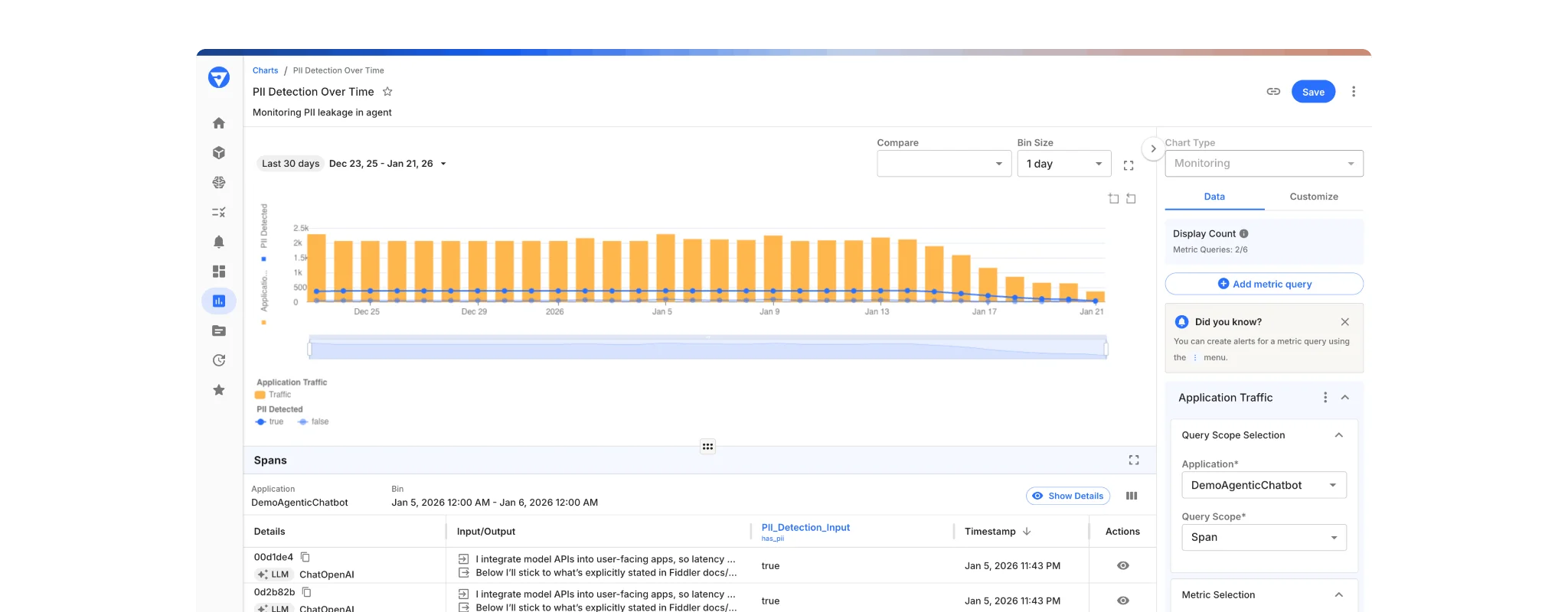
- Agentic observability: A single view shows the performance of all agents, including every action, token, and cost by user and team.
- Auditable enforcement decisions: Each enforcement decision is recorded with who triggered it and what happened, producing audit evidence for GRC standards and AI regulations.
- Inline policy enforcement: Guardrails detect and redact PII, PHI, and secrets in requests before they reach the model and in responses before they reach the user.
- Guardrail coverage: Guardrails address hallucinations, toxicity, PII and PHI, prompt injection, and jailbreak attempts.
- Continuous evaluations: Evaluations run in-environment from testing through production, with support for custom evaluators.
- ML observability: Monitoring for predictive models includes more than 100 pre-defined metrics plus custom metrics.
Limitations (as reported by users on PeerSpot and G2):
- Onboarding for stakeholders: Some users would like simpler onboarding and ease of use for different stakeholder groups.
- Policy context required: Users note that evaluations need company-specific policies and criteria defined, or results may compare against general standards instead.
- Learning curve for newcomers: Some users find the platform difficult to grasp for people new to AI and AI monitoring.
Source: Fiddler AI
Conclusion
Effective AI governance for explainability and audit trails requires visibility into both AI decisions and the systems, identities, data, and tools behind them. Organizations should evaluate platforms based on AI discovery, activity monitoring, identity attribution, agent and tool tracing, tamper-resistant logging, risk classification, and compliance evidence generation. The selected approach should make it practical to reconstruct significant AI actions, investigate unexpected behavior, and demonstrate that required governance controls operated throughout the AI lifecycle.