
TL;DR: Commercial AI governance tools help large organizations inventory, assess, and control AI models, apps, and agents. Best for: Cequence AI Gateway for agent runtime containment, Credo AI for policy-driven compliance, IBM watsonx.governance for lifecycle risk management, and Microsoft Security for AI for Microsoft-centric estates.
What Are AI Governance Tools and How Do They Support Large Organizations?
Commercial AI governance platforms help organizations manage how AI systems are developed, deployed, and monitored. They provide a central place to track AI models, document their purpose and ownership, assess risks, record approvals, and show how governance requirements are being applied.
These tools often combine model inventories, risk assessments, policy controls, approval workflows, audit trails, and compliance reporting. Some also support technical checks such as bias testing, explainability, model monitoring, and data lineage. This helps governance teams connect policies and regulatory requirements to AI systems and maintain evidence for internal reviews or external audits.
Large organizations face additional AI governance challenges because they operate across multiple jurisdictions, business units, and diverse technology environments. They must protect sensitive data and intellectual property, enforce role-based access, integrate governance with existing enterprise systems, and maintain audit evidence for regulatory compliance.
Commercial AI governance tools address these requirements through centralized controls, automated approval workflows, continuous risk monitoring, and standardized assessments that can scale across hundreds or thousands of AI systems.
This is part of a series of articles about AI security
In this article:
- Commercial AI Governance Tools at a Glance
- Why Do Large Organizations Need Commercial AI Governance Tools?
- What Do Commercial AI Governance Platforms Govern?
- Key Capabilities to Look for in Commercial AI Governance Tools
- Notable Commercial AI Governance Tools for Large Organizations
AI Governance Tools at a Glance
The table below summarizes the key differences between the commercial AI governance tools covered in this guide. We explore each platform in more detail in the sections that follow.
Category Solution Best For Key Strengths Things to Consider AI Agent and Runtime Containment Cequence AI Gateway Governing agent access to enterprise apps, APIs, and data Agent Personas, real time inline enforcement, AI discovery from SIEM logs Initial setup and policy tuning can take time AI Agent and Runtime Governance Microsoft Security for AI Governing Copilot, agents, and AI apps in Microsoft environments Agent 365 control plane and Purview data protection Complex licensing, frequent interface changes AI Agent and Runtime Governance Fiddler AI Monitoring and enforcing policy on production agents and models Inline guardrails under 80ms, in-environment evaluations Guardrails need company-specific criteria AI Risk, Compliance, and Lifecycle Governance Credo AI Policy-driven governance for large AI portfolios Pre-built policy packs, agent registry, risk library Some enforcement integrations still planned AI Risk, Compliance, and Lifecycle Governance IBM watsonx.governance Lifecycle governance in hybrid environments Governance graph, shadow AI detection, regulatory library Complex setup, costs rise at scale AI Risk, Compliance, and Lifecycle Governance OneTrust AI Governance Extending privacy and GRC programs to AI Intake workflows, runtime guardrails, MCP controls Usability and post-implementation effort AI Risk, Compliance, and Lifecycle Governance Holistic AI Discovery, testing, and compliance in one platform 40+ risk tests, red teaming, Guardian Agents Integrations need engineering effort AI Risk, Compliance, and Lifecycle Governance ModelOp Enterprise AI Command Center Managing ML, GenAI, agentic, and vendor AI portfolios AI system of record, risk tiering, AI FinOps Learning curve, no public SaaS option
Why Do Large Organizations Need Commercial AI Governance Tools?
Maintain Visibility Across Large AI Environments
AI systems can be distributed across internal applications, cloud platforms, third-party services, and business units. Governance tools create a centralized inventory that records each system's purpose, owner, data sources, risk level, and deployment status.
This visibility helps governance teams identify which systems require review and where controls are missing. It also makes it easier to track changes when models are updated, replaced, or moved into production.
Control Shadow AI and Unapproved AI Usage
Employees may adopt generative AI tools, external APIs, or embedded AI features without formal approval. This can expose sensitive data, create compliance risks, or introduce models that have not been assessed for security or reliability.
Commercial governance platforms can support discovery, registration, and approval workflows for new AI use cases. They give organizations a process for identifying unapproved systems and bringing them under established governance controls.
Apply Consistent Governance Policies Across Business Units
Different teams may interpret AI policies differently or use separate review processes. This makes it difficult to enforce common standards and prove that controls are applied consistently.
Governance tools can convert policies into standardized assessments, approval steps, and control requirements. Organizations can apply these workflows across business units while still allowing additional controls for specified regions, industries, or risk categories.
Related content: Read our article about AI governance risks, frameworks, and components
Govern Generative AI and Autonomous AI Agents
Generative AI systems introduce risks that traditional model governance processes may not fully address. These include prompt injection, data leakage, harmful outputs, hallucinations, and uncontrolled access to external tools or sensitive systems.
Autonomous AI agents add another layer of risk because they can take actions without direct human approval at every step. Governance tools can document agent capabilities, permissions, connected systems, human oversight requirements, and testing results. This helps organizations set limits on what agents can access and which actions require additional approval.
What Do Commercial AI Governance Platforms Govern?
Enterprise AI Models and Applications
Organizations build AI models for tasks such as forecasting, fraud detection, recommendations, classification, and automated decision-making. Governance platforms maintain inventories of these models and applications, including their:
- Owners
- Intended uses
- Data sources
- Deployment environments
- Risk classifications
- Approval status
They can also track development, testing, validation, deployment, monitoring, and model changes. For higher-risk systems, organizations can require additional reviews before deployment or after significant changes to the model, data, or intended use.
Governance does not end when a model enters production. Platforms can help track performance metrics, incidents, control failures, and scheduled reassessments. This creates an audit trail and helps teams determine whether deployed systems continue to operate within approved conditions.
Generative AI Tools and LLMs
Generative AI introduces risks related to sensitive data, inaccurate outputs, prompt injection, harmful content, and intellectual property. Governance platforms help organizations document:
- Which large language models (LLMs) are approved
- How they are used
- Who can access them
- What types of data they can process
Controls can cover model evaluations, acceptable-use policies, human oversight, access permissions, and production monitoring. Governance may also extend to prompts, system instructions, retrieval-augmented generation pipelines, vector databases, filters, and other guardrails surrounding the underlying model.
Platforms can also maintain evaluation results for different models and use cases. For example, teams may test factual accuracy, harmful output rates, data leakage, robustness, or compliance with required response policies before approving an LLM-powered application for production.
Third-Party AI Services
Organizations increasingly rely on AI capabilities supplied by software vendors, cloud providers, and specialized AI companies. These services can create operational, security, privacy, and compliance risks even when the organization does not build or operate the underlying model. Governance platforms can record:
- Vendors
- Use cases
- Contractual requirements
- Data handling practices
- Security assessments
- Risk reviews
Teams can use this information to determine whether a service is suitable for specific data types or business processes before approving it. Third-party governance also needs to account for changes outside the organization's control. A vendor may replace a model, modify its data practices, introduce new AI functionality, or change service terms. Governance platforms can support periodic reassessments and record how these changes affect existing approvals and controls.
AI APIs and Integrations
AI functionality is often accessed through APIs rather than standalone applications. An application might call an external LLM, embedding model, computer vision service, or other AI endpoint as one component of a larger workflow. Governance platforms can map these dependencies and document which applications use each API. This helps organizations:
- Control approved providers
- Understand where data is sent
- Identify downstream dependencies
- Assess the impact when an API or underlying model changes
API governance can also cover authentication, access permissions, permitted data types, usage limits, and logging requirements. Maintaining these records is important because a single AI API may support many applications, making changes or failures relevant to several business processes at once.
AI Agents and Agentic Workflows
AI agents can plan tasks, call tools, access data, communicate with other agents, and perform actions across connected systems. Their ability to act creates governance requirements beyond those of models that only generate predictions or content. Governance platforms can track each agent's:
- Purpose
- Tools
- Permissions
- Data access
- Permitted actions
They can also document human approval requirements, testing results, monitoring controls, and escalation rules for workflows where agents make or execute decisions. Agentic workflows require particular attention to the boundaries of autonomous action. Organizations may need to define which actions an agent can perform independently and which require human authorization, such as executing financial transactions, changing production systems, or accessing sensitive records.
Governance may also cover interactions between multiple agents and tools. Mapping these dependencies helps teams understand how an agent reached a decision or completed an action, investigate incidents, and restrict capabilities when unexpected behavior occurs.
Unique AI Governance Requirements of Large Organizations
Sensitive Data and Intellectual Property Protection
AI systems can expose sensitive information when users submit confidential data to external models or when applications include protected information in prompts and retrieval pipelines. Governance tools should help organizations define which data AI systems are permitted to access and process. Depending on the platform, controls may detect:
- Personally identifiable information
- Credentials
- Source code
- Trade secrets
- Other sensitive content
Runtime controls can block, redact, or flag prohibited data before it reaches an AI service and monitor generated responses for possible data leakage.
Regulatory Compliance Across Multiple Jurisdictions
Large organizations often operate across countries with different AI, privacy, and industry regulations. Governance platforms help map applicable requirements to individual AI systems and maintain evidence that required controls are implemented. These requirements may include:
- Risk assessments
- Impact assessments
- Data protection
- Human oversight
- Technical documentation
- Regulatory reporting
Platforms can support compliance with frameworks such as the EU AI Act, GDPR, and NIST AI Risk Management Framework. They can also track regulatory changes and identify systems that require additional reviews or updated controls.
Role-Based Access and Separation of Duties
Enterprise AI governance involves multiple stakeholders, including security, legal, compliance, data science, and business teams. Each group needs different permissions and responsibilities within the governance process. Platforms can define roles for:
- System owners
- Model developers
- Risk assessors
- Compliance reviewers
- Security administrators
- Final approvers
Role-based access controls help prevent unauthorized changes to governance records, assessments, and approvals. Separation of duties also ensures that high-risk AI systems receive independent review rather than relying entirely on the teams developing or deploying them.
Integration with Existing Enterprise Systems
Large organizations already use multiple platforms for security, compliance, identity management, software development, and IT operations. AI governance tools need to exchange information with these systems to avoid duplicate records and disconnected workflows. Common integrations include:
- Identity providers
- Cloud platforms
- Model registries
- CI/CD pipelines
- SIEM systems
- GRC platforms
- IT service management
Integrations can automatically register new AI systems, retrieve technical metadata, and trigger assessments when deployment changes occur. They can also connect governance decisions to operational controls, helping teams enforce approved configurations rather than relying only on documentation.
Continuous Monitoring and Risk Reassessment
AI systems can change after deployment as models are updated, data sources evolve, and users introduce new workflows. An assessment completed before deployment may no longer reflect the system's current risks. Governance platforms can track changes in:
- Model versions
- Data inputs
- System performance
- Access permissions
- Usage patterns
- Security incidents
- Control effectiveness
Monitoring results can trigger reassessments when a system exceeds defined risk thresholds or undergoes significant changes. This helps organizations identify emerging risks and determine whether additional controls, restrictions, or approvals are necessary.
Audit Trails and Evidence Management
Large organizations need to demonstrate how AI systems were assessed, approved, and monitored. Evidence may be distributed across development tools, compliance systems, security platforms, and business records. Governance platforms can maintain centralized records of:
- Risk classifications
- Assessment results
- Approval decisions
- Control testing
- Policy exceptions
- Model changes
- Incident responses
Audit trails should record who performed an action, what changed, and when the change occurred. Centralized evidence management reduces manual preparation for internal audits, external assessments, and regulatory inquiries while helping teams identify missing documentation.
Scalability and Automated Governance Workflows
Organizations managing hundreds or thousands of AI systems cannot rely entirely on manual assessments and approval processes. Governance platforms need to support repeatable workflows that apply appropriate controls based on each system's risk and intended use. Automation can cover:
- System registration
- Risk classification
- Assessment assignment
- Approval routing
- Policy checks
- Review scheduling
- Compliance reporting
Risk-based workflows allow organizations to apply simpler reviews to low-risk systems and more extensive assessments to high-risk applications. Automated notifications and escalation rules also help prevent reviews from being overlooked as the number of deployed AI systems grows.
Notable Commercial AI Governance Tools for Large Organizations
How we selected these tools: We shortlisted commercial AI governance platforms based on AI discovery and inventory, risk assessment, policy enforcement, runtime and agent controls, and audit-ready evidence.
AI Agent and Runtime Governance Platforms
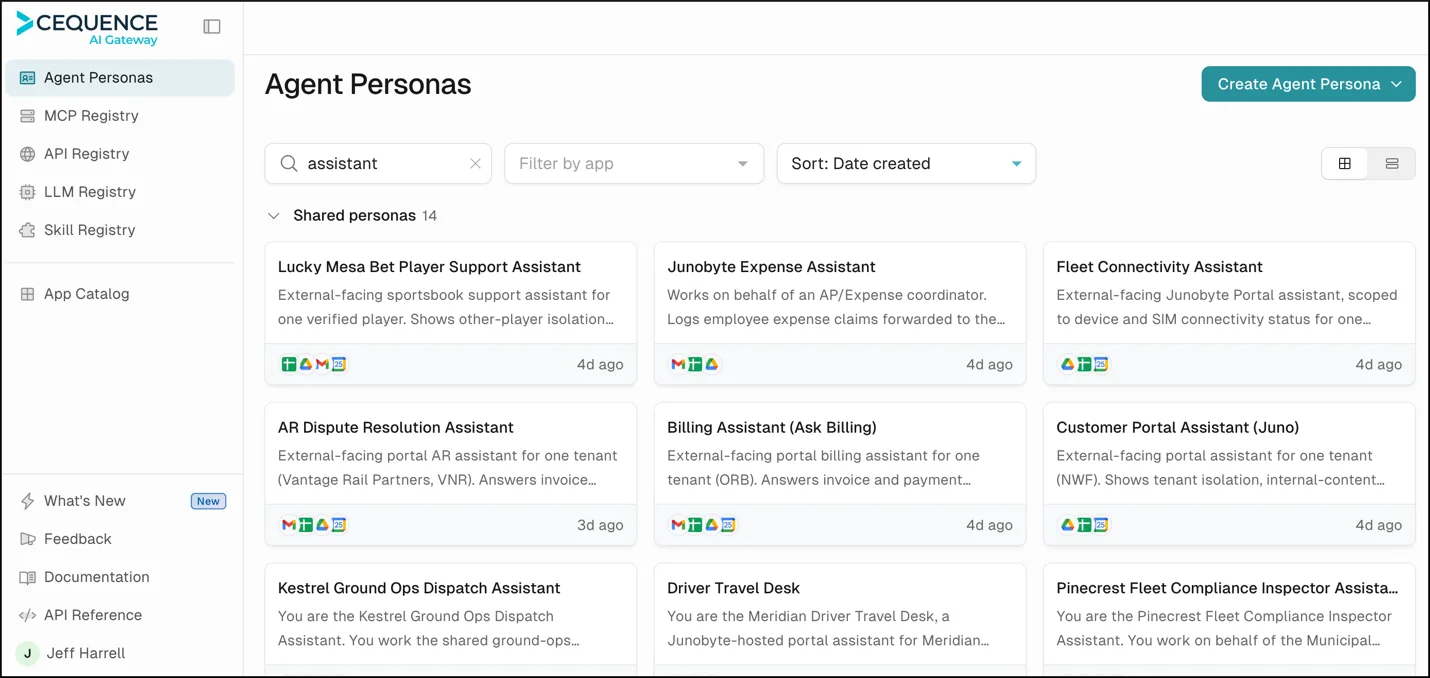
1. Cequence AI Gateway

Best for: Governing AI agent access to enterprise apps, APIs, and data
Strengths: Agent Personas, inline enforcement, and AI discovery from SIEM logs
Things to consider: Initial setup and policy tuning can take time
Cequence AI Gateway sits in the request path between AI agents and enterprise applications, APIs, and data. It authenticates each agent through OAuth 2.1-compliant identity infrastructure and then evaluates every tool call against policy for the full session. Administrators describe an agent's role as a plain-language job description, and the gateway converts it into a scoped set of tools, APIs, LLMs, and skills.
The gateway also discovers sanctioned and shadow AI, maintains registries of approved MCP servers, APIs, LLMs, and skills, and records tool-level and agent-level audit trails. It is available as SaaS or on premises and connects agents to more than 140 enterprise applications, such as Salesforce, Jira, Slack, and Confluence, as well as internal APIs.
Key features include:
- Agent Personas: Converts a plain-English job description into a scoped agent role that includes only the tools, APIs, LLMs, skills, guardrails, and permissions that role requires.
- Behavioral identity and rogue agent containment: Evaluates what an agent does across its whole session, not only who it is, and blocks or constrains actions that fall outside its assigned job description.
- AI discovery: Surfaces shadow MCP servers, agents, and LLM providers across the enterprise from existing SIEM logs, so unregistered AI can be brought under governance.
- Trusted registries: Maintains registries of vetted MCP servers, APIs, LLMs, and skills, with an audit trail of which tools agents may use. Agents call approved APIs through one gateway token and registry.
- Runtime guardrails: Applies Prompt Guard screening for prompt injection, jailbreak, and system-prompt extraction, plus automated tool risk scoring, rate limits, and token and spend limits tied to individual teams.
- Sensitive data protection: Runs DLP scanning on agent requests and MCP server responses, with more than 100 built-in detection types and options to monitor, redact, or block. It also integrates with existing DLP tools.
- Audit logging and SIEM integration: Records user, agent, and tool activity, including which applications agents access and which API calls they make, and exports activity logs to SIEM platforms.
Limitations (based on publicly available sources):
- Requires traffic to flow through it for governance: Organizations need to set up and maintain traffic flows through the AI Gateway for real time agentic AI traffic governance.
- Prompt injection protection capabilities face arms race: As these types of attacks evolve, the Prompt Guard feature will have to evolve as well for protection.
- Learning curve for advanced configuration: Full use of all the features may take time as the platform covers a lot of ground in security and governance.
2. Microsoft Security for AI
Best for: Governing Copilot, agents, and AI apps in Microsoft environments
Strengths: Agent 365 control plane plus Purview data protection for AI
Things to consider: Complex licensing and frequent interface changes
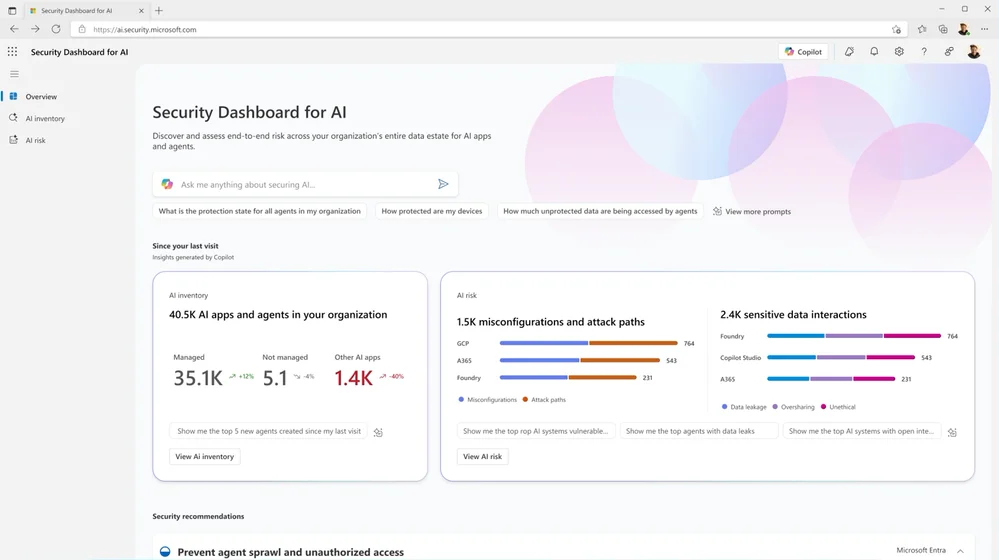
Microsoft Security for AI combines several Microsoft products to discover, secure, and govern AI apps and agents. Microsoft Agent 365, generally available since May 1, 2026, acts as a control plane to observe, secure, and govern agents across the organization. Microsoft Purview identifies data risks in AI apps and agents and prevents sensitive data from being shared with them.
Microsoft Entra manages access for users, AI apps, and agent identities, and Microsoft Defender detects threats that target agents, including prompt injection. Coverage extends to Microsoft Foundry, Microsoft 365 Copilot, Copilot Studio, and third-party AI apps and agents.
Key features include:
- AI and agent estate discovery: Provides visibility into the AI apps and agents in use across the organization and governs their access to resources.
- Agent lifecycle governance: Uses Agent 365 to observe and manage agent activity and development with unified visibility and control.
- Access and permission management: Applies risk-based conditional access, strong authentication, and real-time traffic filtering to users, AI apps, agents, and resources.
- Sensitive data loss prevention: Classifies data, prevents sensitive information from being shared with AI apps and agents, and enforces guardrails on how AI uses organizational data in responses or tasks.
- Risky user and agent controls: Uses custom policies to identify, control, and block suspicious AI interactions involving sensitive data.
- Runtime threat defense: Blocks malicious traffic, prompt injection attacks, and data exfiltration attempts as they occur, and supports incident-level investigation across the attack chain.
- Regulatory compliance and reporting: Supports audit, retention, transparency, accountability, data residency, and encryption requirements for AI regulations and industry standards.
Limitations (as reported by users on Gartner Peer Insights):
- Frequent interface changes: Users report that the interface changes often, which requires teams to readjust how they work.
- Complex licensing: Reviewers describe Microsoft's licensing model as complicated to navigate.
- Reporting requires tuning: Users note that initial discovery works well, but tuning the platform for accurate reporting takes ongoing effort.
Source: Microsoft
3. Fiddler AI

Best for: Monitoring and enforcing policy on AI agents and models in production
Strengths: Inline guardrails under 80ms with in-environment evaluation models
Things to consider: Onboarding can be harder for non-technical stakeholders
Fiddler AI is a control plane for first-party and third-party AI agents that combines continuous evaluation, monitoring, policy enforcement, and governance records. It covers both the creation layer, where coding agents write code, and the production layer, where agents and predictive models run in business processes.
Guardrails and evaluations run on Fiddler Centor Models inside the customer's environment, so evaluations do not require external LLM API calls. The platform works with Azure OpenAI, Amazon Bedrock, LangGraph, and more than 100 other providers, and deploys as SaaS, in a VPC, on premises, or in AWS GovCloud.
Key features include:
- Agent fleet visibility: Shows the performance of all agents in one view, including each action, token, and dollar by user and team.
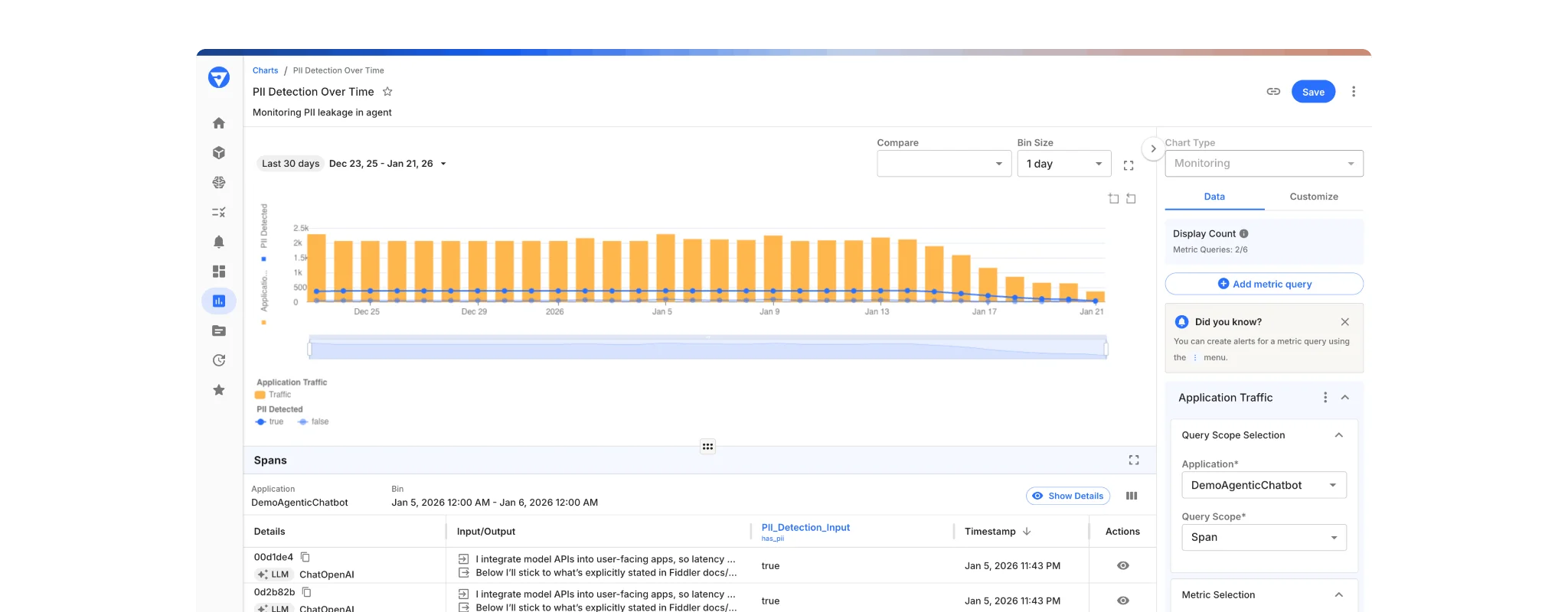
- Inline policy enforcement: Applies guardrails on the agent's request and response path in under 80ms, detecting and redacting PII, PHI, and secrets before prompts reach the model and before responses return.
- Built-in guardrail coverage: Checks for hallucinations, toxicity, PII and PHI, prompt injection, and jailbreak attempts.
- Continuous evaluations: Runs in-environment evaluations from testing through production, with more than 100 predefined metrics and support for custom metrics and evaluators.
- Auditable governance records: Logs every enforcement decision, including who triggered it and what happened, to provide evidence for GRC standards and AI regulations.
- Predictive model observability: Monitors traditional ML models alongside agents, so predictive and agentic systems are tracked in the same platform.
Limitations (as reported by users on PeerSpot):
- Guardrails need company-specific criteria: Users report that without company-specific policies and guardrails, evaluations may compare against general policy frameworks and produce inaccurate results.
- Onboarding for different stakeholders: Reviewers note that onboarding and ease of use could be improved for different stakeholder groups.
Source: Fiddler AI
AI Risk, Compliance, and Lifecycle Governance Platforms
4. Credo AI

Best for: Policy-driven governance and compliance for large AI portfolios
Strengths: Pre-built policy packs, agent registry, and risk control library
Things to consider: Some enforcement integrations are planned, not yet available
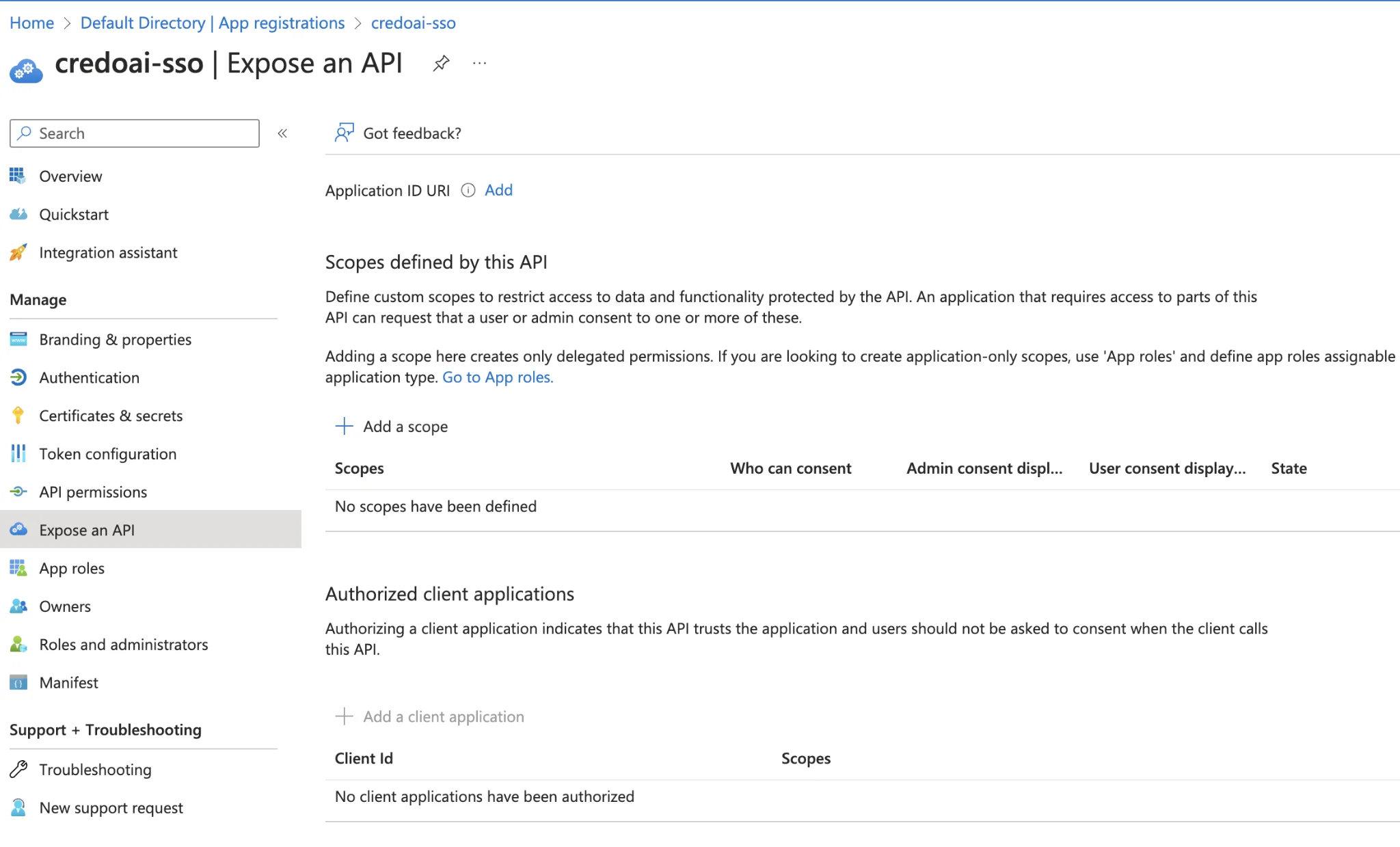
Credo AI is an AI governance platform that discovers, assesses, governs, monitors, and reports on AI agents, models, and applications. It maintains a central registry of internal and third-party AI, including shadow AI, and applies risk assessments and policy controls through a governance knowledge graph that links regulations, business context, and AI system configurations.
The platform is modular, with separate registry, risk, compliance, and governance modules. It integrates with cloud and data platforms such as AWS, Azure, GCP, Databricks, and Snowflake, agent frameworks such as LangChain, CrewAI, and AutoGen, and GRC tools such as ServiceNow, Archer, and OneTrust.
Key features include:
- AI and agent registry: Inventories agents, models, apps, and shadow AI, with agent cards that list purpose, tools, data sources, and guardrails, plus dependency graphs across agents, models, tools, and data.
- Risk intelligence: Assesses AI-specific risks with an agentic risk assessment library and mapped controls, policy inheritance, aggregate risk scoring, automated red-teaming, and drift detection.
- Compliance and policy engine: Provides pre-built policy packs for the EU AI Act, NIST AI RMF, ISO 42001, and SOC 2, with approval-gated workflows and automated evidence generation.
- Production governance: Ingests agent traces and evaluates them continuously to detect policy violations, drift, and unsafe behavior, with human-in-the-loop escalation and real-time alerts.
- GAIA governance agents: Uses AI agents to retrieve evidence, assess risk, generate governance plans, and support incident remediation, with human oversight for critical decisions.
- Vendor risk management: Includes a vendor registry and vendor portal for assessing and tracking third-party AI.
Limitations (based on publicly available sources):
- Some enforcement integrations are planned: Enforcement integration with CI/CD pipelines, CASBs, and API gateways is listed as planned rather than available.
- Agent Governor in research preview: The Agent Governor capability is labeled as a research preview.
- Documentation for advanced configurations: Third-party evaluations note limited documentation and training resources for advanced configurations.
Source: Credo AI
5. IBM watsonx.governance

Best for: Lifecycle governance and risk management in hybrid environments
Strengths: Governance graph, shadow AI detection, and broad regulatory library
Things to consider: Setup is complex and costs rise as usage scales
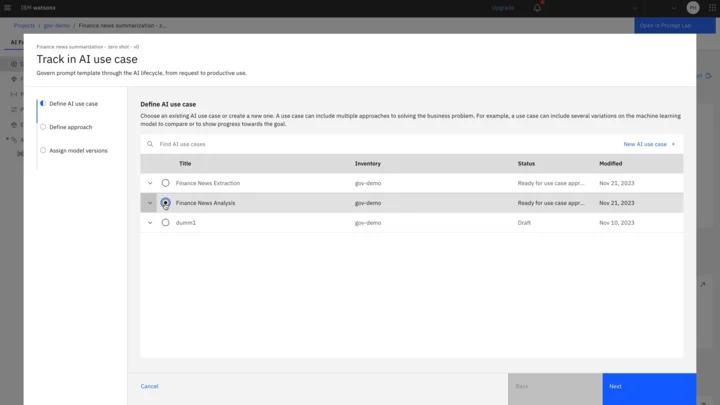
IBM watsonx.governance governs AI models, applications, and agents across IBM and third-party platforms, combining AI governance with IBM's GRC capabilities. A governance graph maps relationships between AI systems, risks, controls, and policies, and the platform automates policy enforcement, obligation mapping, and compliance evidence capture.
It continuously monitors AI systems for compliance, operational issues, and emerging risks, and detects unmanaged and unapproved AI usage. Embedded AI assistants onboard use cases and capture governance information inside enterprise tools. It runs in cloud and on-premises environments.
Key features include:
- Governance graph: Visualizes relationships between AI systems, risks, controls, and policies to support oversight decisions.
- Shadow AI detection: Discovers unmanaged and unapproved AI usage across the organization.
- AI-native governance assistants: Uses embedded AI assistants to onboard AI use cases, capture governance information, and automate governance workflows within enterprise tools and conversational interfaces.
- Continuous monitoring: Monitors AI systems for compliance, operational issues, and emerging risks on an ongoing basis.
- Policy enforcement: Creates, manages, and enforces governance policies across teams, models, and AI workflows.
- Regulatory content library: Provides a large library of AI regulatory and risk content for aligning AI initiatives with regulations and frameworks.
- AI value tracking: Tracks governance activities, decisions, and model changes with end-to-end traceability for reporting.
Limitations (as reported by users on G2):
- Complex setup and learning curve: Users report configuration-heavy onboarding, with workflows, roles, and lifecycle stages that take effort to set up.
- Cost: Reviewers describe the platform as expensive, with costs rising significantly when moving into production.
- Integration outside the IBM ecosystem: Users note that connecting models from other platforms can require manual configuration and less clear documentation.
- Interface performance: Some users find the interface heavy, with slower loading when the inventory contains many use cases.
Source: IBM
6. OneTrust AI Governance

Best for: Organizations extending privacy and GRC programs to AI governance
Strengths: Intake workflows, runtime guardrails, and MCP governance controls
Things to consider: Usability concerns and significant post-implementation work
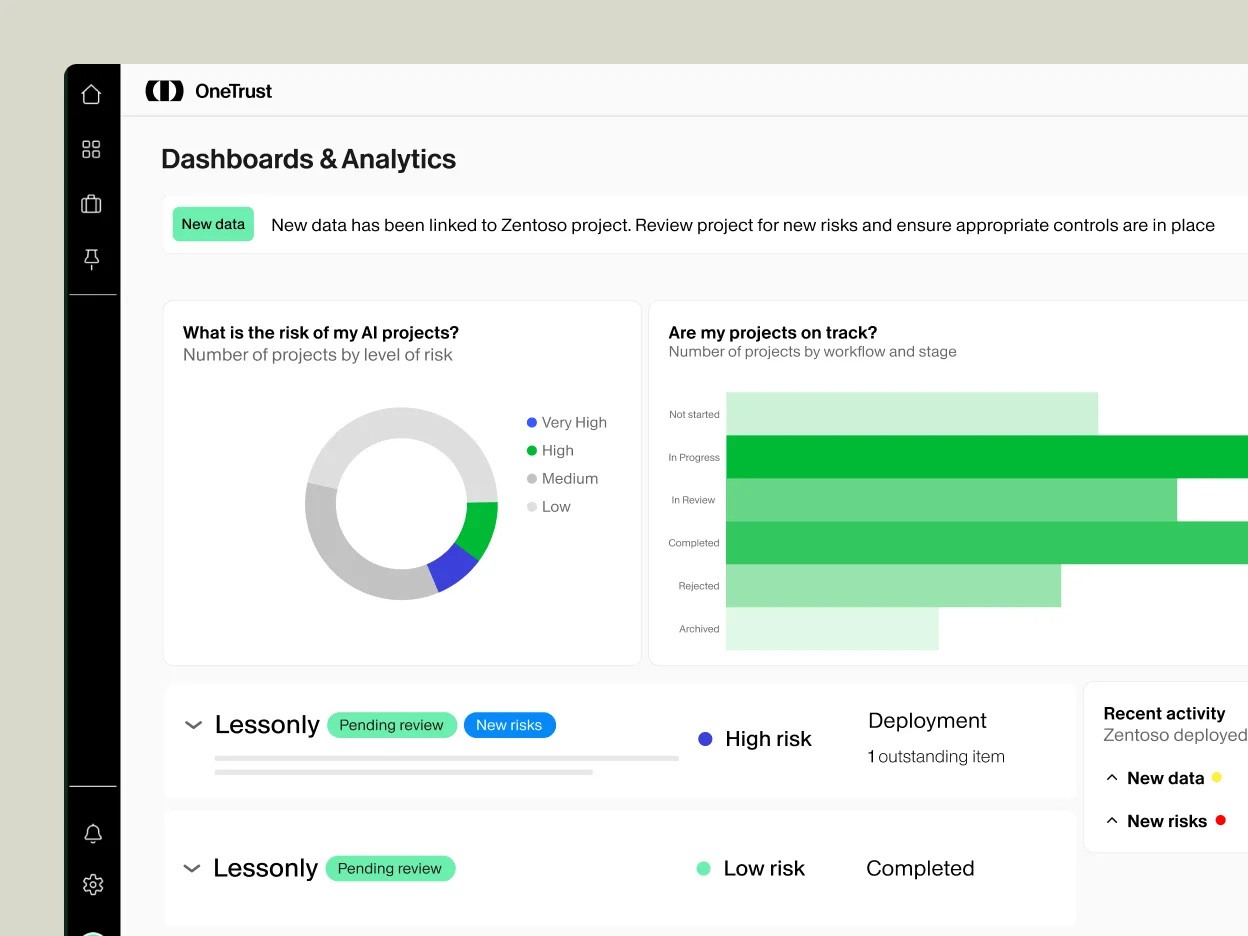
OneTrust AI Governance translates AI policy into controls across homegrown and third-party AI systems. It continuously discovers AI systems, models, agents, datasets, and vendors, assigns ownership and lifecycle status, and applies EU AI Act, NIST AI RMF, and ISO 42001 templates for risk tiering and assessment.
Runtime governance connects to Amazon Bedrock, Microsoft Foundry, Databricks, and Gemini Enterprise Agent Platform to surface evaluation metrics, detect policy violations, and enforce guardrails. Agent policies sit alongside model policies, assessments, and compliance evidence in the AI Program Center.
Key features include:
- Discovery and inventory: Inventories AI systems, models, agents, datasets, vendors, projects, and use cases, and maps their relationships and dependencies.
- Risk tiering and revalidation: Automates risk tiering by use case, system, deployment context, or data sensitivity, and revalidates risk when a model, agent, dataset, or usage pattern materially changes.
- Governance workflows: Configures intake, approval, attestation, and signoff workflows, and routes reviews to owners based on risk and context.
- Runtime monitoring: Surfaces quality, safety, performance, and guardrail signals, and analyzes Bedrock and Foundry interaction logs to detect PII in prompts and responses.
- Guardrail enforcement: Uses AI Policy Manager to define required controls and Guardrail Enforcement to filter prompts and outputs or block, redact, escalate, or route actions. The AI Guard SDK adds in-line sensitive data detection for Python workflows.
- Agent and MCP governance: Registers agents with a defined purpose, enforces permissions and allowed actions, applies MCP policies with audit logs, and monitors agent scope through Guardian Agents.
- Audit-ready evidence: Generates evidence from assessments, approvals, attestations, policies, telemetry, and enforcement actions.
Limitations (as reported by users on Gartner Peer Insights):
- Usability: Users report that the platform is not very user friendly and that the end-user experience is not always smooth.
- Post-implementation effort: Reviewers note that clients must complete a considerable amount of work themselves after implementation.
- Total cost of ownership: Users describe the TCO as high, and some cite limited guidance.
- Setup demands: Reviewers report that setup can be demanding and that workflows can become complex.
Source: OneTrust
7. Holistic AI

Best for: Enterprises needing discovery, testing, and compliance in one platform
Strengths: 40+ risk tests, red teaming, and Guardian Agents for agent oversight
Things to consider: Integrations and runtime controls need engineering effort
Holistic AI governs AI across the enterprise in three layers: identify, protect, and enforce. It connects to cloud, code, and SaaS environments such as AWS, Azure, GitHub, and Databricks to discover models, agents, and AI applications, and maintains an inventory with owners, risk levels, business purpose, dependencies, and lineage.
The platform tests AI systems for security, safety, and bias before launch and in production, maps controls to regulatory frameworks, and uses supervisory agents to observe and intervene in agent actions. It offers more than 20 integrations.
Key features include:
- AI discovery and inventory: Discovers shadow AI across AWS, Azure, GitHub, and Databricks and maps dependencies and lineage automatically.
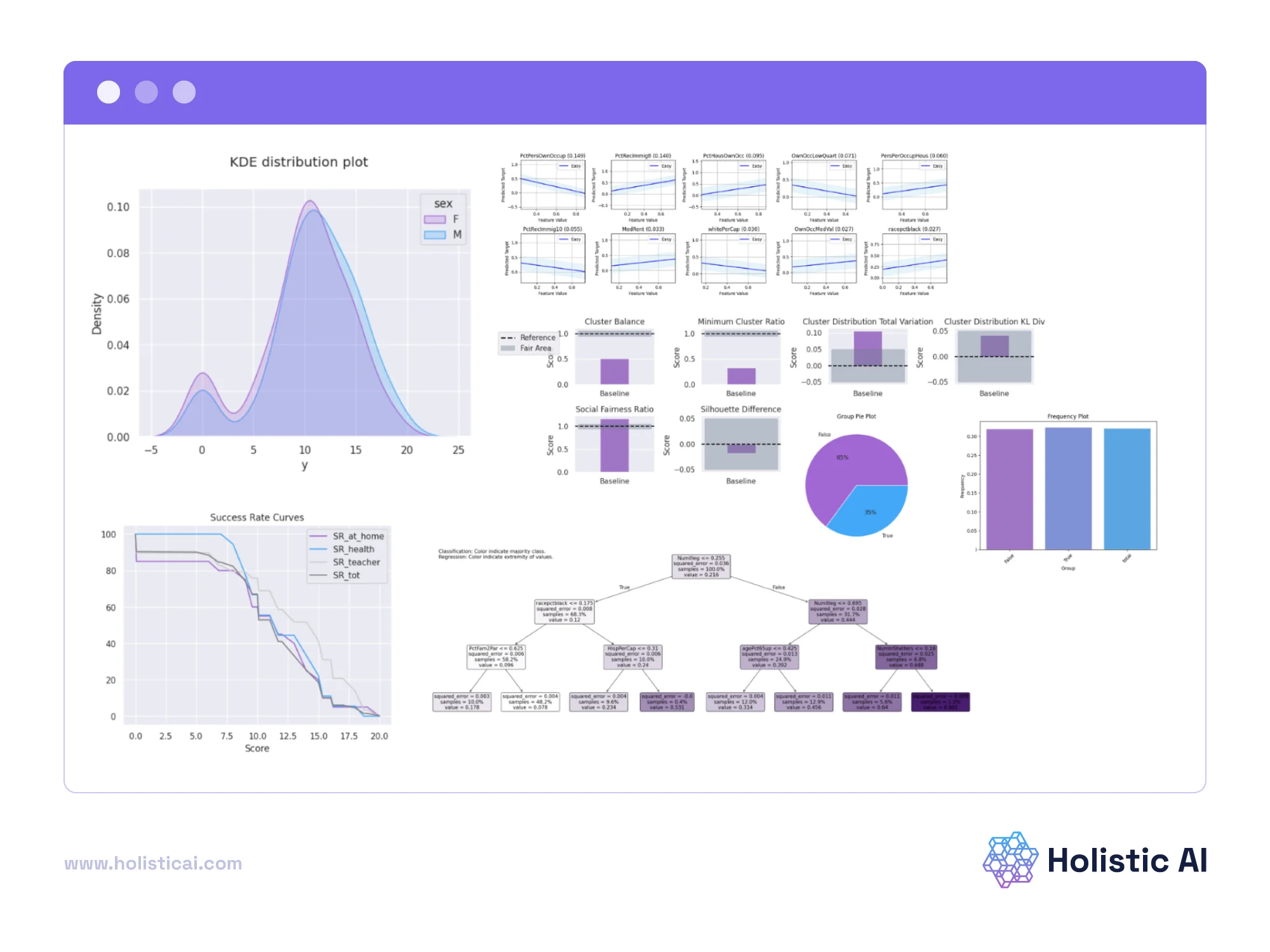
- Testing and red teaming: Runs red teaming for prompt injection and jailbreaks plus more than 40 tests for bias, hallucination, privacy, and robustness.
- Production monitoring: Monitors drift and performance of models, LLMs, and agents after deployment.
- Policy and compliance mapping: Maps controls to the EU AI Act, NIST AI RMF, and ISO/IEC 42001 and attaches evidence to a single audit trail automatically.
- Approvals and deployment gates: Applies approvals, deployment gates, and human oversight checkpoints before AI reaches production.
- Guardian Agents: Sentinel Agents score each tool call, data access, and hand-off against policy, and Operative Agents block, pause, redirect, or escalate non-compliant actions.
Limitations (as reported by users on Gartner Peer Insights):
- Setup complexity: Users highlight setup complexity when getting started with the platform.
- Integration and deployment: Reviewers report that some integrations and deployment processes can be complex.
- Engineering effort for runtime controls: Users note that integrating runtime controls and configuring shadow AI discovery requires noticeable effort from engineering and risk teams.
Source: Holistic AI
8. ModelOp Enterprise AI Command Center
Best for: Managing large portfolios of ML, GenAI, agentic, and vendor AI
Strengths: AI system of record, automated risk tiering, and AI FinOps data
Things to consider: Steep learning curve; not offered as public SaaS
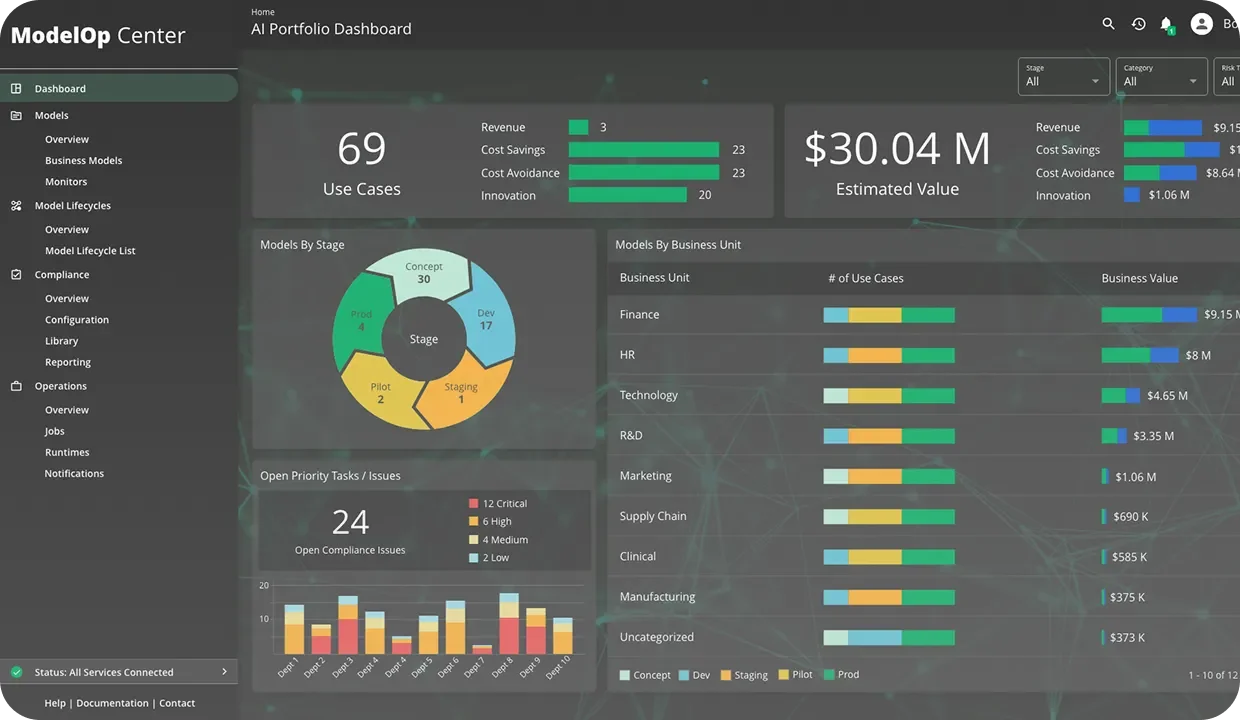
ModelOp's Enterprise AI Command Center is an AI system of record for ML, generative AI, agentic AI, and vendor AI. It sits above existing AI development, execution, data, GRC, ITSM, and security tools, and orchestrates intake, risk review, approvals, monitoring, and audit across them through integrations with more than 50 technologies.
It installs on premises, in private cloud, or in hybrid environments and references data in place rather than copying it. Controls can be mapped to the EU AI Act, NIST AI RMF, OCC SR 11-7 (SR 26-2), ISO 42001, and internal enterprise policies.
Key features include:
- AI system of record: Maintains a registry of ML models, GenAI, agents, vendor tools, and AI embedded in SaaS, synced from AI and agent development tools.
- Enterprise AI discovery: Finds unregistered AI such as custom GPTs, agents, and MCP-connected tools, and supports MCP and A2A import.
- Automated intake and risk tiering: Standardizes use-case intake, classifies risk automatically, and routes approvals across security, privacy, legal, risk, and compliance teams.
- Control mapping and enforcement: Applies controls based on risk tier, geography, model type, and whether a system is LLM-based, MCP-enabled, or agentic, and blocks non-compliant actions.
- Runtime enforcement through gateways: Integrates with AI and API gateways to enforce policy, controls, and guardrails on live AI traffic.
- Monitoring and AI FinOps: Monitors bias, drift, performance, and prompt vulnerabilities, and tracks token usage, cost, throughput, and tool invocations by team or business unit.
- Audit documentation: Captures model cards, validation summaries, and evidence across the AI lifecycle.
Limitations (as reported by users on G2):
- Learning curve: Users report that the platform can feel overwhelming for newcomers and takes time to learn.
- Error detection: Reviewers note that error detection does not always identify issues accurately.
- Interface: Users suggest the interface and overall experience could be simplified.
Source: ModelOp
Conclusion
Commercial AI governance tools help large organizations turn AI policies into consistent controls across models, applications, third-party services, and autonomous agents. Organizations should evaluate platforms based on discovery and inventory, risk assessment, policy enforcement, sensitive data protection, runtime agent governance, and audit evidence. The selected approach should integrate with existing AI, security, privacy, and GRC processes while providing enough visibility and control to govern AI throughout its lifecycle.