
TL;DR: AI governance vendors inventory AI systems, trace decisions, and keep audit-ready records for rules like the EU AI Act. Cequence AI Gateway is best for for auditing AI agent actions, Credo AI for policy-driven compliance, IBM watsonx.governance for hybrid lifecycle governance, and Fiddler AI for agent observability.
What Are AI Governance Vendors?
AI governance vendors provide platforms for model transparency, lineage tracking, and audit-ready compliance reporting to meet rising regulatory standards like the EU AI Act. Their tools create controls around AI use so teams can manage risks, document decisions, assign responsibility, and demonstrate compliance with internal policies and external regulations.
These vendors typically support capabilities such as AI system inventories, risk assessments, model documentation, approval workflows, policy management, and continuous monitoring. Some platforms also test models for bias, explainability, security, privacy, and performance. This gives governance teams a consistent way to identify problems before and after an AI system reaches production.
This is part of a series of articles about AI security
In this article:
- AI Governance Vendors at a Glance
- Why Are Model Transparency and Auditability Important for AI Governance?
- Key Capabilities to Look for in AI Governance Vendors for Model Transparency and Auditability
- Notable AI Governance Vendors for Model Transparency and Auditability
AI Governance Vendors at a Glance
The table below summarizes the key differences between the AI governance vendors covered in this article. We explore each vendor in more detail in the sections that follow.
Category Solution Best For Key Strengths Things to Consider AI Security and Agent Governance Platforms Cequence AI Gateway Governing and auditing AI agent access to enterprise apps and APIs Agent Personas, inline policy enforcement, tool-level audit trails Breadth of features can be intimidating at first AI Security and Agent Governance Platforms Palo Alto Networks Prisma AIRS Securing AI agents, apps, and models across the AI lifecycle AI red teaming, model scanning, runtime protection, AI gateway Granular policy setup can be cumbersome for admins AI Security and Agent Governance Platforms Noma Security Discovering and governing AI agents across SaaS, endpoint, and cloud AI-SPM inventory, agent access control, red teaming, runtime detection Pricing is not published and independent reviews are limited AI Governance, Risk, and Observability Platforms Credo AI Policy-driven AI governance and audit-ready compliance documentation AI registry, regulatory policy packs, automated evidence generation Runtime enforcement integrations with gateways are still planned AI Governance, Risk, and Observability Platforms IBM watsonx.governance Lifecycle governance for ML, GenAI, and agents in hybrid environments Governance graph, shadow AI detection, broad regulatory content Complex setup and integration with non-IBM tools AI Governance, Risk, and Observability Platforms OneTrust AI Governance Organizations extending OneTrust privacy and GRC programs to AI Intake workflows, EU AI Act templates, runtime guardrail enforcement Runtime coverage varies by platform integration AI Governance, Risk, and Observability Platforms ModelOp Enterprise AI Command Center Large enterprises governing ML, GenAI, agentic, and vendor AI AI system of record, automated risk tiering, model cards and evidence Self-hosted only; runtime enforcement relies on gateway integrations AI Governance, Risk, and Observability Platforms Fiddler AI Observability, evaluation, and guardrails for agents and ML models Inline guardrails, Centor evaluation models, auditable enforcement logs Learning curve for users new to AI monitoring concepts
Why Are Model Transparency and Auditability Important for AI Governance?
Understand How AI Systems Make Decisions
Model transparency helps teams understand which data, features, rules, and model components influence an AI system’s outputs. Documentation such as model cards, data lineage, prompts, evaluation results, and decision logs provides context for how the system operates. This information helps reviewers determine whether a model behaves as intended and whether its decisions can be explained to affected users.
Transparency is particularly important for systems used in areas such as lending, healthcare, hiring, and fraud detection, where automated decisions can have significant consequences. Teams need to know which inputs contributed to an output and whether inappropriate correlations or unreliable data influenced the result. For generative AI systems, transparency can also cover system prompts, retrieval sources, model configurations, and guardrails.
Clear documentation also makes models easier to review as they change. Teams can compare versions, understand why changes were introduced, and determine whether those changes affected model behavior or risk levels.
Demonstrate Compliance with AI Regulations and Internal Policies
Auditability provides evidence that an organization followed required governance processes. Audit trails can record model versions, approvals, risk assessments, testing results, data changes, and production updates. Organizations can use these records to show regulators and internal auditors that AI systems were reviewed and controlled throughout their lifecycle.
This evidence is important when regulations or company policies require specific controls based on an AI system’s risk level or intended use. For example, an organization may need to demonstrate that required testing occurred before deployment, that identified risks were reviewed, or that human oversight mechanisms are operating as designed.
Centralized audit records also reduce reliance on manually collected evidence. Governance teams can retrieve documentation from a consistent source rather than reconstructing decisions from emails, spreadsheets, and separate development tools during an audit.
Investigate Unexpected or High-Risk AI Behavior
When an AI system produces inaccurate, biased, unsafe, or otherwise unexpected results, teams need enough historical information to identify the cause. Logs and version histories can show which model, dataset, prompt, configuration, or policy was active when an incident occurred. This reduces the time required to reproduce problems and determine appropriate corrective actions.
Detailed records can also help teams distinguish between different sources of failure. A problem might result from model drift, changes in input data, an updated prompt, a faulty integration, or a newly deployed model version. Without traceability, several teams may need to investigate these possibilities manually.
Auditability also supports incident response after the immediate problem is contained. Teams can document the root cause, affected systems, remediation steps, and control changes, creating useful evidence for future reviews and preventing similar failures.
Establish Accountability Across the AI Lifecycle
AI governance requires clear ownership of decisions made during development, deployment, and operation. Audit records can document who approved a model, changed its configuration, accepted identified risks, or authorized its release. This creates a traceable chain of responsibility and helps prevent important governance decisions from being made without review.
Accountability should extend beyond model developers. Data owners, security teams, legal teams, compliance specialists, business owners, and risk managers may each be responsible for different controls. Governance processes can define these responsibilities and record when required reviews or approvals are completed.
Clear ownership also makes escalation easier. When monitoring identifies a new risk or policy violation, teams can quickly determine who has authority to investigate, restrict, retrain, or retire the system. This helps governance controls remain effective after deployment rather than ending with the initial approval.
Key AI Governance Capabilities Enabling Model Transparency and Auditability
AI Discovery and Inventory
AI governance platforms should provide a centralized inventory of AI models, applications, datasets, APIs, and related components. Automated discovery is useful for finding systems that teams may have deployed without registering them through formal governance processes.
The inventory should capture:
- Ownership
- Purpose
- Deployment status
- Model versions
- Dependencies
- Associated data sources
This creates a reliable record of where AI is used and gives governance teams the foundation needed for risk management, monitoring, and audits.
Model and Application Risk Classification
Organizations need a consistent way to classify AI systems according to their potential impact and risk. Governance vendors should support configurable assessment frameworks based on factors such as:
- Use case
- Affected users
- Data sensitivity
- Autonomy
- Consequences of incorrect outputs
Risk classification should connect directly to governance workflows. Higher-risk systems can then require additional testing, documentation, approvals, human oversight, or monitoring before and after deployment.
Model Transparency and Explainability
AI governance tools should provide information that helps teams understand how models operate and why they produce specific outputs. Relevant capabilities include:
- Model documentation
- Feature importance
- Data lineage
- Explainability methods
- Evaluation results
- Records of model assumptions and limitations
For complex models, the platform should support both global explanations of overall behavior and local explanations for individual predictions where appropriate. These capabilities help technical and governance teams investigate model behavior and communicate relevant information to auditors and other stakeholders.
Related content: Read our article about AI data governance
Comprehensive Audit Trails
A governance platform should maintain detailed, tamper-resistant records of important activities across the AI lifecycle. These can include:
- Model registration
- Risk assessments
- Test results
- Approvals
- Configuration changes
- Deployments
- Incidents
- Exceptions
- Policy decisions
Audit trails should identify what changed, when it changed, and who performed or approved the action. Searchable histories and version records make it easier to reconstruct decisions during audits, compliance reviews, and incident investigations.
Generative AI and LLM Visibility
Organizations increasingly need visibility into generative AI applications that may combine foundation models, prompts, retrieval systems, vector databases, guardrails, and external tools. Governance vendors should document these components and the relationships between them. Useful capabilities include tracking:
- Model providers and versions
- System prompts
- Retrieval sources
- Evaluations
- Safety controls
- Configuration changes
This visibility helps teams understand how an LLM application produces outputs and identify which component may be responsible when behavior changes.
AI API Discovery and Monitoring
AI applications often access external or internal models through APIs, making API-level visibility an important part of governance. Platforms should identify AI API usage and provide information about which applications, users, and services are calling particular models. Monitoring can also capture:
- Model endpoints
- Providers
- Request patterns
- Policy violations
- Changes in usage
These capabilities help organizations identify unapproved AI services, understand dependencies on external providers, and investigate activity that bypasses standard governance processes.
AI Agent and Agentic Workflow Governance
AI agents introduce additional governance requirements because they can make decisions, invoke tools, access data, and perform actions with varying levels of autonomy. Governance platforms should provide visibility into:
- Agents
- Their permissions
- Available tools
- Connected models
- The workflows in which they operate
Auditability should extend to agent actions and tool calls, not only model outputs. Organizations should be able to trace an agent’s execution path, identify which resources it accessed, and determine why sensitive actions occurred. Controls for approval, access, and human intervention are especially important for high-impact actions.
Related content: Read our article about agentic AI governance
Third-Party AI Governance
Organizations remain exposed to AI risks when models or AI-enabled applications are supplied by external vendors. Governance platforms should therefore support inventories and assessments for third-party AI systems alongside internally developed models. Relevant capabilities include:
- Vendor questionnaires
- Risk assessments
- Documentation collection
- Contract and policy tracking
- Monitoring of provider or model changes
This gives governance teams evidence about external dependencies and helps them determine whether third-party systems continue to meet organizational requirements.
Reporting and Compliance Evidence
AI governance vendors should make governance information available through configurable reports, dashboards, and evidence packages. Teams should be able to report on:
- AI inventories
- Risk levels
- Control status
- Outstanding reviews
- Incidents
- Approvals
- Other governance activities
The platform should also make it practical to retrieve evidence for models, applications, or regulatory requirements. Mapping controls and records to applicable frameworks can reduce manual work during audits while helping organizations identify missing documentation or incomplete governance processes.
Notable AI Governance Vendors Supporting Model Transparency and Auditability
How we selected these vendors: We shortlisted AI governance vendors based on AI discovery and inventory, risk classification, model and agent transparency, audit trails, generative AI and agent visibility, and compliance reporting.
AI Security and Agent Governance Platforms
1. Cequence AI Gateway

Best for: Governing and auditing AI agent access to enterprise apps and APIs
Strengths: Agent Personas, inline policy enforcement, tool-level audit trails
Things to consider: Initial policy setup and tuning take time to optimize
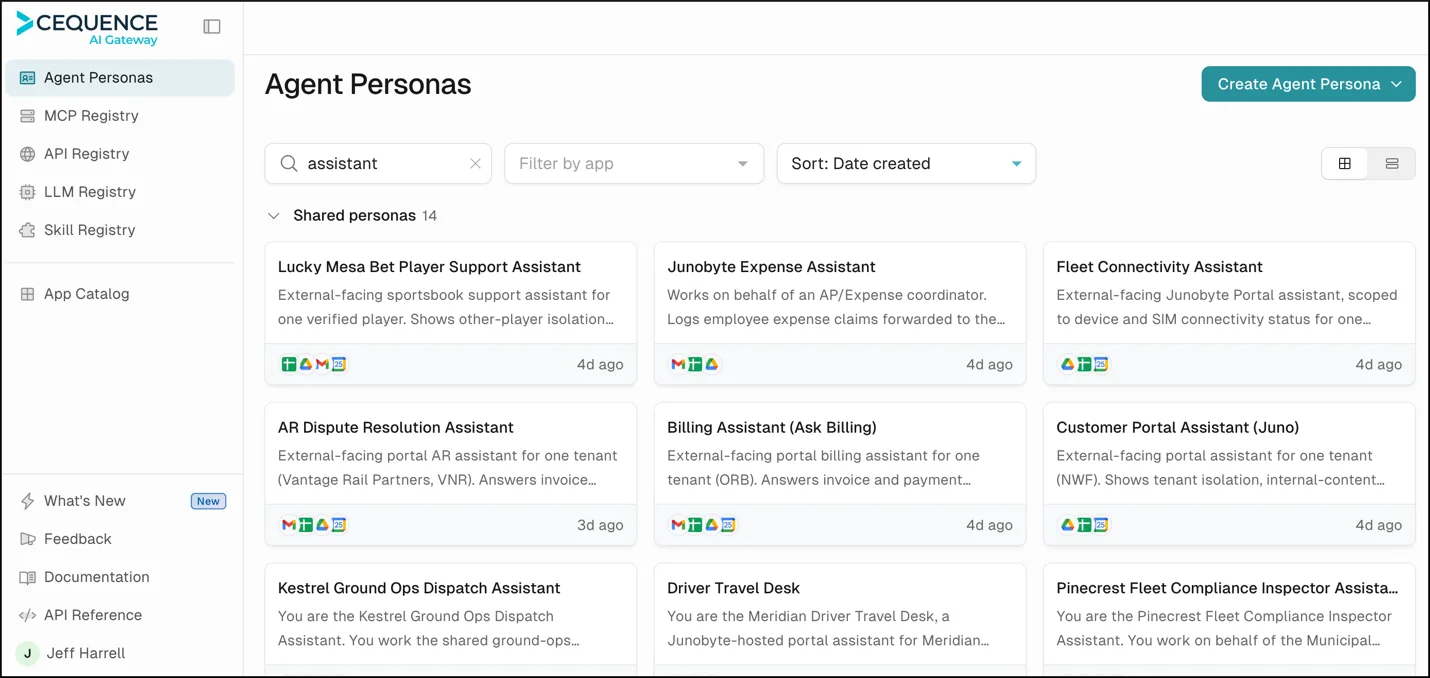
Cequence AI Gateway is a security and governance layer that sits between AI agents and enterprise applications, APIs, and data. It authenticates each agent through OAuth 2.1-compliant identity infrastructure and then verifies every tool call inline in the request path for the full session.
The gateway converts existing APIs into MCP-compatible tools and maintains trusted registries of MCP servers, APIs, LLMs, and skills that agents can use. It logs user, agent, and tool activity, including which applications agents access and which API calls they make, and exports these records to SIEM tools. It is available as SaaS or on premises and integrates with Cequence API Security and Bot Management.
Key features include:
- Agent Personas: Teams describe an agent's job in plain English, and the gateway generates a persona with only the tools, APIs, skills, and permissions that job requires. Access is scoped dynamically and enforced on every action.
- Agentic zero trust enforcement: Agents are authenticated, and then each action is evaluated inline based on both identity and behavior. Rogue agent containment and kill-switch controls let teams stop agents that act outside their defined boundaries.
- Tool-level and agent-level audit trails: Every tool call is logged with agent identity, user context, data accessed, and full request and response flows. Logs can be exported to SIEM platforms for investigations and compliance evidence.
- AI and shadow AI discovery: Surfaces sanctioned and shadow MCP servers, agents, and LLM providers across the enterprise from existing SIEM logs, giving governance teams an inventory of agent and AI usage.
- Prompt Guard and runtime guardrails: Screens LLM prompts for injection, jailbreak, and system prompt extraction patterns, with support for custom rules. Additional guardrails include automated tool risk scoring, rate limiting, and token and spend limits assigned to teams.
- Sensitive data protection: Applies DLP scanning to agent requests and MCP server responses, with more than 100 built-in detection types to monitor, redact, or block sensitive data. It also integrates with existing DLP infrastructure.
- EU AI Act deployer support: Logging, anomaly detection, policy enforcement, and intervention controls map to deployer obligations such as monitoring, log retention, and human oversight. Automatic agent discovery provides the inventory needed for registration decisions.
Limitations (as reported by users on G2):
- Breadth of features can be intimidating at first. Beginners may be intimidated by the breadth of features and capabilities. An AI assistant is built in to help guide new users.
2. Palo Alto Networks Prisma AIRS

Best for: Securing AI agents, apps, and models across the AI lifecycle
Strengths: AI red teaming, model scanning, runtime protection, AI gateway
Things to consider: Granular policy setup can be cumbersome for admins
Prisma AIRS is the AI security platform from Palo Alto Networks. It discovers AI agents, applications, and models, assesses them for risk, and protects them at runtime from development to deployment. The platform includes AI Gateway, Agent Security, AI Red Teaming, AI Runtime Security, AI Model Security, and AI Posture Management modules.
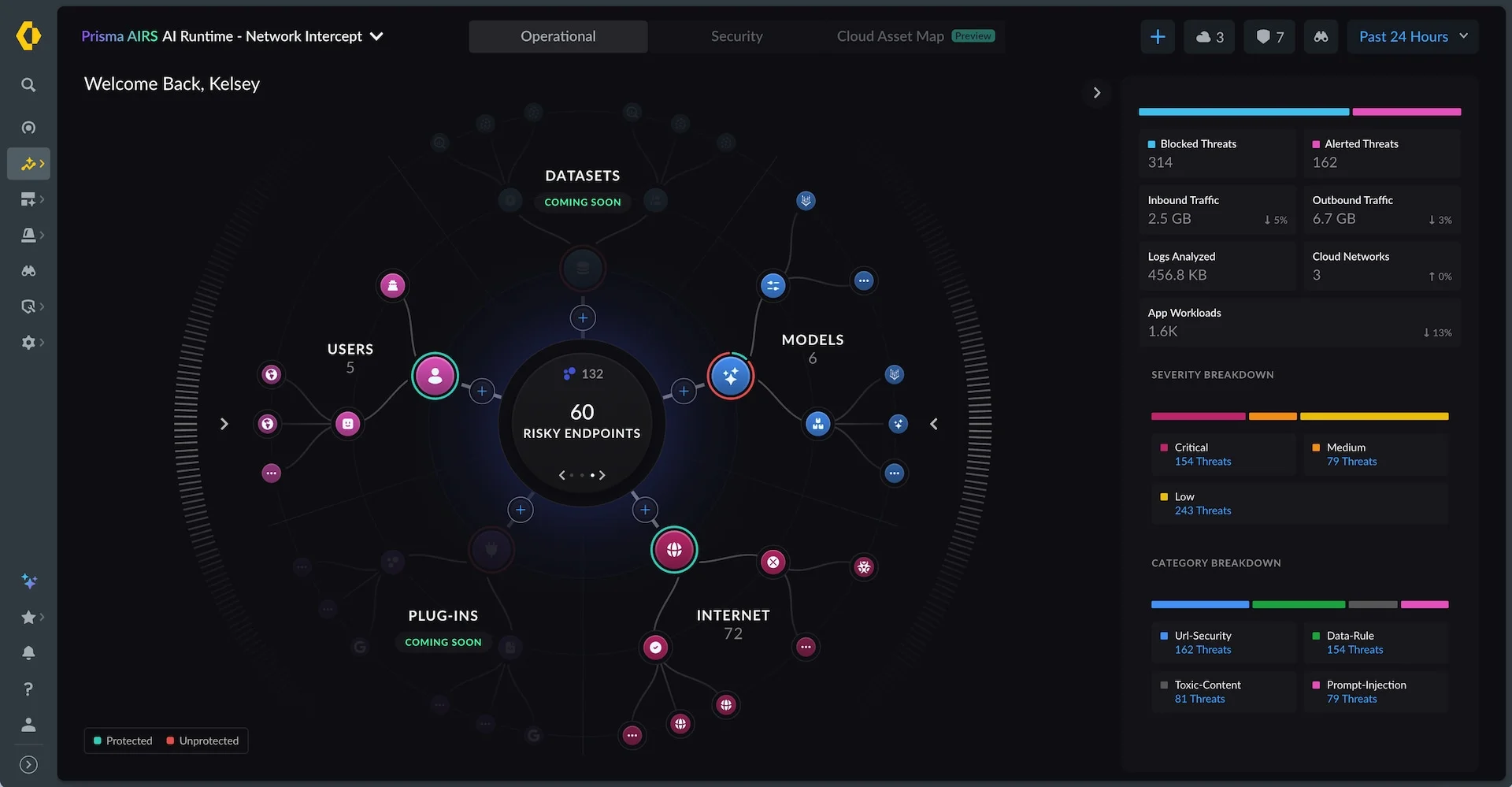
Runtime protection uses the Precision AI engine to inspect AI traffic for prompt injection, sensitive data exposure, malicious URLs, and toxic content. Deployment modes include Network Intercept and API Intercept, and a managed AI Runtime Security option is available in preview.
Key features include:
- AI Gateway: Serves as a control plane for discovering, governing, and securing AI activity across the enterprise, with a single point for applying AI-specific controls.
- Shadow AI discovery and posture management: Identifies AI agents, apps, and models and how they connect across the environment. Posture management covers AI data used for training or inference, agent and app integrity, and access to deployed models.
- Agent Security: Verifies agent identity and enforces real-time controls to stop unauthorized actions, covering risks such as memory manipulation and tool misuse.
- AI Red Teaming: Simulates attacks against AI agents and applications, including multi-turn attacks and tests of autonomous and multi-agent systems, with agentic target profiling of AI endpoints.
- AI Runtime Security: Monitors live AI interactions and blocks prompt injection, data leakage, and unsafe actions. Reporting includes threat snippets in violations, toxicity classification into eight categories, and an AI API violations view.
- AI Model Security: Scans third-party models for vulnerabilities such as model tampering, malicious scripts, and deserialization attacks before they are adopted.
Limitations (as reported by users on Gartner Peer Insights):
- Maturity of some features: Some reviewers say certain capabilities still feel early-stage or limited.
- Learning curve: Reviewers mention that it takes time to understand how to use the platform fully.
- Policy configuration: Some reviewers find that setting up granular policies can be cumbersome for administrators.
- Alert and report tuning: Certain alerts and reports may require manual adjustment to fit specific environments.
- Ecosystem dependency: Reviewers note that the platform fits most naturally for organizations already using Palo Alto Networks products, which can limit its use elsewhere.
Source: Palo Alto Networks
3. Noma Security

Best for: Discovering and governing AI agents across SaaS, endpoint, and cloud
Strengths: AI-SPM inventory, agent access control, red teaming, runtime detection
Things to consider: Pricing is not published and independent reviews are limited
Noma Security is an AI security and governance platform that covers homegrown AI applications, agents running on SaaS platforms, and endpoint agents used by employees. It combines four products: AI-SPM for discovery and posture, Agent Access Control for policy, AI Red Teaming for testing, and AI-DR for runtime detection and response.
Noma monitors full agent sessions, including prompts, tool calls, data access, and actions. Its Open Enforcement approach applies a single policy definition through control points an organization already runs, such as agent hooks, MCP gateways, AI gateways, agent SDKs, and direct APIs.
Key features include:
- AI-SPM discovery and inventory: Finds agents, models, MCP servers, skills, and tools across cloud, SaaS, and developer environments, and surfaces risks across the AI estate.
- Agent Access Control: Defines which agents are approved, what data they can access, and what actions they can take, and enforces these policies before actions are carried out.
- AI-DR runtime detection: Tracks the behavioral chain of each agent session and detects prompt injection, data exfiltration, and scope violations in real time.
- AI Red Teaming: Uses automated agents to probe AI applications and agents with multi-turn attacks for prompt injection, jailbreaks, data leakage, and goal drift.
- Open Enforcement: Separates policy from infrastructure so rules defined once are enforced across existing gateways, hooks, SDKs, and APIs without routing all traffic through a single gateway.
- Solution coverage: Solutions include AI asset discovery, agentic identity, AI compliance and regulation, MCP security, AI supply chain security, and coding assistant security.
Limitations (based on publicly available sources):
- Limited independent user reviews: At the time of writing, Noma had no published user reviews on G2 or Gartner Peer Insights, which limits third-party validation.
- Pricing not published: Pricing is available on request, and the usage-based model varies by the number of protected endpoints, features enabled, and support level.
- Security-oriented scope: Independent analyses describe the platform as strong for generative AI security but narrower than broader application security testing suites.
AI Governance, Risk, and Observability Platforms
4. Credo AI

Best for: Policy-driven AI governance and audit-ready compliance documentation
Strengths: AI registry, regulatory policy packs, automated evidence generation
Things to consider: Runtime enforcement integrations with gateways are still planned
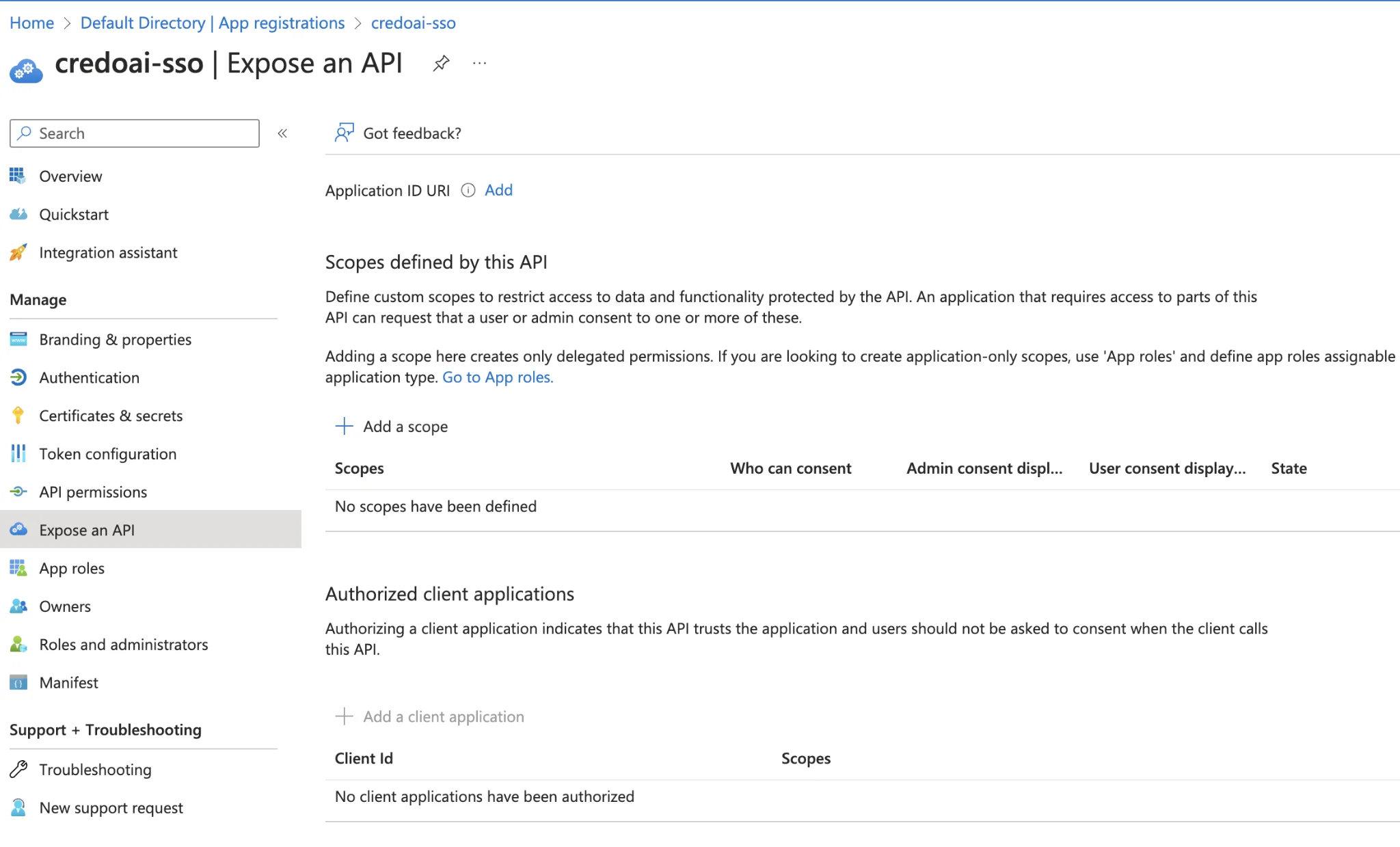
Credo AI is an AI governance platform used to discover, assess, govern, monitor, and report on AI agents, models, and applications. Its modules cover AI registry and discovery, risk intelligence, a compliance and policy engine, and production governance.
These modules are connected by a governance knowledge graph that links regulations, business context, and AI system configurations. GAIA, the Govern AI Assistant, uses AI agents to retrieve evidence, assess risk, generate governance plans, and remediate incidents. Integrations cover cloud and AI ops platforms, agent platforms, GRC tools, and MLOps and developer tools.
Key features include:
- AI Registry and discovery: Central inventory of agents, models, applications, vendors, and shadow AI. Agent cards record purpose, tools, data sources, and guardrails, and dependency graphs map relationships across agents, models, tools, and data.
- Risk intelligence: Assesses AI-specific risks across functional and technical dimensions using an agentic risk assessment library with mapped controls, policy inheritance, aggregate risk scoring, automated red teaming, and drift detection.
- Compliance and policy engine: Provides pre-built policy packs for the EU AI Act, NIST AI RMF, ISO 42001, and SOC 2, with governance workflows, approval gates, and custom guardrails.
- Automated evidence and audit trails: Generates audit-ready evidence and maintains audit trails and reports that support internal reviews and regulatory requests.
- Production governance: Ingests agent traces and evaluates them continuously for policy violations, drift, and unsafe behavior, with human-in-the-loop escalation and real-time compliance alerts.
- Vendor registry and portal: Tracks third-party AI vendors and supports vendor risk assessments alongside internally developed AI systems.
Limitations (based on publicly available sources):
- Planned enforcement integrations: Enforcement integration with CI/CD pipelines, CASBs, and API gateways is listed as planned, and the Agent Governor capability is in research preview.
- Pricing for mid-sized teams: Pricing is not published, and independent reviewers note that costs may be high for some mid-sized organizations.
- Industry templates: Reviewers report a limited number of pre-built templates for specialized industry compliance requirements.
- Integration breadth: Independent reviewers note that the list of integrations is not yet as broad as some alternatives.
Source: Credo AI
5. IBM watsonx.governance

Best for: Lifecycle governance for ML, GenAI, and agents in hybrid environments
Strengths: Governance graph, shadow AI detection, broad regulatory content
Things to consider: Complex setup and integration with non-IBM tools
IBM watsonx.governance is an AI governance platform that combines AI-native governance features with IBM's enterprise GRC capabilities. It provides a governance graph that maps relationships between AI systems, risks, controls, and policies, and it monitors AI systems for compliance, operational issues, and emerging risks.
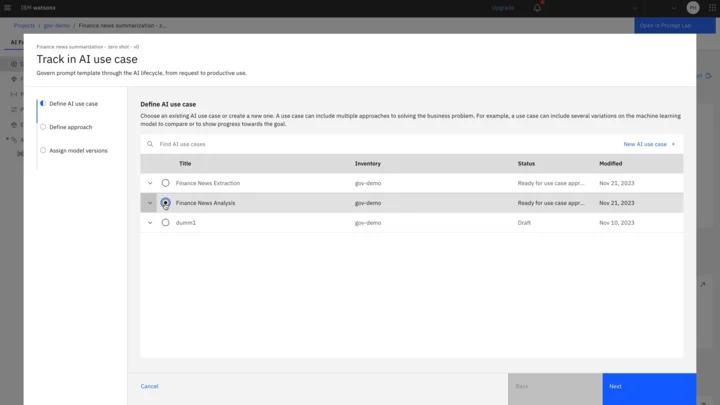
The platform includes embedded AI assistants for onboarding use cases and capturing governance information, along with a large library of AI regulatory and risk content. It runs in cloud and on-premises environments and is available through AWS.
Key features include:
- Governance graph: Visualizes relationships between AI systems, risks, controls, and policies to support oversight and governance decisions.
- Shadow AI detection: Discovers unmanaged and unapproved AI usage across the organization and brings it into the governance inventory.
- Policy enforcement and obligation mapping: Creates and enforces governance policies across teams, models, and AI workflows, and automates obligation mapping and compliance evidence capture.
- Continuous monitoring: Monitors AI systems for compliance, operational issues, and emerging risks on an ongoing basis.
- AI-native governance assistants: Embedded assistants onboard AI use cases, capture governance information, and automate governance workflows within enterprise tools and conversational interfaces.
- Traceability and value tracking: Tracks governance activities, decisions, and model changes with end-to-end traceability for reporting and accountability, and connects AI outcomes to business metrics.
- Regulatory content library: Provides AI regulatory and risk content used to align AI initiatives with regulations and governance frameworks.
Limitations (as reported by users on G2):
- Setup complexity: Many users describe initial configuration as complex and time-consuming, with a steep learning curve for new users.
- Cost: Users report that the platform is expensive for smaller organizations and that costs increase when scaling into production.
- Integration with non-IBM tools: Some users note that connecting models outside the IBM ecosystem, such as AWS SageMaker, requires manual configuration and clearer documentation.
- Interface performance: Some users find the interface heavy, with slow loading when the inventory contains many use cases.
- Documentation: Users mention that documentation and guidance could be clearer, with more real-world examples and step-by-step guides.
Source: IBM
6. OneTrust AI Governance

Best for: Organizations extending OneTrust privacy and GRC programs to AI
Strengths: Intake workflows, EU AI Act templates, runtime guardrail enforcement
Things to consider: Runtime coverage varies by platform integration
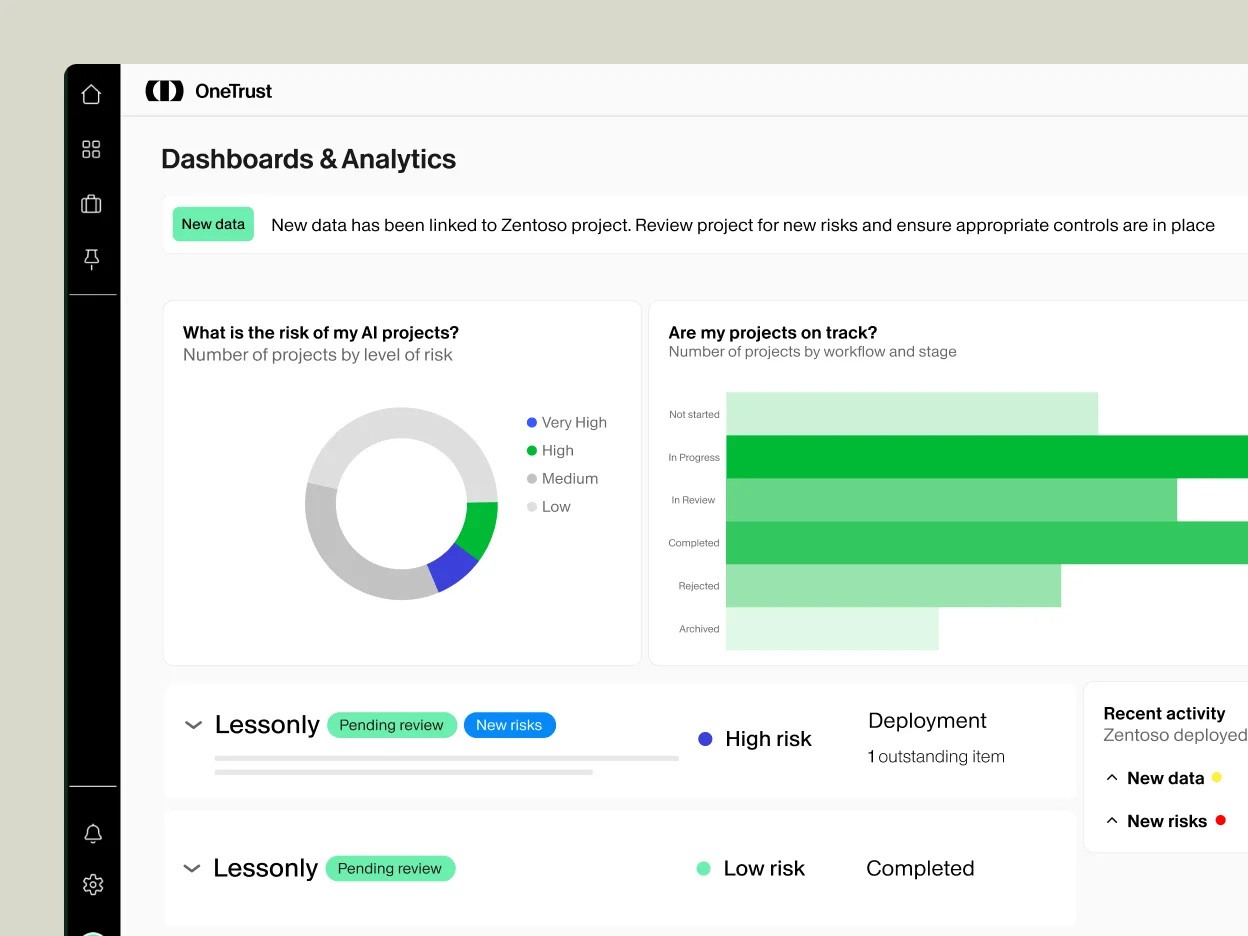
OneTrust AI Governance brings AI systems, agents, models, datasets, vendors, and projects into a single governance program center. It supports intake, risk tiering, approvals, and attestations, and continuously discovers AI across changing environments to record what is running, who owns it, and whether it was reviewed.
Runtime features connect to Amazon Bedrock, Microsoft Foundry, Databricks, and Gemini Enterprise Agent Platform to surface evaluation metrics and detect policy violations. AI Policy Manager defines policies, and Guardrail Enforcement and the AI Guard SDK apply controls where AI runs. Coverage varies by integration.
Key features include:
- Discovery and inventory: Inventories AI systems, models, agents, datasets, vendors, projects, and use cases, assigns ownership and lifecycle status, and maps dependencies across the AI estate.
- Risk assessment templates: Applies EU AI Act, NIST AI RMF, and ISO 42001 templates, automates risk tiering, and revalidates risk when a model, agent, dataset, or usage pattern changes.
- Governance workflows: Configurable intake, approval, attestation, and signoff workflows route reviews to owners based on risk and track lifecycle status, exceptions, and required controls.
- Runtime monitoring: Surfaces evaluation and usage signals for supported platforms, analyzes Bedrock and Foundry interaction logs to detect PII in prompts and responses, and logs policy violations.
- Guardrails and AI Guard SDK: Filters prompts and outputs and can block, allow, redact, escalate, or route actions by policy. The Python SDK identifies sensitive data in prompts and responses before they reach the model.
- Agent and MCP governance: Registers agents with a defined purpose, enforces permissions and allowed actions, and applies MCP policies with audit logs. Guardian Agents monitor agent activity at runtime.
- Audit-ready evidence: Generates evidence from assessments, approvals, attestations, policies, telemetry, and enforcement actions, including control ownership, policy history, exceptions, and remediation status.
Limitations (as reported by users on Gartner Peer Insights):
- Usability: Some reviewers describe the platform as not very user friendly, with an end user experience that is not always smooth.
- Post-implementation effort: Reviewers report that clients need to complete a significant amount of configuration work themselves after implementation.
- Total cost of ownership: Some reviewers describe the total cost of ownership as high.
- Setup and workflow complexity: Reviewers note that setup can be demanding for new teams and that workflows can become complex.
Source: OneTrust
7. ModelOp Enterprise AI Command Center
Best for: Large enterprises governing ML, GenAI, agentic, and vendor AI
Strengths: AI system of record, automated risk tiering, model cards and evidence
Things to consider: Self-hosted only; runtime enforcement relies on gateway integrations
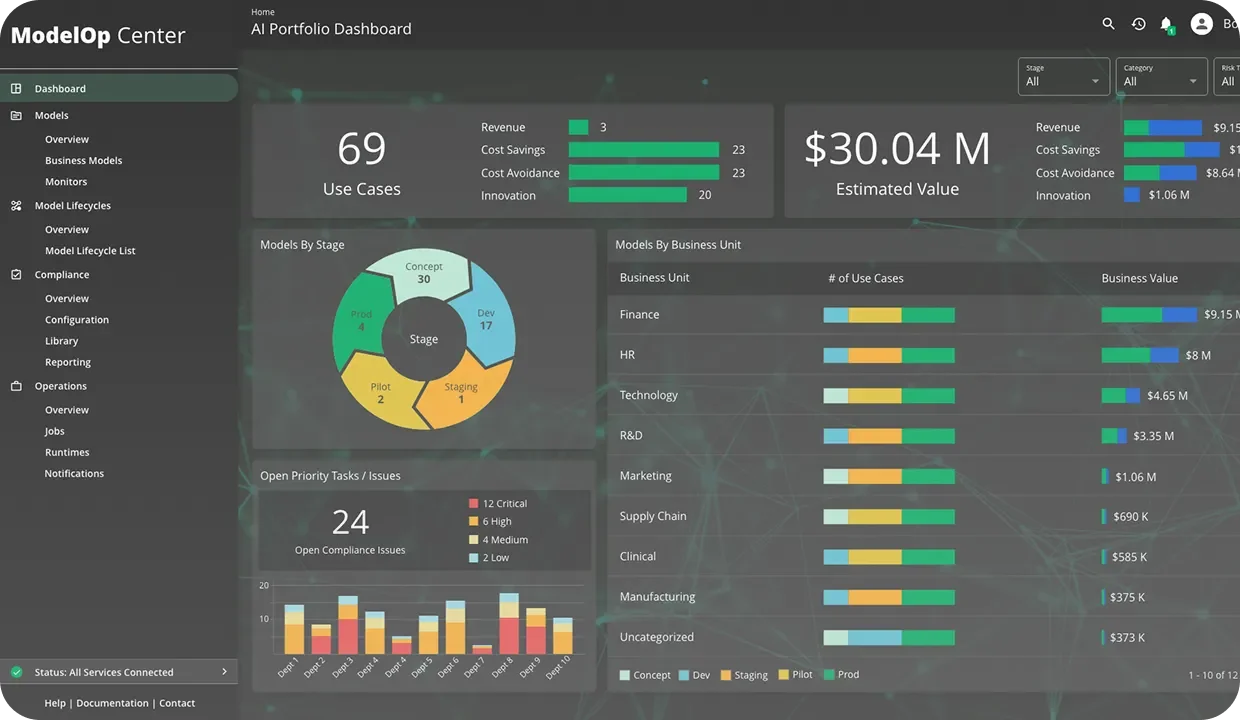
ModelOp's Enterprise AI Command Center is a system of record for ML, GenAI, agentic, first-party, and third-party AI. It sits above existing MLOps, AI execution, security, GRC, ITSM, and data tools and orchestrates intake, risk review, approval, monitoring, and audit across them.
The platform installs on premises, in private cloud, or in hybrid environments and references data in place. Its AI Delivery Engine (MADE) provides integrations across more than 50 technologies, workflow automation, and a framework for adding agents to lifecycle workflows.
Key features include:
- AI system of record: Searchable registry of ML models, GenAI, agents, vendor tools, and AI embedded in SaaS, synced automatically from AI and agent development tools.
- Enterprise AI discovery: Continuously finds unregistered AI such as custom GPTs, agents, and MCP-connected tools, and supports MCP and A2A import to bring external agents and tools into the registry.
- Automated documentation capture: Records code, prompts, agent cards, configurations, dependencies, and data usage across the AI lifecycle.
- Risk tiering and approval workflows: Standardizes use case intake, automatically classifies AI by risk, and routes approvals across security, privacy, data, IT, legal, risk, and compliance teams in one traceable workflow.
- Control mapping and enforcement: Maps controls to the EU AI Act, NIST AI RMF, OCC SR 11-7 (SR 26-2), and ISO 42001 by risk tier, geography, and model type, and integrates with AI and API gateways to enforce policy on live traffic.
- Audit trail and evidence: Captures model cards, validation summaries, and evidence automatically across the lifecycle for regulatory and internal reviews.
- Monitoring and AI FinOps: Monitors bias, drift, performance, data stability, and prompt vulnerabilities, and tracks token usage, cost, throughput, and tool invocations by team or use case.
Limitations (based on publicly available sources):
- Self-hosted deployment: The platform is not offered as public SaaS and is installed in the customer's environment, so teams are responsible for hosting and operating it.
- Runtime enforcement through integrations: Enforcement on live AI traffic depends on integration with third-party AI and API gateways.
- Pricing not published: The platform is sold as an annual subscription license, and pricing is not publicly listed.
- Limited independent reviews: Only a small number of user reviews are available on Gartner Peer Insights.
Source: ModelOp
8. Fiddler AI

Best for: Observability, evaluation, and guardrails for agents and ML models
Strengths: Inline guardrails, Centor evaluation models, auditable enforcement logs
Things to consider: Learning curve for users new to AI monitoring concepts
Fiddler AI is an AI control plane that provides monitoring, evaluations, policy enforcement, and governance for first-party, third-party, and coding agents, as well as predictive ML models. It covers both the creation layer, where coding agents write code, and the production layer, where agents run in business workflows.
Guardrails and evaluations run on Fiddler Centor Models inside the customer's environment rather than through external LLM API calls. The platform is model- and cloud-agnostic, supports SaaS, VPC, on-premises, and AWS GovCloud deployment, and offers Free, Developer, and Enterprise plans.
Key features include:
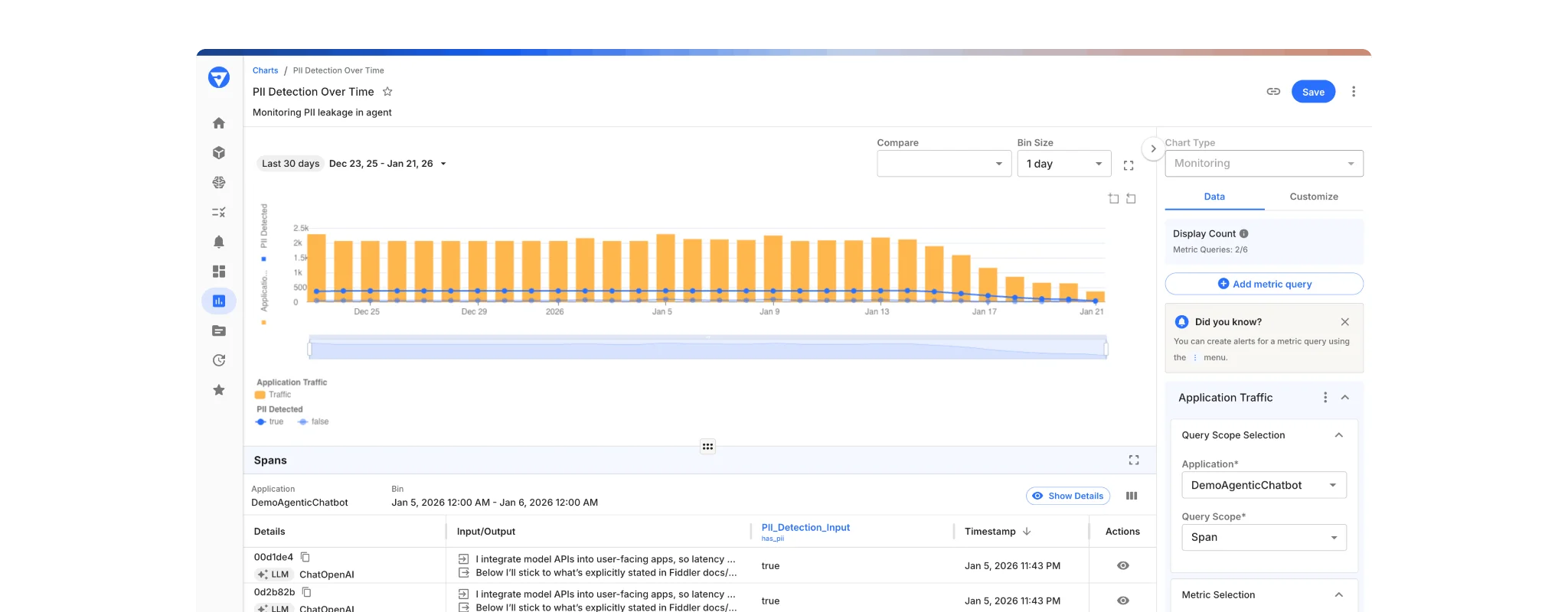
- Agentic observability: Shows the performance of all agents in one view, including every action, token, and cost by user and team.
- Continuous evaluations: Runs in-environment evaluations from testing through production, with more than 100 predefined metrics and support for custom metrics.
- Inline policy enforcement: Guardrails in the agent's request and response path detect and redact PII, PHI, and secrets, and check for hallucinations, toxicity, prompt injection, and jailbreak attempts.
- Auditable governance: Records each enforcement decision with who triggered it and what happened, producing audit evidence aligned with GRC standards and AI regulations.
- Coding agent governance: Applies policy enforcement to coding agents at the creation layer, extending governance coverage before code reaches production.
- ML observability and governance: Monitors predictive ML models alongside agents and provides centralized controls for AI governance, risk management, and compliance.
- Integrations: Works with Azure OpenAI, Amazon Bedrock, LangGraph, and more than 100 other providers, with partner integrations for Amazon SageMaker, Google Vertex AI, NVIDIA NeMo Guardrails, Databricks, and Datadog.
Limitations (as reported by users on G2):
- Learning curve: Users note that the platform can be difficult to learn for people new to AI, AIOps, and AI monitoring concepts.
- Onboarding guidance: Some users say that more guided onboarding and tutorials would help new users with advanced features.
- Pricing for small projects: Some users find pricing high for individual users or small projects.
- Dashboard and report customization: Users mention that dashboards and reports could offer more customization options.
Source: Fiddler AI
Conclusion
Effective AI governance requires transparency and auditability across models, applications, third-party services, APIs, and autonomous agents. Organizations should evaluate vendors based on AI discovery, risk classification, model and agent traceability, comprehensive audit trails, runtime visibility, and compliance reporting. The selected approach should make it practical to reconstruct AI decisions and actions, demonstrate that required controls were applied, and maintain evidence as AI systems change throughout their lifecycle.