
TL;DR: Agentic AI security tools control what AI agents do at runtime, which tools they call, and what data they reach. Cequence AI Gateway is best for governing agent access to apps and APIs, Zenity for multi-platform agent governance, Prisma AIRS for Palo Alto environments, and Lakera for real-time prompt and data guardrails.
What Are Agentic AI Security Tools?
Securing autonomous AI agents requires inline agentic AI security controls and runtime monitoring to manage permissions, block goal hijacking, and prevent data leaks. Traditional security assumes human users, but AI agents move at machine speed and use valid credentials.
Unlike traditional LLM applications that mainly generate content, agents can interact with APIs, databases, browsers, code execution environments, and other systems. This creates security risks beyond prompt and model behavior. Protecting them requires a focus on two main areas:
Runtime behavior and tool use:
- Detect unexpected or malicious agent behavior by monitoring execution traces for suspicious actions and policy violations.
- Restrict which tools agents can use based on identity, role, task, environment, and authorization context.
- Validate tool calls before execution to block unauthorized operations, suspicious arguments, and high-risk requests.
- Control tool parameters and allowed actions by limiting functions, resources, parameter values, destinations, and data scopes.
- Monitor MCP servers and external integrations for excessive permissions, unexpected tool changes, sensitive data exposure, and suspicious activity.
Data access:
- Apply least-privilege data access by limiting permissions according to the resource, operation, session, or task.
- Enforce agent identity and authorization so access reflects both the agent's permissions and those of the user it represents.
- Restrict access to sensitive data sources such as customer records, credentials, financial information, and production data.
- Detect sensitive data in prompts and responses and redact, mask, block, or restrict it when required.
- Prevent unauthorized data exfiltration by inspecting outbound tool calls, network requests, messages, uploads, and generated responses.
In this article:
- Agentic AI Security Tools at a Glance
- How Agentic AI Security Tools Secure Runtime Behavior, Tool Use, and Data Access
- Notable Agentic AI Security Tools for Runtime Behavior, Tool Use, and Data Access
Agentic AI Security Tools at a Glance
The table below summarizes the key differences between the agentic AI security tools covered in this guide. We explore each tool in more detail in the sections that follow.
Category Solution Best For Key Strengths Things to Consider Agent Runtime Governance and Access Control Cequence AI Gateway Governing agent access to enterprise apps, APIs, and MCP tools Agent Personas, inline tool-call enforcement, DLP on MCP traffic Initial setup and policy tuning can take time Agent Runtime Governance and Access Control Zenity Securing agents across SaaS, cloud, and endpoint environments Intent-based detection across full agent execution paths Enforcement depth varies by platform; no public pricing Agent Runtime Governance and Access Control Noma Security Discovery, access control, and runtime detection for AI agents Session-level behavioral context, IdP-keyed tool policies Integration into complex AI environments; pricing on request Agent Runtime Governance and Access Control Prisma AIRS Agent Security Palo Alto Networks customers securing agents across the lifecycle Central control of tool calls, LLM traffic, and MCP connections Some features feel early-stage; tied to Palo Alto ecosystem Runtime Guardrails and AI Threat Detection Lakera AI Agent Security Real-time guardrails on agent inputs, outputs, and actions Prompt attack detection in 100+ languages, sub-50 ms latency Multimodal inspection limited to text in some integrations Runtime Guardrails and AI Threat Detection Prompt Security (SentinelOne) Governing workforce AI use, agents, and MCP servers together Shadow MCP discovery, least-privilege agent scope, audit log Full coverage may need extension, agent, and proxy setup Runtime Guardrails and AI Threat Detection Lasso Intent-based runtime protection with discovery and red teaming Inline enforcement at proxy, API, or gateway; 3,000+ attacks Requires CI/CD and platform integration; few user reviews Runtime Guardrails and AI Threat Detection HiddenLayer AI Runtime Security Runtime detection and enforcement for agents and MCP traffic Tool-use inspection and session reconstruction Needs SDK, proxy, or gateway instrumentation
How Agentic AI Security Tools Secure Runtime Behavior, Tool Use, and Data Access
Securing Agent Runtime Behavior and Tool Use
Agentic AI security tools apply controls while an agent is running, rather than relying only on safeguards built into the model or application. They observe agent decisions, tool calls, inputs, outputs, and interactions with external systems. This makes it possible to detect and block unsafe actions before they execute.
1. Detect Unexpected or Malicious Agent Behavior
Security tools can monitor an agent's execution trace for behavior that violates expected patterns or defined policies. Examples include:
- Repeated access attempts
- Unusual tool sequences
- Attempts to retrieve unrelated sensitive data
- Actions triggered by prompt injection
Runtime monitoring can combine fixed policies with behavioral detection. When suspicious activity occurs, the security layer can block an action, terminate the agent session, require human approval, or generate an alert for investigation.
2. Restrict Which Tools Agents Can Use
Agents should only have access to tools required for their assigned tasks. Security controls can enforce allowlists or deny lists based on the agent's:
- Identity
- Role
- Task
- Environment
- Current authorization context
These restrictions reduce the impact of compromised or incorrectly behaving agents. For example, a research agent might be permitted to search internal documentation but prevented from executing shell commands, modifying production databases, or sending external messages.
Related content: Read our guide to agentic AI governance
3. Validate Tool Calls Before Execution
Security tools can intercept tool calls before they reach the target system. The security layer can check whether the requested tool, operation, and context comply with policy before allowing execution.
Validation can also detect malformed requests, suspicious arguments, or calls produced after an untrusted instruction enters the agent's context. High-risk operations can be rejected or routed to a human for approval instead of executing automatically.
4. Control Tool Parameters and Allowed Actions
Allowing access to a tool does not mean an agent should be allowed to perform every operation that tool supports. Controls can restrict:
- Individual functions
- Resources
- Parameter values
- Destinations
- Data scopes
For example, an agent might receive read access to a database while write and delete operations remain blocked. A messaging tool could allow communication only with approved domains, while a file tool could limit access to directories. Parameter-level controls provide finer-grained protection than tool-level permissions alone.
5. Monitor MCP Servers and External Integrations
Model Context Protocol (MCP) servers can expose data sources and tools to agents through a common interface. Security tools can inspect MCP connections, tool definitions, requests, responses, and authorization decisions to identify risky or unauthorized activity.
Monitoring is also important when MCP servers or other integrations are operated by third parties. Controls can detect unexpected tool changes, excessive permissions, sensitive data exposure, and suspicious responses. Organizations can then enforce policies at the integration boundary instead of trusting every connected server or service implicitly.
Securing Agent Data Access
Agentic AI security tools control which data an agent can retrieve, process, and disclose. These controls are especially important because agents may combine information from databases, files, SaaS applications, APIs, and other sources while completing a task.
6. Apply Least-Privilege Data Access
Agents should receive only the data permissions required for their current tasks. Instead of giving an agent broad, persistent permissions, security tools can limit access by:
- Resource
- Operation
- Session
- Task
For example, an agent that summarizes support tickets may need read access to selected ticket fields but not billing records or account credentials. Narrow permissions reduce the amount of data exposed if the agent is manipulated or behaves unexpectedly.
7. Enforce Agent Identity and Authorization
Security controls can assign each agent or agent session a distinct identity and evaluate authorization before granting access to protected resources. This avoids relying on shared credentials that make it difficult to determine which agent performed an action.
Authorization can also include the identity and permissions of the user the agent represents. An agent should not gain access to information simply because its service account has broader privileges than the requesting user.
8. Restrict Access to Sensitive Data Sources
Organizations can define policies that prevent agents from accessing specified:
- Databases
- Files
- Applications
- Data classifications
Access may also depend on the agent's role, environment, task, or approval status. These controls create boundaries around high-risk sources such as customer records, credentials, financial information, and production data. Sensitive sources can be blocked entirely or exposed through interfaces that return only approved fields.
9. Detect Sensitive Data in Prompts and Responses
Security tools can inspect prompts, retrieved context, tool outputs, and model responses for sensitive information. Detection can cover:
- Credentials
- API keys
- Personally identifiable information
- Financial records
- Source code
- Organization-specific data classifications
When sensitive content is detected, policies can redact or mask values, block the request, restrict the response, or require additional authorization. Applying these checks throughout the agent workflow helps prevent sensitive information from moving between systems unnoticed.
10. Prevent Unauthorized Data Exfiltration
Agents may have legitimate access to sensitive data and external communication tools at the same time. An attacker can exploit this combination by using prompt injection or other techniques to make the agent send protected information to an unauthorized destination.
Security tools can inspect outbound tool calls, network requests, messages, uploads, and generated responses before data leaves a trusted boundary. Policies can block unapproved domains, destinations, or data types and require human approval for high-risk transfers.
Notable Agentic AI Security Tools for Runtime Behavior, Tool Use, and Data Access
How we selected these tools: We shortlisted agentic AI security tools based on their ability to monitor agent runtime behavior, validate and restrict tool calls, secure MCP connections, enforce agent identity and least-privilege access, and detect or block sensitive data exposure.
Agent Runtime Governance and Access Control Platforms
1. Cequence AI Gateway

Best for: Governing agent access to enterprise apps, APIs, and MCP tools
Strengths: Agent Personas, inline tool-call enforcement, DLP on MCP traffic
Things to consider: Initial setup and policy tuning can take time
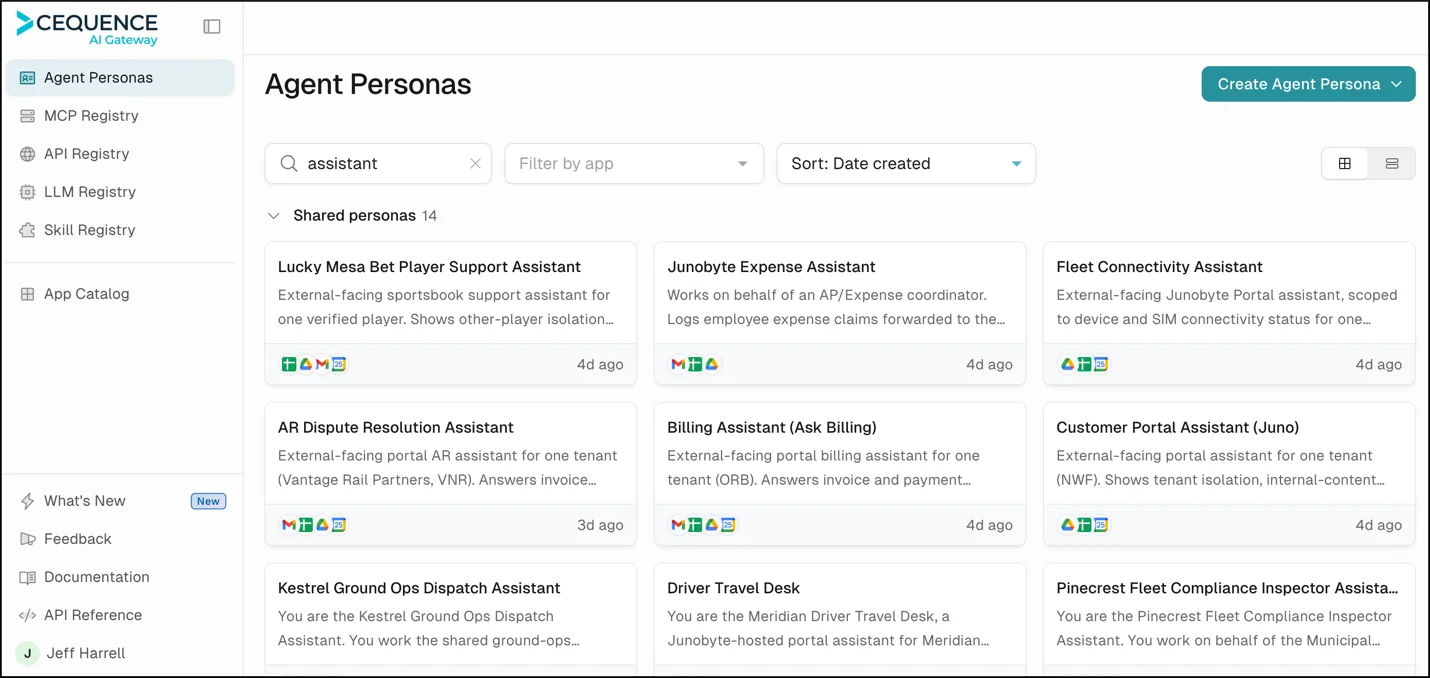
Cequence AI Gateway sits between AI agents and enterprise applications, translating agent requests into native API calls while applying security and governance controls. The gateway authenticates each agent and then verifies every action it takes, enforcing policy inline in the request path, for the full session, on every tool call.
The gateway maintains trusted registries of MCP servers, APIs, LLMs, and skills that agents are allowed to reach. Teams can turn existing APIs into MCP-compatible tools by uploading OpenAPI specifications. It runs as a SaaS service or on-premises, and connects to Cequence API Security and Bot Management for enhanced API specs and protection against agent-driven abuse.
Key features include:
- Agent Personas: Teams describe an agent's job in plain English, and the gateway generates a persona that limits the agent to the tools, APIs, skills, and permissions that job requires. Least-privilege access policies are generated from these job descriptions.
- Inline tool-call enforcement: Proxies both MCP tool calls and direct API calls through one control point. Behavioral identity judges each action by who the agent is and what it is doing, with rogue agent containment, anomaly detection, and kill-switch controls.
- Authentication and authorization: Integrates with OAuth 2.1-compliant identity providers and includes token lifecycle management and RBAC. Session binding locks authenticated sessions to the originating IP address to block token theft and reuse.
- Sensitive data protection: Applies DLP scanning to agent requests and MCP server responses, with more than 100 built-in detection types for monitoring, redacting, or blocking sensitive data. Detection covers data moving across a sequence of tool calls and integrates with existing DLP infrastructure.
- Prompt Guard and runtime guardrails: Screens prompts for injection, jailbreak, and system-prompt-extraction patterns before they reach the model, with support for custom rules. Additional guardrails include automated tool risk scoring, rate limiting, and token and spend limits by team.
- AI discovery: Surfaces shadow MCP servers, agents, and LLM providers across the enterprise using existing SIEM logs.
- Monitoring and audit trails: Logs user, agent, and tool behavior, including which applications agents access and which API calls they make. Tool-level and agent-level audit trails capture agent identity, data accessed, user context, and request and response flows, exportable to SIEM.
Limitations (as reported by users on G2):
- Requires traffic to flow through it for governance: Organizations need to set up and maintain traffic flows through the AI Gateway for it to govern the agentic AI traffic.
- Prompt injection protection capabilities face arms race: As these types of attacks evolve, the Prompt Guard feature will have to evolve as well for protection.
- Learning curve for advanced configuration: Full use of all the features may take time as the platform covers a lot of ground in security and governance.
2. Zenity

Best for: Securing agents across SaaS, cloud, and endpoint environments
Strengths: Intent-based detection across full agent execution paths
Things to consider: Enforcement depth varies by platform; no public pricing
Zenity is an AI agent security and governance platform covering agents embedded in SaaS tools, homegrown agents in cloud environments, and personal and coding agents on end-user devices. The platform has three layers: Surface builds an inventory and evaluates exposure, Enforce acts when an agent makes a decision, and Protect detects, investigates, and responds to threats.
Supported platforms include Microsoft Copilot Studio, Microsoft Foundry, Microsoft 365 Copilot, Salesforce Agentforce, ServiceNow, Amazon Bedrock, Google Vertex AI, ChatGPT Enterprise, and Claude Enterprise. Threat detections are mapped to OWASP and MITRE ATLAS.
Key features include:
- AI observability: Builds a live inventory of agents across SaaS, custom, and endpoint deployments. It tracks agent ownership, what each agent can access, and the data it touches.
- AI security posture management: Evaluates agent configurations and permissions against policy before agents go live, so over-permissioned agents are flagged before runtime.
- AI exposure management: Validates which of an agent's attack paths are exploitable, scores each one, and generates a fix that can be applied through Runtime Boundaries.
- Intent-based detection and response: Examines the full execution path, including tool calls, memory access, data usage, and control flow. This identifies malicious or unintended outcomes even when the inputs look harmless.
- Runtime enforcement: The Enforce layer lets safe actions through and stops harmful actions before they complete. Capabilities include Boundaries, Agentic Identity, and MCP Security.
- Contextual incident response: Correlates configuration, permissions, and runtime behavior into intent-driven signals, and gives investigators context on agent execution paths.
Limitations (based on publicly available sources):
- Enforcement varies by platform: Public analyses note that the depth of runtime enforcement differs across the agent platforms Zenity supports.
- Framework coverage not fully listed: Public product pages do not name some open source agent frameworks, such as LangChain, CrewAI, and AutoGen.
- Deployment options: Public materials present Zenity as a hosted SaaS platform and do not document a self-hosted or air-gapped edition.
- Pricing not published: Standard pricing is not available on public pages.
- Agent-focused scope: The platform does not cover general data loss prevention for human activity unrelated to agents, such as ordinary email or browser uploads.
3. Noma Security

Best for: Discovery, access control, and runtime detection for AI agents
Strengths: Session-level behavioral context and IdP-keyed tool policies
Things to consider: Integration into complex AI environments; pricing on request
Noma Security is an AI security platform covering three environments: endpoint agents such as Claude Code and Cursor, homegrown AI built on AWS Bedrock, Microsoft Foundry, or frameworks like LangChain, and agents built on SaaS platforms such as Copilot Studio, Agentforce, and ServiceNow. It consists of four products: AI-SPM, Agent Access Control, AI-DR, and AI Red Teaming.
The four products share context. Discovery data informs access policies, and red teaming findings become enforced patterns in production. Noma tracks the full chain of agent actions across a session, so it can link an agent reading customer records in one step with emailing a summary to an external address in a later step.
Key features include:
- AI asset discovery and risk map: Finds agents, MCP servers, skills, and models across endpoint, SaaS, and homegrown environments. The agent risk map shows each agent's connections, permissions, and data access, and flags misconfigurations and toxic combinations of capabilities.
- Agent access control: Defines which MCP servers, skills, and tools each agent can use and enforces the policy when the agent acts. Policies can be keyed to IdP groups or applied organization-wide by tool sensitivity, with a live registry of approved items and everything else blocked.
- AI detection and response: Detects prompt injection, data exfiltration, scope violations, and agents that drift from their intent. Each action is evaluated with its surrounding session, the identity behind the agent, the data involved, and behavior over time.
- Policy-based response actions: Depending on policy, the platform alerts, blocks the action, masks data, or routes the action to a human for review.
- Agentic identity: Tracks who an agent is acting as, what it is allowed to do, and whether its actions match the user's intent.
- MCP and AI supply chain security: Discovers, assesses, and governs MCP servers, detects tool poisoning and supply chain attacks, and scans models, tools, and packages.
- AI red teaming: Runs multi-turn attack campaigns with prebuilt scan profiles and compliance presets. Findings feed AI-DR runtime policies.
Limitations (based on publicly available sources):
- Integration effort: Deployment requires integration into complex AI development and deployment environments.
- Dependence on detection updates: Threat detection effectiveness relies on continuous updates to keep pace with new AI attack techniques.
- Pricing on request: Pricing details are not published and are provided upon request or consultation.
4. Prisma AIRS Agent Security

Best for: Palo Alto Networks customers securing agents across the lifecycle
Strengths: Central control of tool calls, LLM traffic, and MCP connections
Things to consider: Some features feel early-stage; tied to Palo Alto ecosystem
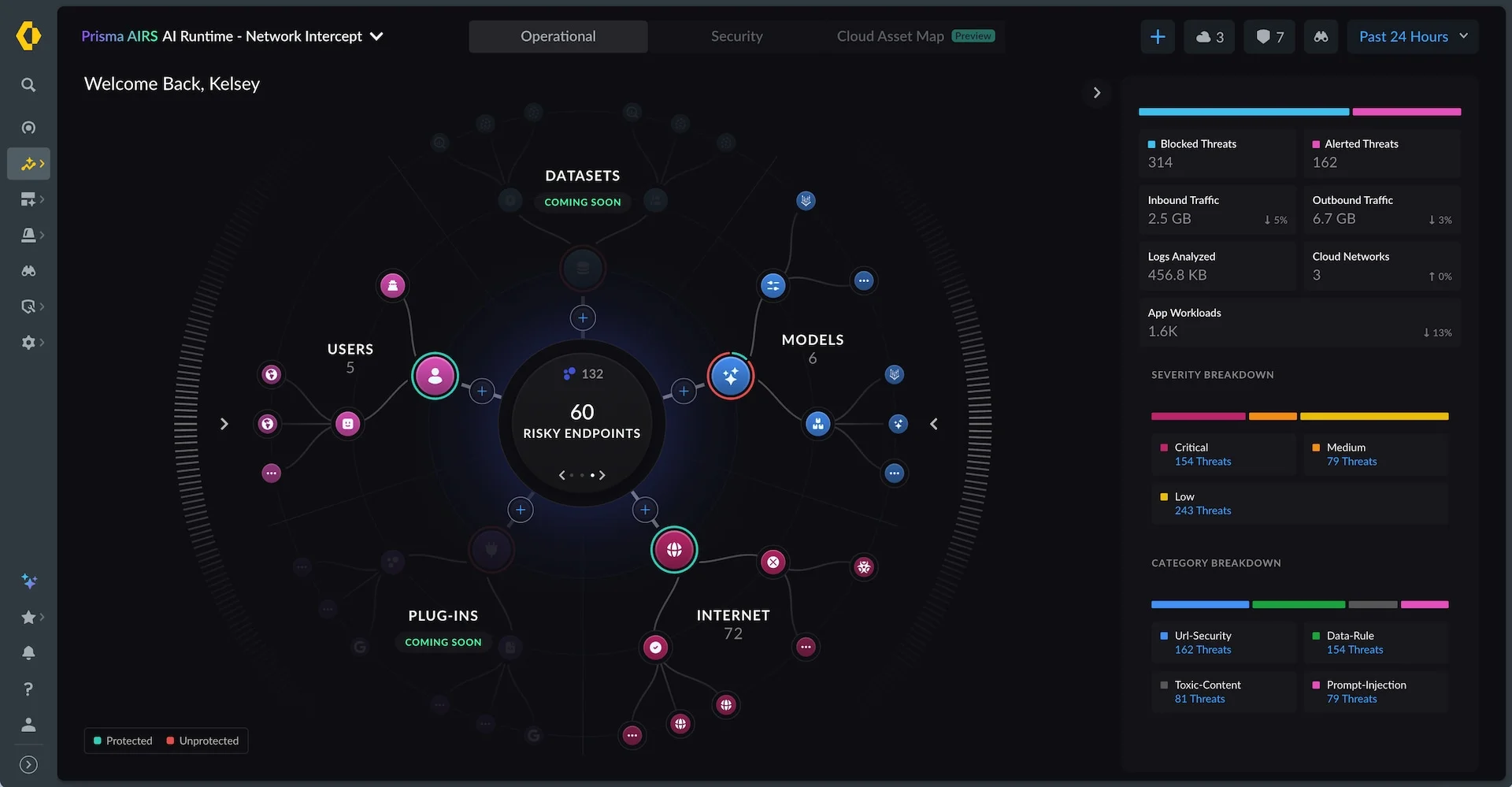
Prisma AIRS Agent Security is part of the Palo Alto Networks Prisma AIRS AI security platform. It covers the agent lifecycle, from discovering agents and scanning their code before deployment to verifying agent identities and enforcing security policies on agent actions at runtime.
Palo Alto Networks is integrating Portkey's AI Gateway into Prisma AIRS to provide one control plane that monitors agent actions, verifies agent identity, and applies runtime policies. Coverage includes agents on SaaS platforms, cloud services, low-code tools, and custom environments.
Key features include:
- Agent discovery and visibility: Discovers AI agents across SaaS platforms, cloud services, low-code tools, and custom environments. It shows what agents are doing, what they can access, and how they make decisions, including shadow and third-party agents.
- Agentic supply chain scanning: Scans agent code, MCP servers, and skills for supply chain vulnerabilities before deployment and provides remediation guidance.
- Agent behavior testing: Tests how agents behave in real-world conditions using a library of attacks or a dynamic red teaming agent.
- Over-privilege detection: Identifies excessive access and revokes unnecessary privileges to reduce the reach of compromised or misconfigured agents.
- Agent identity verification: Inventories and validates agent identities, defines agent ownership and permissions, and enforces least-privileged access.
- Runtime protection: Protects agents from prompt injection and agent-specific risks such as tool misuse, and enforces policies to prevent sensitive data exposure.
- Centralized AI traffic management: Controls tool calls, LLM interactions, and MCP connections from one place, with granular policies on how agents interact with systems.
Limitations (as reported by users on Gartner Peer Insights):
- Early-stage features: Some reviewers find that certain features still feel limited or not fully developed.
- Learning curve: Users mention that it takes time to understand how to get full value from the platform.
- Alert and report tuning: Some alerts and reports need manual adjustment to fit a specific environment.
- Platform dependency: Reviewers note that the product works best within the Palo Alto Networks ecosystem, which can limit its use elsewhere.
Source: Palo Alto Networks
Runtime Guardrails and AI Threat Detection Tools
5. Lakera AI Agent Security (Check Point)

Best for: Real-time guardrails on agent inputs, outputs, and actions
Strengths: Prompt attack detection in 100+ languages with sub-50 ms latency
Things to consider: Multimodal inspection limited to text in some integrations
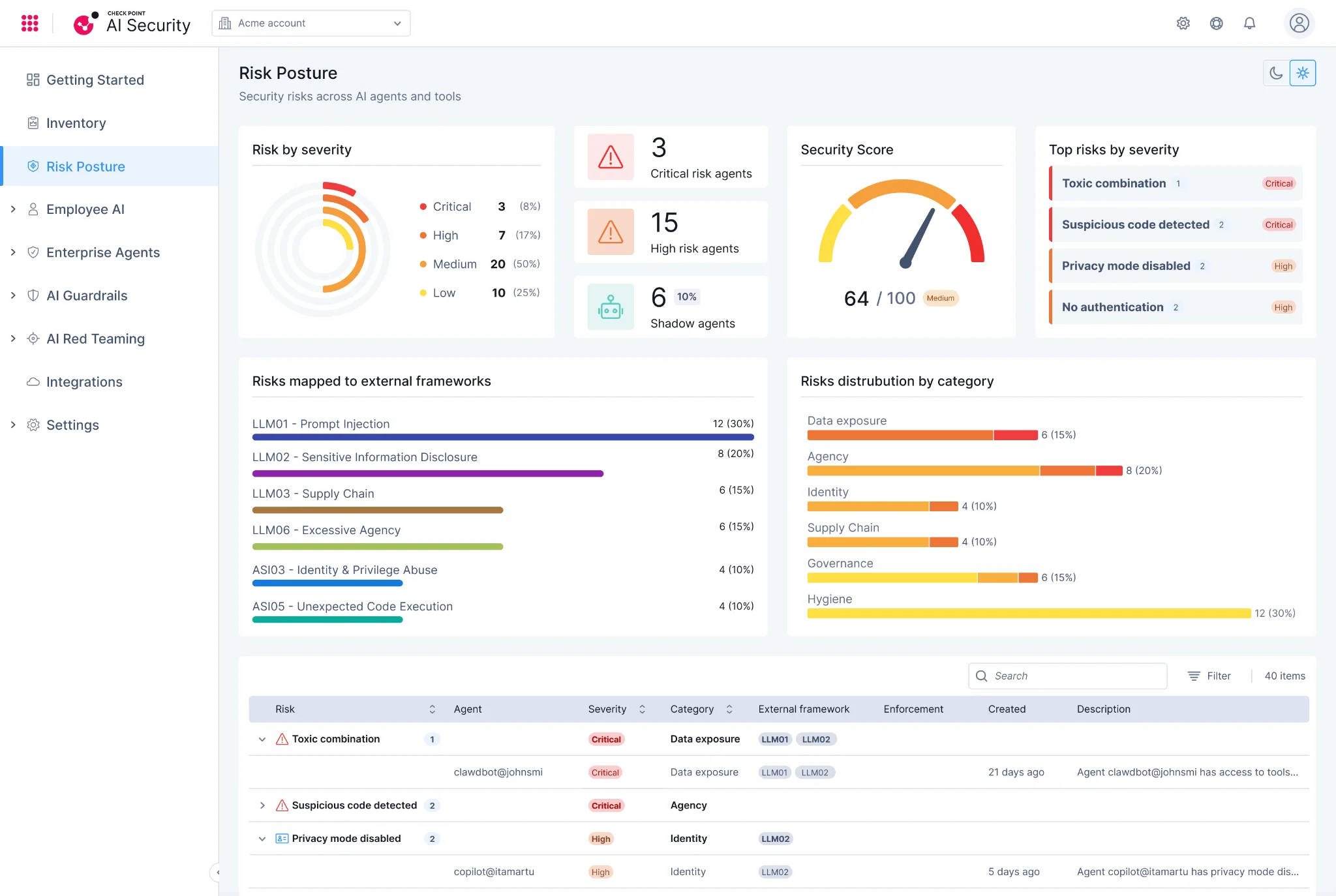
Lakera AI Agent Security, now part of Check Point, inspects what goes into AI agents, controls what comes out, and governs the actions agents take. It discovers agents and MCP-connected tools, assesses their risk, and enforces protection at runtime without changes to models or prompts.
The platform connects to cloud, low-code, and custom environments and rates each agent based on its configuration, tools, data access, MCP servers, and level of autonomy. Detection covers over 100 languages, and runs with sub-50 ms latency.
Key features include:
- Agent and MCP discovery: Finds agents and MCP-connected tools across the environment, including agents that teams did not explicitly build or register. It identifies which data, APIs, and systems each agent can access.
- Agent risk assessment: Scores each agent based on its configuration, tools, data access, MCP servers, and autonomy.
- Prompt attack protection: Blocks prompt injection, jailbreaks, and adversarial instructions before they reach the model.
- Indirect injection blocking: Blocks injected instructions arriving through MCP-connected tools before agents act on them.
- Tool use and action governance: Uses policy and runtime enforcement to control what agents can access, call, and do. It contains unsafe actions, tool abuse, and connected system risk at runtime.
- Data and access protection: Detects sensitive data in prompts and responses and flags unauthorized agent access.
- Policy violation detection: Flags harmful or non-compliant outputs and agent actions that go beyond defined policies.
Limitations (based on publicly available sources):
- Text-only inspection of multimodal content: In some gateway integrations, only text segments of multimodal requests are inspected, and image and embedding outputs cannot be inspected.
- Sensitivity to integration structure: Passing system instructions inside user messages is a common cause of false positives, so integrations need to separate system and user content.
- Response handling left to the application: The Guard API returns a flagged result, and the application decides whether to block, confirm with the user, or only log the event.
Source: Lakera
6. Prompt Security (SentinelOne)

Best for: Governing workforce AI use, agents, and MCP servers together
Strengths: Shadow MCP discovery, least-privilege agent scope, audit log
Things to consider: Full coverage may need extension, agent, and proxy setup
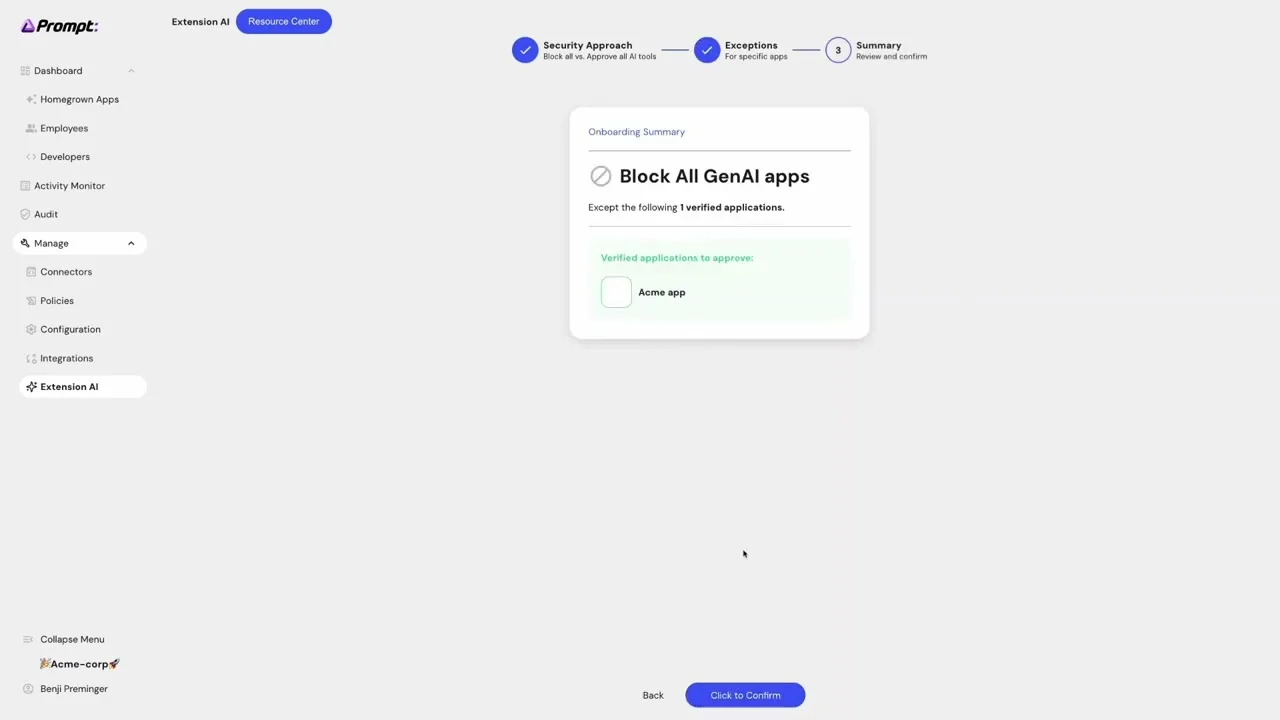
Prompt Security, part of the SentinelOne Singularity Platform, covers employee AI tools, developer code assistants, homegrown AI applications, and autonomous agents. It provides AI governance, data leakage prevention, and threat protection, with policies enforced at the point of interaction.
The Agentic AI Security module maps the agents and MCP servers in an environment and governs what they can do. Policies and AI risk visibility are managed from the same console that covers SentinelOne endpoint, cloud, identity, and data security.
Key features include:
- Agent and MCP discovery: Automatically discovers shadow MCP servers and unsanctioned agent deployments.
- Least-privilege agent access: Enforces access policies so agents operate only within their defined scope.
- Agent action audit log: Keeps a searchable log of every agent action, decision, and interaction with enterprise systems.
- Real-time AI firewall: Blocks adversarial prompts and scrubs sensitive data from outputs of AI applications at runtime.
- Pre-deployment testing: Tests AI applications for prompt injection, jailbreaks, and data poisoning before deployment, and converts red teaming findings into production guardrails on a shared policy fabric.
- Role-based usage policies: Sets granular controls over who can use AI, how, and with what data.
Limitations (as reported by users on Gartner Peer Insights):
- Deployment effort for full coverage: Some reviewers find that achieving full coverage in complex environments requires coordinating a browser extension, an agent, and proxy configuration.
- Reliance on browser extension: Reviewers note that dependence on the browser extension introduces coverage risk.
- Detection consistency: One critical review reports decreased reliability and detection gaps over time.
- Dashboard and settings: Users mention limited reporting dashboard customization and advanced settings that can feel overwhelming.
Source: Prompt Security
7. Lasso

Best for: Intent-based runtime protection with discovery and red teaming
Strengths: Inline enforcement at proxy, API, or gateway; 3,000+ attack tests
Things to consider: Requires CI/CD and platform integration; few user reviews
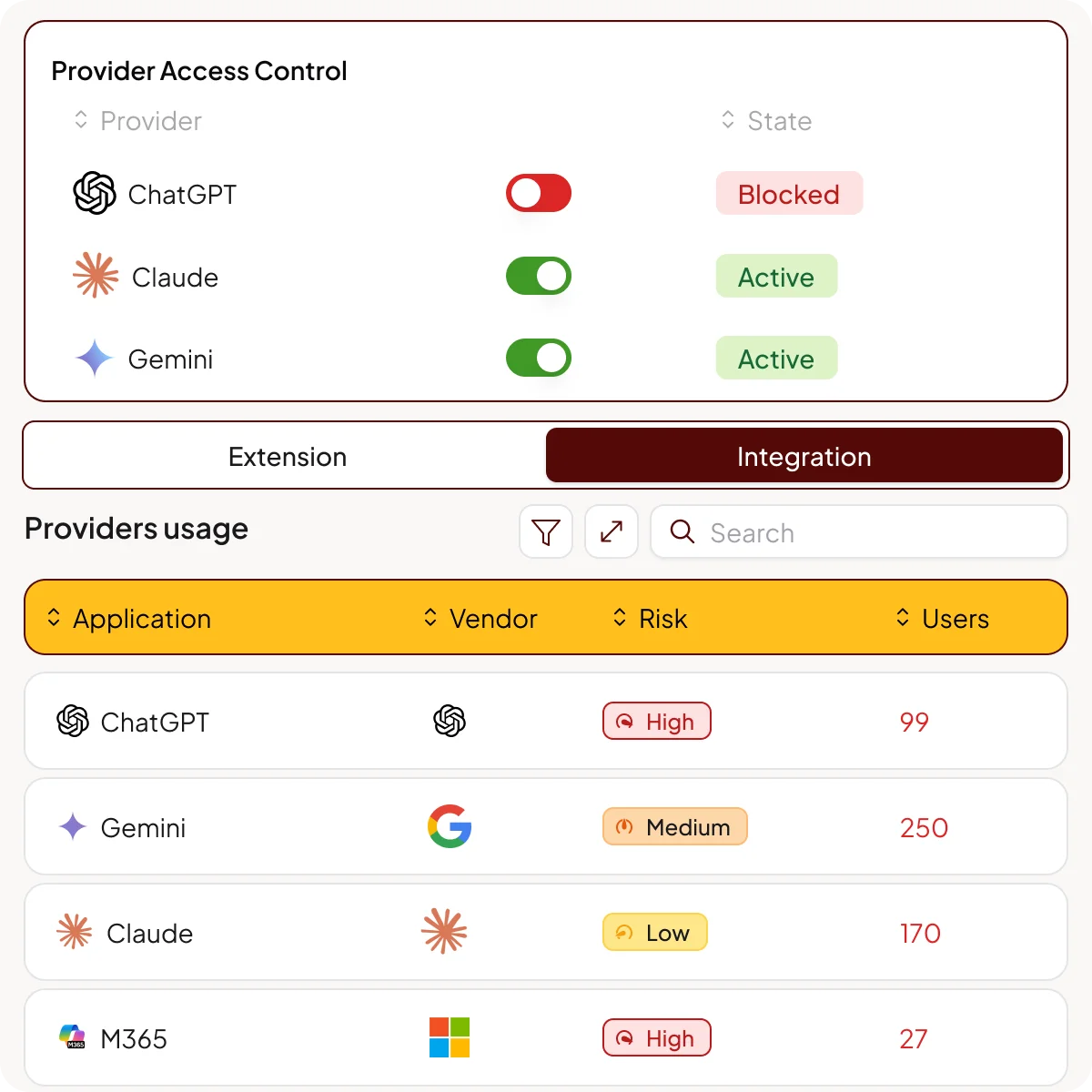
Lasso is an AI security platform that connects discovery, AI risk management, automated red teaming, and runtime protection in a continuous loop. It analyzes the intent behind an agent's actions instead of relying only on fixed patterns, and checks whether agentic applications behave within their intended scope.
Lasso discovers agents through platform integrations and finds homegrown applications through CI connections. Runtime policies are enforced inline at the proxy, API, or AI gateway layer, and threat detections are mapped to MITRE and OWASP.
Key features include:
- Discovery and AI-BOM: Inventories every agent and application and maps models, system prompts, tools, and guardrails. The inventory updates on every change and tracks red teaming scans and policies.
- AI security posture management: Analyzes what agents are exposed to, what actions they can perform, and what sensitive data they can reach. It identifies misconfigurations, policy gaps, and supply chain risk, with NIST and OWASP framework alignment.
- Automated red teaming: Runs adversarial tests from a library of more than 3,000 attacks, including multi-turn agentic attacks, context poisoning, and tool chain manipulation. Purple teaming updates policies based on findings.
- Runtime enforcement: Enforces policies inline at the proxy, API, or AI gateway layer, with remediation guidance and portfolio-wide visibility.
- AI detection and response: Detects and terminates AI threats, with context on each attack, including what happened, which agent was targeted, the impact, and how to resolve it.
- Intent analysis: Uses intent analysis for behavioral anomaly detection, with classification times under 50 ms.
Limitations (based on publicly available sources):
- Integration requirements: Deployment requires integration into existing CI/CD pipelines and platform infrastructure.
- Limited verified user reviews: Gartner Peer Insights lists only a small number of ratings, with a mixed average score.
- Vendor-reported benchmarks: Speed and throughput figures for the LEAP guardrail engine are based on Lasso's own benchmarks.
- Custom enterprise pricing: Enterprise plans use custom pricing and annual contracts.
Source: Lasso
8. HiddenLayer AI Runtime Security
Best for: Runtime detection and enforcement for agents and MCP traffic
Strengths: Tool-use inspection and session reconstruction
Things to consider: Needs SDK, proxy, or gateway instrumentation
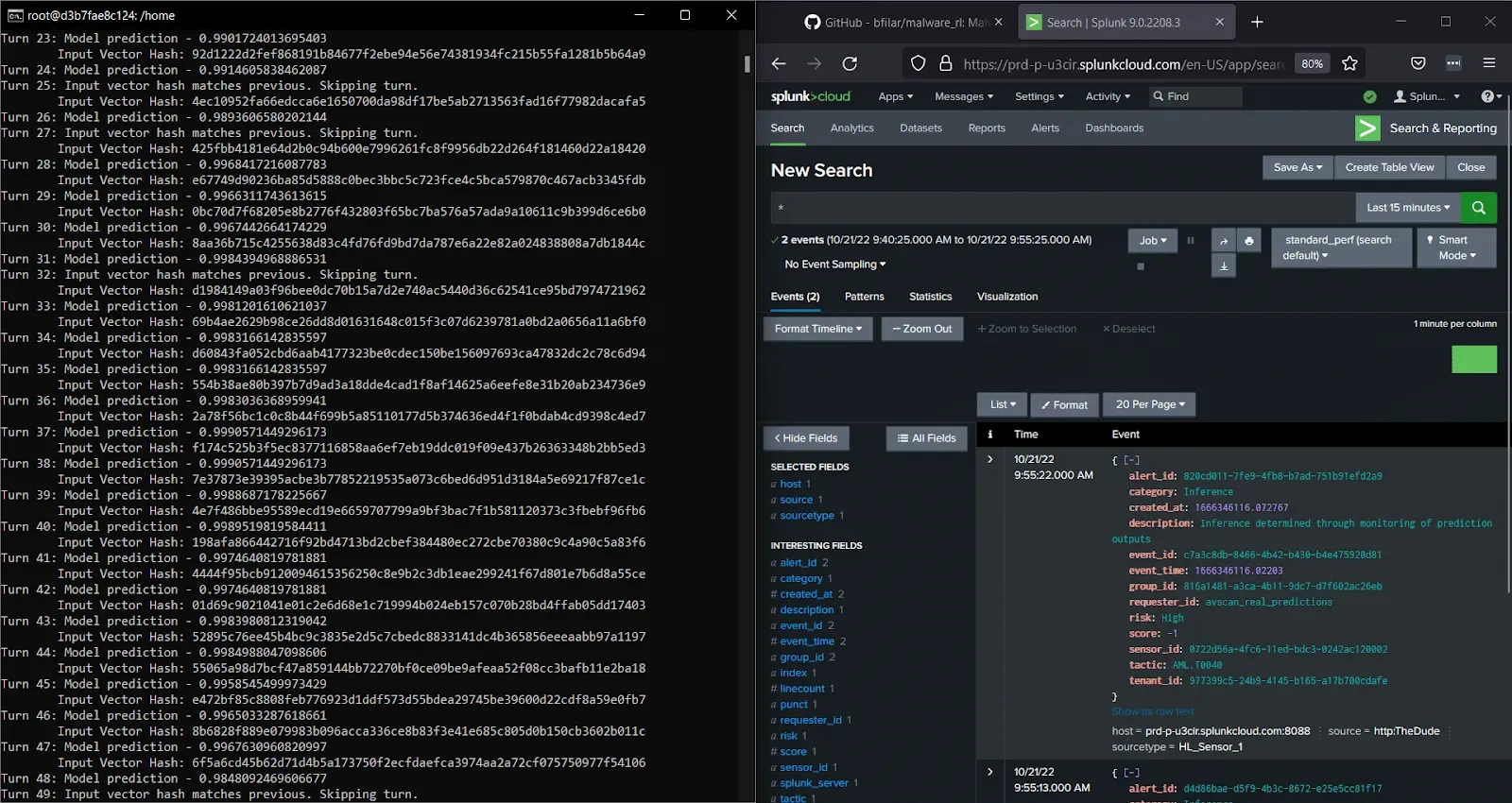
HiddenLayer AI Runtime Security is one module of the HiddenLayer AI Security Platform, which also includes AI Discovery, AI Supply Chain Security, and AI Attack Simulation. It provides runtime visibility, threat detection, and inline enforcement for AI applications, coding agents, and agentic workflows.
HiddenLayer inspects MCP and agent framework traffic using LiteLLM proxy interception, SDK instrumentation, and gateway inspection. It supports frameworks including OpenAI, AWS Bedrock, and MCP-based systems, and sends runtime detections and enforcement events to SIEM and SOAR tools.
Key features include:
- Indirect prompt injection detection: Identifies and blocks injected instructions hidden in data, documents, MCP responses, or retrieved context before they affect agent execution.
- Tool use and action inspection: Monitors agent actions and enforces runtime policy across APIs, MCP tools, code execution, communication tools, and filesystem operations.
- Memory and context safety: Detects unsafe memory recall, cross-agent contamination, and exposed sensitive data before it becomes an instruction.
- Agentic runtime visibility: Observes and reconstructs agent interactions across tools, data, and workflows, and supports investigation of activity across sessions.
- Inline protection: Detects, blocks, or redacts unsafe actions and sensitive information according to policy and platform capabilities.
- Agent harness security: Extends runtime security to AI coding agents through a lightweight on-device integration.
- Security operations integration: Sends detections and enforcement events to existing SIEM, SOAR, and security operations workflows.
Limitations (based on publicly available sources):
- Instrumentation required: Protection depends on integrating through the HiddenLayer SDK, a proxy, or gateway inspection, which adds setup work in existing development and security workflows.
- Enforcement varies by platform: Inline blocking and redaction depend on the capabilities of the platform where the agent runs.
- AI-specific scope: The platform covers AI-specific threats, so organizations may still need separate tools for traditional security needs.
Source: HiddenLayer
Conclusion
Agentic AI security requires controls that follow agents through their full execution path, not just filters around model inputs and outputs. Effective protection combines runtime monitoring, least-privilege access, agent identity, tool and parameter controls, MCP security, and sensitive data inspection. These controls help organizations detect compromised or unintended behavior and stop unauthorized actions or data transfers before they reach connected systems.