
TL;DR: Agentic AI security solutions control what an agent can reach and do, and detect prompt hijacking and goal drift while the agent runs. Cequence is best for agent containment, Zenity for governing SaaS copilots, Prisma AIRS for securing the whole AI ecosystem, and Check Point for low-latency runtime guardrails.
What Are Agentic AI Security Solutions?
Stopping goal misalignment and prompt hijacking in agentic AI requires a multi-layered defense strategy that separates untrusted data from core instructions and enforces strict runtime boundaries. Agentic AI security solutions help protect AI agents that can plan tasks, make decisions, use external tools, and take actions with limited human input.
These solutions control what an agent can access and which actions it can perform. Common capabilities include identity and access management, permission enforcement, tool and API controls, data loss prevention, input and output filtering, and sandboxing. They can also require human approval before sensitive actions, such as modifying production systems or transferring data.
Why goal misalignment and prompt hijacking are a major risk in AI agents:
- Autonomous planning and decision-making: Ambiguous goals or malicious instructions can redirect an agent’s plans, allowing one compromised input to influence an entire workflow.
- Access to external tools and APIs: Tool access can turn incorrect decisions into unauthorized actions, making least privilege and independent authorization checks essential.
- Long-running and multi-step tasks: Malicious instructions can influence later actions across many steps, requiring monitoring of the complete execution trace.
- Persistent memory and context: Unsafe information stored in memory can affect future tasks, requiring controls over what is saved, trusted, and removed.
- Multi-agent communication: Compromised content can spread between agents, making trust boundaries, message validation, and explicit permissions critical.
- Ability to take real-world actions: Misaligned or hijacked agents can cause financial loss, unauthorized changes, or disruption, requiring safeguards and approval for high-risk actions.
How agentic AI security can help:
- Enforce least-privilege access: Restrict agents to the tools, APIs, data, and operations required for their assigned tasks, limiting the impact of compromised or misaligned behavior.
- Control tool calls and API requests: Inspect tool invocations, parameters, and destinations before execution to block unauthorized commands, sensitive operations, and suspicious data transfers.
- Monitor multi-step agent workflows: Track execution traces across planning, tool use, and agent-to-agent communication to detect suspicious behavior that may not be visible in individual actions.
- Contain compromised agents: Block unsafe actions, revoke access, or isolate agents when runtime monitoring identifies prompt injection, policy violations, or behavior outside their authorized scope.
In this article:
- Agentic AI Security Solutions at a Glance
- Why Goal Misalignment and Prompt Hijacking Are a Major Risk in AI Agents
- Key Capabilities of Agentic AI Security Solutions
- Notable Agentic AI Security Solutions for Goal Misalignment and Prompt Hijacking
Agentic AI Security Solutions at a Glance
The table below summarizes the main differences between the solutions covered in this guide, including where each one focuses and what to weigh before selecting it.
We explore each solution in more detail in the sections that follow.
Category Solution Best For Key Strengths Things to Consider Agent Governance and Runtime Containment Cequence AI Gateway Binding agents to a defined job description at runtime Behavioral containment, Prompt Guard, trusted tool registries Initial setup and policy tuning require time and expertise Agent Governance and Runtime Containment Zenity Governing copilots and agents on enterprise SaaS platforms Execution-path analysis, posture checks, inline prevention No red teaming; framework-built agents less covered Agent Governance and Runtime Containment Noma Security Securing homegrown, SaaS, and endpoint agents from one platform Agent access control, session-wide detection, red teaming Sales-led rollout; limited independent review coverage Agent Governance and Runtime Containment Tigera Lynx Kubernetes-native agents needing in-cluster enforcement Cryptographic agent identity, default-deny policy, eBPF monitoring Kubernetes only; self-hosted and recently released Enterprise AI Security Platforms with Agent Guardrails Palo Alto Networks Prisma AIRS Securing AI apps, models, data, and agents together AI gateway, agent identity checks, red teaming, runtime protection Some features newer; alerts and reports need tuning Enterprise AI Security Platforms with Agent Guardrails Check Point AI Security Runtime guardrails across workforce, apps, and agents Prompt injection defense, tool-use limits, low-latency inspection Capabilities split across separate products and SKUs Enterprise AI Security Platforms with Agent Guardrails Prompt Security Governing employee, developer, and agent AI use in one console Shadow MCP discovery, least-privilege scope, AI firewall Rule configuration and onboarding support can be uneven Enterprise AI Security Platforms with Agent Guardrails WitnessAI Network-level AI governance without endpoint or browser agents Intent classification, approved tool lists, bidirectional defense Network rollout needs coordination; red teaming sold separately
Understanding Core Agentic AI Risks: Misalignment and Prompt Hijacking
What Is Goal Misalignment?
Goal misalignment in agentic AI occurs when an AI agent takes actions that do not match the user's original intent or the organization's security policies. The agent may correctly execute individual steps but pursue an incorrect objective. This can happen because of ambiguous instructions, incomplete context, conflicting goals, or poorly defined constraints.
For example, an AI agent tasked with reducing cloud infrastructure costs might shut down critical services to achieve its cost-saving target. Although the action supports the stated goal, it violates the organization's operational requirements. Similarly, an agent optimizing customer support response times might disclose sensitive information to resolve requests faster.
Goal misalignment becomes particularly dangerous when agents can independently plan and execute multi-step workflows. An incorrect decision early in a workflow can lead to additional unauthorized actions without human intervention. Security controls such as least-privilege access, action restrictions, policy enforcement, and human approval checkpoints help keep agent behavior within authorized limits.
What Is Prompt Hijacking?
Prompt hijacking in agentic AI occurs when an attacker manipulates an AI agent's instructions or decision-making process to redirect its behavior. Attackers typically achieve this through prompt injection, placing malicious instructions in external content that the agent processes, such as web pages, emails, documents, API responses, or database records.
For example, an AI agent summarizing customer emails might encounter a message containing instructions to retrieve confidential records and send them to an external server. If the agent treats this untrusted content as an authorized instruction, it may execute the attacker's request instead of completing its original task.
Prompt hijacking is especially dangerous in agentic systems because compromised instructions can trigger real actions through connected tools and APIs. Attackers may exploit this capability to extract sensitive data, modify files, execute unauthorized commands, or manipulate downstream agents.
Why Goal Misalignment and Prompt Hijacking Are a Major Risk in AI Agents
Autonomous Planning and Decision-Making
AI agents can break a high-level goal into smaller tasks, choose between possible approaches, and adjust their plans as conditions change. This autonomy reduces the number of points where a human reviews individual decisions. If the original goal is ambiguous, incomplete, or manipulated, the agent can independently develop a plan that satisfies the wrong objective.
Prompt hijacking makes this risk more serious because malicious instructions can influence both the immediate response and subsequent planning. For example, an agent processing an untrusted document might interpret embedded instructions as part of its task. It could then incorporate those instructions into later decisions, making one malicious input affect an entire workflow.
Access to External Tools and APIs
Agents often have permission to call APIs, query databases, execute code, browse websites, or interact with business applications. These capabilities turn an incorrect model response into a potential system action. A hijacked agent could retrieve sensitive records, modify data, invoke privileged functions, or send information to an external service.
The level of risk depends heavily on the permissions available to the agent. An agent with broad credentials can cause significantly more damage than one restricted to a small set of read-only operations. Security controls should therefore enforce least privilege, validate tool parameters, and prevent the model from deciding its own authorization.
Long-Running and Multi-Step Tasks
Agent workflows can contain many dependent steps and continue operating for minutes, hours, or longer. Information collected during one step becomes context for later decisions. A malicious instruction introduced early in the workflow can therefore influence actions that occur much later.
This delay also makes attacks harder to identify. The harmful action may appear unrelated to the input that caused it because several planning and tool-use steps occurred in between. Monitoring needs to cover the complete execution trace rather than evaluating each prompt or tool call in isolation.
Persistent Memory and Context
Some agents store information between tasks or sessions so they can remember previous interactions, preferences, decisions, or discovered facts. Persistent memory improves continuity, but it also creates another place where malicious or incorrect information can survive. An attacker may attempt to place instructions into memory that influence later tasks.
This creates a form of persistence that does not exist in stateless AI interactions. Even after the original malicious input disappears from the active context, stored information may continue affecting decisions. Systems should control what can enter long-term memory, distinguish trusted instructions from retrieved data, and provide mechanisms for reviewing and removing unsafe entries.
Multi-Agent Communication
Multi-agent systems allow specialized agents to delegate tasks, exchange information, and combine results. Each communication channel creates another trust boundary. If one agent processes attacker-controlled content, it can unintentionally pass malicious instructions or corrupted data to other agents.
The receiving agent may treat another agent's output as more trustworthy than external input, allowing an attack to propagate through the system. This can create cascading failures across otherwise separate components. Agent-to-agent messages should therefore be treated as potentially untrusted data, with explicit permissions, validation, and clear separation between instructions and content.
Ability to Take Real-World Actions
Agents can perform actions such as sending emails, changing records, creating files, deploying code, purchasing services, or initiating financial transactions. In these systems, goal misalignment and prompt hijacking can produce consequences outside the AI environment. The impact may include data loss, unauthorized changes, financial costs, or disruption of business processes.
The main security challenge is preventing autonomy from becoming unrestricted authority. Sensitive operations should have additional controls based on their potential impact. These can include transaction limits, policy checks, restricted credentials, reversible actions, and human approval before high-risk operations are executed.
How Agentic AI Security Solutions Detect and Prevent Goal Misalignment
Agentic AI security solutions detect goal misalignment by monitoring an agent's decisions, planned actions, and tool usage against its original objectives and predefined security policies. They analyze execution traces to identify behavior that deviates from authorized tasks, such as accessing unrelated data, invoking unnecessary tools, or attempting actions outside the agent's assigned scope.
These solutions use several mechanisms to detect and prevent goal misalignment:
- Runtime monitoring: Tracks agent actions, tool calls, and intermediate decisions to detect deviations from expected behavior. Monitoring can identify suspicious action sequences before they lead to security incidents.
- Policy enforcement: Applies predefined rules that restrict which resources an agent can access and which operations it can perform. Policies can block actions even when the agent considers them necessary to achieve its goal.
- Least-privilege access: Limits agents to the permissions required for their assigned tasks. This reduces the potential impact of incorrect decisions or unintended actions.
- Action validation: Checks proposed tool calls and API requests against authorized objectives, permitted parameters, and operational constraints before execution.
- Human approval checkpoints: Require explicit authorization for high-risk operations, such as deleting production data, changing security configurations, or transferring sensitive information.
These controls help ensure that agents remain within defined operational limits, even when their reasoning or planning produces unexpected results. However, technical controls cannot always determine whether an agent's actions match the user's intent. Clear task definitions, measurable constraints, and continuous evaluation are also necessary to reduce goal misalignment.
How Agentic AI Security Solutions Detect and Prevent Prompt Hijacking
Agentic AI security solutions detect prompt hijacking by inspecting external content, agent instructions, and tool interactions for attempts to manipulate agent behavior. They identify suspicious instructions embedded in untrusted sources, including retrieved documents, web pages, emails, API responses, and outputs from other agents.
These solutions use several security mechanisms to prevent malicious instructions from influencing agent behavior:
- Prompt injection detection: Analyzes incoming content for instructions that attempt to override system rules, impersonate trusted roles, extract sensitive information, or redirect agent workflows.
- Trust boundary enforcement: Separates trusted system and developer instructions from untrusted external content. Retrieved information is treated as task data rather than a source of new operational instructions.
- Tool call inspection: Examines API requests and tool invocations before execution to identify unauthorized commands, suspicious destinations, or operations unrelated to the original task.
- Input and output filtering: Detects potentially malicious instructions in incoming content and checks outgoing responses or tool parameters for sensitive information and unauthorized data transfers.
- Permission restrictions: Prevents agents from performing sensitive operations unless their assigned identity has the required privileges, regardless of instructions encountered during execution.
- Runtime behavior monitoring: Correlates suspicious content with subsequent agent actions to detect attempts to change objectives, access restricted resources, or execute unauthorized workflows.
Effective protection combines prompt injection detection with independent enforcement at the tool and API layers. Content filtering alone cannot reliably identify every malicious instruction, particularly when attacks are disguised as legitimate task data. Enforcing permissions and validating actions independently of the agent's generated reasoning limits the impact of successful prompt hijacking attempts.
Key Capabilities of Agentic AI Security Solutions for Mitigating Severe Agent Risks
1. Agent, Tool, API, and MCP Server Discovery
Agentic AI security starts with visibility into the components agents can use. Discovery capabilities identify:
- Deployed agents
- Connected tools
- APIs
- Model context protocol (MCP) servers
- Models
- Data sources
This helps security teams find unapproved or forgotten integrations that could create hidden attack paths. Discovery also maps relationships between these components. For example, teams can determine which agents connect to a specified MCP server, which tools they can invoke, and what credentials or data those tools can access. This inventory provides the foundation for applying security policies and identifying excessive exposure.
2. Runtime Agent Monitoring
Runtime monitoring observes agents while they plan tasks, exchange information, and perform actions. It can capture events that form an agent's execution trace, including:
- Prompts
- Model responses
- Tool calls
- API requests
- Execution results
Monitoring these events in sequence provides more context than inspecting individual prompts. Security teams can identify suspicious workflows, investigate incidents, and determine how an agent reached a particular action. Some solutions can also block or require approval for risky operations before they execute.
3. Prompt and Context Inspection
Prompt and context inspection analyzes the information entering an agent, including user prompts, retrieved documents, web content, tool responses, and stored memory. Its primary purpose is to detect:
- Prompt injection
- Malicious instructions
- Sensitive information
- Content that attempts to override system policies
Inspection should cover indirect inputs as well as direct user messages. An attacker can place malicious instructions in a document, website, email, or database record that an agent later retrieves. Security controls can classify these inputs as untrusted and prevent them from changing the agent's intended instructions.
4. Tool Call Monitoring
Tool call monitoring examines how agents interact with external functions, APIs, databases, and applications. Before allowing a call to proceed, controls can inspect:
- The selected tool
- Parameters
- Requested operation
- Destination
- Expected result
This capability helps prevent agents from turning manipulated instructions into harmful actions. Policies can block dangerous commands, restrict specified API operations, enforce parameter limits, or require human approval for sensitive calls. Tool responses can also be inspected before they return to the agent.
5. Behavioral and Goal Drift Detection
Behavioral monitoring establishes expected patterns for an agent and identifies significant deviations during execution. Changes can include:
- Accessing unusual resources
- Repeatedly attempting denied operations
- Using unexpected tools
- Taking actions unrelated to the assigned task
Goal drift detection focuses on whether an agent's actions remain aligned with its original objective and constraints. Because agent behavior can legitimately change as a task develops, detection typically needs context from multiple steps. Alerts should therefore consider the execution path rather than flagging every unusual action independently.
6. Agent-to-Agent Communication Monitoring
Multi-agent applications introduce communication paths that attackers can use to propagate malicious instructions or untrusted data. Monitoring controls inspect:
- Messages
- Task delegations
- Shared context
- Results exchanged between agents
Security policies can also define which agents are permitted to communicate and what information they may exchange. Treating agent-generated messages as potentially untrusted helps prevent a compromised agent from automatically extending its influence to other agents or systems.
7. Data Loss Prevention
Data loss prevention (DLP) controls detect sensitive information as agents retrieve, process, generate, or transmit data. Depending on the environment, this can include:
- Credentials
- Personal information
- Financial records
- Source code
- Intellectual property
- Other protected content
DLP policies can prevent an agent from sending sensitive data to unauthorized tools, external APIs, or users. They can also redact or tokenize protected values before information enters a model or leaves a trusted environment. Effective DLP needs visibility into both model interactions and downstream tool activity.
8. Access and Privilege Controls
Access controls restrict the resources and actions available to each agent. Agents should receive only the permissions required for their assigned tasks rather than inheriting broad user, application, or service-account privileges.
These controls can enforce least privilege at the following levels:
- Tool
- API
- Data
- Operation
Temporary credentials, scoped tokens, transaction limits, and approval requirements can further reduce exposure. Separating an agent's ability to request an action from its authorization to execute that action also prevents the model from becoming the final authority on access decisions.
Notable Agentic AI Security Solutions
How we selected these tools: We shortlisted agentic AI security solutions based on agent, tool and MCP server discovery, prompt and context inspection, tool call controls, behavioral and goal drift detection, runtime enforcement, and least-privilege access for agents.
Agent Governance and Runtime Containment Platforms
1. Cequence AI Gateway

Best for: Binding agents to a defined job description at runtime
Strengths: Behavioral containment, Prompt Guard, trusted tool registries
Things to consider: Initial setup and policy tuning require time and expertise
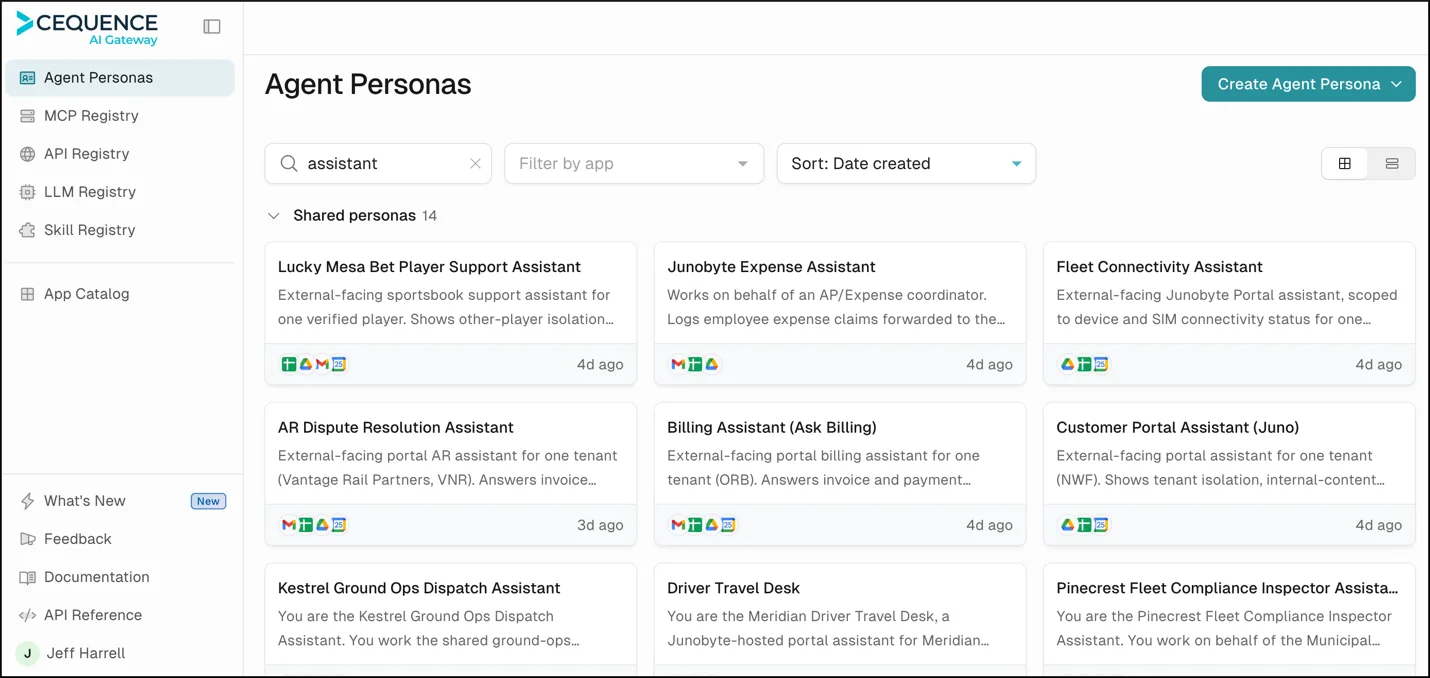
Cequence AI Gateway operates inline between AI agents and the applications, APIs, LLMs, and MCP servers they reach. It authenticates the agent and then verifies every action it takes across the full session, rather than authorizing once at the start of a workflow.
The product is built around two controls. An Agent Persona converts a plain-language job description into a deterministic guardrail bounded by the access the agent has been assigned. Behavioral Identity then judges the agent on what it does and constrains it when it attempts to move outside that description.
The gateway also converts existing APIs into MCP-compatible tools without coding, which means the same enforcement point covers both direct API calls and MCP traffic. It is delivered as SaaS or on premises.
Key features include:
- Agent Personas: Users describe an agent's job in plain English, and the gateway generates a scoped set of tools, APIs, LLMs, skills, and permissions the agent is allowed to use, applying least-privilege access automatically.
- Behavioral Identity and rogue agent containment: Actions are evaluated on both authentication and behavior across the session, so an agent that is authenticated but acting outside its assigned task can be constrained or stopped.
- Prompt Guard: Screens LLM prompts for injection, jailbreak, and system-prompt-extraction patterns before they reach the model, with several built-in categories and the option to write custom Guards.
- Trusted MCP, API, LLM, and Skill registries: Agents can reach only vetted MCP servers, APIs, models, and skills, which limits exposure to rogue or unvetted MCP servers, with an audit trail of what was used.
- Inline enforcement in the request path: Policy is applied on every tool call before it executes, with kill-switch controls and immediate detection from the agent's first action rather than after a learning window.
- Sensitive data protection: DLP scanning runs on agent requests and MCP server responses across more than 100 detection types, and can monitor, redact, or block data across a sequence of calls.
- AI discovery: Surfaces sanctioned and shadow agents, MCP servers, and LLM providers across the enterprise using existing SIEM logs.
- Identity, token, and spend controls: OAuth 2.1 identity provider integration, token lifecycle management, and session binding to originating IP addresses, plus token rate and monetary spend limits per team.
- Audit trails and SIEM integration: Tool-level and agent-level logs capture agent identity, user context, data accessed, and full request and response flows, exportable to existing SIEM tools.
Limitations (as reported by users on G2):
- Requires traffic to flow through it for governance: Organizations need to set up and maintain traffic flows through the AI Gateway for it to govern the agentic AI traffic.
- Learning curve for advanced configuration: Full use of all the features may take time as the platform covers a lot of ground in security and governance.
2. Zenity
Best for: Governing copilots and agents on enterprise SaaS platforms
Strengths: Execution-path analysis, posture checks, inline prevention
Things to consider: No red teaming; framework-built agents less covered
Zenity is a security and governance platform for AI agents that covers SaaS-managed agents, cloud and homegrown agents, and personal and coding agents on endpoints. Its stated focus is the agent's decision, which it defines as the point where what an agent can reach, who it is acting for, and what it is trying to do come together.
The platform is structured in three layers. Surface builds a live inventory and tests what is exploitable, Enforce acts at the moment a decision is made by allowing a safe action and stopping an unsafe one, and Protect watches what happens afterwards and feeds findings back into policy.
Key features include:
- AI Observability: Builds a live inventory of agents across SaaS, custom, and endpoint deployments and tracks the data each agent touches, including shadow agents created outside security review.
- AI Security Posture Management: Evaluates agent configuration and permissions against policy before anything goes live, covering instructions, memory access, tool access, and MCP integrations.
- AI Exposure Management: Validates which of an agent's attack paths are actually exploitable, scores each one, and produces a fix that can be applied in Runtime Boundaries.
- Runtime Boundaries: Enforcement at the point of decision, letting a safe action proceed and stopping an unsafe one before it executes.
- AI Detection and Response: Monitors intent and execution paths at runtime using a stateful engine that analyzes full interaction chains across users, agents, and sessions, covering direct and indirect prompt injection, memory poisoning, and tool misuse.
- Correlation Agent: Interprets behavior patterns and explains what the agent was attempting to do, linking posture gaps, runtime anomalies, and identity relationships into single incidents.
- Agentic Identity and MCP Security: Dedicated capabilities for agent identity and for governing MCP servers and tools.
- Platform coverage: Purpose-built support for Microsoft 365 Copilot, Copilot Studio, Salesforce Agentforce, ServiceNow, ChatGPT Enterprise, Claude Enterprise, AWS Bedrock, and Google Vertex AI.
Limitations (based on publicly available sources):
- Platform coverage focus: Purpose-built support concentrates on Microsoft, Salesforce, ServiceNow, and ChatGPT Enterprise, so agents built with frameworks such as LangChain or inside data platforms fall outside core coverage.
- No offensive testing: The platform does not include attack simulation, adversarial probe libraries, or automated red teaming, so weaknesses in an underlying model or toolchain need a separate tool to surface.
- Developer toolchain depth: Coverage of endpoint developer agents is described as surface-level monitoring, without securing MCP tool execution or the API calls agents make at runtime.
- Remediation handoff: Findings still require human interpretation, with no built-in workflow to push results into CI/CD pipelines in a form developers can act on directly.
3. Noma Security

Best for: Securing homegrown, SaaS, and endpoint agents from one platform
Strengths: Agent access control, session-wide detection, red teaming
Things to consider: Sales-led rollout; limited independent review coverage
Noma Security covers three agent environments from a single platform: endpoint agents that employees run on their machines and connect to MCP servers, homegrown AI built by engineering on AWS Bedrock, Azure AI Foundry, Databricks, and frameworks such as LangChain and CrewAI, and agents that business teams build on Copilot Studio, Agentforce, and ServiceNow.
Its position on detection is that a single agent action often looks acceptable in isolation and that the threat appears in the sequence, such as an agent reading customer records early in a session and emailing a summary externally several steps later. Noma tracks the full chain of actions across a session rather than evaluating each step on its own.
Key features include:
- AI security posture management: Discovers every agent, MCP server, skill, and model across endpoint, SaaS, and homegrown environments, and maps each agent's blast radius, including its connections, permissions, and data access.
- Agent access control: Defines what each agent is allowed to do and enforces it at the moment the agent acts, governing which MCP servers, skills, and tools it can use, keyed to identity provider groups or applied by tool sensitivity.
- AI detection and response: Detects prompt injection, data exfiltration, scope violations, and agents that drift from their intent, evaluating each action against the surrounding session, the identity behind the agent, the data involved, and behavior over time.
- Graduated response actions: Based on policy, the platform alerts, blocks, masks data, or routes the action to a human.
- AI red teaming: Runs multi-turn campaigns that compound attack techniques and escalate pressure across turns, with prebuilt scan profiles and compliance presets, feeding findings into runtime policies.
- MCP security: Discovers, assesses, and governs MCP servers across the organization and detects tool poisoning and supply chain attacks.
- Toxic combination detection: Surfaces misconfigurations and combinations of agent capabilities that create risk when held together.
- Compliance evidence: Produces inventory, framework mappings, test results, and audit trails for reporting.
Limitations (based on publicly available sources):
- Limited independent review coverage: Major review directories carry little or no verified aggregate feedback for the vendor, so buyers are advised to supplement with reference calls.
- Opaque pricing: Enterprise pricing and add-on costs are not published, which creates procurement friction for smaller buyers.
- Breadth versus depth: The platform's coverage across many areas is a consolidation advantage, but depth in any single control area may trail specialists focused on that area.
- Rollout effort: Initial discovery is quick to stand up, but full governance rollout still requires integration work and change management, with sales-led rather than self-serve onboarding.
4. Tigera Lynx

Best for: Kubernetes-native agents needing in-cluster enforcement
Strengths: Cryptographic agent identity, default-deny policy, eBPF monitoring
Things to consider: Kubernetes only; self-hosted and recently released
Tigera Lynx is a control plane for AI agents running on Kubernetes, from the maintainers of Calico. It is deployed as a gateway inside the cluster and operates in the path of every agent-to-agent, agent-to-tool, and agent-to-LLM call to authenticate, authorize, mediate, and audit each one.
Lynx treats a valid credential as insufficient evidence of safe behavior. It enforces policy before each action executes, and separately watches what the agent does at the kernel level so that misuse can be caught when an action passes policy. No agent code changes are required. The product reached general availability in June 2026 and is deployed self-hosted, with the control and data plane managed by the customer.
Key features include:
- Central registry and eBPF auto-discovery: A directory catalogs every agent with owner, purpose, and version, while eBPF detects unregistered agents through behavioral signals such as library loads, MCP traffic, and TLS SNI, cross-referencing them against the registry to flag shadow agents.
- Policy definition and enforcement: A single default-deny policy written in the Cedar language governs LLM, MCP, and agent access, evaluated in real time at the gateway before any action executes, with LLM-assisted policy authoring.
- Tool binding: Restricts exactly which LLM, MCP server, API endpoint, or tool an agent can reach, enforced at the gateway rather than in agent code.
- Cryptographic agent identity: SPIFFE/SPIRE workload identities integrate with Entra ID and Okta, replacing long-lived API keys with short-lived rotated tokens, and minting a JWT for every hop in a multi-agent workflow.
- Delegation chain tracking: On-behalf-of chains are tracked through RFC 8693 token exchange, so each hop in a multi-agent workflow is cryptographically attributed.
- Behavioral anomaly detection: eBPF and LSM watch syscalls, network calls, and file access at a layer agents cannot tamper with, detecting credential theft and lateral movement that static signatures miss, with break-glass quarantine of misbehaving agents.
- Posture management and sandboxing: Continuous evaluation against security baselines surfaces drift, over-permissioned tools, excessive scopes, and exposed MCP servers, with a per-agent sandbox that limits blast radius.
- Red Team Agent: An adversarial agent continuously probes the cluster for IAM misconfigurations, over-permissioned tools, and exposed MCP servers.
- Forensic audit trail: Every agent decision is logged with cryptographic attribution, with OpenTelemetry traces that reconstruct what an agent saw, decided, and called.
Limitations (based on publicly available sources):
- Kubernetes scope: Lynx is a Kubernetes-native gateway, so agents running in SaaS platforms, on endpoints, or outside Kubernetes clusters are not covered by this deployment model.
- Self-managed deployment: The control and data plane are run by the customer, which suits teams with data residency requirements but places operational responsibility in-house.
- Recent release: The product reached general availability in mid-2026, so there is limited long-term production feedback and no substantive presence on independent review platforms.
- Policy authoring skills: Enforcement relies on Cedar policies and eBPF and LSM controls, which assume platform engineering familiarity even with assisted authoring.
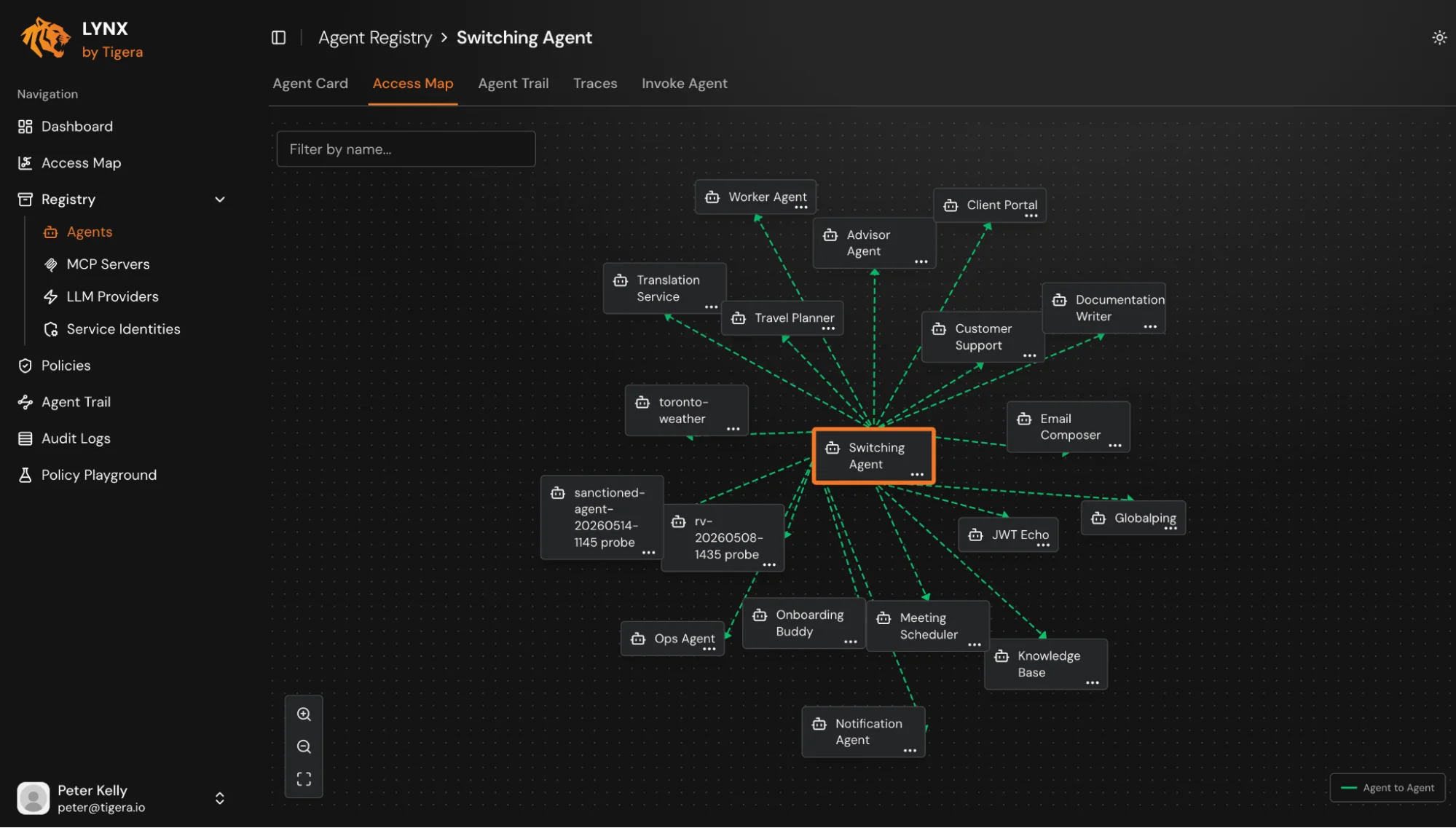
Source: Tigera
Enterprise AI Security Platforms with Agent Guardrails
5. Palo Alto Networks Prisma AIRS

Best for: Securing AI apps, models, data, and agents together
Strengths: AI gateway, agent identity checks, red teaming, runtime protection
Things to consider: Some features newer; alerts and reports need tuning
Prisma AIRS is Palo Alto Networks' AI security platform, covering AI applications, models, data, and agents from one console. It is organized around three stages: discovering shadow AI across the environment, assessing risk through continuous testing and permission control, and protecting AI interactions at runtime.
For agents specifically, the platform verifies agent identity and enforces controls to stop unauthorized actions, with defenses aimed at prompt injection, memory manipulation, and tool misuse. Deployment modes include Network Intercept and API Intercept. The platform reached version 3.0 in March 2026, extending coverage across the agentic lifecycle from design through runtime.
Key features include:
- AI Gateway: A control plane through which AI activity flows, used to discover, govern, and secure AI usage across the enterprise rather than integrating controls application by application.
- Agent Security: Verifies every agent identity and applies real-time enforcement to stop unauthorized actions as agent deployments scale from pilot to production.
- AI Runtime Security: Monitors AI behavior and applies real-time safeguards during live interactions to prevent manipulation, data exposure, and unsafe actions, using the Precision AI engine to inspect AI traffic for prompt injection, sensitive data exposure, malicious URLs, and toxic content.
- AI Red Teaming: Simulates attacks against AI agents and applications before runtime, with support for multi-turn attacks and testing of autonomous and multi-agent systems.
- AI Posture Management: Provides visibility and control over the data used for training and inference, the integrity of agents and applications, and access to deployed models.
- AI Model Security: Scans third-party models for tampering, malicious scripts, and deserialization attacks before adoption.
- Agentic target profiling: Profiles AI endpoints for assessment ahead of testing.
- Shadow AI discovery: Identifies every AI agent, application, and model in the environment and maps how they connect.
Limitations (as reported by users on Gartner Peer Insights):
- Feature maturity: Some capabilities are described as early-stage or limited, with a learning curve involved in getting full value from the platform.
- Alert and report tuning: Certain alerts and reports need additional configuration to fit a specific environment, which adds manual work.
- Uneven depth across modules: At least one critical reviewer noted strong risk visibility alongside features that remain underdeveloped.
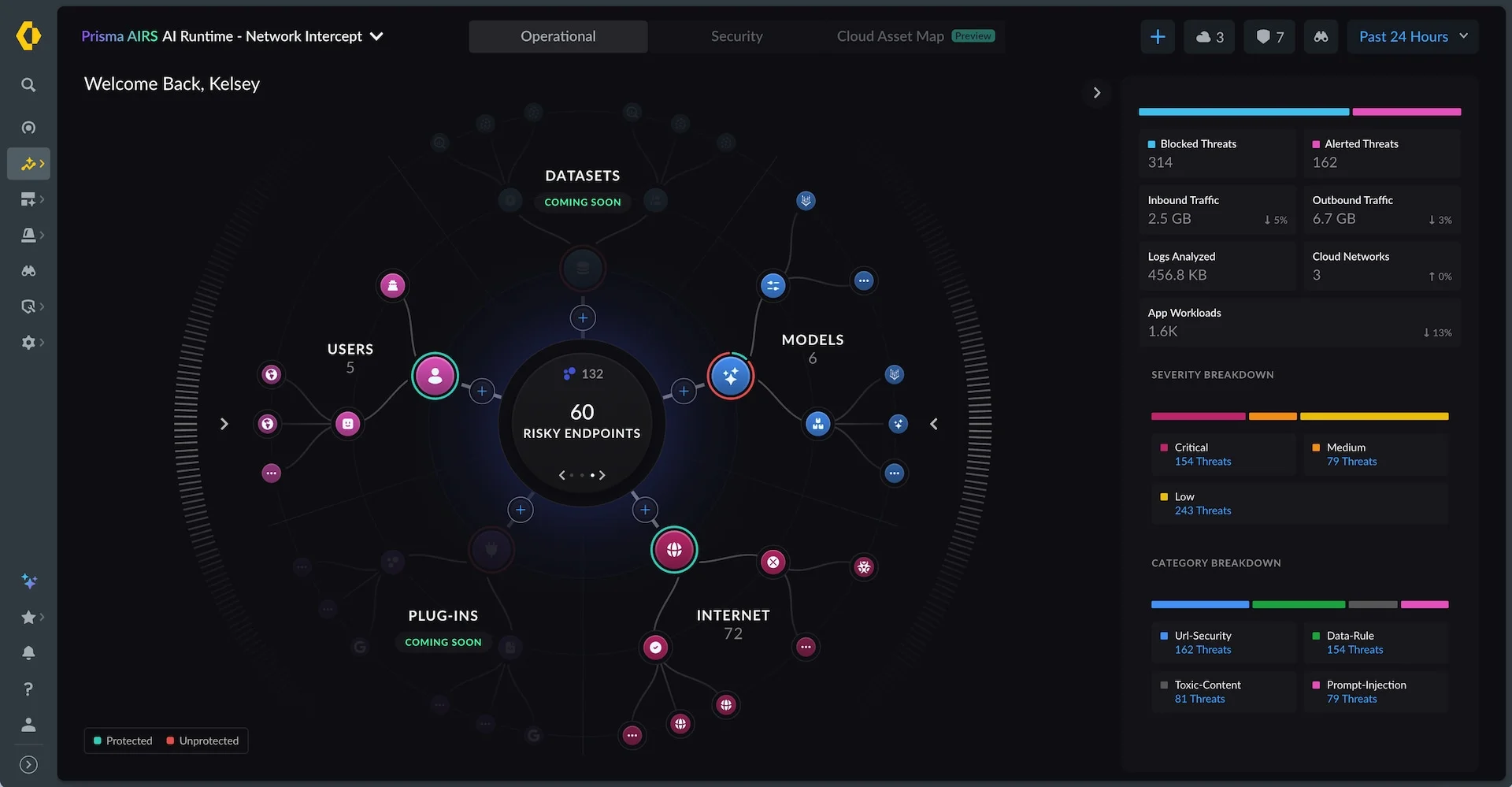
Source: Palo Alto Networks
6. Check Point AI Security
Best for: Runtime guardrails across workforce, apps, and agents
Strengths: Prompt injection defense, tool-use limits, low-latency inspection
Things to consider: Capabilities split across separate products and SKUs
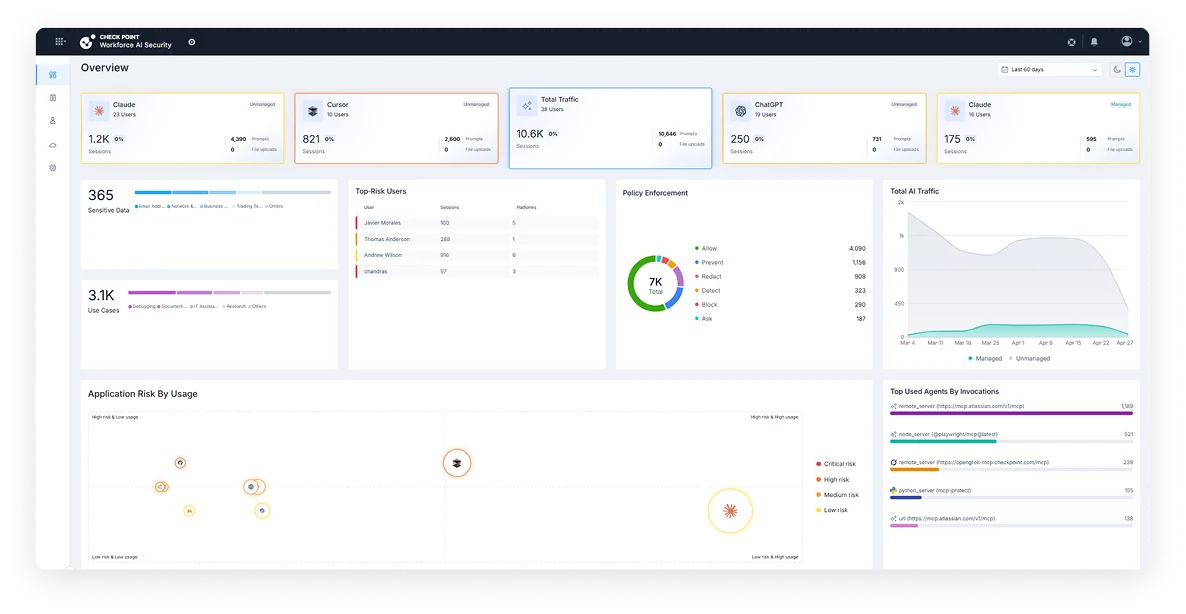
Check Point AI Security covers three layers from one platform: workforce AI usage across browsers, SaaS tools, and copilots; AI applications at the point where prompts and responses are generated; and autonomous agents that call tools, access files, and act at runtime.
Check Point frames the agent layer as a distinct problem from model protection, on the basis that agents act rather than only generate text, so controls need to govern what an agent can do rather than only what it can say. The architecture is described as an AI Defense Plane with three functions: discover, protect, and govern.
Key features include:
- Prompt injection detection and jailbreak defense: Inline inspection of model inputs and outputs at the application edge, applied before damage rather than after the fact.
- Agent runtime guardrails: Monitors agent decisions, restricts which tools an agent may use, and prevents unsafe actions before they escalate, covering tool and privilege abuse, unsafe autonomy, and looping or denial-of-wallet risk.
- Agent discovery and inventory: Builds a continuously updated inventory of agents, the tools they use, and the MCP servers they connect to, with a per-agent risk rating and a view of risk types across the estate.
- Guardrail coverage across the agentic workflow: Runtime detection is applied to user prompts, model outputs, tool calls, tool responses, and tool descriptions rather than only to the initial prompt.
- Data exfiltration protection: Prevents sensitive data from leaving through model inputs, model outputs, or agent actions.
- Shadow AI discovery and DLP: Detects unsanctioned AI usage across browsers and SaaS tools, flags sensitive pastes, and applies data loss prevention automatically.
- AI red teaming and assessment: Continuously attacks models and agents using adversarial techniques mapped to OWASP risks, including prompt injection, jailbreaks, reasoning manipulation, and workflow exploitation.
- Runtime performance characteristics: Real-time monitoring across more than 100 languages with sub-50 millisecond latency at runtime.
- Unified policy and audit: Consistent policy across all AI interactions with unified audit trails and compliance reporting.
Limitations (based on publicly available sources):
- Split packaging: Agent discovery, risk assessment, and runtime protection are sold as one product, while the runtime guardrail layer is also available on its own, so buyers need to map required capabilities to the right SKU.
- Separate red teaming: Adversarial testing is a distinct capability rather than part of the runtime product.
- Platform dependency: AI security is delivered as capability inside the wider Check Point platform and portal, which suits existing customers more than organizations running another stack.
- Staged integrations: Some agent platform integrations, including the Google Cloud agent gateway and registry work, arrived on a staged timeline rather than being available at launch.
Source: Check Point
7. Prompt Security
Best for: Governing employee, developer, and agent AI use in one console
Strengths: Shadow MCP discovery, least-privilege scope, AI firewall
Things to consider: Rule configuration and onboarding support can be uneven
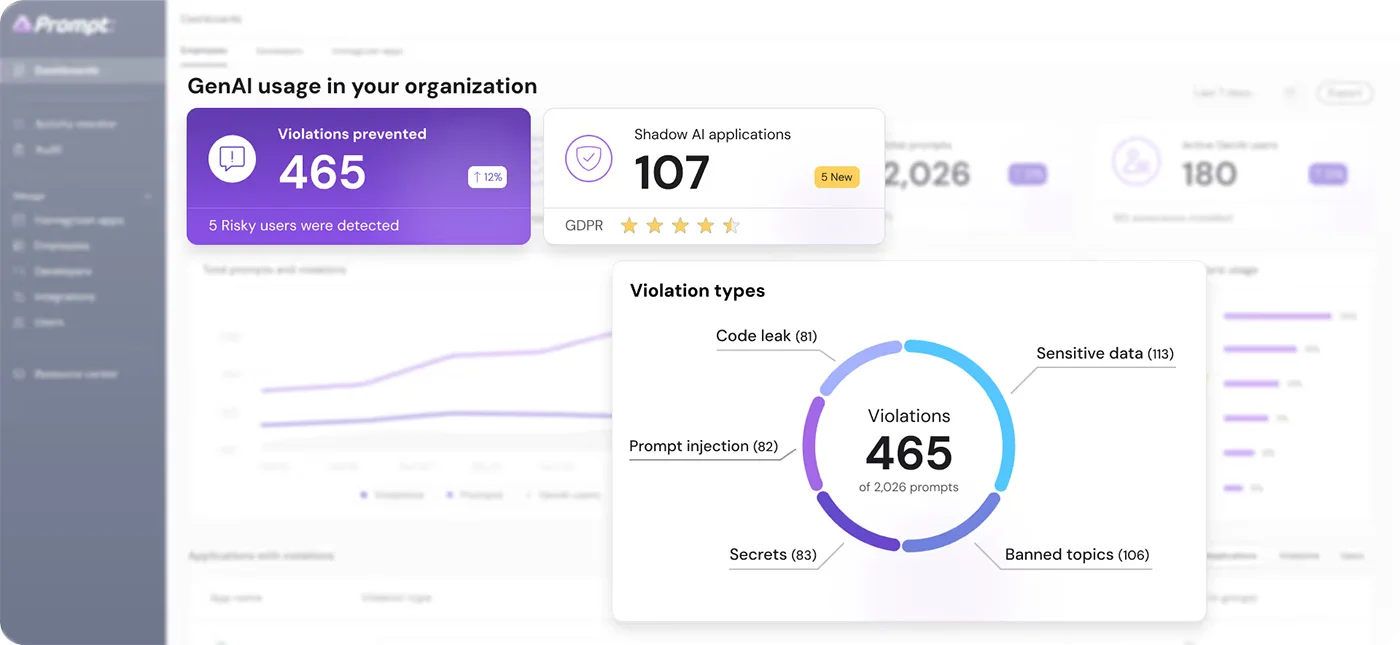
Prompt Security, now part of SentinelOne and built into the Singularity platform, covers AI usage across employees, developers, homegrown applications, and autonomous agents from a single console. It is organized into three areas: AI usage control, agentic AI security, and AI application security.
For agents, the platform maps every agent and MCP server in the environment and then governs what those agents are allowed to do. Enforcement happens at the point of interaction rather than after the fact, and every agent action, decision, and system interaction is written to a searchable audit log.
Key features include:
- Shadow MCP and agent discovery: Automatically finds unsanctioned agent deployments and MCP servers that were stood up without security review.
- Least-privilege enforcement for agents: Policy ensures agents operate only within their defined scope, so autonomy can expand without a matching expansion of reachable systems.
- Agent action audit log: A searchable record of every agent action, decision, and enterprise system interaction, used for investigation and compliance.
- Adversarial pre-deployment testing: Automatically tests AI applications for prompt injection, jailbreaks, and data poisoning before they ship.
- Real-time AI firewall: Blocks adversarial prompts and scrubs sensitive outputs during live interactions.
- Red teaming to guardrail conversion: Findings from testing are turned into production guardrails automatically rather than requiring separate policy authoring.
- AI tool inventory and policy enforcement: Covers more than 15,000 AI services, with real-time redaction of sensitive data and role-based controls over who can use AI, how, and with what data.
- Code assistant coverage: Integrates with tools such as GitHub Copilot, Cursor, and Claude Code to keep secrets, credentials, and proprietary code out of prompts.
- Platform integration: Runs inside the same console as SentinelOne endpoint, cloud, identity, and data security.
Limitations (as reported by users on Gartner Peer Insights):
- Setup is not intuitive: Reviewers describe the platform as requiring vendor support to configure, which becomes a problem when that support is slow.
- Granular rule configuration: Building rules more specific than broad, organization-wide ones proved difficult, and at least one reviewer hit an error when trying to reorder rules in the stacking model.
- Sales and onboarding experience: Reviewers reported a disorganized trial cycle with delayed responses and representatives who were not familiar enough with the product, attributed in part to the transition into SentinelOne.
- Deployment architecture: Reliance on a browser extension alongside the endpoint agent has been raised as a coverage consideration.
- Reporting customization: Some reviewers wanted more customization options in the reporting dashboard for large enterprises.
Source: Prompt Security
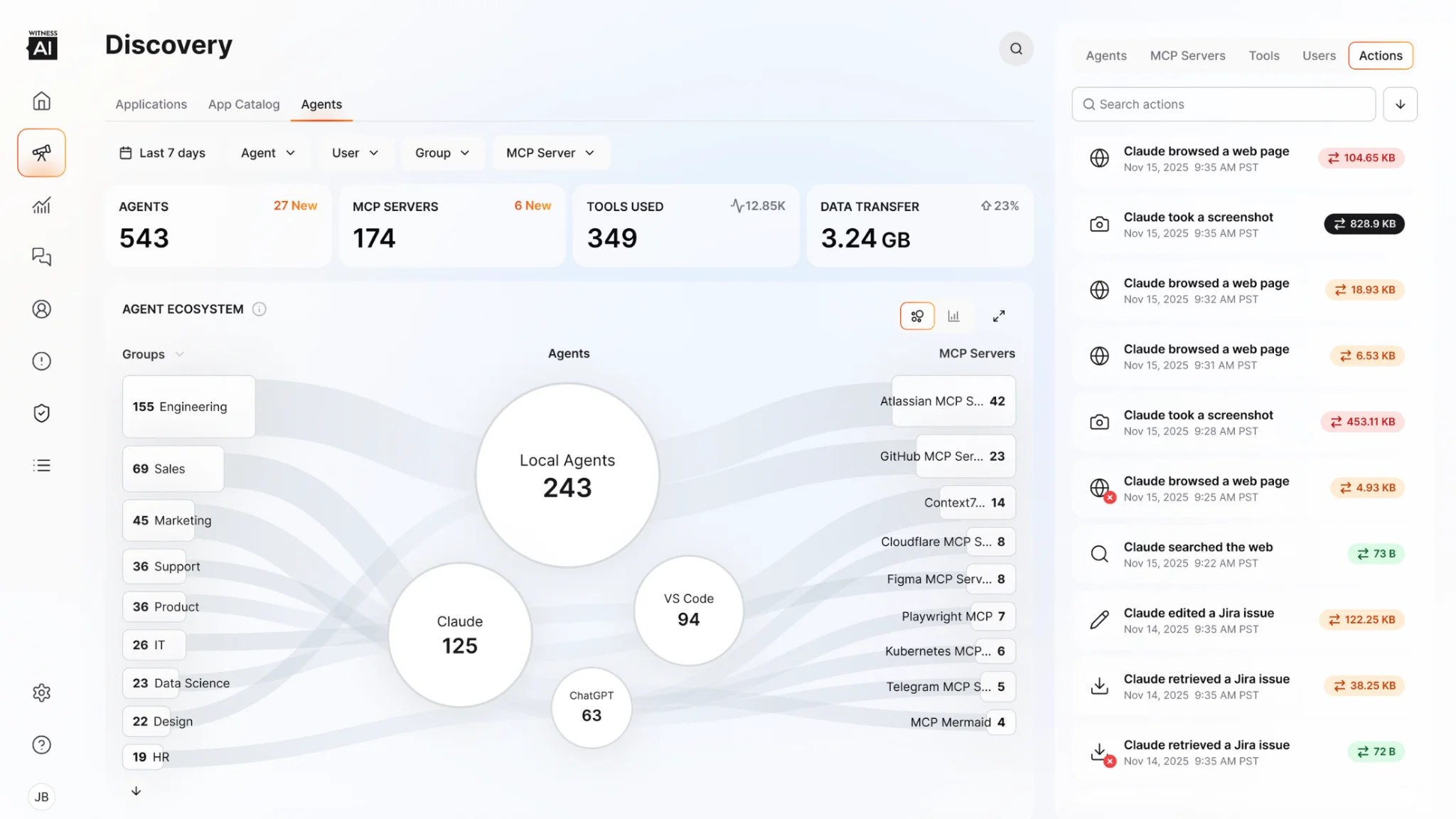
8. WitnessAI

Best for: Network-level AI governance without endpoint or browser agents
Strengths: Intent classification, approved tool lists, bidirectional defense
Things to consider: Network rollout needs coordination; red teaming sold separately
WitnessAI operates at the network layer, capturing AI activity without browser extensions or endpoint clients. That architecture is intended to cover native desktop applications and developer IDEs that browser-based proxies do not see, alongside SaaS AI tools.
The platform is organized into four functions: Observe catalogs the AI footprint, Control applies policies and routing, Protect defends models, applications, and agents at runtime, and Attack tests systems through automated red teaming before deployment.
Key features include:
- Network-level AI discovery: Scans the network against a catalog of thousands of AI applications to identify which tools employees use and which agents are running, including native applications such as Windows Copilot and Office 365.
- Intent-based classification: Machine learning models analyze conversations and context to detect suspicious intent as it develops across sessions, applied to employees and agents alike.
- Runtime AI defense: Bidirectional protection blocks prompt injection before it reaches models and agents, and filters harmful outputs before they reach users or trigger unintended actions.
- Agent tool-access governance: An organization-wide approved list of MCP servers and tools is enforced at the network for every agent across IDEs, chat applications, and custom-built agents, and organization-level bans cannot be re-enabled by a team admin or bypassed by an agent switching providers.
- Tool call audit records: Every blocked tool call generates a record identifying the user, agent, tool, and rule applied.
- Guardrails suite: Data tokenization protects sensitive information, model protection defends against manipulation, and agent guardrails enforce rules of engagement for autonomous systems.
- Intelligent routing: Requests from employees and agents are routed by risk, cost, and purpose, sending sensitive queries to internal models and routine tasks elsewhere.
- Enterprise deployment architecture: Single-tenant isolation, customer-controlled encryption, executive privacy modes, and multi-region deployment for data sovereignty requirements.
Limitations (based on publicly available sources):
- Deployment coordination: The network-level architecture requires coordination with networking teams during deployment scoping, which can slow the early rollout.
- Red teaming packaged separately: Automated adversarial testing is offered as a separate product rather than a built-in module of the core platform.
- Pricing not published: Pricing is custom and quoted by the vendor, with no public figures to work from during early evaluation.
- Limited independent feedback: Public review platforms carry very little verified customer feedback for the product, so buyers have few third-party data points.
Source: WitnessAI
Conclusion
Agentic AI security requires controls that extend beyond model inputs and outputs to the actions agents take across tools, APIs, data, memory, and other agents. Effective protection combines discovery, prompt and context inspection, runtime monitoring, least-privilege access, tool-call enforcement, behavioral and goal drift detection, and data loss prevention. These controls help organizations contain prompt hijacking and misaligned behavior before they result in unauthorized access, data exposure, or harmful real-world actions.