
TL;DR: Bot protection platforms detect and block automated attacks such as credential stuffing, card testing, and scraping. Cequence is best for network-level protection without client-side code, DataDome fits edge protection across web, mobile, and APIs, HUMAN fits session-level fraud defense, and Akamai fits edge bot management for its delivery customers.
What Are Bot Protection Platforms?
Top bot protection platforms for financial institutions combine behavioral analysis, device fingerprinting, and real-time mitigation to block automated threats like credential stuffing and scalping. They distinguish legitimate users and approved bots from malicious automation such as credential stuffing, account takeover attempts, web scraping, spam, and automated abuse.
These platforms analyze signals such as request patterns, browser and device characteristics, user behavior, IP reputation, and traffic velocity. They can respond by blocking requests, rate limiting traffic, presenting challenges, or requiring additional verification. More advanced platforms use behavioral analysis and machine learning to identify bots that imitate normal browser activity or frequently change their infrastructure.
Why financial institutions need bot protection:
- Credit card stuffing and payment fraud: Detects automated card-testing attempts, repeated payment declines, and suspicious transaction patterns to reduce fraud, chargebacks, and processing costs.
- Loan and credit application abuse: Identifies automated applications using stolen, fabricated, or synthetic identities by analyzing submission speed, device characteristics, and related application activity.
- Account takeover: Prevents bots from testing stolen credentials, abusing password recovery workflows, and accessing customer accounts through suspicious authentication activity.
- Automated fund transfer and money mule abuse: Detects unusual transfer sequences, rapid recipient changes, and coordinated movement of funds across compromised accounts.
- Automated account opening and synthetic identity fraud: Identifies large-scale fraudulent registrations by correlating device information, reused identity details, and application submission patterns.
- Account enumeration and credential recovery abuse: Detects automated account lookups, repeated password reset requests, and attempts to identify valid customer accounts.
- Financial data scraping and API abuse: Identifies systematic extraction of account information, transaction records, and other sensitive data through customer portals and APIs.
This is part of a series of articles about bot management
In this article:
- Bot Protection Platforms at a Glance
- Why Do Financial Institutions Need Bot Protection?
- Common Bot Attacks Against Financial Institutions
- Key Capabilities to Look for in a Bot Protection Platform for Financial Institutions
- Notable Bot Protection Platforms for Financial Institutions
Bot Protection Platforms at a Glance
The table below summarizes the key differences between the bot protection platforms covered in this guide. We explore each platform in more detail in the sections that follow.
Category Solution Best For Key Strengths Things to Consider Dedicated bot and fraud protection Cequence Bot Management Network-level bot defense for web, mobile, and APIs No JavaScript or SDK required, behavioral ML, Biometric Check Initial policy tuning has a learning curve Dedicated bot and fraud protection DataDome Bot Protect Edge protection for web, apps, APIs, and MCP servers Every request analyzed, edge PoPs, 24/7 SOC Pricing scales with request volume Dedicated bot and fraud protection HUMAN Sightline Cyberfraud Defense Bot and fraud defense across the customer journey Session correlation, custom mitigations, investigations Rule management can require manual effort Dedicated bot and fraud protection Kasada Bot Defense Client-side defense against retooling attackers Proof of execution VM, invisible challenges Relies on client-side sensors Edge, CDN, and WAAP platforms Akamai Bot Manager Edge bot management on Akamai's platform Bot Score, tiered responses, known-bot directory Higher pricing, learning curve Edge, CDN, and WAAP platforms Cloudflare Bot Management Bot mitigation inside the Cloudflare stack Network-trained ML, behavioral analysis, Turnstile Advanced bot features need higher-tier plans Edge, CDN, and WAAP platforms F5 Distributed Cloud Bot Defense Bot defense for F5 delivery and security users Agent-aware detection, step-up controls Setup effort, higher pricing Edge, CDN, and WAAP platforms Imperva Advanced Bot Protection Granular tuning and explainable reporting 700+ detection dimensions, bot analysts Limited automation integration
Related content: Read our comparison of the best enterprise bot management solutions
Why Do Financial Institutions Need Bot Protection?
Prevent Account Takeover and Credential Stuffing
Attackers use automated tools to test large sets of stolen usernames and passwords against login pages. Even a low success rate can compromise many accounts when bots can make millions of attempts. Financial institutions are frequent targets because compromised accounts may provide access to payment methods, stored balances, rewards, or personal information.
How bot protection helps: It identifies abnormal login patterns, device signals, IP reputation, request frequency, and user behavior. It can block known malicious automation or require additional verification when activity appears suspicious. This makes credential stuffing more expensive and difficult while allowing legitimate customers to continue signing in with minimal friction.
Reduce Fraud and Financial Losses
Bots can automate payment fraud, card testing, fake account creation, promotion abuse, and unauthorized purchases. For example, card-testing bots can submit many small transactions to determine whether stolen payment cards are still valid. These attacks create direct losses as well as payment processing fees, support costs, and fraud investigation work.
How bot protection helps: Bot protection can identify automated transaction patterns and stop suspicious requests before they reach payment or order-processing systems. It can also apply additional verification only to high-risk activity.
Protect Customer Accounts and Sensitive Data
A compromised account can expose personal information, payment details, transaction histories, loyalty points, addresses, or other sensitive data. Bots can also scrape information from authenticated applications at a scale that would be difficult for a human attacker to achieve manually.
How bot protection helps: It helps detect automated access even when an attacker has valid credentials. Behavioral signals can reveal activity such as unusually fast navigation, repeated access to similar records, or requests that do not match normal browser behavior. Blocking this activity reduces the risk of data theft and limits the damage caused by compromised credentials.
Prevent Abuse of High-Value Business Workflows
Attackers target workflows that have financial or operational value, including checkout, money transfers, password resets, gift card balances, inventory reservations, and loyalty programs. Bots can execute these actions rapidly and across thousands of accounts, allowing attackers to scale abuse far beyond manual methods. Traditional rate limits are often insufficient because attackers can distribute requests across many IP addresses, accounts, and devices.
How bot protection helps: It evaluates multiple signals to determine whether individual requests are part of coordinated automation. Organizations can then block the activity, slow it down, or require additional verification at sensitive points in the workflow.
Common Bot Attacks Against Financial Institutions
Credit Card Stuffing and Payment Fraud
Attackers use bots to test stolen card numbers, expiration dates, and security codes against payment forms. By distributing attempts across IP addresses and making small purchases, they can identify valid cards while avoiding simple rate limits. Validated card details can then be used for larger fraudulent transactions or resold.
Bot protection can detect patterns such as:
- Rapid payment attempts
- Repeated declines
- Unusual device behavior
- Coordinated requests from distributed infrastructure
Blocking card-testing automation helps reduce fraud, chargebacks, and unnecessary payment processing costs.
Loan and Credit Application Abuse
Bots can submit large numbers of fraudulent loan, credit card, or financing applications using stolen, synthetic, or fabricated identities. Automation allows attackers to test different combinations of identity data and target application processes at scale.
Protection requires more than limiting the number of requests from one IP address. Bot detection can evaluate:
- Device characteristics
- Interaction patterns
- Submission speed
- Connections between applications
This helps to identify automated or coordinated activity before applications reach downstream underwriting systems.
Account Takeover
Account takeover attacks often begin with bots testing credentials obtained from data breaches, phishing campaigns, or malware. Once attackers find a working username and password combination, they may access funds, stored payment methods, personal data, or loyalty balances.
Bots may also automate:
- Password resets
- Multi-factor authentication abuse
- Attempts to bypass login controls
Bot protection adds behavioral and device-level analysis to authentication workflows, helping identify automated access even when the credentials themselves are valid.
Automated Fund Transfer and Money Mule Abuse
Attackers use bots to initiate unauthorized transfers from compromised accounts or move stolen funds through networks of money mule accounts. Automation allows them to submit transfers rapidly, test transaction limits, and distribute funds across multiple destinations before suspicious activity is detected.
Bots may automate:
- Adding new transfer recipients
- Initiating repeated transfers to unfamiliar accounts
- Testing transaction limits
- Moving funds across multiple compromised accounts
Bot protection can identify unusual transaction sequences, rapid changes in recipients, and coordinated activity across accounts, devices, and sessions. Risk-based controls can block suspicious automation or require additional verification before a transfer is completed.
Automated Account Opening and Synthetic Identity Fraud
Attackers use bots to create bank accounts, digital wallets, and other financial accounts using stolen, fabricated, or synthetic identities. Automated scripts can submit large numbers of applications, reuse identity information, and test which combinations pass initial validation.
Bot protection can detect patterns such as:
- Repeated applications from related devices or infrastructure
- Unusually fast form completion
- Reused contact information across applications
- Similar submission patterns across different identities
Correlating these signals helps financial institutions identify coordinated account-opening campaigns. Suspicious applications can be challenged or routed for additional identity verification before accounts are activated.
Automated Account Enumeration and Credential Recovery Abuse
Attackers use automated requests to determine whether specific customer accounts exist. They may target login forms, password recovery endpoints, account registration pages, and authentication APIs. Differences in application responses can reveal valid usernames, email addresses, or account identifiers.
Bots may also abuse recovery workflows to trigger repeated verification messages or attempt unauthorized account resets.
Bot protection can identify:
- High volumes of account lookup attempts
- Repeated password recovery requests
- Sequential or patterned account identifiers
- Distributed requests targeting the same authentication endpoints
Detecting these patterns helps prevent attackers from building lists of valid accounts for credential stuffing, phishing, and account takeover attempts.
Financial Data Scraping and API Abuse
Attackers use automated tools to extract financial information from customer portals, banking applications, and APIs. Depending on the application and access permissions, targeted information may include account details, transaction histories, pricing data, financial product information, or customer records.
Scraping bots may operate through authenticated sessions or send requests directly to backend APIs, bypassing normal browser interactions.
Bot protection can identify:
- Repeated access to large numbers of records
- Systematic enumeration of API parameters
- Unusual request sequences and data retrieval volumes
- Automated access across multiple accounts or sessions
Behavioral and API-level monitoring helps distinguish legitimate customer activity from large-scale automated data collection. Suspicious requests can be rate-limited, challenged, or blocked before significant data is extracted.
Key Capabilities to Look for in a Bot Protection Platform for Financial Institutions
Behavioral Bot Detection
Behavioral detection analyzes how users interact with an application rather than relying only on IP addresses or known bot signatures. It can examine:
- Navigation patterns
- Request timing
- Mouse and keyboard activity
- Session behavior
- The sequence of actions performed during sensitive workflows
This approach helps identify sophisticated bots that use real browsers, rotate IP addresses, or imitate human traffic. For financial institutions, behavioral analysis is especially useful around login, account recovery, payment, and other workflows where legitimate and malicious requests can look similar.
Server-Side and Network-Based Detection
Client-side signals are useful, but attackers can modify browsers, disable scripts, or interact directly with backend endpoints. Server-side and network-based detection provides another layer by analyzing requests independently of code running in the user's browser. A platform should examine signals such as:
- Connection characteristics
- Request headers
- IP reputation
- Traffic velocity
- Session consistency
Combining these signals with client-side telemetry makes it harder for bots to evade detection by manipulating a single source of data.
Machine Learning-Based Traffic Analysis
Static rules can identify known attack patterns but may struggle when attackers frequently change their tools and infrastructure. Machine learning models can analyze large volumes of traffic and identify combinations of signals associated with automated or abusive behavior.
The platform should continuously adapt to changes in normal and malicious traffic without depending entirely on manual rule updates. It should also provide enough visibility into detection decisions so security teams can investigate false positives and tune controls for important customer workflows.
Web, Mobile, and API Coverage
Bot attacks do not target only public websites. Attackers can:
- Access mobile application APIs directly
- Automate native applications
- Send requests to APIs without using the intended user interface
A bot protection platform should therefore provide consistent protection across websites, mobile applications, and APIs. Centralized policies and telemetry make it easier to identify attackers that move between channels or target the least protected version of the same business workflow.
Related content: Read our guide to API security
Account Takeover Detection
Account takeover detection should identify suspicious activity throughout the account lifecycle, not only at the login page. Relevant signals include:
- Unusual login behavior
- Changes in devices or locations
- Automated password resets
- Rapid account modifications
- Abnormal activity after authentication
Monitoring post-login behavior is important because attackers may use valid stolen credentials and initially appear to be legitimate users. The platform should be able to increase risk scores, challenge suspicious sessions, or block high-risk actions before funds or sensitive data are affected.
Credential Stuffing Protection
Credential stuffing protection should detect automated attempts to test stolen username and password combinations at scale. Effective detection needs to work even when attackers distribute attempts across large numbers of IP addresses and keep request rates low enough to bypass basic thresholds. The platform should correlate activity across:
- Accounts
- Sessions
- Devices
- Network sources
It should also support targeted responses such as blocking malicious requests, applying rate limits, or requiring additional authentication without creating unnecessary friction for legitimate users.
Fraud and Business Logic Abuse Detection
Many automated attacks use valid application features rather than exploiting software vulnerabilities. Examples include:
- Automated fund transfer abuse
- Fraudulent account opening
- Loan and credit application fraud
- Payment card testing
- Account recovery abuse
- Rewards and referral fraud
- Financial data scraping
A suitable platform should understand sequences of actions within important business workflows and detect abnormal automation across them. This allows organizations to protect application logic that traditional web application firewalls may treat as technically valid traffic.
Real-Time Bot Mitigation
Detection provides limited value if malicious requests can complete sensitive actions before a response is applied. Bot protection should classify and mitigate suspicious traffic in real time, particularly around authentication, payments, account changes, and checkout. Mitigation options should include:
- Blocking
- Rate limiting
- Challenges
- Additional authentication
- Other risk-based responses
Organizations should also be able to apply different actions based on endpoint sensitivity and confidence level, reducing malicious automation without unnecessarily blocking legitimate customers.
Notable Bot Protection Platforms for Financial Institutions
How we selected these platforms: We shortlisted bot protection platforms based on behavioral and machine learning-based bot detection, coverage of web, mobile, and API traffic, account takeover and fraud prevention, and real-time mitigation options.
Dedicated Bot and Fraud Protection Platforms
1. Cequence Bot Management

Best for: Network-level bot defense across web, mobile, and API apps
Strengths: No JavaScript or SDK, behavioral ML, Biometric Check
Things to consider: Initial policy tuning has a learning curve
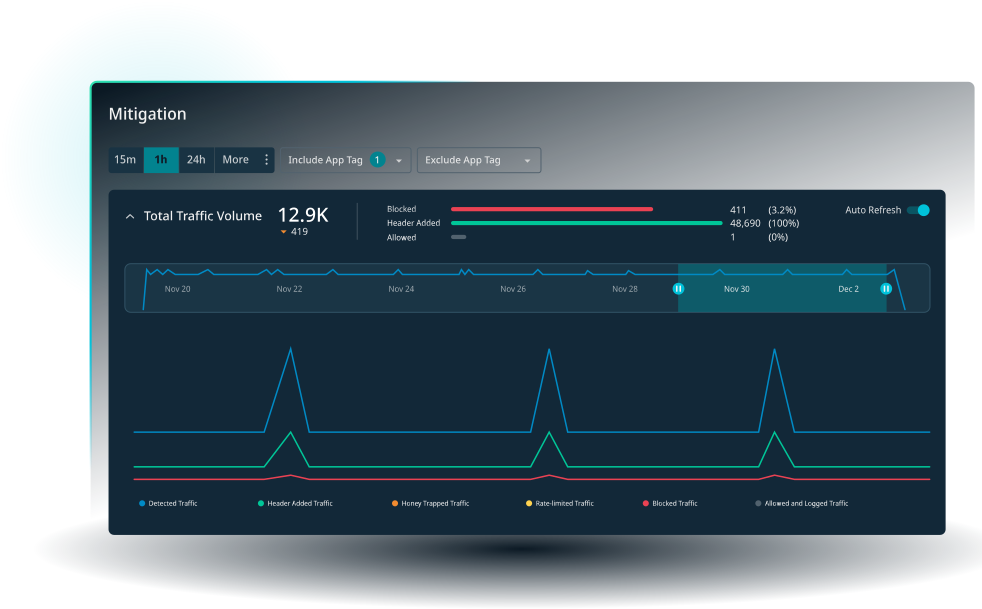
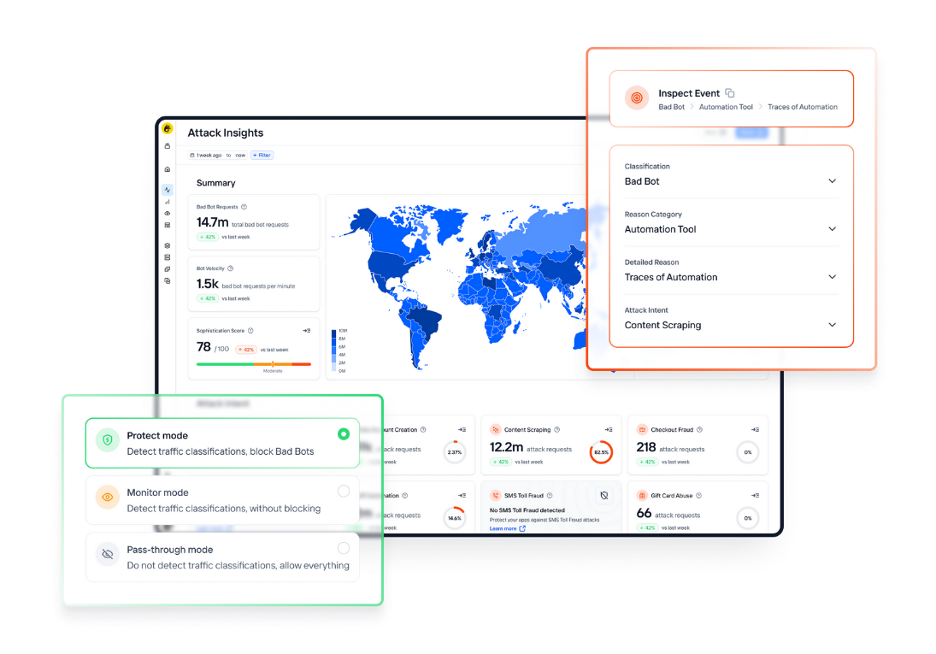
Cequence Bot Management protects web, mobile, and API applications from automated attacks, including account takeover, content scraping, gift card and loyalty program abuse, and business logic abuse. It is part of the Cequence platform, which also includes API security and controls for agentic AI workflows.
Cequence inspects traffic at the network level, so it does not require client-side JavaScript or SDK integration. Machine learning analyzes behavioral intent across web, mobile, and API traffic to build behavioral fingerprints and separate good bots from bad bots. It deploys on premises, in the cloud, or hybrid, with sensors running passively or inline.
Key features include:
- Network-based detection without app changes: Protects web and mobile applications, APIs, and microservices-based architectures from the network level. Development teams do not need to integrate third-party code or run regression testing.
- Behavioral intent analysis: Machine learning analyzes behavior across web, mobile, and API traffic rather than relying on device signals. It tracks malicious activity as attackers change tools and infrastructure.
- Real-time mitigation: AI detects attacks and creates mitigation rules and policies that can be applied automatically or after human review. Options include blocking, rate limiting, header injection, and deception.
- Biometric Check verification: Routes suspicious traffic to native biometric authentication such as Face ID, Touch ID, or Windows Hello instead of CAPTCHAs or SMS codes. It confirms a real person is present in under a second.
- Coverage of financial abuse: Detects account takeover, content scraping, sensitive data exposure, and business logic abuse.
- Fraud prevention and forensics: Applies customizable, granular policies specific to a business and industry. Incident forensics provides transaction analysis of fraudulent and malicious activity.
- AI bot and agent protection: Blocks unwanted AI bot content scraping and AI-driven attacks. It also discovers unauthorized internal AI use and data leakage through AI APIs.
- Flexible deployment: Runs on premises, in the cloud, or hybrid, with hundreds of predefined, customizable rules. Machine learning baselines applications within hours.
Limitations (as reported by users on G2):
- Initial tuning time: Some users note that configuring policies for complex environments with many APIs takes time and familiarity with the platform.
- Dashboard performance on large queries: Some users report slower dashboard response when running large data queries.
- Custom reporting effort: Some users would like reports tailored to different stakeholders to be easier to configure.
2. DataDome Bot Protect

Best for: Edge bot protection for web, mobile apps, APIs, and MCP servers
Strengths: Every request analyzed, edge PoPs, 24/7 SOC, Agent Trust
Things to consider: Pricing scales with request volume
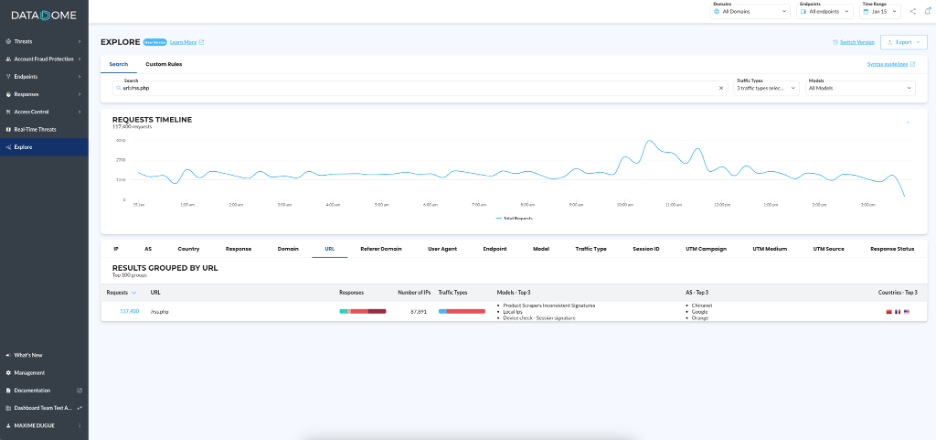
DataDome Bot Protect detects and mitigates bot and AI agent traffic across websites, mobile apps, APIs, and MCP servers. It is part of the DataDome Cyberfraud Protection Platform, alongside Account Protect, DDoS Protect, Priority Protect, and Ad Protect.
Bot Protect analyzes every request rather than a sample, evaluating hundreds of client-side and server-side signals across page visits, logins, and cart requests. Detection runs at the edge across more than 35 points of presence and returns a decision in under 2 milliseconds. High-risk traffic triggers automated mitigation based on the business flow.
Key features include:
- Full request analysis: Evaluates every request throughout the user journey using client-side and server-side signals, rather than relying on sampled data.
- Multi-layered AI detection: Uses more than 1,000 out-of-the-box and customer-specific models, behavioral analysis, device fingerprinting, invisible challenges, and Device Check. CAPTCHAs can be enabled by policy.
- Edge mitigation: Inspects traffic at more than 35 global points of presence near users and returns decisions in under 2 milliseconds.
- Payment use cases: Stops credential stuffing and brute-force login attacks, carding at checkout, price scraping, and Layer 7 DDoS attacks.
- Agent Trust: Identifies, classifies, scores, and governs AI agent traffic. Verified agents and crawlers can be allowed while malicious ones are blocked, including traffic over MCP, ACP, and A2A protocols.
- Dashboard and endpoint discovery: Watchtower discovers and onboards new endpoints. The dashboard shows threats by type, attack drill-downs, business metrics, and custom dashboards and reports.
- Integrations: Deploys through more than 80 pre-built integrations, including CDNs such as Fastly, Cloudflare, Akamai, and CloudFront, and servers such as NGINX, F5, HAProxy, and Envoy.
- SOC monitoring and privacy controls: A 24/7 SOC team monitors traffic and model performance. Two-layer PII encryption protects customer data.
Limitations (as reported by users on G2):
- Cost at scale: Some users note that pricing tied to request volume becomes harder to manage as traffic grows, including low-value traffic.
- Integration effort: Some users found mobile SDK integration and certain deployment types, such as load balancer installs, time-consuming.
- Data retention and export limits: Some users report short data retention and limits on extracting large volumes of data from the dashboard.
- Multi-tenant management: Users managing many tenants describe switching between them and per-tenant access controls as cumbersome.
- Limited customization: Some users would like more control over threat model customization and more endpoints per workspace.
Source: DataDome
3. HUMAN Sightline Cyberfraud Defense

Best for: Bot and fraud defense across the full customer journey
Strengths: Session-level correlation, custom mitigations, investigation tools
Things to consider: Rule management and tuning can require manual effort
HUMAN Sightline Cyberfraud Defense, part of the Human Defense Platform, manages traffic from humans, bots, and AI agents across web, mobile apps, and APIs. It covers account takeover, compromised accounts, fake accounts, scraping, data contamination, and transaction abuse.
Sightline uses machine learning, behavioral analysis, and fingerprinting. It correlates session activity across each authentication stage instead of evaluating single requests at isolated points such as login or checkout. Layered AI models learn from detection and mitigation events, and the Satori threat intelligence team researches fraud schemes.
Key features include:
- Layered session protection: Continuously analyzes and correlates session activity across authentication stages rather than evaluating individual requests in isolation.
- Adaptive learning: Layered AI models learn from each detection and mitigation event and adjust to threat adaptations.
- Customizable responses: Applies hard blocks, soft challenges through HUMAN Challenge, silent controls, and investigation triggers. Responses integrate with WAF, CDN, IAM, and fraud operations tools.
- Crawler, LLM scraper, and AI agent controls: Shows activity from known bots, LLM scrapers, and AI agents, with policies to block, allow, limit, or monetize automated activity.
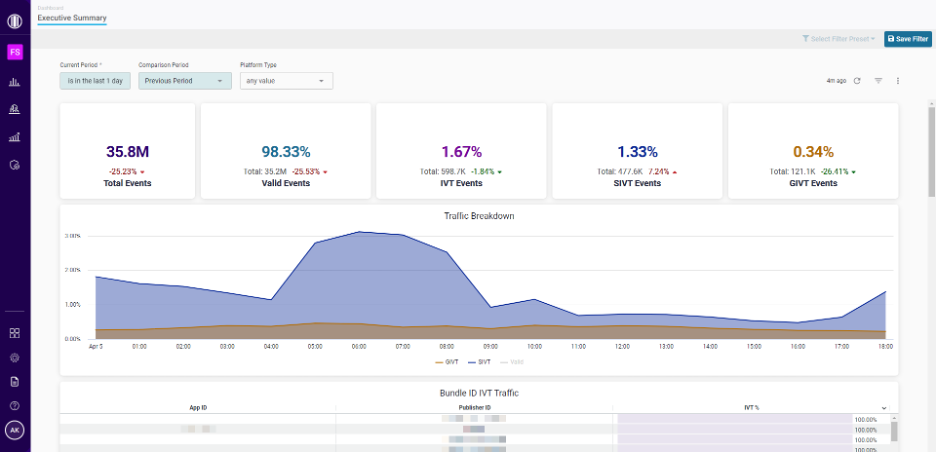
- Investigation tools: Provides AI-generated insights, pattern analysis, automated reports, and dashboards for fraud, security, and business teams. Secondary detection identifies fraud networks and distinct threat profiles.
- Contextualized events and custom models: Each detection and mitigation event includes explanations and business signals. First-party data can inform custom fraud models.
Limitations (as reported by users on G2):
- Rule management complexity: Some users find creating and fine-tuning rules for high-volume filtering requires significant manual effort.
- Short dashboard data retention: Some users note dashboard data covers roughly two weeks, which limits longer historical investigations.
- Limited visibility into detections: Some users describe parts of the detection logic as opaque, making it harder to understand why traffic was blocked.
- No configuration as code: Some users report that configuration is done through the UI, without infrastructure-as-code support.
- Repeated challenges: Some users report legitimate users occasionally receiving repeated or double challenges.
- Analyzer latency: Some users note the search and analyzer tools are not real-time and can be slow on longer time ranges.
Source: HUMAN
4. Kasada Bot Defense
Best for: Client-side bot defense against retooling attackers
Strengths: Obfuscated VM proof of execution, invisible challenges, no CAPTCHAs
Things to consider: Relies on client-side sensors in browsers and apps
Kasada Bot Defense protects websites, APIs, and mobile apps from bots, scrapers, and automated attacks. It is one of four connected capabilities on the Kasada platform, along with Account Intelligence, AI Agent Trust, and KasadaIQ for Fraud, which share one detection engine.
Kasada combines invisible client-side challenges with server-side detection. Hidden sensors collect traces of automation from the first request, and client data is checked for tampering. Code runs inside an obfuscated virtual machine that requires attackers to execute in real browsers and devices. Threat intelligence from bot communities feeds new sensors.
Key features include:
- Invisible signal collection: Hundreds of client-side sensors collect hidden traces of automation and detect bots from the first request, before malicious requests reach the backend.
- Client validation: Checks data received from the client for signs of automation and tampering, and detects attempts to bypass detection.
- Proof of execution: Runs dynamic code paths in a highly obfuscated virtual machine, so attackers must run their code in real browsers and mobile devices.
- Fast anomaly detection: Models built on trillions of bot interactions identify automated session behavior in under 2 milliseconds and force adversaries to revalidate sessions.
- Data analytics and threat intelligence: Live product data is analyzed to find bypass attempts. Information from botting communities and attack tools is used to add new client-side sensors across all customers in minutes.
- Connected fraud capabilities: Account Intelligence links devices to identities to expose multi-accounting, promo abuse, and repeat offenders at guest checkout. The platform also detects credential stuffing and one-time-code abuse.
- CAPTCHA-free mitigation: Uses hidden challenges instead of CAPTCHAs and does not require customers to manage rule updates.
Limitations (based on publicly available sources):
- Limited UI customization: Customers in a 2026 analyst evaluation reported limited customization of the user interface.
- Client-side integration required: Detection depends on client-side sensors and code execution, so integration covers browsers and mobile apps in addition to server-side components.
- Pre-production testing: Users note that deployments should be tested carefully before going live because of how the client-side defenses operate.
Source: Kasada
Bot Protection Within Edge, CDN, and WAAP Platforms
5. Akamai Bot Manager

Best for: Edge bot management for organizations on Akamai's platform
Strengths: Per-request Bot Score, tiered responses, large known-bot directory
Things to consider: Higher pricing and a learning curve for new users
Akamai Bot Manager detects and mitigates bot traffic at the edge and manages known good bots. It applies the same detections to websites and mobile apps and includes visualization and reporting tools that show how different bot types affect business and infrastructure.
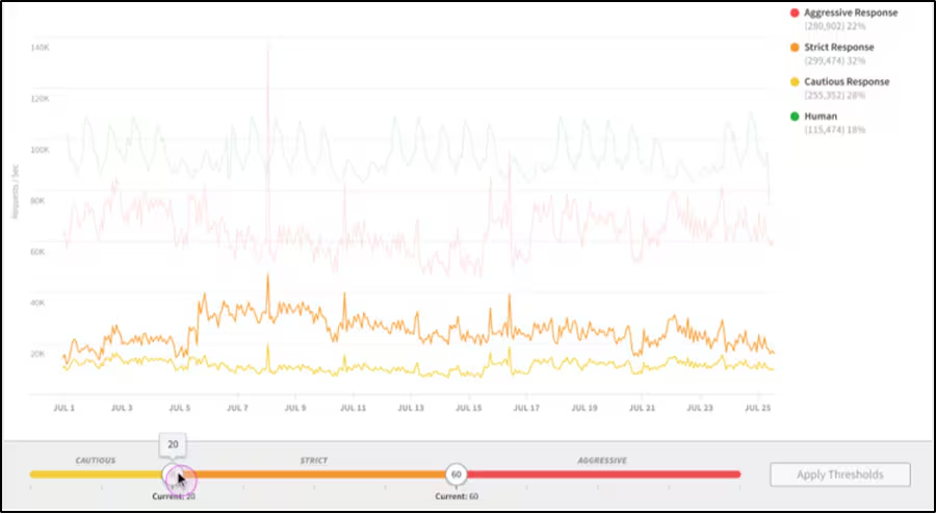
Bot Manager assigns each request a Bot Score from 0 (human) to 100 (bot), starting from the first request and increasing as anomalies accumulate. Teams map score ranges to Cautious, Strict, and Aggressive response segments and adjust the actions applied. Behavior anomaly detection is configured by injecting a script into monitored pages.
Key features include:
- Bot Score and response segments: Scores every request and applies tunable response strategies for traffic that should be watched, challenged, or mitigated.
- AI-based behavioral detection: Uses AI models for user behavior analysis and browser fingerprinting. Every bot is evaluated against every detection, with details on why it was classified as a bot.
- Stealthy mitigation actions: Goes beyond block and allow with challenges, slowing bots, and serving cached content to bots, which avoids tipping off attackers.
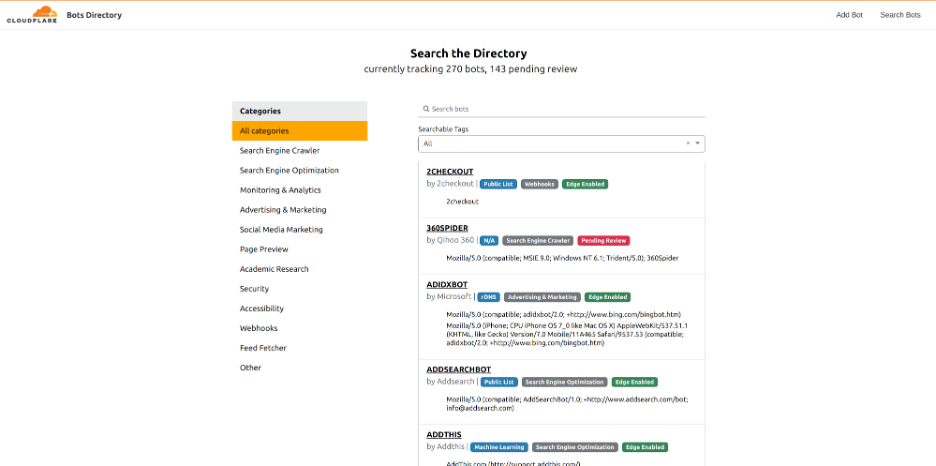
- Known bot directory and custom categories: Includes a continuously updated library of known bots. Teams can create categories for their own or partners' bots.
- Mobile app coverage: Applies the same bot detections to mobile apps as to websites.
- APIs and SIEM integration: Bot Manager functionality is available through APIs for DevSecOps workflows. Bot Score insights can be sent to SIEM tools.
Limitations (as reported by users on G2):
- Pricing and service fees: Some users note higher pricing and onboarding service charges when activating new products.
- Navigation learning curve: Some users report that first-time users need several weeks to become comfortable with the interface.
- Tuning and hidden thresholds: Users note false positives without proper tuning, and some thresholds, such as session validation, are not visible to customers.
- Vendor involvement: Some users report needing Akamai's team to mitigate certain traffic surges or handle advanced configurations.
Source: Akamai
6. Cloudflare Bot Management

Best for: Bot mitigation built into the Cloudflare edge stack
Strengths: Network-scale ML models, behavioral analysis, Turnstile
Things to consider: Runs as part of the Cloudflare platform
Cloudflare Bot Management uses machine learning and behavioral analysis across Cloudflare's global network to detect and stop malicious bot traffic before it reaches the application. It runs inside the Cloudflare stack rather than as a separate product.
Its machine learning models are trained on traffic from a large portion of the internet, and protections for newly observed attacks are deployed across customers. Mitigation happens at the edge close to users. Use cases include credential stuffing on login endpoints, API scraping and probing, and inventory hoarding on e-commerce sites.
Key features include:
- Network-trained machine learning: Models are trained on traffic across Cloudflare's network to detect novel attacks and deploy protections.
- Behavioral analysis: Analyzes traffic behavior to separate automated abuse from human visitors.
- Edge mitigation within the Cloudflare stack: Stops bots at the edge as part of the same platform that runs Cloudflare's WAF, rate limiting, and CDN services.
- Turnstile: Provides a free, privacy-preserving alternative to CAPTCHA for verifying visitors.
- Credential and API protection: Protects login endpoints from credential stuffing and APIs from scraping, resource abuse, and automated probing.
- E-commerce bot defense: Protects e-commerce sites from inventory hoarding bots.
- Traffic quality signals: Bot detection data can be used to adjust user experience and marketing spend in real time.
Limitations (as reported by users on G2):
- Advanced bot features tied to higher plans: Some users note that advanced bot management and analytics are only available on higher-tier plans, which increases costs as needs grow.
- False positives and challenges: Some users report that aggressive security or bot settings can block legitimate traffic or present challenges to real visitors until rules are tuned.
- Learning curve for granular settings: Some users find custom rules and granular bot management settings take time to learn, especially for less technical team members.
- Support on lower tiers: Some users report slow support responses outside enterprise plans.
- Platform dependence: Some users note that moving away from Cloudflare's edge ecosystem later can require significant technical effort.
Source: Cloudflare
7. F5 Distributed Cloud Bot Defense

Best for: Bot defense for organizations using F5 delivery and security
Strengths: Agent-aware detection, step-up controls, BIG-IP and WAAP integration
Things to consider: Users rate ease of setup lower than some alternatives
F5 Distributed Cloud Bot Defense protects web apps, mobile apps, and APIs by distinguishing humans, trusted AI agents, and harmful automation. It targets abuse of login, checkout, account recovery, and APIs, including fraud, inventory hoarding, and data scraping.
The product uses real-time behavioral analysis, client-side intelligence, and platform-wide telemetry to detect bots and AI agents at the application interaction layer. Defenses adjust automatically as attacker techniques change. It is delivered on the F5 Application Delivery and Security Platform across hybrid, multi-cloud, and on-premises environments.
Key features include:
- Human, agent, and bot classification: Identifies and controls AI agents based on behavior and intent rather than static signatures or identity claims.
- Risk-based controls: Applies allow, block, rate-limit, or step-up controls where abuse occurs, with stricter controls only for low-trust interactions.
- Business logic abuse detection: Detects abuse of workflows such as checkout and account recovery, even when traffic appears human.
- Continuous adaptation: Adjusts defenses as attacker techniques and AI behaviors change, without constant rule tuning.
- Deployment options: Available through F5 Distributed Cloud WAAP, as a native BIG-IP module or iApp, or in VMs and containers close to public cloud workloads.
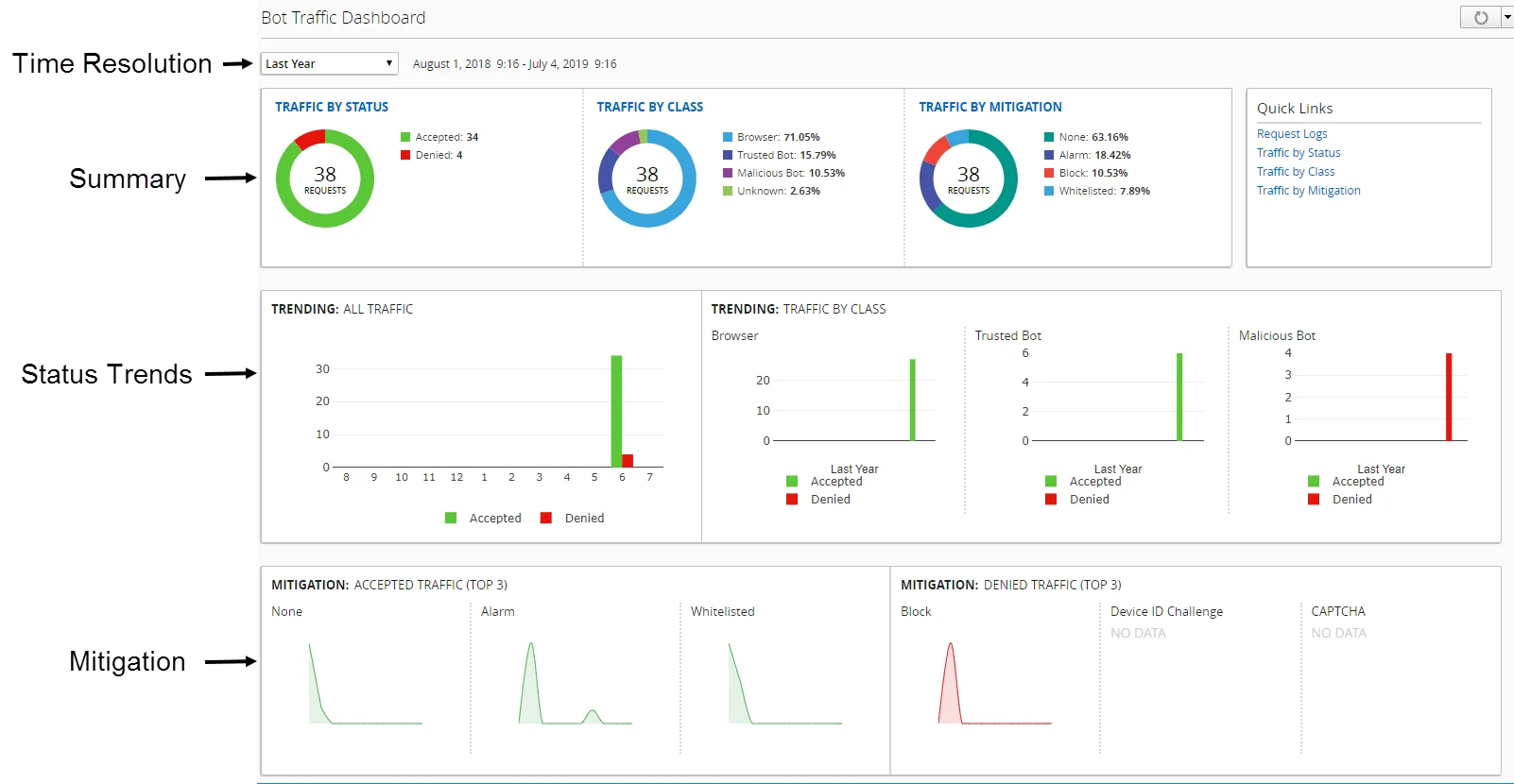
- SIEM and data export: Sends data and inferences to Syslog, leading SIEM systems, or cloud buckets for threat analysis.
Limitations (as reported by users on G2):
- Initial setup effort: Some users report that first-time setup takes considerable time or requires help from F5's team.
- Pricing: Some users note that pricing is higher than competing products.
- Limited visibility into detection logic: Some users find it hard to gauge efficacy or understand what the AI detection models are looking for.
- Added latency: Some users report that cloud-hosted request analysis can occasionally add latency.
Source: F5
8. Imperva Advanced Bot Protection

Best for: Bot protection with granular tuning and explainable reporting
Strengths: 700+ detection dimensions, OWASP automated threat coverage, analysts
Things to consider: Pending verification of user-reported limitations
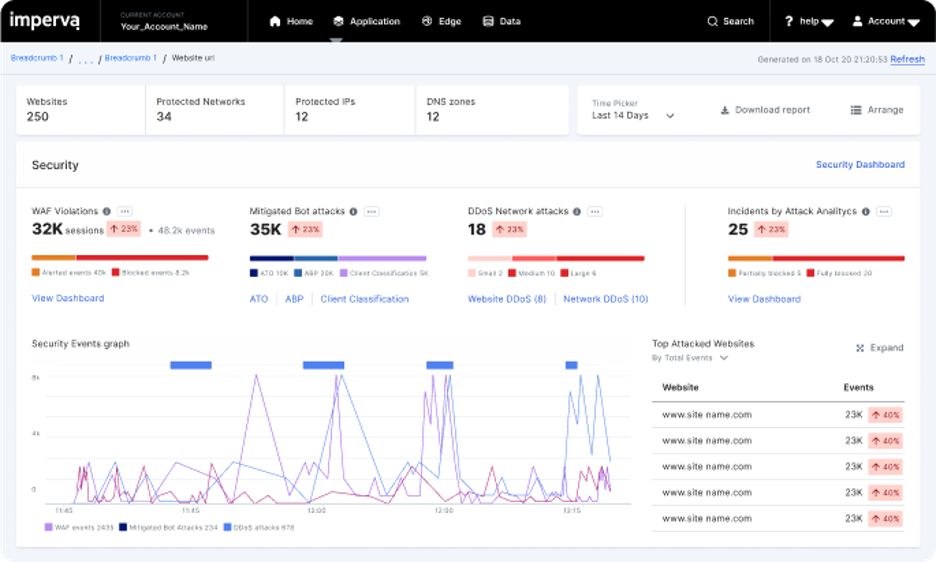
Imperva Advanced Bot Protection, from Thales, protects websites, mobile apps, and APIs from automated attacks, including all OWASP Automated Threats. It is part of Imperva's application security portfolio alongside WAF, API security, DDoS protection, and account takeover protection.
Detection combines direct client interrogation, behavior analysis, machine learning, connection characteristics, and threat intelligence feeds, examining more than 700 dimensions to fingerprint human, good bot, and bad bot traffic. Teams get granular tuning, real-time testing tools, and access to Imperva bot analysts for setup and policy reviews.
Key features include:
- Multi-layered detection: Combines client interrogation, behavior analysis, machine learning, connection characteristics, and threat intelligence across more than 700 dimensions.
- Validation and feedback loops: Tests detections against historical data and hundreds of browsers. Post-deployment feedback loops and metadata replay reduce false positives and negatives.
- Granular controls and explainable reporting: Provides full visibility and tuning rather than relying only on risk scores, with reporting that supports false positive analysis and policy creation.
- Custom dashboards and reports: Analyzes trends across applications or by path or rule, using hundreds of dimensions to build custom dashboards.
- Real-time testing: Tests configurations in production to confirm bot-blocking policies before enforcing them.
- Response options: Offers out-of-the-box and customizable responses, including optional CAPTCHA challenges.
- Bot analyst support: Imperva bot analysts assist with setup, ongoing reviews, policy tuning, and alerting.
- Fraud and abuse use cases: Addresses automated fraud, fake interactions, Layer 7 DDoS, chargebacks, and scraping of proprietary content and pricing.
Limitations (as reported by users on G2 and Gartner Peer Insights):
- Limited automation integration: Some users report that automation integrations are not available for the bot protection product.
- Interface usability: Some users note that certain features could be more intuitive and that user friendliness could be improved.
- Pricing: Some users mention cost as a drawback.
Source: Imperva
Conclusion
Effective bot protection requires visibility and controls across websites, mobile applications, APIs, and sensitive business workflows. Financial institutions should evaluate platforms based on behavioral detection, server-side and client-side signals, account takeover and credential stuffing protection, fraud detection, and real-time mitigation. The selected approach should stop automated abuse without creating unnecessary friction for legitimate customers, while providing enough telemetry and policy control to adapt as bot techniques and AI-driven automation evolve.