
TL;DR: Bot protection software detects and blocks automated traffic behind scraping, credential stuffing, and fraud across web, mobile, and APIs. Best for network-based web, mobile, and API defense: Cequence. For every-request edge detection: DataDome. For full-journey fraud defense: HUMAN. For edge scoring on large estates: Akamai.
What Is Bot Protection Software?
Bot protection software stops automated threats like web scraping, credential stuffing, and fraud by analyzing traffic behavior and device fingerprints to separate humans from malicious scripts. It distinguishes malicious bots from legitimate users and approved bots, such as search engine crawlers. Common threats include credential stuffing, account takeover, web scraping, spam, inventory hoarding, and automated fraud.
These tools analyze signals such as request patterns, browser and device characteristics, IP reputation, user behavior, and traffic volume. More advanced systems use behavioral analysis and machine learning to identify bots that imitate human activity. When suspicious traffic is detected, the software can block the request, rate-limit it, require additional verification, or challenge the client before allowing access.
How bot protection software prevents scraping, credential stuffing, and fraud:
- Behavioral analysis across sessions and requests: Examines request timing, navigation patterns, interaction sequences, and session history to detect automated activity that imitates human behavior.
- Cross-channel bot detection: Monitors web, mobile, and API traffic using browser characteristics, application telemetry, authentication context, and protocol-level signals to identify automation across different interfaces.
- Correlation across accounts, devices, IPs, and sessions: Connects related activity across multiple identifiers to uncover distributed bot attacks that evade IP-based rate limits and individual request checks.
- High-value workflow protection: Detects suspicious activity targeting login, registration, checkout, inventory, and payment processes, including credential stuffing, account takeover, card testing, and automated fraud.
- Real-time, risk-based mitigation: Blocks malicious requests, rate-limits suspicious traffic, applies verification challenges, or restricts endpoint access based on the assessed risk, while allowing legitimate users and approved bots to continue operating.
This is part of a series of articles about bot management
In this article:
- Bot Protection Software at a Glance
- Why Is Bot Protection Important for Modern Applications and APIs?
- How Bot Protection Software Prevents Scraping, Credential Stuffing, and Fraud
- Key Capabilities to Look for in Bot Protection Software to Prevent Scraping, Credential Stuffing, and Fraud
- Notable Bot Protection Software for Scraping, Credential Stuffing, and Fraud
Bot Protection Software at a Glance
The table below summarizes the key differences between the bot protection software covered in this article. We explore each solution in more detail in the sections that follow.
Category Solution Best For Key Strengths Things to Consider Dedicated Bot Management and Fraud Prevention Platforms Cequence Bot Management Network-based bot defense for web, mobile, and APIs No JavaScript or SDK; AI-generated mitigation rules Initial policy tuning benefits from dedicated expertise Dedicated Bot Management and Fraud Prevention Platforms DataDome Bot Protect Edge bot protection for sites, apps, APIs, and MCP servers Every-request analysis; automated, low-latency mitigation Request-based pricing can rise with traffic volume Dedicated Bot Management and Fraud Prevention Platforms HUMAN Sightline Cyberfraud Defense Bot and fraud defense across the customer journey Session-level correlation; investigation tools Short dashboard data retention; manual rule tuning Dedicated Bot Management and Fraud Prevention Platforms Radware Bot Manager Bot protection within Radware cloud app protection Crypto challenges; mobile attestation; AI crawler controls Limited reporting customization Bot Management Within Edge, CDN, and WAAP Platforms Cloudflare Bot Management Organizations already routing traffic through Cloudflare Network-scale ML models; free Turnstile challenge Users want deeper analysis and visibility Bot Management Within Edge, CDN, and WAAP Platforms Akamai Bot Manager Edge bot management for large Akamai-delivered estates Bot Score; known bot directory; stealthy responses Premium pricing; tuning may need Akamai involvement Bot Management Within Edge, CDN, and WAAP Platforms Imperva Advanced Bot Protection Coverage of all OWASP automated threats 700+ detection dimensions; explainable reporting Usability and testing options could improve Bot Management Within Edge, CDN, and WAAP Platforms F5 Distributed Cloud Bot Defense Bot defense on F5 hybrid and multi-cloud platforms Agent-aware classification; client-side telemetry Setup can require time or F5 assistance
Related content: Read our comparison of the top 8 bot management vendors.
Why Is Bot Protection Important for Modern Applications and APIs?
Automated Attacks Can Mimic Legitimate Users
Advanced bots can execute JavaScript, maintain cookies, simulate browser behavior, and reproduce realistic navigation patterns. This makes them difficult to distinguish from legitimate users using basic request attributes alone.
How bot protection helps: It adds behavioral and client-side signals to the detection process. It can identify inconsistencies in interaction patterns, browser characteristics, request timing, and session behavior that indicate automation.
Attackers Can Distribute Activity Across Large Botnets
Attackers can route requests through thousands of compromised devices, cloud servers, or residential proxies. Each source may generate only a small number of requests, allowing the overall attack to remain below per-IP rate limits.
How bot protection helps: Effective bot protection evaluates activity across sessions, accounts, devices, and network sources. This helps identify coordinated attacks even when individual requests appear normal.
APIs Create Additional Paths for Automated Abuse
APIs expose application functions directly, often without the browser signals available on web pages. Attackers can automate calls to login, registration, search, checkout, and other endpoints at high speed.
How bot protection helps: API bot protection must analyze factors such as authentication context, request sequences, endpoint usage, and behavioral patterns. These controls can detect automation while allowing legitimate API clients and integrations to operate normally.
Related content: Read our guide to API security.
How Bot Protection Software Prevents Scraping, Credential Stuffing, and Fraud
Analyze Behavioral Patterns Across Sessions and Requests
Bots often produce patterns that differ from normal human activity. Examples include unusually fast navigation, repeated requests at regular intervals, identical action sequences, or high request volumes across many sessions. Scraping bots may systematically enumerate product pages, while credential-stuffing tools may attempt many username and password combinations.
Bot protection software analyzes these patterns over time instead of evaluating each request in isolation. It can compare request timing, navigation paths, interaction sequences, and session history with expected behavior. This helps detect automation even when attackers deliberately reduce request rates or introduce random delays to appear human.
Behavioral analysis is also useful when IP reputation provides little information. A request may come from a residential proxy or previously unseen address, but its behavior can still reveal that it belongs to an automated campaign.
Detect Automated Activity Across Web, Mobile, and APIs
Attackers can target browser applications, mobile backends, and APIs directly. Protecting only website traffic leaves other application interfaces exposed to automation. An attacker may bypass the user interface entirely and send requests directly to the same API endpoints used by a web or mobile application.
Bot protection can inspect traffic across these channels using signals appropriate to each one. These can include:
- Browser characteristics
- Application telemetry
- API request patterns
- Authentication data
- Client integrity signals
- Protocol-level attributes
Cross-channel visibility is important because the same attack can move between interfaces. For example, an attacker might obtain account information through an API and then use automated browser sessions to attempt logins or transactions. Monitoring multiple channels makes these related activities easier to detect.
Correlate Signals Across Accounts, Devices, IPs, and Sessions
Attackers frequently rotate IP addresses, accounts, device identifiers, and sessions to avoid simple detection rules. Examining each request independently can hide the relationship between these activities. Large botnets and residential proxy networks make IP-based controls particularly easy to evade.
Correlation connects related signals across multiple requests and identities. For example, the system may detect many accounts attempting similar transactions from related devices or infrastructure, indicating credential stuffing or coordinated fraud. It may also identify one account being accessed from an unusual number of devices within a short period.
This broader view helps expose distributed attacks that appear harmless at the individual request level. It also reduces dependence on any single identifier, which attackers may be able to change or spoof.
Identify Abuse of Login, Checkout, and Other High-Value Workflows
Some automated attacks target individual business processes rather than generating obviously malicious traffic. Bots may:
- Test stolen credentials at login
- Create fake accounts
- Reserve limited inventory
- Abuse promotions
- Scrape pricing data
- Submit fraudulent purchases
Bot protection can monitor the sequence and frequency of actions within these workflows. For example, repeated failed logins across many accounts can indicate credential stuffing, while rapid checkout attempts using different payment details may indicate payment fraud or card testing.
Workflow context helps distinguish malicious automation from legitimate high-volume activity. The system can evaluate what action is being performed, which resources are involved, and whether the sequence matches normal application use before assigning risk.
Apply Real-Time Blocking, Challenges, and Risk-Based Mitigation
Detection must lead to an appropriate response without unnecessarily disrupting legitimate users. Bot protection software can:
- Block clearly malicious requests
- Rate-limit suspicious clients
- Require additional verification
- Restrict access to endpoints
Risk-based mitigation allows responses to vary according to confidence and potential impact. Low-risk requests can proceed normally, while higher-risk activity can receive challenges or stricter controls before accessing sensitive functions. Organizations can also apply stronger policies to high-value workflows such as authentication, account recovery, and checkout.
Real-time responses are important because automated attacks can generate large numbers of requests in seconds. Immediate mitigation limits the number of credentials, records, transactions, or application resources an attacker can access before the activity is stopped.
Key Capabilities to Look for in Bot Protection Software to Prevent Scraping, Credential Stuffing, and Fraud
Behavioral Bot Detection Across Web, Mobile, and APIs
Behavioral detection examines how clients interact with an application instead of relying only on identifiers such as IP addresses. Useful signals include:
- Request timing
- Navigation sequences
- Interaction patterns
- Session duration
- Repeated actions
Coverage should extend across websites, mobile applications, and APIs. This prevents attackers from bypassing browser protections by sending automated requests directly to backend endpoints. The system should also connect activity across channels when the same campaign targets multiple interfaces.
Related content: Read our article about bot detection in the AI age.
Network-Based and Server-Side Bot Detection
Network and server-side detection can identify suspicious automation without depending entirely on JavaScript or other code running in the user's browser. This is important for APIs, mobile applications, and bots that disable or manipulate client-side detection mechanisms.
Relevant signals can include:
- IP reputation
- Proxy usage
- Connection characteristics
- Request headers
- Protocol behavior
- Traffic patterns
Combining these signals with application context makes it harder for attackers to evade detection simply by rotating IP addresses or changing user-agent strings.
Machine Learning-Based Traffic and Intent Analysis
Static rules are useful for known attack patterns, but sophisticated bots continually change their behavior. Machine learning can analyze large volumes of traffic to identify patterns and anomalies that fixed thresholds may miss.
Effective systems should analyze both individual requests and sequences of activity. This can help distinguish a legitimate customer making repeated requests from automation performing malicious actions, such as:
- Scraping
- Account enumeration
- Credential testing
- Inventory abuse
Models should work alongside configurable rules so security teams retain control over enforcement.
Credential Stuffing and Account Takeover Detection
Credential stuffing uses automated login attempts to test usernames and passwords obtained from previous data breaches. Attackers can distribute these attempts across many IP addresses and devices, making simple per-IP rate limits ineffective.
Bot protection software should identify patterns across:
- Login attempts
- Accounts
- Devices
- Sessions
- Network sources
It should also detect account enumeration, password spraying, and suspicious activity following a successful login. This helps protect both authentication endpoints and later stages of an account takeover.
Scraping and Business Logic Abuse Detection
Scraping does not always produce unusually high traffic. Sophisticated scrapers can operate slowly, rotate infrastructure, maintain sessions, and imitate normal navigation while systematically collecting:
- Product data
- Prices
- Content
- Other valuable information
Detection should therefore consider which resources a client accesses and how those requests relate to normal user workflows. The same approach can identify business logic abuse such as inventory hoarding, automated purchasing, fake account creation, promotion abuse, and repeated reservation attempts.
Fraud Detection Across Accounts, Sessions, and Transactions
Fraud often becomes visible only when activity is correlated across multiple identities and transactions. A single purchase may appear legitimate, while dozens of similar purchases across related accounts, devices, or payment methods can reveal coordinated abuse.
Bot protection software should connect signals across:
- Accounts
- Sessions
- Devices
- IP addresses
- Transactions
Risk scoring can then incorporate both current behavior and related historical activity. This provides additional context for detecting payment fraud, card testing, fake accounts, and other automated fraud schemes.
Real-Time Mitigation with Blocking, Rate Limiting, and Deception
Detection is most useful when suspicious activity can be mitigated immediately. Bot protection software should support multiple responses, including:
- Blocking requests
- Limiting request rates
- Requiring additional verification
- Restricting access to sensitive functions
More advanced platforms can use deception techniques that return modified responses, introduce delays, or otherwise interfere with malicious automation without revealing exactly how it was detected. Policies should be adjustable by endpoint, workflow, and risk level so organizations can apply stronger controls to sensitive operations while minimizing friction for legitimate users.
Notable Bot Protection Software for Scraping, Credential Stuffing, and Fraud
How we selected these solutions: We shortlisted bot protection software based on behavioral bot detection across web, mobile, and APIs, credential stuffing and account takeover protection, scraping and business logic abuse detection, fraud detection, and real-time mitigation options.
Dedicated Bot Management and Fraud Prevention Platforms
1. Cequence Bot Management

Best for: Network-based bot defense across web, mobile, and API apps
Strengths: No JavaScript or SDK, with AI-generated mitigation rules
Things to consider: Initial policy tuning benefits from dedicated expertise
Cequence Bot Management detects and mitigates automated attacks against web, mobile, and API applications. Covered attacks include account takeover, content scraping, flash sale and sneaker drop abuse, sensitive data exposure, gift card and loyalty program abuse, and business logic abuse. Protection runs at the network level, so it requires no client-side JavaScript, mobile SDKs, or application changes.
Machine learning analyzes behavioral intent across web, mobile, and API traffic to build behavioral fingerprints that separate good bots from bad bots and keep tracking attackers as they re-tool. Software sensors inspect traffic passively or inline, on-premises, in the cloud, or in hybrid environments. Bot Management is part of the Cequence platform, which also includes API security and an AI Gateway.
Key features include:
- Network-based detection: Inspects traffic at the network level with no JavaScript or SDK integration, covering web and mobile apps, APIs, and cloud and microservices architectures without regression testing.
- Behavioral intent analysis: Machine learning analyzes behavior across web, mobile, and API traffic instead of relying on device signals, producing behavioral fingerprints that distinguish good and bad bots.
- AI-generated mitigation: AI detects attacks and creates mitigation rules and policies that run automatically or after human review, with options including blocking, rate limiting, header injection, and deception.
- Biometric Check verification: Routes suspicious traffic to the user's native biometric prompt, such as Face ID, Touch ID, or Windows Hello, instead of CAPTCHAs or SMS codes, confirming a real person in under a second.
- Fraud prevention and forensics: Applies customizable, granular fraud policies specific to the business and industry, with incident forensics that provide transaction analysis of fraudulent and malicious activity.
- Predefined rules and fast baselining: Hundreds of predefined, customizable rules provide protection from deployment, and machine learning baselines applications within hours.
- AI bot and agent protection: Blocks unwanted AI bot content scraping, discovers unauthorized internal AI use, and prevents sensitive data leakage through AI APIs.
Limitations (as reported by users on G2):
- Initial tuning takes time: Some users report that setting up policies and tuning detection for large or complex environments takes time and familiarity with the platform.
- Learning curve for analytics: Some users note that granular event data and policy options take time to learn, especially for non-technical team members.
- Dashboard responsiveness: A few users mention that the dashboard can respond slowly when running large data queries.
2. DataDome Bot Protect

Best for: Edge bot protection for websites, apps, APIs, and MCP servers
Strengths: Every-request analysis with automated, low-latency mitigation
Things to consider: Request-based pricing can rise as traffic volume grows
DataDome Bot Protect detects and mitigates bots and malicious AI agents targeting websites, mobile apps, APIs, and MCP servers. It analyzes every request, from page visits to logins and cart requests, evaluating hundreds of client-side and server-side signals. Its detection engine uses more than 1,000 out-of-the-box and customer-specific models combined with collective threat intelligence.
Detection runs at the edge across more than 35 points of presence, with decisions in under 2 milliseconds. Bot Protect deploys through more than 80 pre-built integrations, including edge CDNs such as Fastly, Cloudflare, Akamai, and CloudFront, and server-side platforms such as NGINX, F5, HAProxy, and Envoy. A 24/7 SOC team monitors customer traffic and model performance.
Key features include:
- Multi-layered detection: Combines AI detection models, behavioral analysis, client-side and server-side signals, invisible challenges, Device Check, and device fingerprinting. CAPTCHAs can be enabled by policy.
- Every-request analysis: Evaluates all traffic rather than samples, assessing user intent and behavior throughout the journey, including logins, account creation, and checkout.
- Automated mitigation: Triggers automated responses to high-risk traffic in line with business logic, without requiring human-in-the-loop alerts.
- Attack coverage: Addresses credential stuffing and brute force attacks, content and LLM scraping, scalping and inventory hoarding, carding and payment fraud, and Layer 7 DDoS attacks.
- Agent Trust: Identifies, classifies, scores, and governs AI agent traffic, validating agent identity and intent so verified crawlers and agents can access content while malicious ones are blocked. LLM crawler traffic can also be monetized.
- Dashboard and endpoint discovery: Watchtower discovers and onboards new endpoints, and the dashboard shows threats by type over time, supports drill-down into attacks, and offers custom dashboards, saved views, and reports.
- Data privacy controls: Applies two-layer encryption to personally identifiable information.
Limitations (as reported by users on G2):
- Cost at scale: Users report that pricing is tied to request volume, so costs can become harder to manage as traffic grows, including traffic from low-value scrapers.
- False positives: Some users report occasional false positives affecting legitimate users or internal staff when detection is not carefully tuned, with Account Protect needing additional tuning.
- Integration effort: Some users found mobile SDKs and certain environments, such as progressive web apps and load balancer integrations, required developer time to implement.
- Limited self-service customization: Some users want more control over threat models, KPIs, and challenge page design without involving the DataDome team.
- Short data retention: A few users note relatively short data retention, which makes long-term trend analysis harder without exporting data.
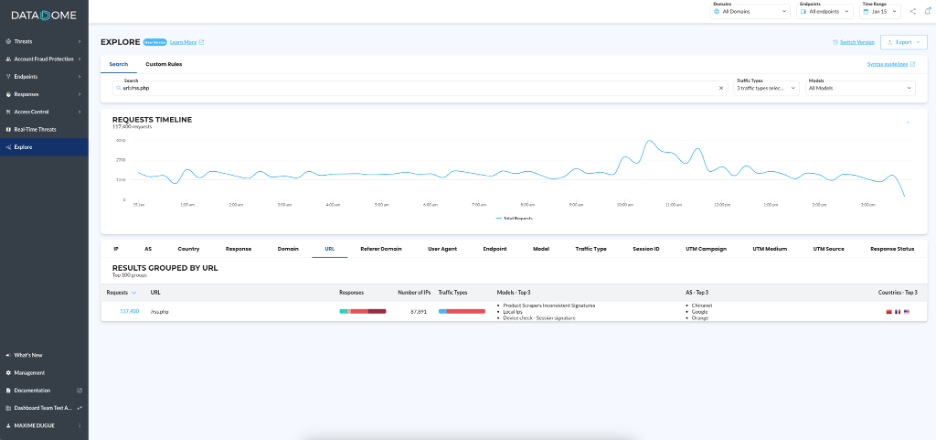
Source: DataDome
3. HUMAN Sightline Cyberfraud Defense

Best for: Bot and fraud defense across the full customer journey
Strengths: Session-level correlation with investigation tools
Things to consider: Short dashboard data retention and manual rule tuning
HUMAN Sightline Cyberfraud Defense detects and mitigates bot attacks, human-led fraud, and AI agent activity across web, mobile, and APIs. It covers account takeover, scraping, fake accounts, carding, scalping, compromised accounts, and transaction abuse. Detection uses machine learning, behavioral analysis, device fingerprinting, and botnet detection techniques, including analysis of micro-behaviors.
Instead of evaluating individual requests at single points such as login or checkout, Sightline correlates session activity across each authentication stage, and layered AI models learn from each detection and mitigation event. Mitigation actions integrate with existing WAF, CDN, IAM, and fraud operations tools. HUMAN's Satori threat intelligence team researches emerging fraud schemes.
Key features include:
- Layered session protection: Continuously analyzes and correlates session activity across authentication stages rather than evaluating single requests at disparate interaction points.
- Adaptive learning: Layered AI models learn from each detection and mitigation event to detect and respond to threat adaptations.
- Customizable responses: Applies hard blocks, soft challenges through HUMAN Challenge, silent controls, and investigation triggers, using customer-defined mitigation policies.
- Crawler, LLM scraper, and AI agent control: Provides visibility into known bots, LLM scrapers, and AI agents, with policies to allow, block, limit, or monetize automated activity, suppress ads, or show alternate content.
- Threat investigation tools: Offers AI-generated insights, pattern analysis, automated reports, and dashboards tailored to fraud, security, and business stakeholders.
- Secondary detection: Uncovers fraud networks, identifies distinct threat profiles, and tracks evolving attack patterns to support investigations.
- Custom fraud models: Uses customer first-party data to inform custom fraud models, and provides context and business signals for each detection and mitigation event.
Limitations (as reported by users on G2):
- Short data retention: Several users report that dashboard and log data are retained for about two weeks, which limits long-term trend analysis and investigations.
- Slow analysis tools: Some users note that data can take several minutes to populate and that analyzer queries can be slow, especially when searching by route.
- Limited detection transparency: Some users describe parts of the detection logic as a black box, with limited visibility into why specific traffic was blocked.
- Rule management effort: Users with high-volume filtering needs report manual effort managing rules, and some note limited configuration-as-code support.
- Occasional challenge friction: A few users report periods of increased challenges or repeated CAPTCHAs presented to legitimate users.
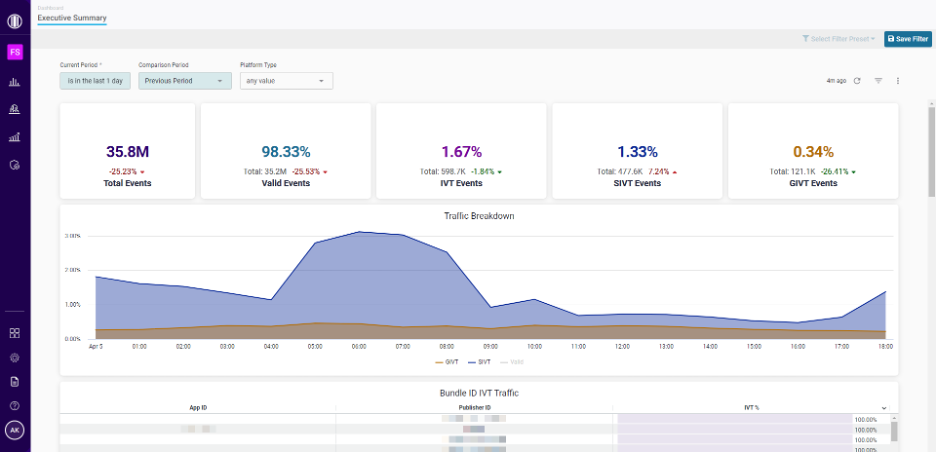
Source: HUMAN
4. Radware Bot Manager

Best for: Bot protection integrated with Radware cloud app protection
Strengths: Crypto challenges, mobile attestation, and AI crawler controls
Things to consider: Reporting customization is limited, per some users
Radware Bot Manager protects web apps, mobile apps, and APIs from malicious bots, AI crawlers, and AI agents, covering the OWASP Top 21 automated threats, including account takeover, scraping, and payment fraud. It is offered as part of Radware's Cloud Application Protection Services, alongside Radware's WAF, API security, and DDoS protection.
Bot Manager uses three layers of defense. Preemptive protection blocks malicious sources using the Radware ERT Active Attackers feed, AI-based correlation, JavaScript validation, and iOS and Android attestation. AI-based behavioral algorithms then detect human-like bots in real time, and mitigation applies generated attack signatures with a range of response options.
Key features include:
- AI-based behavioral detection: Uses proprietary AI-based algorithms to analyze behavior and identify malicious bots in real time.
- Advanced detection modules: Identifies bots that manipulate identities and IP addresses, uncovers distributed bot attacks, and detects CAPTCHA farm services.
- Real-time signature generation: Generates attack signatures in real time and blocks threats using options that include non-interactive challenges and custom responses.
- CAPTCHA-less crypto challenge: Blocks sophisticated bots with a blockchain-based crypto challenge that legitimate users complete without solving a CAPTCHA.
- AI crawler and agent visibility: Classifies AI crawler traffic by intent with management options, and identifies AI agents accessing applications, including those verified through web bot authorization.
- Cross-module correlation: Uses AI to correlate threats detected in other Radware security modules and preemptively block malicious sources.
- Native mobile app protection: Verifies devices and apps with Integrated Device Authentication for Android and iOS and validates requests with Secure Identity.
Limitations (as reported by users on G2):
- Limited reporting customization: Some users report that reports are basic and cannot be adjusted for specific use cases, and that dashboards could offer more data and control.
- Pricing: Some users describe the product as expensive for smaller organizations.
- Good bot blocking: A few users report that friendly crawlers and good bots were occasionally blocked.
- Update issues: Some users report encountering bugs with updates and new releases.
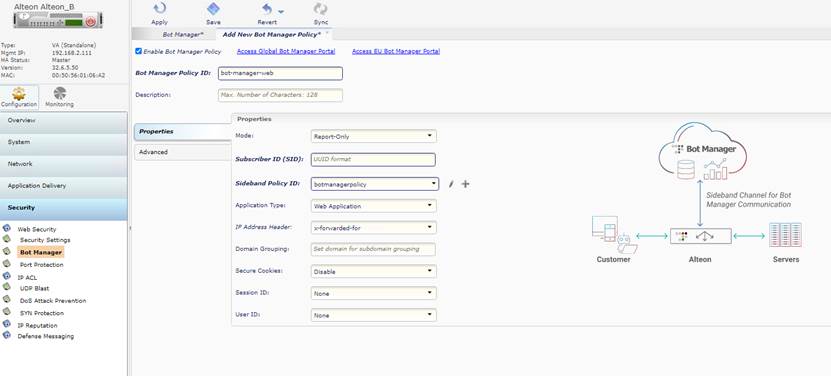
Source: Radware
Bot Management Within Edge, CDN, and WAAP Platforms
5. Cloudflare Bot Management

Best for: Organizations already routing traffic through Cloudflare
Strengths: Network-scale ML models and free Turnstile CAPTCHA alternative
Things to consider: Some users want deeper analysis and visibility
Cloudflare Bot Management detects and stops malicious bot traffic using machine learning and behavioral analysis across Cloudflare's global network. Its machine learning models are trained on traffic from a large portion of the Internet, which Cloudflare uses to identify new attack patterns and deploy protection across all customers.
Bot Management is built into the Cloudflare stack rather than deployed as a separate product, and mitigation runs at the edge, close to users. It protects login endpoints from credential stuffing, APIs from scraping, resource abuse, and automated probing, and e-commerce sites from inventory hoarding bots. Cloudflare Turnstile is offered as a free CAPTCHA alternative.
Key features include:
- Network-scale machine learning: Trains detection models on traffic from a large share of the Internet to detect novel attacks and deploy protection to all customers.
- Behavioral analysis: Combines behavioral signals with machine learning to separate automated traffic from human users.
- Edge mitigation: Stops bots at the edge as part of the Cloudflare stack, alongside services such as WAF and rate limiting.
- Credential and API protection: Protects login endpoints from credential stuffing and secures APIs against scraping, resource abuse, and automated probing.
- E-commerce bot defense: Protects online stores from inventory hoarding bots.
- Turnstile challenge: Provides a free, privacy-preserving alternative to CAPTCHA for verifying users.
- Bot signals for UX and marketing: Uses bot detection in real time to inform user experience and marketing spend decisions.
Limitations (as reported by users on Gartner Peer Insights):
- Limited analysis depth: Some users report that analysis and visibility features could provide deeper insights.
- Support and stability: A user reports encountering bugs and limited support, particularly for smaller businesses.
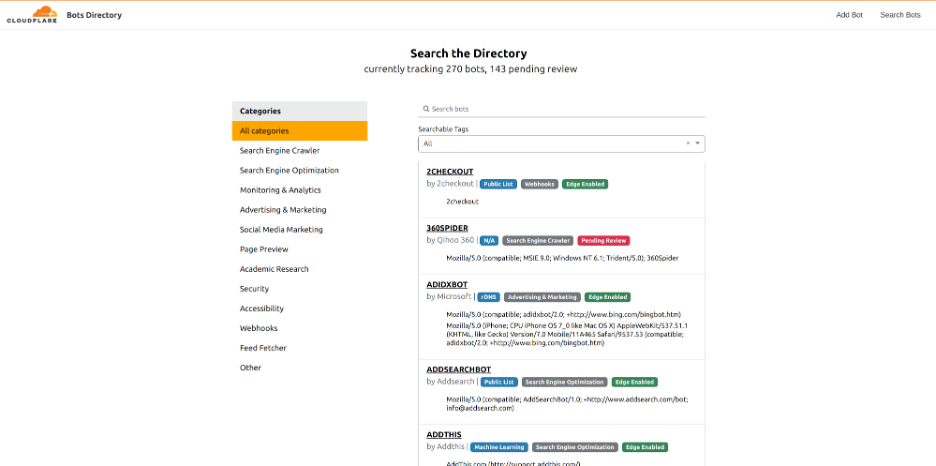
Source: Cloudflare
6. Akamai Bot Manager

Best for: Edge bot management for large Akamai-delivered web estates
Strengths: Bot scoring, known bot directory, and stealthy response actions
Things to consider: Premium pricing; tuning may need Akamai team involvement
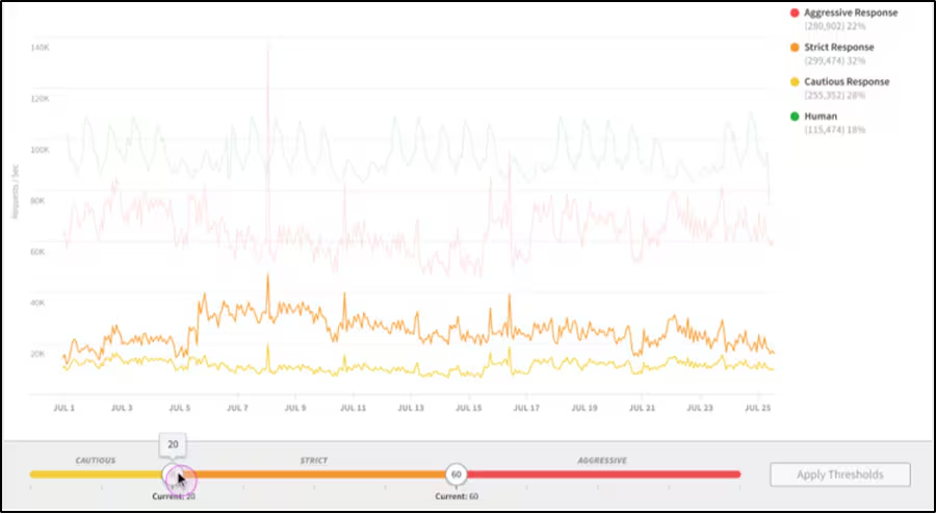
Akamai Bot Manager detects bot traffic and mitigates malicious bots at the Akamai edge while managing good bots. It assigns each request a Bot Score from 0 (human) to 100 (bot), starting with the first request, and the score can increase as more requests arrive from the same bot. Detection uses AI models for user behavior analysis, browser fingerprinting, and other techniques.
Customers define response strategies by score in three segments, cautious, strict, and aggressive, and can tune the thresholds and actions for each. Bot Manager is part of Akamai's Bot & Agent Control portfolio, its functions are available through APIs, and Bot Score insights can be sent to SIEM tools.
Key features include:
- Bot Score: Scores every request from 0 to 100 and evaluates each bot against every detection, showing why it was classified as a bot.
- Score-based response strategies: Applies cautious, strict, or aggressive responses based on configurable score thresholds and actions.
- Behavior anomaly detection: Configures behavioral detection automatically by injecting a script into each monitored page, with AI models analyzing user behavior and browser fingerprints.
- Stealthy mitigation actions: Goes beyond block and allow, with responses that slow attacks, serve cached content to bots, and increase attacker costs without revealing detection.
- Known bot directory: Maintains a continuously updated library of known bots, with custom categories for bots created by the organization or its partners.
- Mobile app protection: Applies the same detections to mobile apps as to web traffic.
- API and SIEM integration: Exposes Bot Manager functions through APIs for DevSecOps workflows and sends Bot Score insights to SIEM tools.
Limitations (as reported by users on G2):
- Pricing: Several users describe the product, particularly the premier tier, as expensive, and one notes onboarding service fees for new product activations.
- Tuning and exceptions: Some users report false positives when the product is not tuned properly, requiring many exceptions for different teams.
- Limited threshold visibility: Some users note that certain thresholds are not visible to customers and that much of the configuration is handled by the Akamai team.
- Learning curve: A user reports that new users need several weeks to become familiar with the interface navigation.
Source: Akamai
7. Imperva Advanced Bot Protection

Best for: Bot protection covering all OWASP automated threats
Strengths: 700+ detection dimensions and explainable reporting
Things to consider: Usability and testing options could improve, per users
Imperva Advanced Bot Protection protects websites, mobile apps, and APIs from bot attacks, including all OWASP 21 automated threats. It uses multi-layered detection that combines direct client interrogation, behavior analysis, machine learning, connection characteristics, and threat intelligence feeds. Imperva is part of Thales.
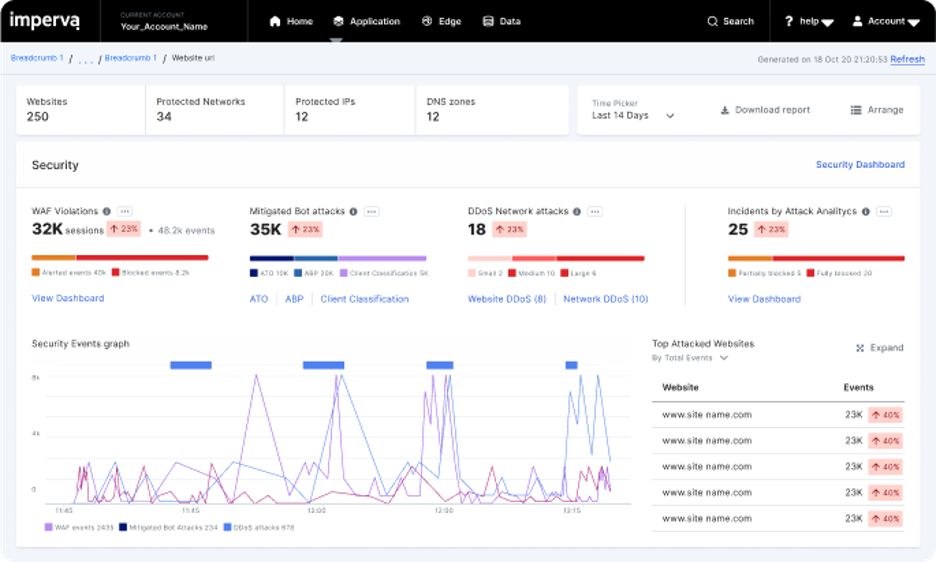
The system evaluates more than 700 dimensions to separate human, good bot, and bad bot traffic and build fingerprints that resist evasion. Customers get granular tuning controls, explainable reporting, real-time testing tools, and access to Imperva bot analysts for setup, policy reviews, fine-tuning, and alerting.
Key features include:
- Multi-layered detection: Combines client interrogation, behavior analysis, machine learning, connection characteristics, and threat intelligence to detect sophisticated bots.
- Granular tuning controls: Provides full visibility and granular configuration to customize defenses, rather than relying only on risk scores.
- Good bot management and responses: Manages good bots and offers out-of-the-box and customizable responses, with CAPTCHA available as an optional response.
- Customizable reporting: Supports dashboards and reports across hundreds of dimensions, with analysis across applications or by path or rule.
- Real-time testing: Provides reporting and testing tools for policy creation, false positive analysis, and testing configurations in production.
- Attack coverage: Addresses content and pricing scraping, automated fraud, fake interactions, and Layer 7 DDoS attacks.
- Bot analyst support: Provides access to bot analysts for setup, ongoing reviews, policy fine-tuning, and alerting.
Limitations (as reported by users on G2):
- Usability: Some users report that user-friendliness could be improved.
- Testing restrictions: A user notes that during implementation, testing was only possible with Imperva's own test bot rather than a custom bot.
- Pricing: A user mentions pricing as a drawback.
Source: Imperva
8. F5 Distributed Cloud Bot Defense

Best for: Bot defense for apps on F5 hybrid and multi-cloud platforms
Strengths: Agent-aware classification and client-side telemetry
Things to consider: Setup can require time or help from F5
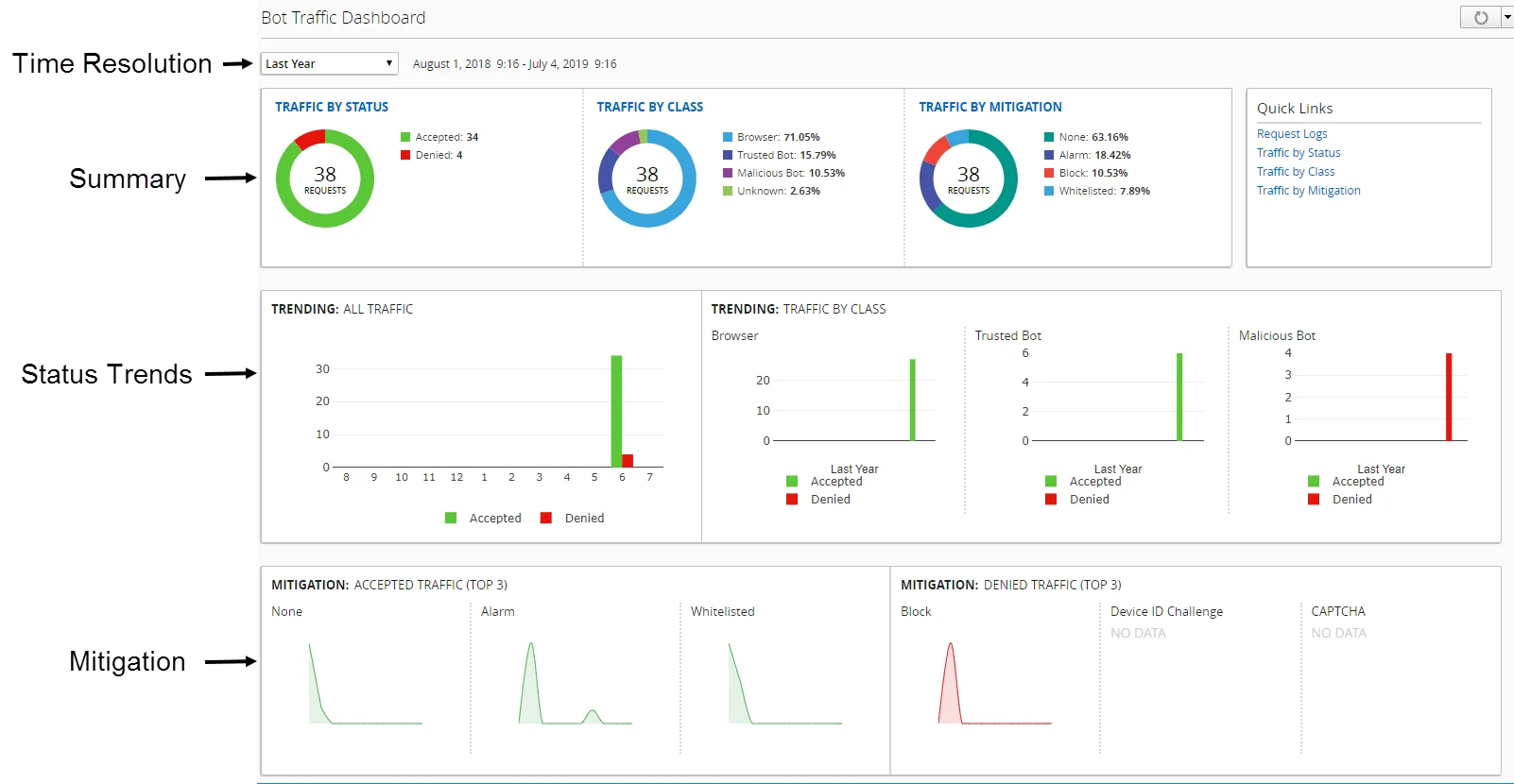
F5 Distributed Cloud Bot Defense detects and controls bots and AI agents targeting web apps, mobile apps, and APIs. It separates humans, trusted AI agents, and malicious automation using real-time behavioral analysis, client-side telemetry, and telemetry from across the F5 platform. It covers abuse of login, checkout, account recovery, and API workflows, including fraud, inventory hoarding, and data scraping.
Bot Defense is delivered on the F5 Application Delivery and Security Platform. It can be enabled through F5 Distributed Cloud WAAP, integrated with BIG-IP through a native module or iApp, or deployed in on-premises, hybrid, or multi-cloud architectures, including VMs or containers close to public cloud workloads.
Key features include:
- Agent-aware classification: Identifies and controls AI agents based on behavior and intent rather than static signatures or identity claims.
- Behavioral analysis: Detects human-like bots that evade signature-based detection.
- Client-side telemetry: Collects high-fidelity client signals to counter evasion techniques.
- API and mobile protection: Protects non-browser traffic from mobile apps and APIs.
- Real-time enforcement: Applies allow, block, rate-limit, or step-up controls where abuse occurs, with stricter controls only for low-trust interactions.
- Business logic protection: Detects abuse of workflows such as login, checkout, and account recovery, not only technical exploits.
- Continuous adaptation: Adjusts defenses automatically as attacker techniques and AI behaviors change, without manual rule tuning.
- SIEM integration: Sends Bot Defense data and inferences to Syslog, leading SIEM systems, or cloud buckets.
Limitations (as reported by users on G2):
- Setup effort: Some users report that first-time setup takes considerable time or support from the F5 team.
- Added latency: A user notes that cloud-hosted processing can occasionally add latency.
- Limited detection transparency: A user reports difficulty gauging efficacy and understanding what the AI models look for.
- Pricing: Some users describe pricing as higher than competing products.
Source: F5
Conclusion
Effective bot protection requires more than blocking known IP addresses or applying simple rate limits. Organizations should evaluate software based on behavioral detection, coverage across web, mobile, and APIs, credential stuffing and scraping protection, cross-session fraud analysis, and real-time mitigation. The selected approach should detect distributed and human-like automation while minimizing false positives and preserving access for legitimate users, integrations, and approved bots.