
TL;DR: AI gateway solutions for multi-model traffic sit in front of AI apps, APIs, and agent endpoints to verify callers, inspect prompts and responses, and enforce policy whatever model runs behind them. Best for: Cequence for agent governance, Akamai and Cloudflare for edge protection, F5 for unified model and MCP control.
What Are AI Gateway Solutions for Managing Multi-Model Traffic?
AI gateway solutions provide a centralized security and traffic management layer between AI-powered applications and the users, external AI agents, and systems accessing them. These gateways inspect and control incoming requests to AI applications, APIs, and agent endpoints, helping organizations enforce consistent security policies, prevent abuse, and protect sensitive information before requests reach application services.
As organizations deploy AI applications powered by multiple large language models (LLMs), they expose an expanding number of interfaces through chatbots, AI assistants, APIs, and agentic workflows. Although these applications may rely on different models and backend services, they face many of the same external security threats, including prompt injection, automated abuse, unauthorized access, and data exfiltration. AI gateways establish a common enforcement point across these external-facing interfaces, regardless of which models the applications use internally.
Core capabilities for managing external traffic to multi-model AI applications include:
- Continuous AI application discovery and visibility: Identifies exposed AI applications, agent endpoints, MCP servers, and APIs to help organizations understand their AI attack surface and detect unmanaged deployments.
- Unified inbound traffic management: Centralizes incoming requests from users, third-party applications, and external AI agents, supporting consistent request routing, rate limiting, and traffic policies across AI-powered services.
- Zero Trust authentication and identity-based access controls: Verifies the identities and permissions of users and external agents before allowing them to access AI applications, APIs, or sensitive operations.
- Real-time prompt injection detection and prevention: Inspects incoming prompts and other untrusted inputs for malicious instructions, jailbreak attempts, and attempts to manipulate application behavior.
- Sensitive data protection and data loss prevention (DLP): Monitors requests and responses for confidential information, helping prevent unauthorized disclosure through AI interfaces.
- Centralized security policy enforcement: Applies consistent access controls, content restrictions, abuse prevention rules, and security policies across externally accessible AI applications.
- External AI agent governance and behavioral protection: Monitors and restricts automated agents interacting with enterprise applications, preventing unauthorized operations, excessive requests, and business logic abuse.
- MCP endpoint and tool-level security: Protects MCP servers and tools exposed to external AI agents through authentication, authorization, request validation, and runtime monitoring.
- API discovery, protection, and governance: Identifies AI-facing API endpoints and protects them against unauthorized access, automated attacks, sensitive data exposure, and application logic exploitation.
In this article:
- AI Gateway Solutions for Managing Multi-Model Traffic at a Glance
- How AI Gateways Manage Traffic Across Multiple LLMs
- Common Challenges of Managing Multi-Model AI Traffic
- Key Features to Look for in AI Gateway Solutions for Managing Multi-Model Traffic
- Notable AI Gateway Solutions for Managing Multi-Model Traffic
AI Gateway Solutions for Managing Multi-Model Traffic at a Glance
The table below summarizes the key differences between the AI gateway solutions covered in this article. We explore each solution in more detail in the sections that follow.
Category Solution Best For Key Strengths Things to Consider AI gateways for agent, API, and MCP traffic Cequence AI Gateway Governing external agent access to enterprise apps and APIs Agent Personas, session-level behavior checks, DLP across MCP, API, LLM Initial setup and configuration options involve a learning curve AI gateways for agent, API, and MCP traffic F5 AI Gateway F5 users unifying model, MCP, and guardrail controls One policy model for Model Gateway, MCP Gateway, and AI Guardrails Latest release offered through early access; air-gapped support planned AI gateways for agent, API, and MCP traffic Kong AI Gateway Kong users governing LLM, MCP, and A2A traffic MCP tool generation from APIs, quotas, multi-LLM routing Advanced AI plugins need an AI license; steep learning curve Edge and runtime AI firewalls Akamai Firewall for AI Edge inspection of prompts and responses for public AI apps Input and output guardrails at the edge or via REST API Documented as limited availability; policies may need tuning Edge and runtime AI firewalls Cloudflare AI Security for Apps Cloudflare users protecting internet-facing LLM endpoints Automatic LLM endpoint discovery and WAF rule builder mitigation Detection capabilities vary by plan; WAF rules can be complex Edge and runtime AI firewalls Harness AI Security AppSec teams securing AI APIs, MCP servers, and agents AI discovery, AI Firewall, and OWASP-based AI testing Blocking and redaction support depends on deployment type
Related content: Read our guide to the best enterprise AI gateway solutions.
How AI Gateways Manage External Traffic to Multi-Model AI Applications
Centralizing Incoming Requests Through a Unified AI Gateway
An external-facing AI gateway acts as a controlled entry point for traffic reaching AI-powered applications, whether requests originate from human users, automated clients, business partners, or external AI agents. Instead of allowing each application to independently handle incoming traffic and security enforcement, organizations can place gateway controls in front of their exposed AI interfaces.
For example, an enterprise might operate a customer support chatbot, an AI-powered financial assistant, and an agentic commerce application. Each application may use different LLMs or combinations of models internally, but all three accept incoming requests that require authentication, abuse prevention, and data protection. An AI gateway can apply common security policies across these entry points without needing to control how the applications select their underlying models.
Centralizing inbound AI traffic enables organizations to manage security consistently across multi-model applications while maintaining visibility into who is accessing each service and how it is being used. It also reduces fragmented security configurations and helps organizations introduce new AI applications without creating separate, unmanaged points of exposure.
Related content: Learn about agent gateway use cases and capabilities.
Managing Traffic Across AI Applications and External Access Channels
AI gateways manage incoming traffic across the external interfaces through which users and other systems interact with AI-powered applications. These interfaces may include web-based chatbots, mobile AI assistants, public APIs, partner integrations, and endpoints accessed by autonomous AI agents.
Depending on the deployment, gateways can direct requests to the appropriate application endpoint, validate supported protocols, apply rate limits, and enforce policies based on the requesting identity, application, endpoint, or operation. They can also help protect application availability by identifying excessive request volumes, suspicious automation, and repeated attempts to access restricted functionality.
For example, an organization offering several AI-powered services might allow authenticated customers to submit requests to its support assistant while restricting high-risk operations to approved users or partner agents. The gateway can evaluate the incoming traffic before forwarding authorized requests to the relevant application.
This type of traffic management focuses on controlling access to AI applications, rather than selecting which underlying LLM provider processes each request. It provides consistent protection even when applications use multiple models or change their backend AI infrastructure.
Enforcing Consistent Security Policies Across AI Applications
AI gateways provide a centralized security enforcement point for external requests reaching AI-powered applications. These controls can include authentication, request-level authorization, prompt injection detection, sensitive data inspection, rate limiting, and behavioral threat detection.
When an incoming request reaches the gateway, the solution can evaluate its source, authentication context, requested endpoint, parameters, and content against configured security policies. Depending on the findings, it may allow the request, challenge or restrict access, redact sensitive content, or block suspicious activity before the application processes it.
Advanced AI gateways extend Zero Trust enforcement to external AI agents interacting with enterprise applications and APIs. Rather than treating an authenticated agent as trustworthy throughout an entire session, they can evaluate individual requests and operations against defined permissions and behavioral expectations.
For example, an external customer service agent may have permission to retrieve order status information but should not be allowed to modify payment details or export customer records. The gateway can enforce these restrictions on API and tool requests crossing the controlled application boundary, helping prevent both malicious activity and unintended actions performed using valid credentials.
Monitoring AI Application Requests, Responses, and Agent Interactions
AI gateways provide centralized observability into external traffic reaching AI applications. They can collect information about requesting identities, accessed endpoints, request volumes, response status codes, latency, rejected requests, and security policy violations.
AI-aware monitoring extends this visibility to prompts, responses, user sessions, and externally initiated agent interactions that pass through the gateway. This helps security teams identify suspicious prompt patterns, unusual automation, attempts to extract confidential information, and repeated requests targeting sensitive application functionality.
Centralized monitoring and audit trails help security teams investigate incidents, detect emerging attack patterns, and understand how external users and agents interact with AI applications. For example, a gateway may reveal that one external agent is repeatedly requesting customer records outside its authorized scope or submitting unusually large volumes of prompts to a public-facing AI assistant.
Integrations with security information and event management (SIEM) platforms can support correlation with other security events. Where organizations also collect application-side telemetry, they can connect gateway activity with downstream model and tool execution to gain a broader view of AI workflows.
Common Challenges of Managing Multi-Model AI Traffic
Fragmented Visibility into AI Applications and External Access
Organizations increasingly expose AI capabilities through customer-facing applications, APIs, embedded assistants, and agent-accessible services. When these interfaces are deployed independently across teams, security personnel may lack a complete inventory of which AI applications are externally accessible and who can interact with them.
Shadow AI deployments compound this challenge by introducing AI-powered applications, agent endpoints, and MCP servers outside established security governance processes. These unmanaged interfaces may expose sensitive business functionality without consistent authentication, monitoring, or protection against automated abuse.
As a result, organizations can struggle to distinguish legitimate external access from suspicious activity or identify which AI endpoints require additional security controls.
Inconsistent Security and Access Controls Across AI Applications
Different AI applications may implement their own authentication mechanisms, rate limits, content filters, and authorization rules. An organization might enforce strict access controls for a customer support chatbot while allowing a separate AI-powered API to accept requests with limited validation.
Fragmented security controls create exploitable gaps across the AI application attack surface. Attackers may target less-protected endpoints to bypass restrictions, gain unauthorized access, or manipulate AI functionality that would be restricted through another interface.
These inconsistencies become more difficult to manage when AI applications incorporate autonomous agents, MCP endpoints, and sensitive business operations. Without centralized enforcement, organizations must maintain separate protection mechanisms for each exposed service.
Prompt Injection, Data Leakage, and Unauthorized AI Interactions
AI-powered applications accept natural-language inputs and other content that can influence application behavior. Attackers may submit malicious prompts to override intended instructions, extract information, manipulate responses, or induce agentic applications to perform unauthorized actions.
Unlike conventional input validation problems, prompt injection exploits how AI systems interpret instructions and contextual information. A request may appear syntactically valid while attempting to persuade an AI assistant to disclose confidential data or misuse a connected business function.
Traditional API security controls alone may not recognize malicious intent embedded in natural-language requests. Organizations need AI-aware inspection alongside conventional authentication, authorization, and application security to identify dangerous inputs and prevent sensitive information from being exposed through AI responses.
The risk increases when externally accessible applications support agents capable of performing transactions, changing records, or accessing enterprise data.
Automated Abuse, Resource Exhaustion, and AI-Driven Application Costs
Publicly accessible AI applications can attract automated attacks that consume significant application resources. Malicious bots or external agents may submit excessive requests, repeatedly invoke expensive AI functionality, or distribute traffic across multiple accounts and sessions to evade rate limits.
These activities can affect application availability and indirectly increase model inference costs, especially when each incoming request triggers multiple backend model calls or agent operations. Attackers may also exploit expensive workflows, automated retries, or resource-intensive application features to amplify their impact.
Protecting AI application availability requires more than traditional request-count limits. Organizations need to identify abusive traffic patterns, enforce appropriate quotas, and apply behavioral controls that distinguish legitimate high-volume usage from suspicious automation.
An external gateway can limit or block abusive requests before they trigger costly application processing, even when it does not directly manage underlying LLM token consumption or provider billing.
Key Features to Look for in AI Gateway Solutions for Managing Multi-Model Traffic
Continuous AI Application Discovery and External Traffic Visibility
AI gateways should help organizations identify the AI applications, public APIs, MCP endpoints, and agent-accessible services exposed to external traffic. Discovery capabilities provide security teams with a clearer understanding of where AI functionality is accessible and which interfaces may lack appropriate protections.
Look for solutions that combine traffic visibility with API discovery and existing security telemetry, rather than limiting their inventory to endpoints manually configured in the gateway. These capabilities help uncover unmanaged AI applications, newly introduced endpoints, and shadow deployments that have not undergone security review.
Centralized inventories should provide information about application ownership, exposed functionality, authentication requirements, traffic patterns, and associated risks. This helps organizations prioritize protection for sensitive AI services and maintain visibility as their external AI attack surface expands.
Unified Inbound Traffic Management Across AI Applications
An AI gateway should provide centralized management of incoming traffic across multiple AI-powered applications and external access channels. This includes requests from customer-facing interfaces, partner integrations, public APIs, and external AI agents.
Look for configurable traffic management controls covering application-level request routing, rate limiting, quotas, and protection against traffic spikes. The gateway should support consistent enforcement across different application endpoints while allowing policies to reflect their individual risk profiles and business requirements.
For example, a public information chatbot may require different rate limits and authentication rules than an AI application that allows customers to modify financial records. Gateway policies should account for these differences while maintaining a unified view of external traffic.
Zero Trust Authentication and Identity-Based Access Controls
AI gateways should enforce Zero Trust principles by verifying the identities and permissions of users, applications, and external AI agents before granting access to AI-powered services. Integration with identity providers, OAuth-based authentication, and role-based or attribute-based access controls helps organizations align gateway enforcement with existing security policies.
Authentication alone should not provide unrestricted access to an AI application's functionality. Look for solutions that support request-level authorization, session validation, and granular permissions based on the requesting identity, target resource, operation, and business context.
For example, an authenticated external agent may be authorized to retrieve product information but not change prices or submit high-value transactions. The gateway should be able to distinguish these operations and enforce the relevant access restrictions when the requests pass through its controlled interfaces.
Real-Time Prompt Injection Detection and Prevention
AI gateways should inspect incoming prompts and other untrusted inputs for malicious instructions designed to manipulate AI application behavior. These attacks may attempt to override application instructions, extract system prompts, obtain sensitive information, or trigger unauthorized workflows.
External-facing AI applications are particularly exposed because attackers may directly submit prompts through chat interfaces, API requests, or agent communication channels. Malicious instructions may also be embedded in externally supplied documents or other content that the application is asked to process.
Look for solutions with inline prompt injection detection, semantic content inspection, configurable security rules, and runtime guardrails that can identify and block suspicious inputs before they reach the AI application.
Sensitive Data Protection and Data Loss Prevention (DLP)
External-facing AI gateways should provide DLP capabilities that inspect incoming requests and outgoing responses for sensitive information. This can include personally identifiable information (PII), payment details, authentication credentials, confidential business records, and other regulated or proprietary data.
Look for bidirectional data inspection that can monitor, redact, or block sensitive information based on configurable security policies. Incoming inspection can help prevent secrets or other restricted content from being submitted to inappropriate application workflows, while outgoing inspection can reduce the risk of confidential information being disclosed to unauthorized users or agents.
For example, an AI customer service application may accidentally include another customer's personal information in a generated response. A gateway capable of inspecting that response before delivery can identify the disclosure and apply the configured protection policy.
Centralized Security Policy Enforcement Across AI Applications
AI gateways should provide a centralized policy enforcement layer that applies consistent security controls across externally accessible AI applications, regardless of which LLMs or backend services those applications use.
Without centralized enforcement, organizations may need to configure authentication, request filtering, content inspection, and abuse prevention separately for every chatbot, AI API, or agent endpoint. This creates additional maintenance work and increases the likelihood of security gaps.
Look for real-time policy enforcement covering identity verification, authorization, prompt security, sensitive data protection, rate limiting, and suspicious behavior. Security teams should be able to establish common protection requirements while configuring more restrictive policies for high-risk applications and sensitive operations.
External AI Agent Governance and Behavioral Access Controls
AI gateways should protect enterprise applications from misuse by external AI agents that interact with exposed APIs, services, and business workflows. Unlike traditional clients, autonomous agents may generate requests dynamically, execute multi-step tasks, and repeatedly invoke application functionality without direct human supervision.
Look for granular controls that restrict external agents to authorized endpoints, operations, data, and business functions. These controls should evaluate more than whether a request contains valid credentials. They should also consider the agent's identity, permitted purpose, requested action, and behavioral patterns.
For example, an external purchasing agent may be authorized to check inventory and create orders within defined spending limits. However, it should not be permitted to enumerate unrelated customer accounts, change product pricing, or repeatedly submit transactions that exceed its authorized scope.
Related content: Read our article about agent gateway use cases and capabilities.
MCP Endpoint and Tool-Level Security
As organizations make enterprise functionality accessible to external AI agents through the Model Context Protocol (MCP), they need security controls for the MCP servers and tools exposed through these interfaces.
MCP enables agents to discover and invoke application capabilities using standardized tool definitions. However, an exposed MCP endpoint may provide access to sensitive business data or operations, making authentication, authorization, and request validation essential.
Look for secure MCP endpoint exposure, agent authentication, tool-level authorization, request inspection, and continuous monitoring of externally initiated tool calls. Gateways should help organizations restrict which tools an agent can discover and invoke, validate parameters, and block requests that exceed its authorized permissions.
Related content: Read our article about MCP gateway capabilities and best practices.
API Discovery, Protection, and Governance for AI Traffic
AI gateways should integrate with API security capabilities to protect the endpoints through which external users and agents access AI-powered applications. These APIs may expose conversational functionality, data retrieval, agent execution, transactional operations, and other sensitive business capabilities.
As AI adoption expands, organizations may introduce new API endpoints or make existing business APIs accessible to external agents. Each exposed interface can become an entry point for unauthorized access, automated abuse, and business logic exploitation.
Look for continuous API discovery, centralized inventories, and runtime protection against API abuse, unauthorized operations, and sensitive data exposure. Security controls should address traditional API vulnerabilities, such as broken object-level authorization, alongside AI-specific threats involving malicious prompts and agent-driven behavior.
Notable AI Gateway Solutions for Managing Multi-Model Traffic
How we selected these solutions: We shortlisted AI gateway solutions that sit between AI applications and the users, external agents, and systems accessing them, based on inbound traffic control, identity-based access, prompt injection detection, sensitive data protection, MCP and agent governance, and AI endpoint discovery.
AI Gateways for Agent, API, and MCP Traffic
1. Cequence AI Gateway

Best for: Governing external agent access to enterprise apps and APIs
Strengths: Agent Personas, session-level behavior checks, and inline DLP
Things to consider: Initial setup involves a learning curve for configuration
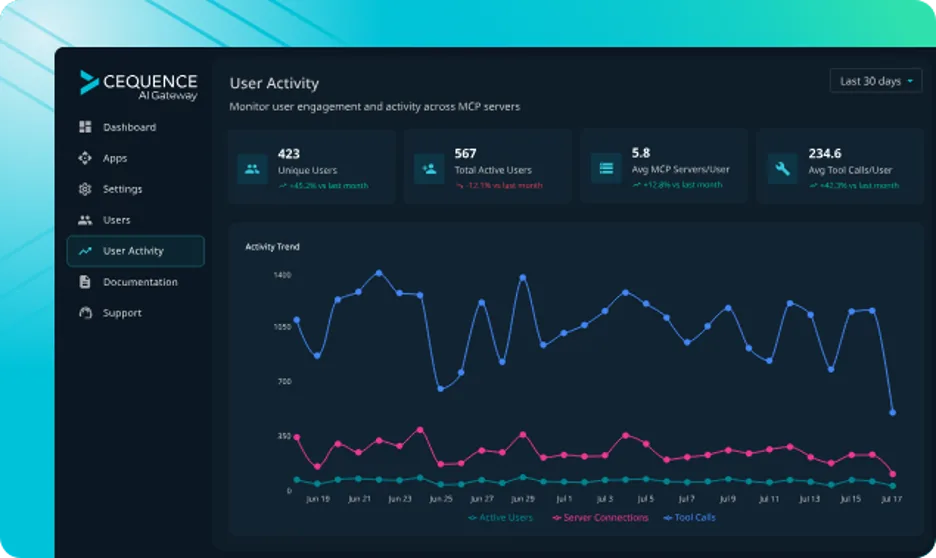
Cequence AI Gateway is a security and governance layer that sits between AI agents and the enterprise applications, APIs, MCP servers, and LLMs they access. It authenticates each agent, checks every request against that agent’s assigned role, and enforces policy inline on each tool call for the full session, regardless of which model or AI platform the agent runs on.
The gateway converts existing APIs into MCP tools by uploading OpenAPI specifications, and connects agents to a catalog of more than 140 enterprise applications. It is delivered as SaaS and also supports on-premises deployment, and it runs on the same platform as Cequence API Security and Bot Management.
Key features include:
- Agent Personas: Teams describe an agent’s job in plain English, and the gateway generates a scoped persona that exposes only the tools, APIs, skills, LLMs, and permissions that job requires. Policy follows the persona, so one update applies to every agent that uses it.
- Agent containment and behavior protection: Agent Behavior Protection evaluates each tool call in the context of the full session, stopping off-task actions and risky chains of individually permitted calls. Agents can be throttled or halted mid-session when their actions deviate from their role.
- Credential isolation and Zero Trust access: Agents authenticate with Agent Access Keys while the gateway brokers backend tokens, so agents never hold backend credentials. OAuth 2.1 IdP support, RBAC, and session binding to originating IP addresses help prevent token theft and reuse.
- Prompt Guard and runtime guardrails: Screens prompts for injection, jailbreak, override instructions, and system prompt extraction before they reach a model or tool, with support for custom guards. Tool risk scoring, rate limits per tool and per persona, and system prompt lock limit what a compromised agent can do.
- Sensitive data protection: Applies DLP scanning to requests and responses across MCP, API, LLM, and A2A traffic, including data exposed across a sequence of tool calls. It can monitor, mask, redact, or block data using more than 100 built-in detection types and integrates with existing DLP tools.
- Trusted registries and team mapping: Registries of MCP servers, APIs, LLMs, and skills define what agents can connect to. Teams map to a configurable org chart, so access to MCP servers and personas follows the existing organizational structure.
- AI spend and model controls: Sets token and spend budgets per employee, team, and persona by day or month, with a monitor mode before enforcement. It also applies routing and cost policies across multiple LLM providers and fails over to an alternate model when a provider is unavailable.
- Audit, investigation, and AI discovery: Records every request and response, allowed or blocked, with the user, persona, tool, and API call behind it, and exports per-tool-call records to SIEM tools. It also discovers shadow MCP servers, agents, and LLM providers from existing SIEM logs.
Limitations (as reported by users on G2):
- Breadth of features can be intimidating at first. Beginners may be intimidated by the breadth of features and capabilities. An AI assistant is built in to help guide new users.
2. F5 AI Gateway

Best for: F5 users unifying model, MCP, and guardrail controls
Strengths: One policy model across Model Gateway, MCP Gateway, Guardrails
Things to consider: Latest release offered through early access program
F5 AI Gateway is a control plane that sits between users, agents, and AI services, combining a Model Gateway, an MCP Gateway, and F5 AI Guardrails under one policy model and console. It inspects prompts and responses, controls which users and agents can reach specific models and tools, and tracks token spend, without requiring application changes.
The gateway is part of the F5 Application Delivery and Security Platform and can be layered with F5 load balancing, API gateway, WAF, Bot Defense, and DDoS protection. The latest release, which added these functions and integrated the gateway into the F5 AI Security Platform, is offered through an early access program.
Key features include:
- AI Guardrails: Applies more than 20 guardrail policies to every prompt and response, including prompt injection and jailbreak defense with fail-closed enforcement. Controls cover PII leakage, PHI, PCI, and EU AI Act alignment.
- Sensitive data redaction: Detects and redacts PII, PHI, source code, credentials, and customer data in prompts before they reach external AI models.
- MCP Gateway and tool access control: An MCP Server Registry lists public, remote, and private MCP servers. Per-tool allow and deny lists, access controls, and budgets limit which users and agents can invoke specific tools.
- Model Gateway routing: Routes requests across multiple AI providers and models from one control point, with smart routing, GPU-aware routing, load balancing, and failover across models.
- Token metering and budgets: Attributes token consumption by provider, model, team, and user, and enforces per-team budgets. Semantic and exact caching reduce repeated inference calls.
- Audit and observability: Captures a full audit trail of AI interactions and tool calls, with dashboards, OpenTelemetry telemetry, SIEM export, and data residency controls.
Limitations (based on publicly available sources):
- Early access status: The release that combined the Model Gateway, MCP Gateway, and AI Guardrails was announced in August 2026 with an early access sign-up rather than general availability.
- Deployment options still expanding: The gateway supports SaaS, hybrid SaaS, and hybrid multicloud deployments, while air-gapped support is listed as planned.
- Broader protection depends on other F5 products: Network and application-layer controls such as WAF, Bot Defense, and DDoS protection come from separate products in the F5 platform.
3. Kong AI Gateway

Best for: Kong users governing LLM, MCP, and agent-to-agent traffic
Strengths: MCP tool generation from APIs, quotas, and multi-LLM routing
Things to consider: Advanced AI plugins require an AI license; learning curve
Kong AI Gateway extends the Kong API platform to govern LLM, MCP, and agent-to-agent (A2A) traffic through a single gateway. It applies access control, PII sanitization, semantic prompt guards, and quotas to AI traffic, and generates MCP servers on top of APIs already managed in Kong.
The gateway provides a unified API interface for multiple AI providers and supports routing, load balancing, and provider switching. It is available through Kong Konnect, and Kong AI Gateway 2.x exposes providers, models, MCP servers, and agents as first-class entities rather than plugin configurations.
Key features include:
- LLM governance: Controls how developers, apps, and agents consume LLMs, with access control, PII sanitization, and semantic prompt guards for prompt and content policies.
- MCP server generation and auth: Automatically generates MCP tools and servers on top of Kong-managed APIs and enforces authentication for MCP server access. MCP context optimization reduces token usage.
- Agent-to-agent governance: Enforces centralized authentication and authorization for A2A traffic and audits each A2A call with caller identity and capabilities invoked.
- Quota management: Sets user, model, and time-bound quotas for LLM consumption and token spend, enforced at the gateway, with showback and chargeback across LLM, agent, and MCP usage.
- Traffic efficiency: Applies semantic caching, routing, and load balancing to LLM traffic, and switches between providers to maintain availability during downtime.
- AI observability: Tracks AI consumption, tool usage, and token spend, and captures A2A payloads, latency, token usage, and errors, with logging and tracing for debugging.
Limitations (as reported by users on G2):
- Plugin documentation gaps: Documentation for some plugins is limited, and initial setup instructions can be hard to follow for new users.
- Steep learning curve: Onboarding and advanced configuration can be difficult for teams without prior API gateway experience.
- Cost for smaller teams: Plugin pricing and the enterprise edition can be expensive for smaller teams.
- Slower support for some requests: Support for integrations with other systems and new feature requests can take longer.

Source: Kong
Edge and Runtime AI Firewalls for Public-Facing AI Applications
4. Akamai Firewall for AI
Best for: Edge inspection of prompts and responses for public AI apps
Strengths: Input and output guardrails at the edge or via REST API
Things to consider: Documented as limited availability; may need tuning
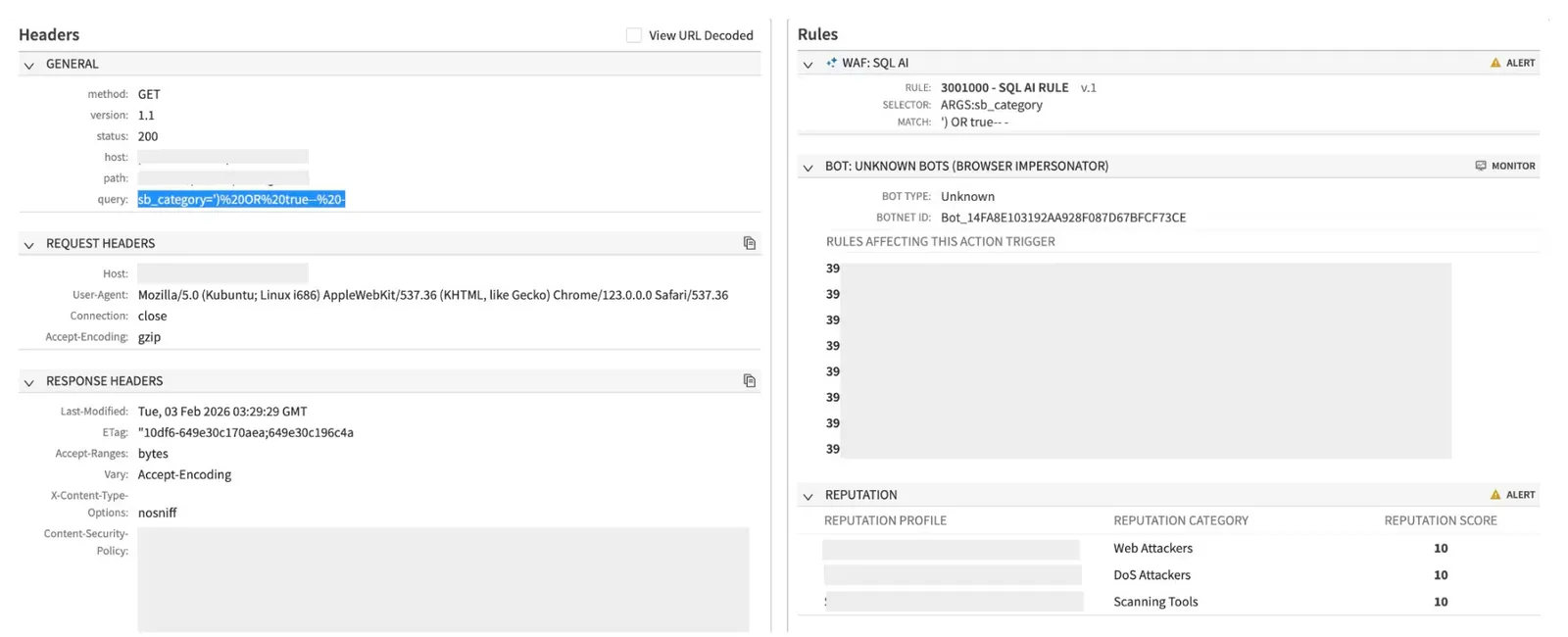
Akamai Firewall for AI is an LLM firewall that inspects prompts sent to AI applications and the responses they return. It detects and blocks prompt injection, jailbreaks, and adversarial inputs before they reach the model, and filters responses for data leaks, toxic content, and compliance violations.
The firewall is model-agnostic and works with LLM-based applications hosted on-premises, in the cloud, or in hybrid environments. It runs on the Akamai edge or integrates through a REST API, and Akamai’s documentation lists it as offered in limited availability.
Key features include:
- Prompt inspection: Analyzes incoming prompts in real time to detect and block prompt injection, jailbreaks, harmful queries, and policy violations before they reach the AI model.
- Response filtering: Reviews generated responses to block toxic, misleading, or noncompliant content and to prevent disclosure of PII and intellectual property.
- Edge enforcement: Blocks attacks at the Akamai edge to protect LLM inference, inspecting prompts and responses before they reach AI applications.
- Flexible deployment: Deploys through the Akamai edge or a REST API, so applications hosted outside Akamai can also use the protections.
- Exfiltration and model theft protection: Detects unauthorized queries and data scraping attempts aimed at extracting model knowledge, training data, or confidential information.
- Policy-based compliance controls: Enforces policy-driven controls mapped to frameworks such as the OWASP Top 10 for LLM Applications, and refines rules as new risks emerge.
Limitations (based on publicly available sources):
- Limited availability: Akamai’s technical documentation describes Firewall for AI as offered in limited availability.
- Setup varies by hosting platform: Apps on the Akamai edge link a Firewall for AI configuration to a security configuration, while apps on other platforms need the solution’s API to set protections.
- Initial policy tuning: Reviewer feedback notes that policies may need tuning after deployment.
- Usage-based pricing: Pricing depends on metrics such as API calls, data volume, and enabled features, so costs scale with AI traffic.
Source: Akamai
5. Cloudflare AI Security for Apps
Best for: Cloudflare users protecting internet-facing LLM endpoints
Strengths: Automatic LLM endpoint discovery and WAF rule builder mitigation
Things to consider: Detection capabilities vary by Cloudflare plan
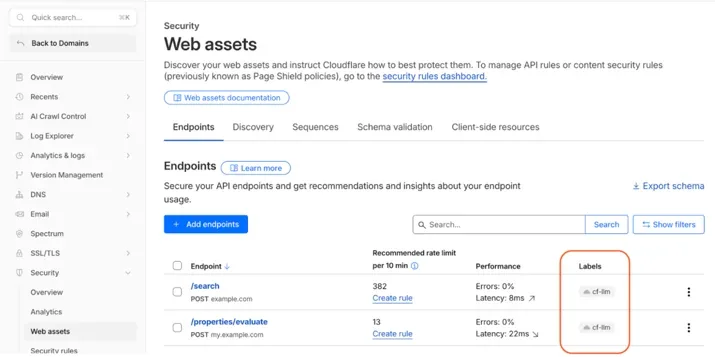
Cloudflare AI Security for Apps, formerly Firewall for AI, sits in front of LLM-powered applications as part of Cloudflare’s reverse proxy, whether the application uses a third-party model or a self-hosted one. It discovers LLM-powered endpoints, detects threats in prompts, and lets teams act on them through the Cloudflare WAF.
Detections cover prompt injection, PII exposure, toxic topics, sensitive information disclosure, and unbounded consumption. Endpoint discovery is available on all Cloudflare plans, including Free, Pro, and Business, while detection capabilities vary by plan.
Key features include:
- Automatic LLM endpoint discovery: Identifies LLM-powered endpoints across web properties regardless of where they are hosted or which model they use.
- Built-in threat detection: Detects prompt injection, PII exposure, toxic topics, sensitive information disclosure, and unbounded consumption in traffic to AI endpoints.
- Custom topic detection: Teams define their own topic categories, and the service scores each prompt’s relevance so it can be logged, blocked, or handled according to policy.
- WAF rule builder mitigation: Uses the existing Cloudflare WAF rule builder to act on malicious or off-policy requests and leaked sensitive data.
- Broad model format support: Supports request formats used by OpenAI, Anthropic, Google Gemini, Mistral, Cohere, xAI, DeepSeek, and others, and runs detection on the full request body when no known pattern matches.
- Unified posture visibility: Lists discovered LLM endpoints for review, and a Wiz partnership gives mutual customers a combined view of their AI security posture.
Limitations (as reported by users on G2):
- Rule configuration complexity: Managing complex firewall rules and WAF configurations can be difficult, especially for dynamic applications.
- Learning curve for advanced features: Advanced capabilities take time to learn for users without a networking background.
- Pricing concerns: Some smaller businesses find costs hard to predict as they add features.
- Support on lower plans: Direct customer support is limited on the Pro plan.
Source: Cloudflare
6. Harness AI Security

Best for: AppSec teams securing AI APIs, MCP servers, and agents
Strengths: AI discovery, AI Firewall, and OWASP-based AI testing
Things to consider: Blocking and redaction support depends on deployment
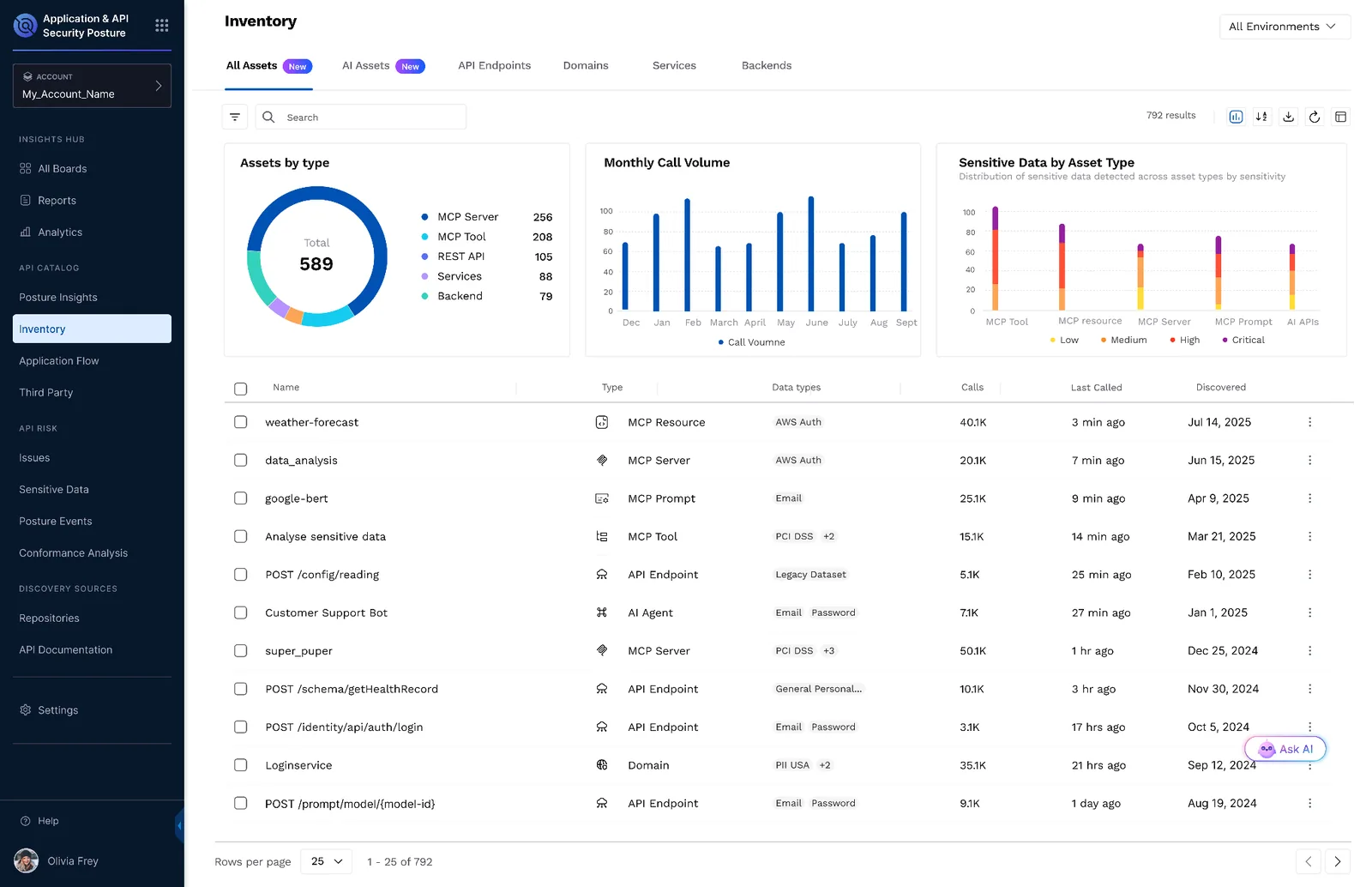
Harness AI Security extends Harness API security to AI components, monitoring runtime API traffic to discover LLMs, MCP servers, AI services, and agents, including third-party services. It combines AI Discovery, an AI Firewall that inspects prompts and responses, and AI Testing against OWASP Top 10 LLM and MCP risks.
The AI Firewall detects and blocks prompt injection and inspects AI API and MCP traffic for sensitive data. It was introduced in beta in March 2026, and Harness documentation lists which deployment types support blocking and redaction.
Key features include:
- AI Discovery: Monitors AI API traffic to build a continuously updated inventory of LLMs, MCP servers, AI services, and agents, with sensitive data details for each asset.
- AI asset risk scoring: Evaluates each discovered asset for authentication, encryption, internet exposure, and known vulnerabilities to prioritize remediation.
- Prompt injection protection: Detects and blocks prompt injection attacks in real time before malicious outputs reach users.
- Data leakage prevention: Inspects prompts and responses for PII and sensitive data flowing through AI APIs and MCP endpoints.
- Token limit enforcement: Sets token budgets per model to cap consumption.
- AI and agent testing: Tests LLMs, agents, and AI APIs against OWASP Top 10 LLM and MCP risks, with tests configured from production traffic and run in CI/CD pipelines.
Limitations (as reported by users on G2):
- Interface usability: The UI can be confusing, and users cannot save queries, views, or filters.
- Reporting at scale: Reporting, especially for historical data, needs improvement in larger environments.
- False positives: Configuring and managing custom threats can be challenging, which can lead to false positives.
- Documentation: Documentation gaps can require additional support for effective use.
Source: Harness
Conclusion
Choosing an AI gateway for multi-model traffic requires evaluating model compatibility, routing flexibility, security enforcement, and operational visibility. Organizations should prioritize unified provider management, intelligent routing and failover, identity-based access controls, prompt injection protection, and data loss prevention. For environments using autonomous AI agents, additional considerations include MCP server security, tool-level authorization, least-privilege permissions, and runtime monitoring of agent actions. Teams should also assess token budgets, rate limiting, deployment options, and integration with existing security infrastructure.