



KPMG and Cequence are partnering on AI agent governance, and the first result is a joint report, Delegating Outcomes, Not Authority: Agentic AI Runtime Security, Governance, and Control. KPMG in Singapore contributed to the report as part of the two firms' collaboration on agentic AI governance and security advisory solutions, and the firms will present its findings to senior business, technology, and policy leaders at KPMG's Singapore office on 19 November.
KPMG operates in 138 countries and territories, with more than 276,000 partners and employees across its member firms, and boards and regulators rely on it to explain risk. Governing AI agents is now a board-level question, and the firms boards rely on for advice want answers based on how agents behave in production.
Why KPMG and Cequence are working together
KPMG brings deep experience in governance, risk, and regulation. Cequence brings expertise in AI agent containment as well as visibility into how agents behave on real applications and APIs every day, drawn from the platform it has used to deliver API security and bot defense for over a decade. Gerry Chng, Partner, Cyber, at KPMG in Singapore, described the shift that brought the two together:
“Organizations across Asia-Pacific are moving from experimenting with AI to deploying them to achieve real business outcomes. Traditional controls such as identity verification and fixed access permissions are important, but they may not be sufficient when an agent can carry out a sequence of actions on behalf of a business or customer. Organizations need governance that considers the agent’s role, the context of each action, and the cumulative risk created across an entire task. KPMG’s contribution to this report brings together our experience in governance, risk, regulation and cyber security to help organizations put appropriate oversight around AI agents while enabling legitimate work to continue.”
Cequence has established its regional headquarters in Singapore and plans to build local teams in the Philippines, Singapore, and South Korea, and its customers in the region include NTT DOCOMO and Philippine Airlines. In Cequence CEO and co-founder Ameya Talwalkar's view, Singapore is setting the pace on governing AI agents, which made it the natural place for the two firms to start their partnership.
AI agent governance starts with what agents actually do
Organizations are beginning to hand AI agents business outcomes instead of single tasks: resolve this billing complaint, reconcile these accounts, restore this service. The agent chooses the path. An employee handed the same complaint knows to stay within their refund authority; an agent has only its instructions, its tools, and whatever authority it is granted. Identity and static permissions confirm who is acting and what it can reach, but they can't tell whether a specific action, right now, serves the job the agent was given.
Cequence field data in the report shows how far this has already gone. In one week in October 2026, the Cequence CQ Prime threat research team tracked more than a quarter million AI agent visits across five industries, and about one in seven took an action: booked, bought, signed in, or managed an account for a customer. At a Tier 1 telecommunications carrier, traffic from agents that didn’t identify themselves grew from about 100 requests a day to as many as 32,000 within three weeks of a major consumer agent's launch. Those agents signed in as the customer and passed multi-factor authentication.
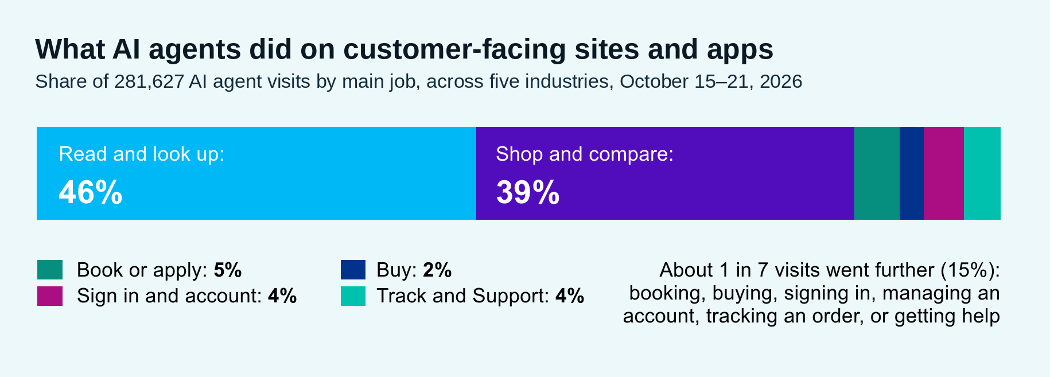
Source: Cequence field data, 281,627 AI agent visits, October 15–21, 2026.
A known AI agent’s name doesn’t mean the traffic is legitimate. At one online marketplace, more visits claimed to be a well-known consumer AI agent than all the genuine agent visits Cequence tracked that week. Every one went straight to the sign-in page and failed – it was a credential stuffing campaign masquerading as trusted agents.
Runtime governance checks every action as it happens
The report's central argument is that organizations can delegate outcomes to AI agents without delegating unlimited authority. Runtime governance enforces that limit: controls evaluate each action before it executes and return a binding decision to proceed, observe, escalate, deny, or redirect the agent toward a permitted route. Shreyans Mehta, Cequence CTO and co-founder and a co-author of the report, describes the principle simply: "An approval at step one shouldn't carry into step five."
Redirection matters as much as denial. A blocked agent still has an unfinished goal, and that's when agents retry, rephrase, or look for a way around the restriction. In a controlled study using a Cequence research prototype, agents with only logins and fixed permissions tried to act outside their job in 44% of runs. When each agent had a defined job and every action was checked against it, those attempts fell to 1%, task completion rose from 76% to 95%, and agents used about 35% fewer tokens per run.
The same principle applies to customer agents. An organization can't assign that agent's job, so runtime governance asks whether each request fits the customer's authority, the legitimacy of the task, and the consequence of getting it wrong.
Read the KPMG and Cequence report on agentic AI security
The full report covers seven recurring ways authorized agents produce unauthorized outcomes, a three-stage AI agent governance model, a runtime engine that decides each consequential action before it executes, where to place enforcement for deployed and customer agents, and a 90-day adoption roadmap. Download the report to see the full findings and the study's methodology.
Cequence puts these principles into practice across the Cequence platform. Cequence AI Gateway applies runtime governance to the agents an organization deploys, while Bot Management and API Security evaluate the agents operating on behalf of customers.